
Search by title, topic or phrase
Use our Crypto Search Engine 🔍 to find the topics and keywords you're looking for.
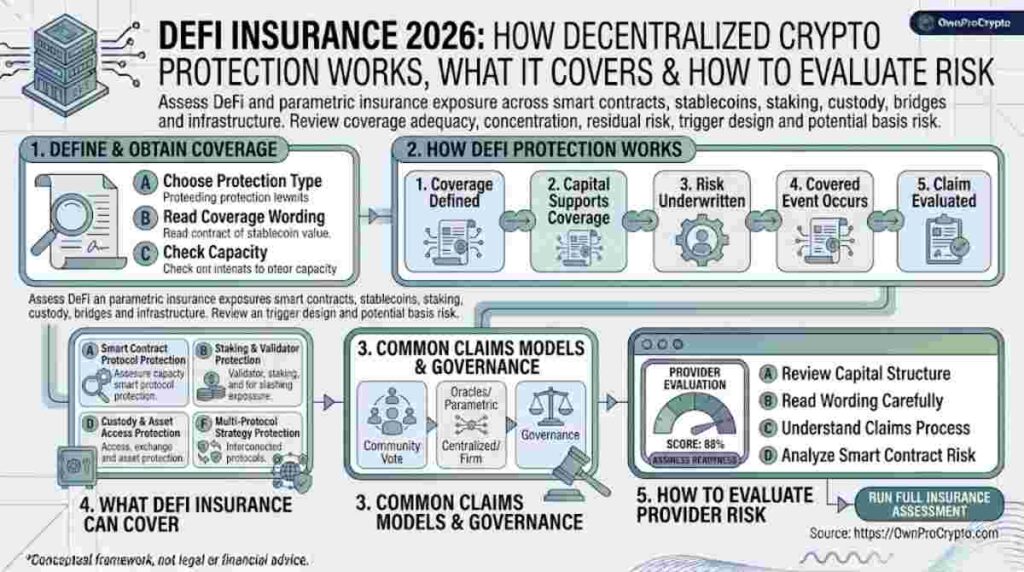
Assess DeFi and parametric insurance exposure across smart contracts, stablecoins, staking, custody, bridges and infrastructure. Review coverage adequacy, concentration, residual risk, trigger design and potential basis risk.
Define the measurable condition that could determine whether a parametric payout trigger has occurred.
This visual separates the underlying exposure from insurance protection and the remaining residual risk.
Underlying asset or protocol exposure.
Smart-contract, stablecoin, staking, custody, bridge or infrastructure risk.
Coverage limit, deductible and coverage ratio.
Potential uninsured exposure after considering the simplified inputs.
Remaining exposure after the simplified insurance assessment.
Items requiring additional policy or risk review.
Illustrative scenarios show how different loss levels interact with the simplified policy limit and deductible inputs.
The crypto insurance calculator is an educational risk-screening tool designed to help evaluate potential insurance requirements across DeFi and parametric insurance models.
It considers factors such as exposure, desired coverage, policy limits, deductibles, concentration, underlying protocol risk and, where relevant, parametric triggers, oracle dependency and basis risk.
The result is a preliminary assessment of coverage adequacy and residual risk — not an insurance quote or a guarantee of coverage.


For readers researching the technical and regulatory foundations behind blockchain-based insurance, the
NAIC blockchain technology resource
provides an insurance-regulatory perspective, while
Nexus Mutual’s documentation
explains an existing on-chain discretionary mutual model. For the technical side of decentralized parametric insurance,
Etherisc
provides infrastructure resources for blockchain-based insurance products. Academic readers can also explore the
2026 ASTIN Bulletin research on collaborative and parametric insurance on Ethereum.
It provides a preliminary screening of crypto insurance exposure by combining financial exposure, coverage assumptions, underlying risk factors and selected insurance characteristics. Parametric assessments also consider trigger alignment, oracle dependency and potential basis risk.
No. The calculator is an educational assessment tool. It does not provide an insurance quote, determine eligibility, guarantee coverage or predict whether a claim will be paid. Actual terms depend on the specific insurer, policy wording, underwriting process and applicable jurisdiction.
DeFi insurance generally focuses on defined digital-asset or protocol risks, such as smart-contract, custody, staking or bridge-related exposure. Parametric insurance uses predefined measurable conditions or triggers that can determine a payout according to the policy structure.
Basis risk occurs when the measurable trigger used by a parametric policy does not perfectly match the actual economic loss experienced by the insured exposure. For example, an index or oracle may move differently from the specific asset or position being protected.
Insurance may not eliminate all exposure. Policy limits, deductibles, exclusions, trigger conditions, concentration and differences between the insured event and the actual loss can leave some residual risk. The tool highlights these areas for further review.
Important:
This tool is provided for educational and research purposes only. It is not financial, legal, actuarial or insurance advice and does not replace the terms of an actual insurance policy. Always review the specific policy wording, exclusions, limits, deductibles, settlement conditions and provider terms before relying on insurance protection.