
Table of Contents
ToggleBitcoin is still one of the most misunderstood investments in 2026. Some people believe it is digital gold and a long-term hedge against inflation. Others think it is too volatile and dangerous for beginners. The truth is somewhere in the middle.
For most beginners, Bitcoin is not “safe” if treated like a short-term trading game. But it can become a relatively safer long-term asset when approached with proper risk management, small position sizing, and a disciplined Dollar-Cost Averaging (DCA) strategy.
If you are wondering whether now is the right time to enter crypto, this guide explains the risks, beginner mistakes, and the safest way to start without exposing your savings to unnecessary losses.
| Question | Short Answer |
|---|---|
| Is Bitcoin safe for beginners? | Moderately safe if approached long term |
| Is short-term trading safe? | No, high risk for beginners |
| Best beginner strategy | Small automated DCA buys |
| Safe portfolio allocation | 1% to 5% of liquid capital |
| Biggest beginner mistake | Overinvesting during hype |
| Best mindset | Long-term accumulation |
Most beginners do not lose money because Bitcoin “fails.” They lose money because they enter with unrealistic expectations.
Common mistakes include:
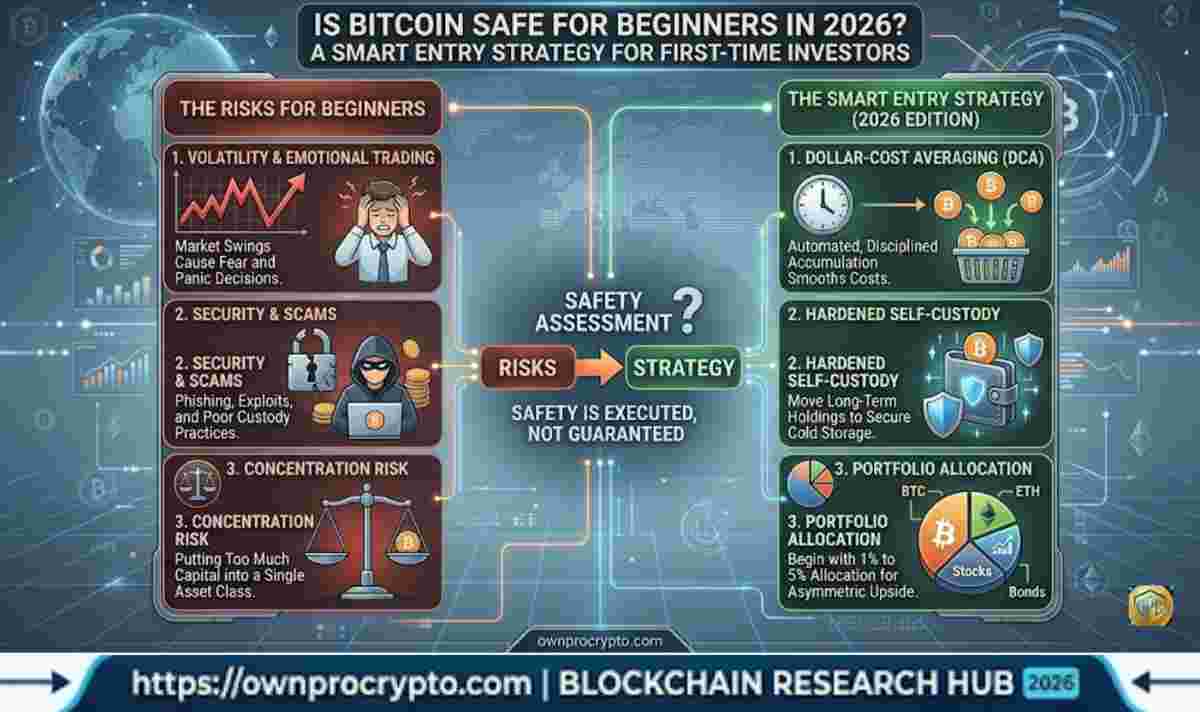
Bitcoin regularly experiences sharp corrections. A 15% to 30% drop can happen even during strong long-term bull markets. New investors often underestimate how emotionally difficult this feels in real time.
That is why strategy matters more than prediction.

Bitcoin itself remains one of the most secure digital networks ever created. The blockchain has never been hacked directly, and institutional adoption continues growing through ETFs, custody services, and corporate treasury exposure.
However, there are still real risks:
Bitcoin is best understood as a high-volatility long-term asset, not a guaranteed safe haven during every market event.
In the short term, Bitcoin often behaves like a risk asset. During geopolitical stress or market panic, institutions may sell Bitcoin temporarily to raise liquidity. But over longer time horizons, many investors still view it as a scarce digital asset similar to digital gold.

For most new investors, the safest approach is simple:
Instead of trying to predict the perfect entry point, invest small fixed amounts regularly.
Example:
This reduces emotional decision-making and lowers the risk of buying heavily at market peaks.
Do not allocate your entire savings to Bitcoin.
A safer beginner range is:
This allows participation without creating financial stress during volatility.
Many beginners lose money trying to use leverage during market swings.
Spot investing is safer because:
| Asset | Main Purpose | Risk Level | Long-Term Growth Potential |
|---|---|---|---|
| Cash | Stability and expenses | Low | Weak against inflation |
| Gold | Defensive store of value | Low to moderate | Moderate |
| Bitcoin | Digital scarcity asset | High short term | High long term |
Gold remains more stable during crises. Bitcoin remains more volatile but offers stronger long-term upside potential if adoption continues increasing.
Many investors now use both:

Trying to perfectly time Bitcoin bottoms is one of the biggest mistakes beginners make.
Historically:
A small DCA position solves this problem because it removes emotional paralysis while keeping risk controlled.
Before buying Bitcoin, make sure you:
The goal is survival first, profits second.
No investment is guaranteed. Bitcoin still carries volatility and regulatory risk.
However, many long-term investors believe Bitcoin has several advantages:
For beginners, the safest mindset is not “get rich quick.”
It is:
So, is Bitcoin safe for beginners in 2026?
It can be — if beginners avoid speculation, keep allocations small, and focus on long-term investing instead of short-term trading.
The biggest risks are usually not the technology itself. They are emotional decisions, leverage, scams, and unrealistic expectations.
For most first-time investors, a slow DCA strategy with small exposure remains one of the safest ways to enter the crypto market while learning over time.
Bitcoin is not a guaranteed path to wealth. But for disciplined investors willing to think long term, it may still deserve a place in a diversified portfolio.
How to Buy Bitcoin Safely in 2026?
The safest way to buy Bitcoin in 2026 is through regulated and trusted cryptocurrency exchanges with strong security systems, proof-of-reserves, and two-factor authentication (2FA).
Beginners should avoid unknown trading platforms promising unrealistic returns or “guaranteed profits.” After purchasing Bitcoin, many long-term investors move their holdings into hardware wallets for better protection and self-custody.
A simple rule:
Many beginner losses happen because users trust unsafe platforms rather than because Bitcoin itself fails.
What is the Safest Way to Buy Bitcoin?
Using regulated exchanges, enabling security protections, and slowly accumulating through a Bitcoin DCA strategy is generally safer than active trading or trying to time the market.
Beginners should focus on:
This reduces emotional mistakes and lowers exposure to extreme short-term volatility.
Bitcoin exchange platform:
Beginners should use trusted and regulated exchanges like: Binance while enabling two-factor authentication and proper wallet security.
Is Bitcoin Safer Than Altcoins for Beginners?
Generally yes. Bitcoin has the longest operating history, the largest market liquidity, and lower collapse risk compared to many speculative altcoins.
While Bitcoin remains volatile, smaller cryptocurrencies often carry:
For beginners learning crypto investing, Bitcoin is usually considered the lower-risk entry point within the digital asset market.
Institutional adoption has continued growing through products like the BlackRock Bitcoin ETF.
How Much Bitcoin Should a Beginner Buy?
Most beginners should keep crypto exposure relatively small, usually between 1% and 5% of total liquid capital.
This allows participation in potential long-term upside without creating financial stress during market corrections.
A safer beginner mindset is:
Overinvesting too early is one of the biggest crypto mistakes beginners make.
Is Bitcoin Too Late in 2026?
Many investors still believe Bitcoin adoption remains relatively early compared to traditional financial assets. Institutional adoption, ETF demand, and global awareness continue expanding.
However, Bitcoin is no longer a tiny speculative experiment. Volatility remains high, and large price swings should still be expected.
For beginners, the better question is usually not:
“Is it too late?”
It is:
“Can I enter safely with proper risk management?”
Should Beginners Wait for a Market Crash Before Buying?
Trying to perfectly predict Bitcoin bottoms is extremely difficult, even for professional traders.
Many investors wait for lower prices, miss recovery rallies, and later buy back in emotionally at higher levels.
A Bitcoin DCA strategy helps reduce this problem by spreading purchases over time instead of relying on one perfect entry point.
For most beginners, consistency matters more than perfect timing. Bitcoin market data
What is the Best Method in a Bitcoin DCA Calculator?
The most reliable Bitcoin beginner strategy is automated Dollar-Cost Averaging (DCA), where fixed amounts are invested at regular intervals such as weekly or monthly.
This approach helps:
Many long-term investors prefer DCA because it focuses on consistency instead of short-term prediction.
Spot Trading vs. Futures for Beginners: Which is Safer?
Spot trading is significantly safer for beginners because you own the actual Bitcoin asset directly.
With spot investing:
Futures trading is much riskier because leverage can rapidly amplify losses. Many new traders lose their entire account during sudden price swings.
For most beginners, spot investing is the safer long-term approach.
Bitcoin vs. Gold for Inflation: Which Performs Better in 2026?
Gold and Bitcoin serve different purposes.
Gold is traditionally viewed as a stable store of value with lower volatility during economic uncertainty. Bitcoin behaves more like a high-volatility digital asset with stronger long-term growth potential but larger short-term price swings.
Many investors now use both:
Bitcoin may outperform during long-term adoption cycles, while gold often performs better during immediate market panic.
Can Bitcoin Crash Again?
Yes. Bitcoin has historically experienced multiple major corrections and periods of high volatility.
Even during strong long-term bull markets, Bitcoin can temporarily fall 20% to 50% or more.
Beginners should understand this before investing. The safest approach is:
Volatility is normal in crypto markets.
New investors can also explore beginner educational resources available on Bitcoin.org.
What Are the Biggest Crypto Mistakes Beginners Make?
Some of the most common beginner crypto mistakes include:
Many beginners also focus too heavily on short-term price movements instead of learning proper risk management.
The goal for new investors should not be fast profits.
It should be:
surviving long enough to benefit from long-term market cycles
protecting capital
learning gradually
Welcome to OwnProCrypto (Own & Pro Crypto) — a next-generation Bitcoin and blockchain education platform where the science of finance meets the power of AI-driven automation.
Our mission is simple: to equip you with the knowledge, frameworks, and tools needed to make smarter financial and business decisions in the Web3 economy.
Beyond analysis, OwnProCrypto focuses on transparency, verifiable data, and practical frameworks that investors and builders can actually use. Our goal is not hype — but clear thinking, disciplined analysis, and long-term value creation in the decentralized economy.
Our Background
Crypto Tools & Analysis:
Crypto Fundamental Analysis Tools | Protocol Evaluation System | DeFi Risk Analysis Tools | Crypto Portfolio Dashboard | Token Risk vs Reward Tool
Guides:
Crypto Fundamental Analysis | Blockchain Project Evaluation | Tokenomics Analysis | DeFi Protocol Analysis
© 2026 OwnProCrypto — Built for smarter crypto decisions