infographic of site logo for contact us

OwnProCrypto.com

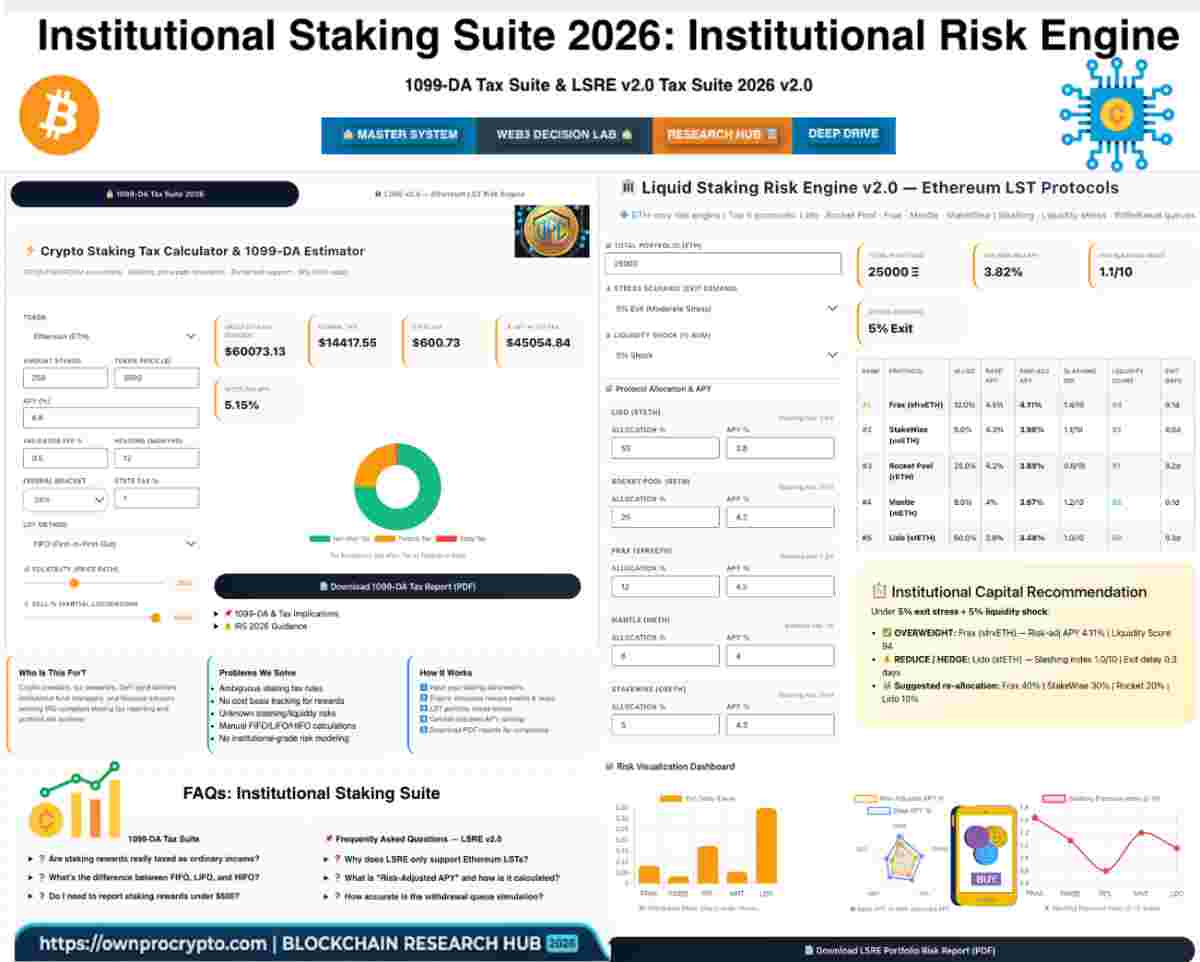
Institutional Staking Suite 2026: Institutional Risk Engine

1099-DA Tax Suite & LSRE v2.0 Tax Suite 2026 v2.0

Crypto Staking Tax Calculator & LSRE v2.0 | 1099-DA Institutional Suite 2026

⚡ Crypto Staking Tax Calculator & 1099-DA Estimator

FIFO/LIFO/HIFO lot accounting · Realistic price path simulation · Partial sell support · IRS 2026 ready

35%
100%
Tax Breakdown: Net After-Tax vs Federal vs State

🏛️ Liquid Staking Risk Engine v2.0 — Ethereum LST Protocols

🔷 ETH-only risk engine | Top 5 protocols: Lido · Rocket Pool · Frax · Mantle · StakeWise | Slashing · Liquidity stress · Withdrawal queues

ℹ️ This engine analyzes Ethereum Liquid Staking Tokens (LSTs) only. ETH is the base asset — no coin selection needed.

📊 Protocol Allocation & APY

📊 Risk Visualization Dashboard

📉 Withdrawal Delay (Days) under stress
📊 Base APY vs Risk-Adjusted APY
⚠️ Slashing Exposure Index (0-10 scale)
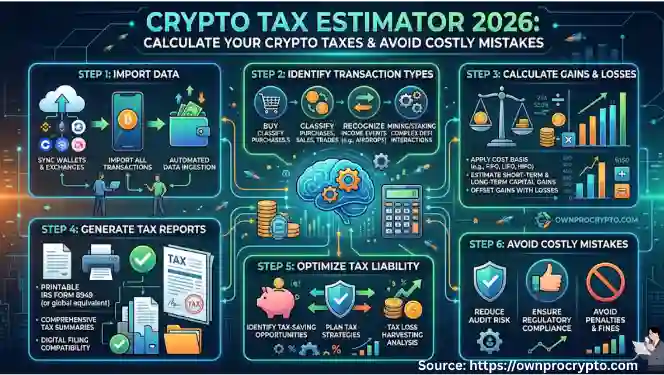
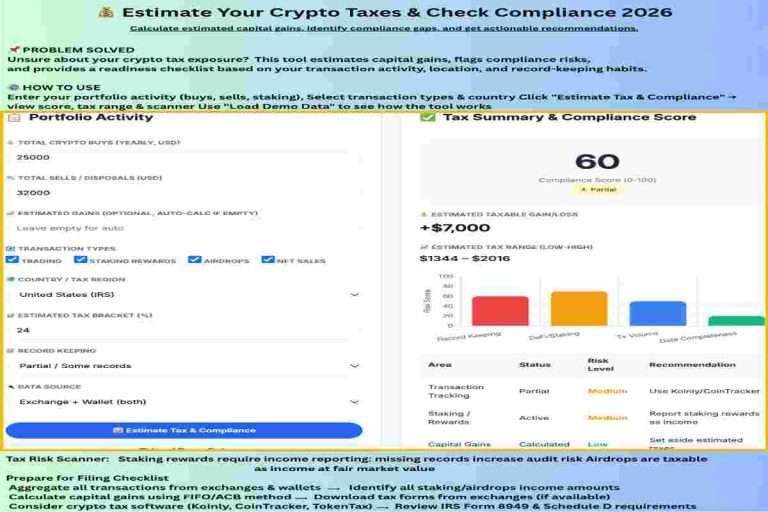
Infographic of Crypto Tax Estimator & Compliance Checker 2026

Bridging the Compliance Gap: High-Precision Institutional Staking Suite for 2026

As institutional oversight tightens, the primary bottleneck for both retail stakers and fund managers isn’t finding yield—it’s managing the dual threats of IRS 1099-DA reporting and liquid staking volatility. We’ve solved this by consolidating two elite utilities into a single Institutional Staking Suite a command center. The Crypto Staking Intelligence Suite 2026 delivers a high-fidelity Tax Compliance module alongside our LSRE v2.0 Risk Engine, allowing you to stress-test your portfolio against liquidity shocks while generating instant tax simulations. No more manual spreadsheets or ambiguous risk metrics—just raw, actionable data designed for those who treat their digital assets like a professional business.

Infographic of Crypto Institutional Staking Suite 2026
Tab to Access Crypto Staking Suite 2026


Who Is This For?

Crypto investors, tax preparers, DeFi yield farmers, institutional fund managers, and financial advisors seeking IRS-compliant staking tax reporting and protocol risk analysis.

Problems We Solve

  • Ambiguous staking tax rules
  • No cost basis tracking for rewards
  • Unknown slashing/liquidity risks
  • Manual FIFO/LIFO/HIFO calculations
  • No institutional-grade risk modeling

How It Works

1️⃣ Input your staking parameters
2️⃣ Engine simulates reward events & taxes
3️⃣ LST portfolio stress-tested
4️⃣ Get risk-adjusted APY ranking
5️⃣ Download PDF reports for compliance

Tool #1: 1099-DA Staking Tax Calculator

Simulates staking rewards as ordinary income at FMV — just like the IRS requires. Tracks cost basis for each reward event, applies FIFO/LIFO/HIFO accounting, and projects capital gains on future sales. Includes realistic price path simulation and partial liquidation support.

Inputs

Token, amount, APY, fees, tax bracket, holding period, volatility

Engine

Reward events → Ordinary income → Tax liability → Cost basis → Capital gains

Outputs

Gross rewards, tax owed, after-tax APY, capital gain, PDF tax report

Tool #2: Liquid Staking Risk Engine (LSRE v2.0)

Institutional-grade risk analyzer for Ethereum LST protocols (Lido, Rocket Pool, Frax, Mantle, StakeWise). Simulates slashing probability, withdrawal queue delays, and liquidity shocks under market stress. Outputs risk-adjusted APY rankings and portfolio allocation recommendations.

Inputs

Total ETH, protocol allocation %, stress scenario, liquidity shock

Engine

Slashing prob → Withdrawal queue → Liquidity stress → Risk-adjusted yield

Outputs

Risk ranking, slashing index, liquidity score, exit delay, allocation recommendation

This Infographic of Crypto Tax Estimator & Compliance Checker 2026
Access the Intelligence Suite Now

FAQs: Institutional Staking Suite

1099-DA Tax Suite

❓ Are staking rewards really taxed as ordinary income?
Yes. IRS Notice 2023-14 confirms staking rewards are taxable as ordinary income at fair market value when received. This applies to both PoS chains and DeFi protocols. You’ll receive Form 1099-MISC if rewards exceed $600, and Form 1099-DA may apply when you sell.
❓ What’s the difference between FIFO, LIFO, and HIFO?
FIFO (First-In-First-Out): oldest rewards sold first — most common. LIFO (Last-In-First-Out): newest rewards sold first — may reduce short-term gains. HIFO (Highest-In-First-Out): sells highest cost basis first — maximizes tax efficiency. The IRS accepts all methods if used consistently.
❓ Do I need to report staking rewards under $600?
Yes. The $600 threshold applies to exchange reporting (1099-MISC), not your tax liability. All staking rewards — regardless of amount — must be reported as “Other Income” on Schedule 1, Line 8z. Failure to report can trigger IRS audits.

LSRE v2.0

❓ Why does LSRE only support Ethereum LSTs?
Ethereum has the largest and most mature liquid staking ecosystem ($50B+ TVL across LSTs). Protocols like Lido, Rocket Pool, and Frax have unique risk profiles (slashing, withdrawal queues, liquidity depth) that require specialized modeling. For other chains, use our Tax Calculator (supports SOL, ATOM, etc.).
❓ What is “Risk-Adjusted APY” and how is it calculated?
Risk-Adjusted APY = Base APY — Slashing Penalty — Liquidity Discount — Delay Opportunity Cost. A protocol with 6.5% base APY but high slashing risk (2.5%) might yield only 3.1% risk-adjusted. This metric helps institutions compare true expected returns across protocols.
❓ How accurate is the withdrawal queue simulation?
Based on Ethereum’s validator exit queue (max ~1,800 ETH/day under normal conditions). Under stress (5-10% of AUM exiting), congestion multipliers apply — realistic for black swan events like the 2022 stETH depeg. Not financial advice, but institutional-grade approximation. Read More >>