infographic of site logo for contact us

OwnProCrypto.com

Use our Crypto Search Engine 🔍 to find the topics and keywords you're looking for.

DEFI RESEARCH • DUE DILIGENCE • RISK

DeFi Protocol Analysis Guide (2026): How to Evaluate DeFi Projects, Risk & Yield

DeFi Protocol Analysis is the structured process of evaluating a decentralized finance protocol before using it, supplying liquidity, depositing assets, staking, borrowing, or allocating capital. A useful analysis goes beyond headline APY and examines the protocol’s purpose, adoption, tokenomics, on-chain activity, revenue, liquidity, smart contracts, governance, dependencies, and failure scenarios.

This 2026 guide provides a practical framework for understanding how to analyze DeFi projects without treating TVL, yield, token price, or an audit as a standalone measure of quality. The objective is to determine whether a protocol’s economics and risk profile make sense for the specific capital being evaluated.

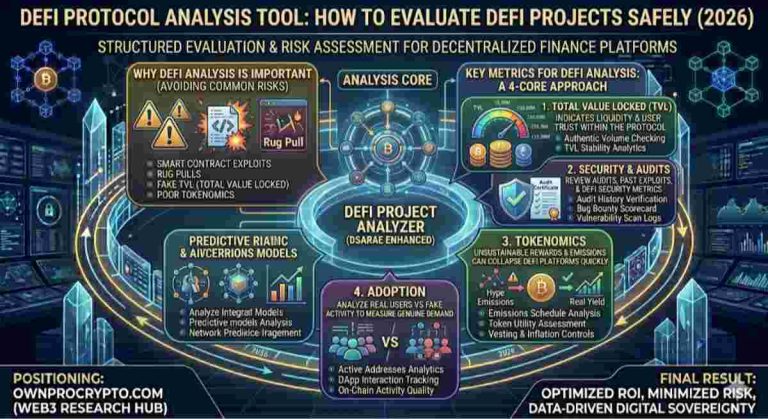
Infographic of DeFi Protocol Analysis Guide explained How to Evaluate DeFi Projects Safely in 2026
Master with the Defi Protocol Analysis Guide


Table of Contents

How Do You Analyze a DeFi Protocol?

A strong DeFi protocol analysis should answer one central question: what are you actually exposed to when you interact with this protocol? That requires examining the product’s economic purpose, real user demand, tokenomics, TVL, fees, revenue, yield source, liquidity, smart-contract design, governance authority, oracle and bridge dependencies, and resilience under market stress.

Analysis Layer Question to Answer What It Reveals
1. Protocol Purpose What problem does the protocol solve? Whether there is a meaningful economic function behind the application.
2. Adoption & Activity Are users actually using the product? Whether activity appears connected to genuine demand.
3. Tokenomics How are tokens created, distributed and used? Potential dilution, incentive dependence and value-capture dynamics.
4. Economics Where do fees, revenue and yield come from? Whether returns are supported by economic activity or subsidies.
5. Liquidity Can capital exit when conditions deteriorate? Slippage, withdrawal constraints and liquidity concentration.
6. DeFi Security What can fail in the code or infrastructure? Smart-contract, oracle, bridge, upgrade and dependency exposure.
7. Governance Who can change or control critical components? Administrative concentration and upgrade risk.
8. DeFi Risk Analysis What happens if key assumptions fail? The protocol’s vulnerabilities under adverse market and operational conditions.
Core principle: The purpose of DeFi analysis is not to identify the protocol with the biggest TVL or highest APY. It is to understand the relationship between economic value, capital efficiency, liquidity, technical security and risk before deciding whether the exposure is appropriate.

What Is DeFi Protocol Analysis?

DeFi protocol analysis is a structured process for evaluating how a decentralized finance protocol works, where its economic value comes from, what risks support its advertised returns, and whether those economics can remain viable as market conditions change.

The purpose is not simply to find a protocol offering the highest APY. A useful analysis examines the relationship between utility, yield, capital, liquidity, security, governance, and market stress. This matters because two protocols can advertise similar returns while having completely different risk profiles.

For investors, researchers, and digital-asset analysts, the central question should be: What is actually producing the return, and what could cause that return to disappear?

The Core DeFi Analysis Model

A practical DeFi risk analysis should move through seven connected questions:

01. Utility What problem does the protocol solve?
02. Yield Where does the return actually originate?
03. Capital How much capital supports the activity?
04. Liquidity Can users enter and exit efficiently?
05. Security What technical vulnerabilities exist?
06. Governance Who can change or control the system?
07. Stress Test What happens when market conditions deteriorate?
The key distinction A protocol can have high TVL, high trading volume, and an attractive APY while still having weak underlying economics. DeFi protocol analysis becomes useful when these headline metrics are connected to their underlying causes.

What a Strong Analysis Should Separate

Metric What It Tells You What It Cannot Prove Alone
APY Current advertised return That the return is sustainable
TVL Capital currently committed That the protocol is safe or profitable
Fees What users pay for protocol activity How much economic value is retained
Revenue Economic value captured by the protocol or stakeholders That technical risks are low
Token Incentives Rewards used to attract or retain capital Organic demand
Security Technical and operational exposure That the investment will be profitable

The Three Questions to Ask Before Going Deeper

  1. What creates the yield? Identify the actual source of the return rather than accepting the dashboard APY at face value.
  2. What supports the yield? Examine users, trading activity, borrowing demand, staking economics, fees, liquidity, and incentives.
  3. What could break the model? Look for smart-contract vulnerabilities, liquidity shortages, governance concentration, oracle failures, leverage, or declining incentives.

Start With the Protocol’s Economic Purpose

Before comparing APYs, TVL or token prices, determine what the DeFi protocol actually does. This is the foundation of effective DeFi risk analysis because the risks and revenue mechanisms differ substantially between lending markets, decentralized exchanges, liquid-staking systems, derivatives platforms and yield aggregators.

A protocol that provides a service demanded by independent users has a different economic foundation from one whose activity is largely created by temporary token rewards. The first question should therefore be about economic function, not advertised return.

Research principle Do not ask, “Which protocol has the highest APY?” before asking, “Why does anyone need this protocol, and who is willing to pay for its service?”

Common DeFi Protocol Types

Protocol Type Economic Function Typical Value Source Important Risk
DEX Facilitates decentralized asset swaps Trading fees Liquidity, oracle and smart-contract risk
Lending Protocol Connects lenders and borrowers Borrowing interest and fees Bad debt and liquidation risk
Liquid Staking Provides liquidity against staked assets Staking rewards and protocol fees Validator, depeg and protocol risk
Derivatives Provides leveraged or synthetic exposure Trading and funding activity Liquidation, oracle and market risk
Yield Aggregator Routes capital through yield strategies Strategy or performance fees Strategy, composability and smart-contract risk
Stablecoin Protocol Creates or manages stable-value assets Collateral, fees or reserve economics Depeg, collateral and liquidity risk

Separate Real Demand From Incentive-Driven Activity

Once the protocol’s function is understood, determine whether users are interacting with it because they need the service or because they are being paid to participate. This distinction is particularly important when how to analyze DeFi projects becomes a question of long-term sustainability rather than short-term yield.

Potential Organic Demand

  • Users pay fees for a useful service.
  • Borrowing demand exists without excessive subsidies.
  • Trading activity persists across different market conditions.
  • Users have a reason to remain after incentives decline.

Potential Incentive Dependence

  • Most activity is concentrated around reward programs.
  • Users rapidly leave when emissions decrease.
  • Advertised APY relies heavily on protocol tokens.
  • Economic activity remains weak relative to capital deposited.

The Economic Purpose Test

A useful screening method is to temporarily ignore the protocol’s token price and advertised APY. Then ask whether the underlying service would still have a reason to exist if token incentives were reduced substantially.

Question Strong Signal Warning Signal
Does the protocol solve a clear problem? Clear and measurable utility Primarily speculative demand
Are users paying for the service? Consistent fee generation Limited organic fee activity
Would users remain without incentives? Service remains useful Capital is highly reward-sensitive
Does capital generate economic activity? Capital is actively used Large idle or inefficient capital base
Why this matters for sustainable yield

The protocol’s economic purpose provides the foundation for everything that follows. Once you understand the service, you can trace the path from user activity → fees → revenue → rewards → yield. If that chain is unclear, the advertised return deserves additional scrutiny before capital is considered.

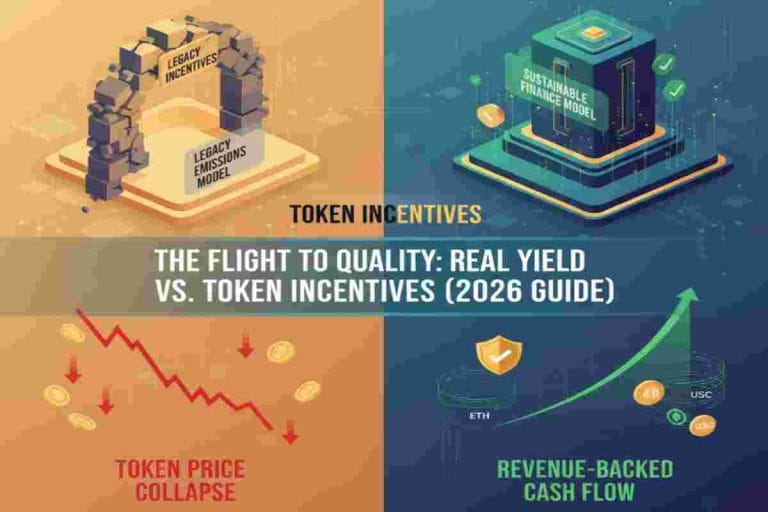
This Introduction Infographic Image of Real Yield vs. Token Incentives (2026)
Sustainable Yield vs. Incentive Yield

Sustainable Yield vs. Incentive Yield

One of the most important steps in DeFi Protocol Analysis is identifying where the advertised return actually comes from. A high APY can look attractive on a dashboard, but the headline number does not tell you whether the return is generated by genuine economic activity, network rewards, temporary token emissions, or a combination of several sources.

This is why DeFi risk analysis should separate organic yield from incentive yield. Organic yield is connected to an identifiable economic activity, while incentive yield depends on rewards that may be reduced, redirected, diluted, or discontinued.

The key question If the protocol reduced its token incentives by 50%, would the underlying yield still provide a compelling reason to keep capital there?

What Counts as Sustainable DeFi Yield?

There is no universal yield source that is automatically safe. Instead, evaluate whether the return has a clearly identifiable economic driver and whether that driver appears capable of continuing under reasonable market conditions.

Yield Source Potential Economic Foundation What to Investigate
Trading Fees Users pay to execute trades Volume quality, fee rate, liquidity and trader demand
Borrowing Interest Borrowers pay for access to capital Borrow demand, utilization, collateral and bad debt
Staking Rewards Underlying network rewards Network economics, validator exposure and reward changes
Protocol Fees Economic activity captured by the protocol Fee generation, distribution and historical consistency
Token Emissions New tokens distributed as rewards Emission schedule, dilution, token demand and sell pressure
Temporary Incentives Short-term capital acquisition or retention What happens when the campaign ends?

Do Not Confuse APY With Economic Return

A protocol might display a 15% APY, but that number can contain several components. For example, 6% could come from borrowing demand, 2% from trading or staking activity, and 7% from token incentives. The headline APY is still 15%, but its durability is very different from a strategy where most of the return comes from recurring economic activity.

Higher-Quality Yield Signal

  • Connected to measurable user activity.
  • Supported by recurring fees or protocol economics.
  • Remains meaningful after incentives decline.
  • Has a transparent mechanism that can be independently evaluated.

Potentially Fragile Yield Signal

  • Large percentage comes from newly issued tokens.
  • APY changes rapidly as rewards are adjusted.
  • Users appear highly sensitive to incentive changes.
  • Economic activity is weak relative to the rewards distributed.

The 25%–50%–75% Incentive Stress Test

A simple way to test yield durability is to model progressively lower incentives. Do not assume that today’s reward rate will remain unchanged. Instead, ask what the strategy would look like if its incentive component were reduced.

Scenario What Changes Research Question
25% Reduction Moderate incentive decline Does the strategy remain competitive?
50% Reduction Rewards are materially lower Would users continue supplying capital?
75% Reduction Most incentive yield disappears Is there enough organic economics left?

A Practical Yield Decomposition

Organic Yield Fees, borrowing, staking or other identifiable activity
+
Incentive Yield Temporary or recurring token rewards
=
Headline APY The number displayed to the user

The decomposition is intentionally simple. Actual DeFi strategies can include compounding, token-price movements, impermanent loss, leverage, fees, slippage and other variables. The objective is to understand the source of the return before comparing one opportunity with another.

Bottom line

The highest APY is not necessarily the strongest opportunity. In serious DeFi Protocol Analysis, the better question is whether the return is supported by durable economic activity and whether the strategy remains reasonable after temporary incentives are reduced or removed.

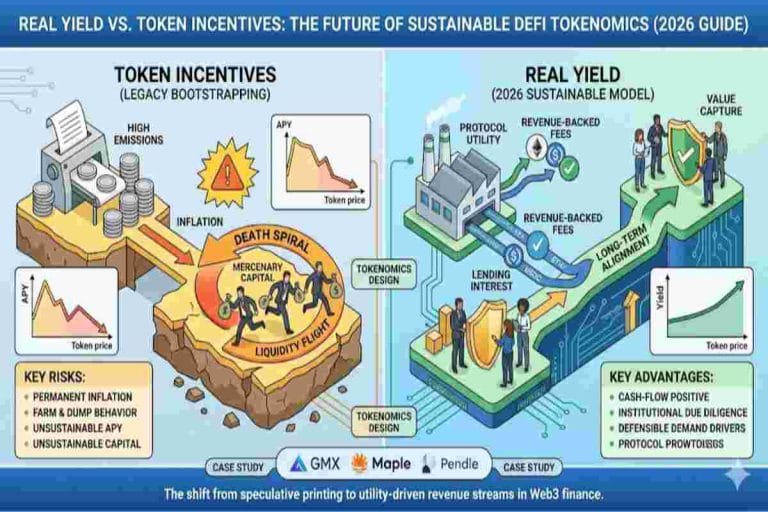
Infographic shows Real Yield vs. Token Incentives and Explain The Future of Sustainable DeFi Tokenomics (2026 Guide)
Compare DeFi Fees, Revenue and Token Incentives

How to Compare DeFi Fees, Revenue and Token Incentives

A reliable DeFi protocol analysis should never treat fees, revenue and token incentives as the same thing. They describe different parts of a protocol’s economic model, and confusing them can make an apparently attractive yield opportunity look much stronger than it actually is.

Fees represent what users pay for using a protocol. Revenue represents the portion of that economic activity that is actually retained by the protocol, treasury, token holders or another defined stakeholder group. Token incentives are rewards distributed to attract liquidity, users or capital and may depend on an emission schedule rather than organic demand.

For anyone learning how to analyze DeFi projects, separating these three categories is one of the fastest ways to identify whether a headline APY is supported by genuine economic activity or temporary subsidies.

Key principle: A protocol can generate substantial fees without retaining substantial revenue, and it can offer a high APY while relying heavily on token emissions. Always follow the flow of value from the user to the final recipient.

Metric What It Means What to Investigate
Fees Amount paid by users for protocol activity Trading volume, borrowing activity, fee rates and fee consistency
Revenue Economic value retained by the protocol or defined stakeholders Revenue distribution, treasury flows and historical trend
Token Incentives Rewards used to attract or retain participants Emission schedule, token demand and selling pressure
Net Yield Return remaining after relevant costs and losses Fees, slippage, impermanent loss and incentive dependency

Why Fees Alone Can Be Misleading

High fees can indicate strong user activity, but they do not automatically mean that liquidity providers or token holders receive an equally strong economic return. A protocol may route a significant percentage of collected fees to liquidity providers, validators, external services or other participants.

For example, suppose a hypothetical decentralized exchange processes $1 billion in monthly trading volume and collects $3 million in fees. That tells you something about activity, but it does not by itself tell you how much economic value is retained by the protocol.

Step 1
Measure Fees

How much are users actually paying?

Step 2
Trace Revenue

Where does the collected value go?

Step 3
Check Incentives

How much yield depends on token rewards?

Measure Incentive Dependency

A useful analytical exercise is to remove token incentives from the advertised return. This produces a clearer view of the yield supported by underlying protocol economics.

Organic Yield = Total Advertised Yield − Incentive Yield

This is a simplified analytical model rather than a universal accounting definition. Actual yield calculations may require additional adjustments for fees, losses, leverage, compounding and changing reward prices.

Hypothetical Strategy Advertised APY Organic Yield Incentive Yield
Strategy A 15% 11% 4%
Strategy B 20% 6% 14%
Strategy C 9% 8% 1%

In this hypothetical comparison, Strategy B has the highest advertised APY but also the greatest dependence on incentives. If its token rewards were reduced substantially, its effective yield could fall much faster than Strategy A or Strategy C.

Research warning: Do not assume that a token reward is equivalent to risk-free income. The market value of an incentive token can change rapidly, and selling rewards may create additional price impact. Analyze both the nominal reward rate and the economic value of the reward.

The 25%–50%–75% Incentive Stress Test

One practical method for DeFi risk analysis is to reduce the incentive component and observe whether the strategy still appears economically attractive. This does not predict what will happen; it simply exposes how dependent the current yield is on subsidies.

Scenario Incentive Reduction Question
Moderate 25% Does the strategy remain competitive?
Severe 50% Does organic activity still support the position?
Extreme 75% Would capital likely remain without heavy subsidies?

What a Strong Result Looks Like

A stronger economic profile is one where user activity produces meaningful fees, a transparent portion of those fees becomes revenue, and the expected return remains reasonably understandable even after temporary token incentives are discounted.

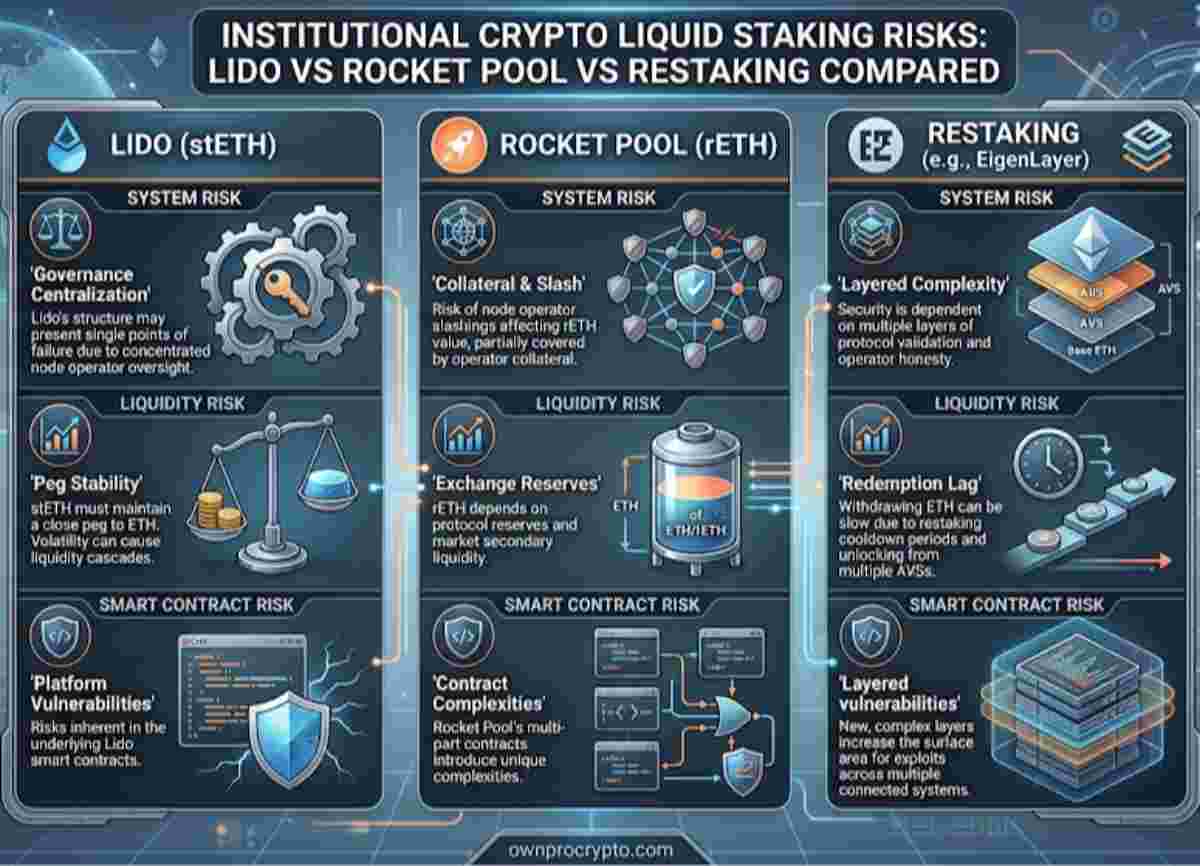
Infographic of Institutional Crypto Liquid Staking Risks: Lido vs Rocket Pool vs Restaking Compared in 2026
Evaluate DeFi Liquidity and Exit Risk

How to Evaluate DeFi Liquidity and Exit Risk

Liquidity is one of the most overlooked parts of DeFi Protocol Analysis. A strategy can show an attractive APY, strong TVL and impressive historical returns while still becoming difficult or expensive to exit when market conditions deteriorate.

For that reason, DeFi risk analysis should evaluate not only how capital enters a protocol, but also how quickly and efficiently that capital can leave. The relevant question is simple: if you needed to exit today during a stressed market, who would provide the liquidity for your exit?

Core principle: Yield is only part of the return equation. If exiting a position creates significant slippage, delay, withdrawal restrictions or forced losses, the headline APY may materially overstate the practical opportunity.

Why High TVL Does Not Guarantee Easy Exit

TVL measures the value of assets deposited into a protocol, but those assets should not automatically be interpreted as immediately available exit liquidity. Capital may be locked, concentrated in a small number of assets, deployed into strategies, subject to withdrawal queues or dependent on another market remaining liquid.

This distinction is particularly important when how to analyze DeFi projects involves comparing protocols with very different architectures. A lending market, automated market maker, liquid-staking protocol and yield vault can all report substantial TVL while exposing users to very different exit mechanisms.

Liquidity Factor Stronger Signal Warning Signal
Market Depth Deep liquidity relative to position size A moderate trade causes large price movement
Withdrawal Terms Flexible and transparent withdrawals Long lockups, queues or unclear conditions
Asset Concentration Diversified liquidity Liquidity dominated by one volatile asset
Stablecoin Liquidity Multiple reliable exit venues Dependence on one pool or venue
Stress Liquidity Depth remains available during volatility Liquidity disappears when demand for exits rises

Position Size Matters

Liquidity risk is relative to the size of the position. A market may be perfectly liquid for a $1,000 position but unsuitable for a $1 million position. Therefore, never evaluate liquidity independently from the amount of capital being considered.

Liquidity Coverage = Available Exit Liquidity ÷ Intended Position Size

This is a simplified analytical ratio rather than a standardized financial metric. Use it as a screening concept and combine it with actual market-depth and slippage analysis.

The closer your position becomes to a meaningful percentage of available exit liquidity, the more important execution risk becomes. A theoretical yield should therefore be discounted when a large position would materially affect the market while being unwound.

A Simple $100,000 Exit Example

Consider a hypothetical DeFi strategy where you deposit $100,000 and the dashboard displays a 15% annualized return. Under normal conditions, the strategy appears attractive.

Now assume a market shock reduces available liquidity and your effective exit cost reaches 8%. An immediate exit would create an $8,000 loss from slippage or execution impact before considering the strategy’s accumulated yield, market movement or other risks.

Scenario Position Exit Cost Illustrative Impact
Normal $100,000 1% $1,000
Volatile $100,000 4% $4,000
Stressed $100,000 8% $8,000

These figures are hypothetical examples for illustrating liquidity mechanics, not forecasts of actual execution costs.

Check the Exit Route Before Entering

Before depositing capital, map the complete exit route:

  1. Identify the asset you will receive when withdrawing.
  2. Determine whether withdrawal is immediate or delayed.
  3. Identify the primary market where that asset can be sold.
  4. Estimate available liquidity relative to your position size.
  5. Check expected slippage under normal conditions.
  6. Consider what could happen if market liquidity falls sharply.
  7. Check whether bridges, oracles or other protocols are required for the final exit.

Important distinction: A protocol can have high TVL while still having poor liquidity for your specific exit. Always distinguish between capital deposited and capital immediately available to absorb withdrawals or market sales.

Liquidity Questions to Add to Your DeFi Due Diligence

Question Why It Matters
Can I withdraw immediately? Withdrawal restrictions can turn market risk into forced holding risk.
What asset will I receive? The withdrawal asset may have different liquidity and volatility characteristics.
Where is the deepest exit liquidity? The primary exit venue determines potential execution cost.
What happens during a 40% market decline? Normal liquidity conditions may disappear during severe volatility.
Does the strategy depend on another protocol? A dependency failure can make an otherwise functional exit route unavailable.

The Practical Rule

Do not ask only, “How much can this DeFi strategy earn?” Ask, “How much can I realistically recover if I need to exit during the worst reasonable market conditions?” That second question often reveals risks that an APY dashboard does not show.

Infographic Image of Smart Contract Risk Calculator: DeFi Risk Scanner & Protocol Security Tool (2026)
Evaluate Smart Contract Security in DeFi

How to Evaluate Smart Contract Security in DeFi

Smart contract security should be treated as a first-class component of DeFi Protocol Analysis. A protocol can have strong revenue, deep liquidity and attractive historical returns, yet a vulnerability in its smart contracts can expose deposited capital to catastrophic loss.

This is why DeFi risk analysis cannot stop at financial metrics. Before deciding whether a protocol deserves further consideration, examine its deployed contracts, audit history, upgrade permissions, administrative controls, oracle dependencies and response mechanisms.

Core principle: An audit is evidence of a security review, not a guarantee that a protocol is safe. The real question is whether the current deployed system, its dependencies and its control structure remain consistent with the security assumptions you are relying on.

What Should You Check Before Trusting a DeFi Protocol?

A useful security review should move beyond the question, “Has this protocol been audited?” Instead, determine what was audited, when it was audited, which version was reviewed and whether the deployed contracts can be changed after the audit.

Security Layer Question to Ask Potential Warning
Audit Scope Which contracts and functions were reviewed? Only selected contracts were audited
Audit Date When was the review completed? Audit is substantially older than the deployed system
Code Changes Has the deployed code changed since review? Material changes without corresponding review
Upgradeability Who can modify the implementation? Single wallet has broad upgrade authority
Admin Controls Who controls critical parameters? Unlimited or poorly documented privileges
Oracle Security How are external prices supplied? Single or manipulable price source
Emergency Controls What happens after a detected exploit? No clear containment mechanism

Audits Are Useful — But Read the Details

An audit should be treated as one piece of evidence within a larger security assessment. The existence of an audit does not establish that every contract is secure, that every vulnerability was discovered, or that future code changes will remain safe.

When reviewing an audit, look for the scope, commit or code version, findings, severity classifications and remediation status. If a protocol has undergone multiple major upgrades, check whether the relevant deployed version was reviewed.

Check 01
Scope

Confirm what was actually included in the review.

Check 02
Version

Compare the reviewed code with the current deployment.

Check 03
Findings

Review severity and whether reported issues were resolved.

Check 04
Changes

Look for material upgrades after the audit.

Upgradeability Creates a Separate Risk

A smart contract may have passed an audit while still allowing an administrator, multisig or governance process to replace the implementation later. This creates a distinction between code security and control security.

When evaluating a protocol, identify who can upgrade contracts, modify parameters, pause markets, change fee settings, alter collateral rules or move assets. The more powerful the control mechanism, the more important it becomes to understand who controls it and how those actions are constrained.

Control Structure Relative Risk Signal What to Verify
Timelocked Multisig Generally stronger control structure Signers, threshold and delay period
DAO Governance Potentially broader control Voting concentration and execution mechanism
Multisig Without Delay Requires closer review Signer independence and emergency authority
Single Administrator High concentration signal Exact permissions and ability to revoke control

These labels are analytical signals, not universal safety ratings. A multisig can still be compromised, and decentralized governance can still be highly concentrated.

Check the Oracle Attack Surface

Many DeFi applications depend on external price information to determine collateral values, liquidations, exchange rates or asset balances. An attacker who can manipulate a critical price feed may exploit a protocol even when the underlying smart-contract code contains no obvious vulnerability.

Therefore, security research should identify where prices originate, how they are validated and what happens if the oracle becomes unavailable or produces an abnormal value. This becomes particularly important for lending, derivatives and leveraged strategies.

Security Dependency Chain

Price Source
→
Oracle
→
Protocol Logic
→
Liquidation / Settlement

Build a Security Evidence Checklist

Before assigning a favorable technical-risk assessment, collect evidence for each of the following:

  1. Identify the exact contracts holding or controlling user funds.
  2. Verify the deployed contract addresses and implementation versions.
  3. Review available independent security audits.
  4. Check whether material code changes occurred after those audits.
  5. Identify upgrade administrators and emergency authorities.
  6. Review oracle and external-protocol dependencies.
  7. Check publicly documented incidents, vulnerabilities and remediation history.
  8. Determine how the protocol can respond if a critical component is compromised.

Do not use “audited” as a shortcut for “safe.” Security is a continuously changing property. New deployments, upgrades, integrations, governance decisions and external dependencies can alter the risk profile after an audit has been completed.

The Practical Rule

A strong DeFi security assessment connects code, control and dependencies. Do not ask only whether the contract was audited. Ask whether the current code was reviewed, who can change it, what external systems it depends on and what happens if one of those components fails.

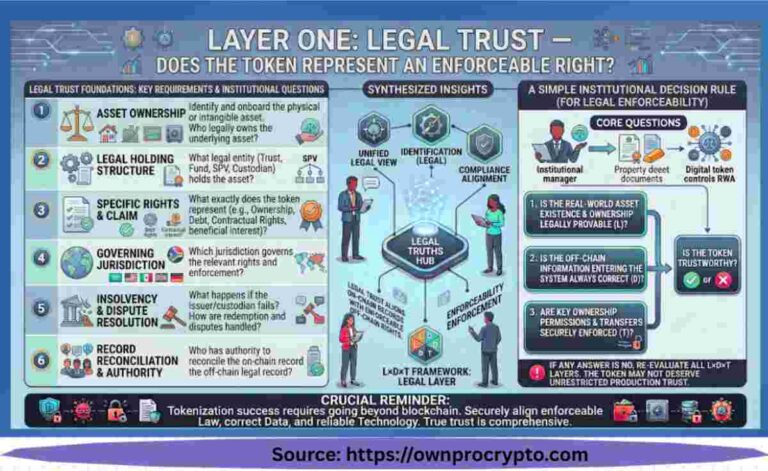
Infographic of Layer One: Legal Trust — Does the Token Represent an Enforceable Right? (2026 updated)
Evaluate DeFi Governance and Control Risk

Evaluate DeFi Governance and Control Risk

A DeFi protocol can appear decentralized while important decisions remain concentrated in a small group of wallets, a multisignature committee, an upgrade administrator, or another privileged control structure. For DeFi protocol analysis, governance should therefore be treated as a measurable risk layer rather than a branding claim.

The key question is not simply whether a protocol uses decentralized governance. The more useful question is who can change the system, how quickly they can change it, and what protections exist before those changes affect user funds.

Governance principle: A protocol’s effective level of decentralization is determined by its actual control mechanisms, not by the presence of a governance token alone.

What Should You Check?

When researching how to analyze DeFi projects, map the permissions that can materially change protocol behavior. Pay particular attention to upgrades, treasury movements, risk parameters, emergency controls, oracle configuration and asset listings.

Control Area Lower-Risk Structure Warning Signal
Contract Upgrades Multisig plus timelock and transparent proposals Single wallet can upgrade contracts immediately
Risk Parameters Changes subject to defined governance controls Privileged account can change limits without delay
Treasury Transparent multisig or governed treasury Concentrated control over significant assets
Emergency Controls Limited scope and clearly defined conditions Broad unilateral pause or intervention authority
Governance Voting Distributed voting influence Small number of wallets dominate decisions
Oracle Management Transparent and constrained configuration Privileged party can alter critical price sources

Why Timelocks and Multisigs Matter

A multisignature wallet can reduce dependence on a single private key because multiple authorized participants may be required to approve an action. A timelock can provide an additional delay between proposal and execution, giving users, researchers and other stakeholders an opportunity to identify potentially dangerous changes.

Neither mechanism eliminates risk. A compromised majority of a multisig can still approve a malicious transaction, while a timelock may provide little protection if users cannot react quickly enough. The objective is to understand the complete control path.

Governance Control Path

Proposal
→
Vote
→
Timelock
→
Execution

Governance Questions for Your Research Notes

  • Who has administrative or upgrade authority?
  • How many signers are required for critical changes?
  • Is there a timelock before important changes become active?
  • Can governance modify collateral, borrowing, fee or liquidation parameters?
  • Can privileged actors add new assets or markets?
  • Who controls emergency pause functionality?
  • Are major governance decisions publicly documented?
  • How concentrated is voting power among the largest participants?
Research warning: A governance token does not automatically make a protocol decentralized. Always investigate the actual permissions attached to deployed contracts and administrative wallets.

Governance structures can change over time. For serious DeFi risk analysis, verify the currently deployed contracts, permissions, multisig configuration, timelocks and recent governance proposals rather than relying only on historical documentation.

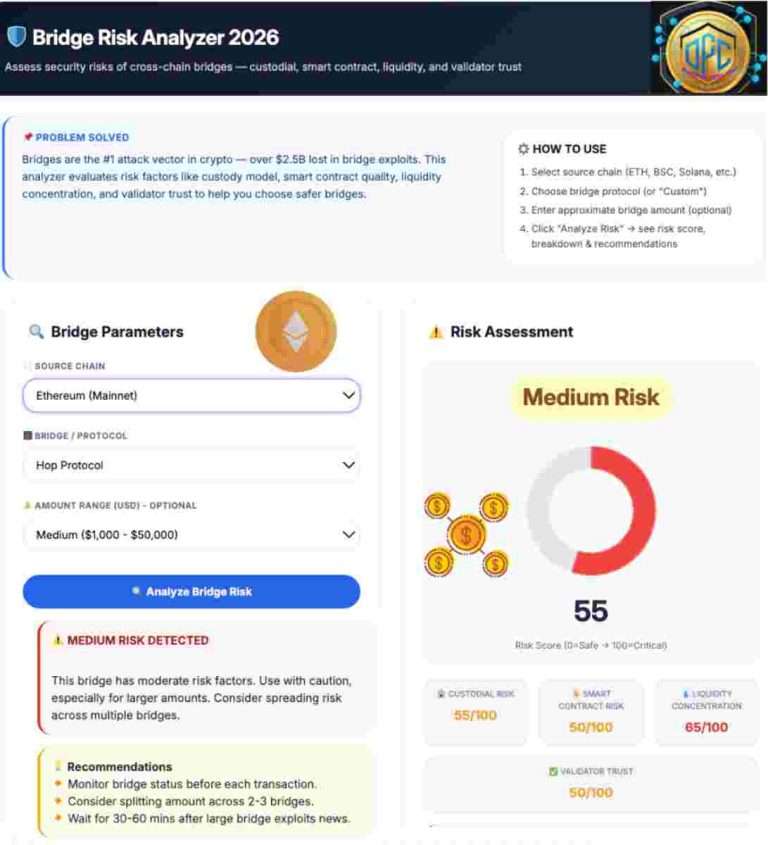
Infographic of zero-trust interoperability in 2026 explained crypto Bridge Risk Analyser 2026
Peel back the layers of complex smart contract risks.

Analyze Oracle, Bridge, and Composability Risk

A DeFi protocol rarely operates completely on its own. Lending markets may depend on price oracles, vaults may interact with external lending protocols, cross-chain applications may rely on bridges, and derivatives platforms may depend on several liquidity venues and data sources. This interconnected structure creates an important layer of DeFi risk analysis: the risk inherited from external dependencies.

This is commonly described as composability risk. The protocol itself may function correctly while a dependency fails, produces incorrect data, becomes illiquid, or is exploited. A strong DeFi protocol analysis therefore needs to map not only the protocol’s own contracts but also the systems it relies upon.

The dependency test: Ask what happens to the protocol if each critical external dependency becomes unavailable, manipulated, illiquid, delayed, or compromised.

1. Oracle Risk

Oracles provide blockchain applications with information they cannot directly obtain from the blockchain itself, such as asset prices. When a protocol uses external price data to determine collateral values, liquidations, exchange rates, or settlement amounts, the reliability of that data becomes part of the protocol’s risk profile.

When reviewing an oracle dependency, determine which assets rely on external pricing, where the data originates, how frequently it updates, and what the protocol does if the price feed becomes stale or unavailable.

Oracle Question What to Investigate Potential Failure
Price Source Where does the asset price originate? Manipulated or inaccurate valuation
Update Frequency How often does the price update? Stale price during rapid volatility
Fallback Logic What happens when the feed fails? Incorrect liquidations or frozen operations
Asset Coverage Are all supported assets reliably priced? Weak pricing for thinly traded assets

2. Bridge and Cross-Chain Risk

Cross-chain functionality can increase the utility of a DeFi application, but it can also introduce additional trust assumptions. A protocol may depend on a bridge, messaging system, wrapped asset or cross-chain verification mechanism. The security of that external component becomes relevant to the assets and operations depending on it.

Important distinction: A native asset and a bridged representation of that asset can have different risk profiles. Always identify what actually backs the asset being used by the protocol.

3. Composability Risk

Composability is one of DeFi’s major strengths because protocols can be combined to create increasingly sophisticated financial applications. The same feature can create interconnected failure paths.

For example, a hypothetical yield vault could deposit capital into a lending market, use a liquid-staking token as collateral, rely on an oracle for valuation, and use a decentralized exchange for rebalancing. The vault’s effective risk is therefore greater than simply reviewing the vault’s own contract.

Dependency Possible Failure Potential Consequence
Oracle Incorrect or stale price Bad liquidations or incorrect collateral valuation
Bridge Exploit or verification failure Loss of backing or asset devaluation
Lending Market Bad debt or contract exploit Losses transmitted to dependent strategies
DEX / Liquidity Venue Liquidity collapse High slippage or failed rebalancing
Liquid-Staking Asset Depeg or validator-related problem Collateral value falls unexpectedly

4. Build a Dependency Map

DeFi Protocol
Core application
→
Oracle
Market data
→
Liquidity
Execution
→
External Protocol
Composability

The more critical dependencies a protocol has, the more important it becomes to understand their individual failure modes.

5. Apply the Single-Dependency Failure Test

A practical way to strengthen DeFi risk analysis is to temporarily assume that one dependency has failed. Then determine whether user funds remain protected, withdrawals remain possible, positions can still be valued correctly, and governance has a safe response mechanism.

  • What happens if the primary oracle becomes unavailable?
  • What happens if an important asset loses its peg?
  • What happens if a connected protocol suffers an exploit?
  • What happens if liquidity falls sharply?
  • Can users withdraw without relying on the failed component?
  • Can governance isolate the affected market or asset?
  • Does the failure remain contained or spread through the protocol?
Best practice: Do not evaluate a DeFi protocol only as an isolated application. Trace the assets, price feeds, liquidity venues, bridges and external protocols that must continue functioning for the strategy to work as intended.

Dependency structures can change as protocols add new markets, assets, chains and integrations. Recheck the dependency map whenever a major integration or architectural change occurs.

Build a DeFi Protocol Risk Score

After reviewing a protocol’s economics, yield source, liquidity, smart-contract architecture, governance and dependencies, the next step is to turn the research into a structured comparison. A scoring model can help reduce emotional decisions and prevent one attractive metric—such as a high APY or large TVL—from dominating the entire analysis.

The following DeFi protocol risk analysis framework uses 100 points across seven categories. It is designed as a research tool rather than a prediction model. A high score does not mean a protocol is safe, and a low score does not automatically mean it will fail. The purpose is to make the assumptions behind a decision visible.

Risk Category Maximum Points What to Evaluate
Economic Utility 15 Real user demand, product usefulness and economic activity.
Yield Quality 15 Organic revenue versus temporary incentives and token emissions.
Liquidity & Exit Risk 15 Market depth, withdrawal conditions, concentration and stress liquidity.
Smart Contract Security 20 Audits, deployed code, vulnerabilities, upgrades and emergency controls.
Governance 10 Admin keys, multisigs, timelocks and voting concentration.
Oracle & Dependencies 10 Oracle reliability, bridges, external protocols and composability exposure.
Stress Resilience 15 Expected behavior during major price declines, liquidity shocks and incentive reductions.
Total 100 Structured DeFi protocol assessment
80–100
Stronger Profile

The protocol demonstrates comparatively strong economics and risk controls, subject to ongoing monitoring.

60–79
Moderate Profile

Several strengths may exist, but one or more meaningful risk factors require closer investigation.

40–59
Elevated Risk

The expected return should be evaluated carefully against identifiable weaknesses and downside scenarios.

Below 40
High Risk

Multiple weaknesses may make the protocol unsuitable for capital that cannot tolerate substantial loss.

Important scoring rule: Do not allow a strong economic score to compensate for a critical security failure. Some risks are effectively non-compensable. For example, an unresolved critical smart-contract vulnerability can justify rejecting a protocol even when its yield, TVL and revenue metrics appear attractive.

How to Use the Score in Real DeFi Research

Score each category using evidence that can be independently verified. Avoid awarding points simply because a protocol describes itself as decentralized, audited or sustainable. The evidence should come from deployed contracts, governance records, historical metrics, documented fee structures and observable liquidity conditions.

Most importantly, record why each score was assigned. A score without an explanation can create false confidence, while a documented score creates an audit trail that can be revisited when protocol conditions change.

DeFi Stress Testing: The 20–40–60 Model

A protocol can look healthy during normal market conditions and still contain weaknesses that only become visible during a sharp market move. That is why DeFi risk analysis should include stress testing rather than relying exclusively on current APY, TVL, revenue or historical performance.

The 20–40–60 model provides a simple way to examine how a protocol might behave as market conditions become progressively more difficult. It is not a prediction of future prices. Instead, it is a structured exercise for identifying fragile assumptions before capital is exposed to them.

20%
Moderate Shock

Test whether collateral, liquidity and withdrawals continue operating without unusual stress.

40%
Severe Shock

Examine liquidation pressure, falling liquidity, oracle behavior and the possibility of bad debt.

60%
Extreme Shock

Identify the first major failure point if prices, liquidity and confidence deteriorate simultaneously.

Scenario Stress Condition What to Examine Warning Signal
−20% Underlying asset falls moderately Collateral ratios, withdrawals and liquidity Unexpected liquidation or withdrawal pressure
−40% Severe market decline Liquidation engine, oracle and market depth Bad debt, extreme slippage or oracle instability
−60% Extreme market stress System dependencies and failure points Protocol insolvency, frozen exits or cascading failures

Stress-Test More Than the Token Price

A useful stress test should not simply change the price of one asset. DeFi systems are interconnected, so several assumptions can deteriorate at the same time. For example, a 40% market decline could occur alongside lower trading volume, reduced liquidity, increased withdrawals and a decline in the market value of collateral.

A stronger DeFi stress test asks:
  • What happens to collateral health if asset prices fall sharply?
  • Can liquidators execute efficiently when market depth deteriorates?
  • Does the oracle continue providing reliable prices during extreme volatility?
  • Can users withdraw without severe delays or unexpected losses?
  • What happens if protocol TVL falls substantially?
  • Does the advertised yield remain attractive when incentives decline?
  • Could a failure in an external dependency spread into the protocol?

Add an Incentive-Shock Test

Price volatility is only one part of the exercise. If a protocol’s yield depends heavily on token emissions, test what happens when those rewards fall by 25%, 50% and 75%. This helps distinguish an attractive headline APY from a return supported by durable economic activity.

Incentive Reduction Question Interpretation
−25% Does the strategy remain competitive? Tests moderate reward dependence.
−50% Would capital likely remain? Reveals significant subsidy dependence.
−75% Is there still an economic reason to participate? Tests whether organic economics can stand on their own.
The objective is not to predict a crash. The objective is to discover which assumption fails first. If a protocol becomes dependent on perfect liquidity, continuously rising asset prices, uninterrupted oracle availability or permanent token incentives, that dependency should be visible before capital is committed.

Example: Comparing Two Hypothetical DeFi Protocols

A practical framework becomes more useful when it is applied to a real decision. Consider two hypothetical lending protocols that appear attractive for different reasons. Protocol Alpha advertises a 14% annualized yield, while Protocol Beta advertises 8%.

An investor focused only on the headline APY might immediately prefer Alpha. A deeper DeFi protocol analysis produces a different question: how much of each return comes from durable economic activity, and how much depends on incentives or assumptions that may change?

Metric Protocol Alpha Protocol Beta
Advertised Yield 14% 8%
Organic Yield 5% 7%
Token Incentive 9% 1%
Liquidity Medium High
Governance Risk High Medium
Stress Resilience Low Higher

Why the Lower APY May Be More Attractive

Alpha’s 14% headline return initially looks superior. However, only 5 percentage points come from the hypothetical organic yield, while 9 percentage points come from token incentives. That means approximately 64.3% of Alpha’s advertised return is incentive-driven under this example.

Beta produces a lower headline return, but 7 of its 8 percentage points come from the underlying economic activity. Only 1 percentage point depends on incentives. If rewards are reduced or removed, Beta’s economics therefore change less dramatically.

Protocol Alpha
14% headline yield

5% organic yield + 9% token incentives. More dependent on continued rewards and carries higher hypothetical governance and liquidity risk.

Protocol Beta
8% headline yield

7% organic yield + 1% token incentives. Lower headline return but stronger hypothetical dependence on underlying economic activity.

Apply the 20–40–60 Stress Test

The comparison should not stop at yield composition. Apply the same stress scenarios to both protocols. Ask how collateral, liquidity, liquidations, oracle systems and withdrawals could behave during a sharp market decline.

Stress Test Alpha — Questions Beta — Questions
−20% Does medium liquidity absorb increased exits? Does high liquidity remain available?
−40% Can liquidations function without significant bad debt? Does stronger liquidity reduce exit and liquidation pressure?
−60% Does the system remain viable if incentives and liquidity deteriorate? Where is the first major failure point under extreme stress?
The lesson: The highest advertised APY is not automatically the strongest opportunity. A better comparison considers the quality of the yield, liquidity, governance, security and resilience of the entire system. The final decision depends on the investor’s objectives, risk tolerance, time horizon and ability to absorb losses.

Turn the Comparison Into a Decision Record

For each protocol you evaluate, record the headline yield, organic yield estimate, incentive component, liquidity conditions, security findings, governance controls and stress-test observations. Date the assessment because DeFi conditions can change quickly.

This creates a repeatable research process instead of making every decision from a dashboard snapshot. When APY, TVL, governance or protocol architecture changes, the original analysis can be reviewed and updated rather than starting from zero.

How to Analyze DeFi Projects: A Practical Due Diligence Checklist

Knowing how to analyze DeFi projects becomes much easier when the research process follows the same order every time. Instead of jumping between APY dashboards, token charts and social-media claims, start with the protocol’s purpose and progressively examine its economics, liquidity, security, governance and dependencies.

The following checklist is designed as a first-pass screening process. It does not replace contract-level research or professional advice, but it can help identify obvious weaknesses before you spend significant time evaluating a protocol.

10-Step DeFi Protocol Screening Process

  1. Identify the protocol’s core function. Determine whether it is primarily a DEX, lending market, liquid-staking protocol, derivatives platform, vault, aggregator or another type of decentralized application.
  2. Identify the source of the advertised yield. Ask whether the return comes from trading fees, borrowing interest, staking rewards, protocol revenue, token emissions or a combination of sources.
  3. Separate organic yield from incentives. Do not treat token rewards as equivalent to revenue generated by actual protocol activity. Estimate how much of the headline APY would remain if incentives were reduced.
  4. Review TVL and capital concentration. Look beyond the headline TVL figure. Check whether deposits are diversified, stable over time or dominated by a small number of assets, wallets or incentive programs.
  5. Check liquidity and exit conditions. Evaluate market depth, withdrawal restrictions, lockups, pool composition and expected slippage relative to the size of the position you are considering.
  6. Review smart-contract security. Check available audits, deployed contract addresses, historical incidents, bug disclosures and whether the deployed implementation matches the code that was reviewed.
  7. Map administrative and governance controls. Identify multisigs, upgrade authorities, emergency guardians, timelocks and voting concentration. Determine who can change critical protocol parameters.
  8. Map external dependencies. Identify oracle providers, bridges, underlying protocols, stablecoins and liquidity venues whose failure could affect the strategy.
  9. Run downside scenarios. Test what could happen after 20%, 40% and 60% market declines. Examine collateral health, liquidation mechanisms, liquidity and withdrawal conditions.
  10. Define your invalidation conditions. Before committing capital, decide which changes would make you reconsider the position—for example, a major contract upgrade, falling liquidity, declining organic revenue or unexpected governance changes.

A Simple Go / Review / Avoid Framework

After completing the first-pass analysis, classify the protocol according to the strength of its evidence rather than the size of its advertised yield.

Assessment Typical Characteristics Research Response
Stronger Case Clear utility, identifiable revenue, reasonable liquidity, mature security controls and transparent governance. Proceed to deeper due diligence and position-specific risk analysis.
Needs Review Strong headline metrics but meaningful uncertainty around incentives, liquidity, dependencies or governance. Investigate the unresolved risk before making a decision.
High Risk / Avoid Unclear yield source, severe concentration, unresolved security issues, weak liquidity or excessive administrative control. Stop the evaluation until the material risks are independently resolved.
Research rule: Do not let one attractive metric override a material weakness elsewhere. A high APY, large TVL or rapidly growing volume can make a protocol worth investigating, but none of these metrics independently establishes that the underlying opportunity is safe or sustainable.

DeFi Protocol Monitoring: What to Track After Your Initial Analysis

DeFi due diligence should not end when the initial research is complete. Protocol conditions can change quickly as liquidity moves, incentives expire, governance proposals pass, contracts are upgraded and market conditions shift. A protocol that looked attractive several months ago may have a very different risk profile today.

For this reason, DeFi protocol analysis should be treated as an ongoing monitoring process rather than a one-time checklist. The objective is to identify changes that could materially alter the original investment thesis.

Metric What to Monitor Potential Warning Signal
TVL Overall trend, asset composition and concentration. Rapid unexplained outflows or dependence on one asset or liquidity source.
Fees User-generated activity and fee trends. Persistent decline while advertised yield remains unusually high.
Revenue Economic value actually retained by the protocol or relevant stakeholders. Yield becomes increasingly disconnected from underlying revenue.
Incentives Emission rates, reward tokens and changes to incentive programs. Increasing subsidies are required to maintain the same level of liquidity.
Liquidity Market depth, withdrawal conditions and effective slippage. Liquidity falls while position size or protocol exposure remains unchanged.
Governance Major proposals, voting concentration and administrative changes. Unexpected changes to risk parameters, upgrade authority or emergency controls.
Security Contract upgrades, incidents, disclosures and newly discovered vulnerabilities. Unreviewed code changes or unresolved critical security issues.

Monitor Changes That Can Break the Original Thesis

The most useful monitoring system focuses on thesis-breaking events rather than attempting to track every blockchain metric. Ask whether the fundamental reason for holding the position is still valid.

Economic Activity

Is real user activity still supporting fees and revenue?

Yield Quality

Has organic yield remained healthy after incentive changes?

Liquidity

Can capital still be exited without materially worse conditions?

Security

Have contracts, permissions or dependencies changed?

A Practical Monitoring Trigger

Consider performing a fresh full review whenever there is a major smart-contract upgrade, governance change, exploit, substantial TVL movement, significant incentive reduction, oracle change, bridge change or material shift in protocol economics. These events can invalidate assumptions made during the original analysis.

Key takeaway: The goal of monitoring is not to predict every market move. It is to detect when the evidence supporting your original DeFi thesis has materially changed.

DeFi Protocol Analysis Tools and Research Sources

No single dashboard can provide a complete picture of a DeFi protocol. A serious research process combines protocol metrics, yield data, smart-contract information, governance activity, market liquidity and project documentation.

The objective is not to collect as many metrics as possible. Instead, use each source to answer a specific question in your DeFi risk analysis process.

Research Area Data to Examine Research Question
Protocol Economics TVL, fees, revenue and volume Is there genuine economic activity supporting the protocol?
Yield APY, reward emissions and historical yield How much of the return comes from organic activity versus incentives?
Liquidity Pool depth, trading liquidity and withdrawal conditions Can capital realistically exit during stressed conditions?
Smart Contracts Contract addresses, audits, permissions and upgrade mechanisms What technical controls and vulnerabilities should be considered?
Governance Proposals, voting activity, multisigs and administrative permissions Who can change or control critical protocol parameters?
Dependencies Oracles, bridges, stablecoins and underlying protocols Could another system failure propagate into this protocol?

Use Multiple Sources Instead of Trusting One Dashboard

Protocol dashboards are useful starting points, but important decisions should be cross-checked against primary documentation and independent data. Metrics can use different definitions, update at different frequencies and sometimes present economic activity differently.

Protocol Documentation

Use official documentation to understand mechanisms, supported assets, contracts and protocol assumptions.

On-Chain Data

Use blockchain data to verify contract activity, transactions, balances and other observable activity.

Security Research

Review audits, disclosed incidents, contract changes and security documentation before relying on historical claims.

Governance Records

Review proposals and voting activity to identify changes that may affect protocol economics or control.

Do Not Rely on Static Numbers

TVL, fees, revenue, volume, APY and liquidity can change continuously. Treat figures in educational articles as analytical examples unless they are explicitly presented as current data. Before making a decision, verify the latest available protocol metrics, documentation, contract addresses and governance information.

Research discipline: Use dashboards to discover information, primary sources to verify it, and your risk framework to interpret it. A metric becomes useful only when you understand what it measures, what it excludes and how it can change under stress.

DeFi Protocol Analysis FAQs

These frequently asked questions address the practical search intent behind DeFi protocol analysis, sustainable yield research and evaluating DeFi projects. The answers focus on how the research process works rather than promising specific returns or recommending individual protocols.

What is DeFi protocol analysis?

DeFi protocol analysis is the process of evaluating a decentralized finance protocol’s utility, economics, yield sources, liquidity, smart-contract security, governance and external dependencies before deciding whether it deserves further consideration. The goal is to understand both potential return and the risks that could cause that return to disappear.

How do you analyze a DeFi project?

Start by identifying what the protocol actually does and who uses it. Then examine the source of its yield, TVL, fees, revenue, liquidity, smart contracts, governance controls, oracle dependencies and historical performance under difficult market conditions. A useful analysis separates measurable economic activity from temporary token incentives.

How do you identify sustainable DeFi yield?

Identify exactly where the return comes from. Yield generated by trading fees, borrowing demand or other identifiable economic activity has a different structure from yield that depends primarily on newly issued incentive tokens. A stronger analysis also tests whether the strategy remains viable if incentives fall substantially.

Is high APY a good indicator of a DeFi protocol?

No. High APY is an output, not proof of economic quality. A high advertised return can be influenced by token incentives, leverage, temporary demand, limited liquidity or other conditions that may not persist. The important question is what supports the APY and what happens when those supporting conditions change.

Does TVL determine whether a DeFi protocol is safe?

No. TVL measures the value of assets held within a protocol, but it does not independently establish smart-contract security, governance quality, liquidity resilience or sustainable revenue. TVL is useful context, but it should be analyzed alongside economic activity, capital concentration and technical risk.

What metrics should I use for DeFi risk analysis?

Useful metrics include TVL, fees, revenue, trading or borrowing activity, yield composition, incentive emissions, liquidity depth, collateral quality, concentration, smart-contract permissions, governance participation and dependency exposure. No individual metric should be treated as a complete DeFi risk score.

What is the difference between DeFi fees and revenue?

Fees are amounts paid by users for protocol services, while revenue generally refers to the portion of economic value retained by the protocol or its relevant stakeholders after accounting for the protocol’s distribution structure. The distinction matters because high user fees do not automatically mean that the protocol captures a similarly high amount of economic value.

What should I check before investing in a DeFi protocol?

Check the protocol’s purpose, yield source, historical economics, TVL composition, liquidity, smart-contract audits and deployed contracts, upgrade authority, governance concentration, oracle and bridge dependencies, incentive structure and potential failure scenarios. Also establish your exit conditions before committing capital rather than deciding only after conditions deteriorate.

How do you evaluate smart-contract risk in DeFi?

Review the contracts that actually hold or control funds, available security audits, known incidents, upgradeability, administrator permissions, emergency controls and dependencies. An audit can provide useful evidence but should not be treated as a guarantee that a protocol is secure or immune from future vulnerabilities.

How can I compare two DeFi protocols?

Compare them across the same framework rather than comparing APY alone. Examine economic utility, organic yield, incentives, TVL quality, liquidity, smart-contract security, governance, external dependencies and stress resilience. A protocol offering a lower headline yield can have a stronger risk-adjusted profile if its return depends less on temporary subsidies and its underlying economics are more resilient.

What is a good DeFi stress test?

A useful stress test examines multiple adverse scenarios instead of relying on a single forecast. For example, model 20%, 40% and 60% market declines and examine collateral health, liquidation capacity, oracle behavior, liquidity, withdrawal conditions and the effect of reduced incentives. The purpose is to identify structural weaknesses, not to predict the exact size of a future market crash.

Can DeFi yield be completely risk-free?

No. DeFi can involve smart-contract, market, liquidity, governance, oracle, bridge, operational and regulatory risks. Even a protocol with strong historical performance can experience unexpected losses. The purpose of DeFi protocol analysis is therefore to understand and manage risk, not to claim that risk can be eliminated.

FURTHER READING • DEFI INTELLIGENCE

DeFi Protocol Analysis Resource Library

DeFi due diligence rarely ends with one protocol analysis. Use the resources below to move from DeFi protocol analysis into smart-contract security, portfolio risk, sustainable yield research and broader crypto decision-making. Each resource covers a different research layer so you can expand your analysis without repeating the same search intent.

YIELD INTELLIGENCE
Real Yield vs Token Incentives
Separate sustainable economic yield from token emissions and temporary incentives.
SECURITY INTELLIGENCE
Smart Contract Risk Calculator
Evaluate upgradeability, oracle exposure, administrative controls and contract-level risk.
SECURITY LAYER
Crypto Security Tools
Expand protocol research into wallet, scam, approval, bridge and DeFi security analysis.
PORTFOLIO INTELLIGENCE
Crypto Portfolio Analysis Guide
Move from evaluating one DeFi protocol to understanding its impact on overall portfolio risk.
RESEARCH INTELLIGENCE
Crypto Analysis Tools
Broaden fundamental, tokenomics, adoption, liquidity and market research beyond DeFi.

Independent DeFi Research Sources

For live metrics and security methodology, cross-check protocol information with established independent resources rather than relying exclusively on a project dashboard.

LIVE DEFI DATA
DeFiLlama Data Definitions
Review standardized definitions for TVL, fees, revenue and other DeFi metrics.
SECURITY STANDARD
OWASP Smart Contract Security
Use an independent security framework when evaluating smart-contract exposure and controls.
Recommended Research Path
Analyze the protocol → verify sustainable yield → check smart-contract risk → evaluate security exposure → measure portfolio impact
Looking for another topic? Search the OwnProCrypto research archive.
Comments
💬 comments 0
← Best DeFi Analytics Tools (2026): Compare DefiLlama, Dune, Token Terminal & Artemis
DeFi Lending 2026: How Decentralized Lending & On-Chain Credit Work →
🛠 Explore Tools ▼
📚 Explore Crypto Research Select a research category