
Search by title, topic or phrase
Use our Crypto Search Engine 🔍 to find the topics and keywords you're looking for.
Table of Contents
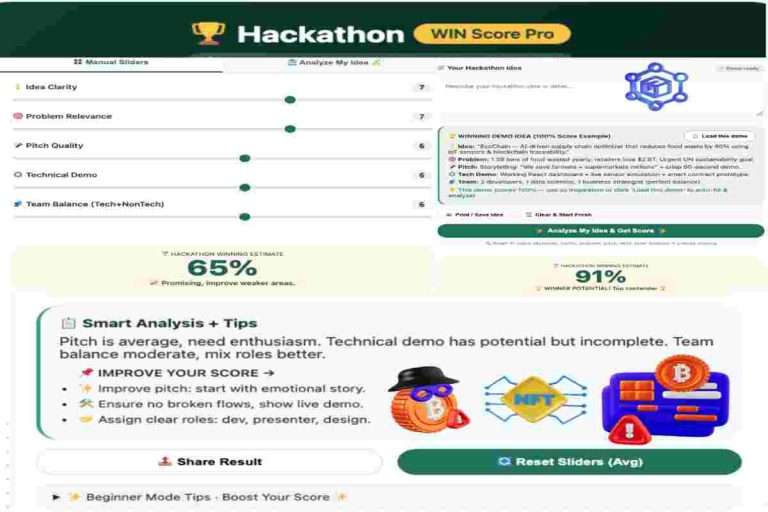
Toggle💡 Idea: "EcoChain — AI-driven supply chain optimizer that reduces food waste by 40% using IoT sensors & blockchain traceability."
🎯 Problem: 1.3B tons of food wasted yearly; retailers lose $2.6T. Urgent UN sustainability goal.
🎤 Pitch: Storytelling: “We save farmers + supermarkets millions” + crisp 90-second demo.
⚙️ Tech Demo: Working React dashboard + live sensor simulation + smart contract prototype.
👥 Team: 2 developers, 1 data scientist, 1 business strategist (perfect balance).
🌟 This demo scores 100% — use as inspiration or click 'Load this demo' to auto-fill & analyze!
The Beginner to Master Blockchain Hackathon Tool (2026) is designed to help anyone win blockchain hackathons without coding by using AI-powered insights, pre-built strategies, and a proven WIN Score system. This no-code blockchain hackathon tool enables beginners, founders, and Web3 enthusiasts to analyze winning ideas, optimize project execution, and improve their chances of success in competitive hackathons. By combining blockchain analytics, AI-driven decision-making, and structured scoring models, the platform simplifies how to win hackathons without coding while maximizing innovation, efficiency, and presentation impact. Whether you’re new to Web3 or aiming to master blockchain competitions, this tool provides a clear path from beginner to expert with data-backed strategies.
Think of it as a 48-hour sprint where ideas turn into reality. For a beginner, it’s not just a coding contest; it’s a high-pressure sandbox to test the viability of a decentralized solution. With a Blockchain Hackathon Tool, the focus shifts from “How do I code this?” to How does this solve a $100M problem?. The WIN Score methodology is a practical application of the technical ecosystems built in our Web3 Development Guide (2026): Building dApps, Smart Contracts & Ecosystems. Track global hackathon trends at Gitcoin.
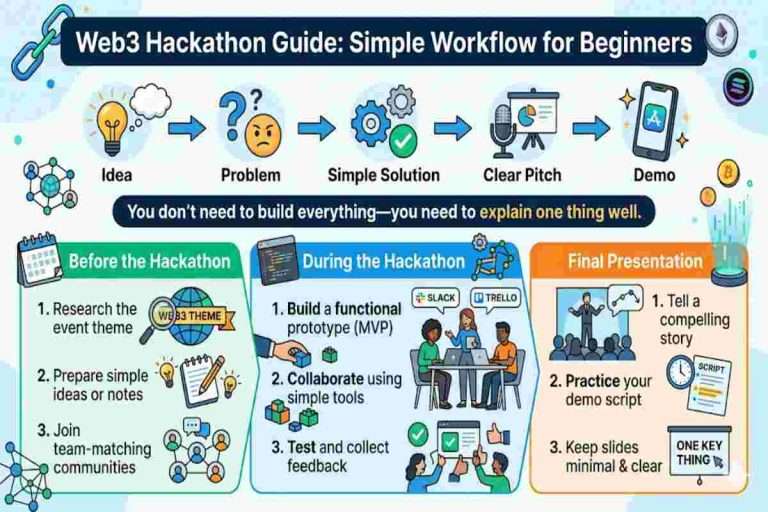
The modern Blockchain Hackathon Tool ecosystem is designed for visionary “Vibe Coders,” UX designers, and project managers. Whether you are a business student looking to tokenize real-world assets (RWA) or a creative strategist aiming to solve on-chain compliance, these tools empower you to build functional MVPs through natural language and modular drag-and-drop interfaces.
By mastering Web3 Rapid Prototyping through a No-Code Smart Contract Builder, any strategist can now deploy functional MVPs. Acting as an AI prompt specialist, you can leverage an AI-Powered Code Editor to transform natural language into high-impact decentralized solutions with precision.
Absolutely. In 2026, many winning teams are led by non-technical founders. By leveraging an AI-driven Blockchain Hackathon Tool, you can generate smart contract logic or frontend components simply by describing your vision. Judges now look for “Vibe Coding” excellence—where the clarity of the product’s purpose outweighs the manual labor of the script.
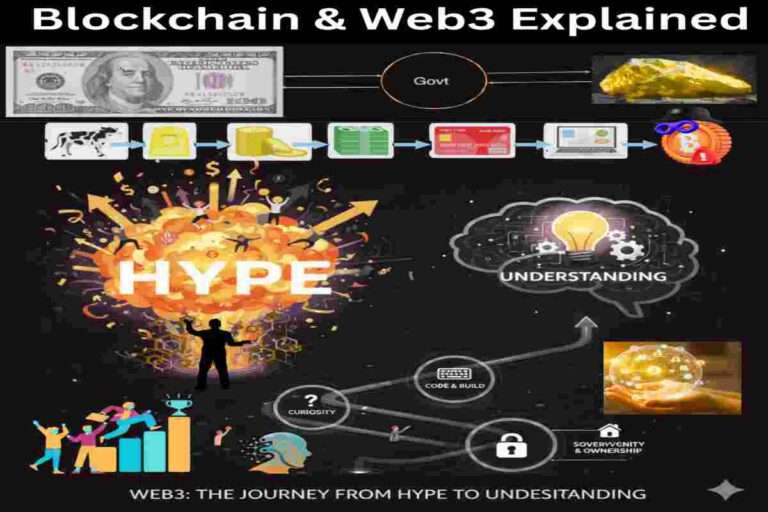
To win, your project must feel current. In 2026, the “Golden Keywords” for judges are:
By leveraging a Blockchain Hackathon Tool and the AI-Powered Code Editor strategies from our pillar study, you can win by acting as an AI prompt specialist. This practical approach uses a No-Code Smart Contract Builder for Web3 Rapid Prototyping, allowing you to dominate the leaderboard without writing a single line of manual code.
To maximize your WIN Score in 2026, you must treat your project like a startup, not a school assignment. One of the most effective Blockchain Hackathon Tips is to prioritize “The First 30 Seconds” of your demo; judges often review dozens of entries, so a crisp, high-fidelity UI—even if powered by a no-code Blockchain Hackathon Tool—will instantly set you apart from “terminal-only” projects. Additionally, focus on Capital Efficiency and On-Chain Compliance as your core features, as these are the high-value problems the industry is currently paying to solve. Finally, never underestimate the power of a “Live” feel—if you can show a transaction happening on a testnet in real-time during your video, your credibility and winning chances skyrocket.
This system belongs to the Asset Security layer of the Web3 Decision Lab.
You may also explore:
– Generational Wealth Planning (Estate & Asset Protection)
– Startup Failure Simulator (Web3 Failure Analysis)
– Blockchain Decision Lab: Financial Failure Fixer
Winning a blockchain hackathon in 2026 is about the bridge you build between technology and humanity. By utilizing a modern Blockchain Hackathon Tool, you remove the technical friction and allow your creativity to lead. Focus on the trends, polish your pitch, and remember: the best code is the code that solves a real problem, regardless of who wrote it.
Study the fundamental architecture and security frameworks provided by the National Institute of Standards and Technology at https://www.nist.gov/blockchain. Aligning your Web3 Rapid Prototyping with these NIST standards ensures your MVP meets the rigorous security expectations of top-tier hackathon judges.
Yes, you can win a blockchain hackathon without coding by focusing on idea validation, problem-solving, UI/UX design, and using no-code blockchain tools. Many winning teams leverage AI tools, templates, and strong presentations instead of deep technical development.
The best blockchain hackathon strategy in 2026 includes identifying a real-world problem, using AI-powered tools for rapid prototyping, integrating cross-chain or Web3 features, and presenting a clear, scalable solution with strong business potential.
A WIN Score is a performance-based scoring system that evaluates a project’s innovation, usability, scalability, and impact. It helps participants optimize their hackathon projects by focusing on key judging criteria used in Web3 competitions.
Beginner-friendly blockchain hackathon tools include no-code platforms, AI analytics dashboards, smart contract templates, and cross-chain development tools that simplify building and presenting Web3 projects without advanced coding skills.
Most hackathon projects fail due to unclear problem statements, lack of real-world use cases, poor presentation, weak teamwork
| Core Question | Expert Answers | Case Study Failure |
| Q: Do I need to know Solidity to win? | A: No. In 2026, AI-integrated tools can generate secure Solidity scripts based on your logic flow. | Failing teams often spend 40 hours debugging a single contract instead of perfecting the user journey. |
| Q: What is the most important part of the submission? | A: The Pitch and the Demo Video. Judges often view the video before the code. | Projects with “perfect” code but no clear explanation of “Why” rarely make the finals. |
| Q: How do I find a team as a non-coder? | A: Join the event’s Discord early and pitch yourself as a “Product/UX specialist” rather than “just a non-coder.” | Teams composed only of developers often lack a clear market strategy or a polished UI. |
| Q: What tools should I use for no-code Web3? | A: Use platforms like Momen or AI Copilots that act as a comprehensive Blockchain Hackathon Tool. | Many beginners try to use complex CLI tools and get stuck on installation before they even start. |
| Q: Is it okay to use pre-built templates? | A: Yes, provided you customize them. Innovation lies in the application, not the boilerplate. | Failure occurs when teams submit “copy-paste” projects without adding a unique “WIN Score” element. |