
Signal → Evaluation → Risk Detection → Trade Filtering → Decision Score → Execution → Feedback
Forces structured decision-making | Not signals — it's a trading operating system
No trades evaluated yet.
Go to Pre-Trade Lab to run your first decision.
Enter trade details and click "Run Decision Engine"
No decision data yet
Run a trade in Pre-Trade Lab to see your decision quality curveNo market data yet
Run a trade to see crowd positioning analyticsTable of Contents
ToggleLet’s be honest. Most crypto traders don’t lose because they lack signals. They lose because they lack discipline. They chase hype, enter trades without a plan, and only realize the mistake after the position is red.
This Crypto Trading System, isn’t another signal tool. It’s not a charting platform. It’s something entirely different: a pre-trade decision engine that forces you to justify every trade before execution.
Enter CDIS – Crypto Decision Intelligence System.
Think of it as a co-pilot that asks: Why this trade? What validates it? What could break it? Then it gives you a clear, numeric score and tells you if you should execute, scale down, or walk away.
This Crypto Trading System is part of our Signal Intelligence layer inside Institutional Infrastructure and is designed to complement broader system-level topics such as custody, governance, and execution architecture.
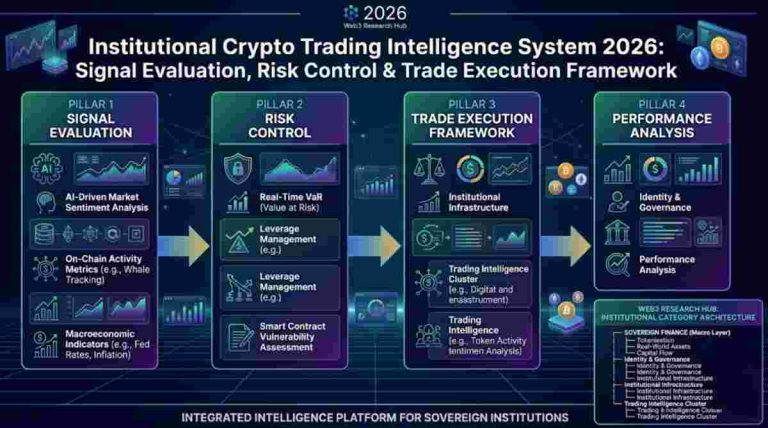
It includes core pillars:
Crypto Decision Operating System (CDIS) 2026
Crypto Signal Evaluation Framework 2026
Why Crypto Signal Groups Fail (Institutional Breakdown)
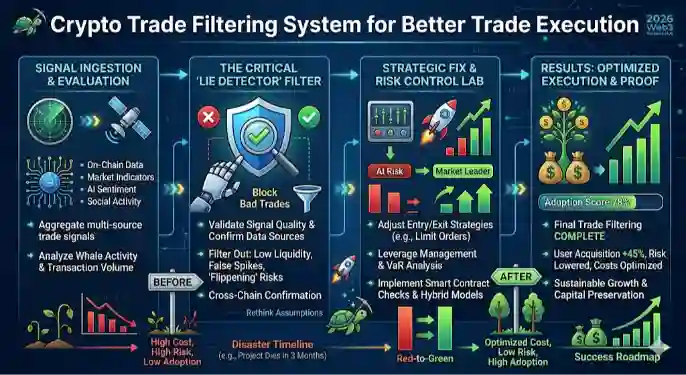
Crypto Trade Filtering System 2026
Together, these pillars form a complete institutional-grade trading intelligence model covering signal validation, system failure analysis, and pre-trade filtering. Moving beyond retail noise is essential for the high-level execution found in our Crypto Trading Intelligence & Risk Systems 2026. Review the Financial Conduct Authority (FCA) warnings on social media financial promotions.
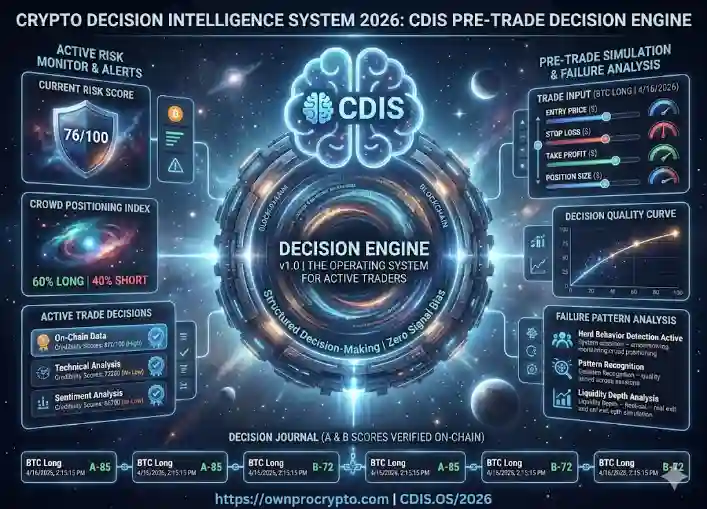
CDIS operates like a four-stage pipeline, but you don’t need to know the engineering. Here’s what happens when you use it:
You select an asset (BTC, ETH, SOL), choose direction (Long/Short), pick your signal source (On-chain, Technical, Sentiment, or Liquidity), and set your entry, stop loss, take profit, and position size.
Behind the scenes, CDIS runs three simultaneous checks:
Within seconds, you see:
Every trade you evaluate gets saved to your Smart Journal. Over time, CDIS builds a Decision Quality Curve – a graph showing whether your decision-making is improving, not just your P&L.
| Benefit | What It Means For You |
|---|---|
| Forces Discipline | You can’t trade without a score. No more impulse entries. |
| Institutional Logic | Uses the same framework professional funds use to evaluate trades. |
| Auditable Trail | Every decision is logged. Review what worked and what failed. |
| Risk First | Catches crowded trades, poor risk/reward, and tight stops before you lose money. |
| No Installation | Works entirely in your browser. Copy-paste into WordPress/Elementor. |
| Free & Isolated | Won’t break your site design. No style leakage. |
This system belongs to the Sovereign Finance layer of the Web3 Decision Lab.
You may also explore:
– Web3 Investment Calculator (DeFi, Blockchain & Growth Channels)
– 5-in-1 Smart AI Crypto Portfolio & Trading Tool <—– use links
– Portfolio Allocation Strategy (Real Estate, Gold & Crypto)
The crypto market doesn’t need more information. It needs better decisions.
Crypto Trading System won’t predict the future. No tool can. But it will force you to think before you click “buy” or “sell.” It will flag your blind spots. It will show you, in cold hard numbers, whether your trade idea actually makes sense.
Try it once. Run a trade you were about to take. See what score it gets. You might be surprised – and that surprise could save you real money.
Stop guessing. Start deciding.
Is it “too late” to get into Bitcoin in April 2026?
No. Industry analysts and academic experts agree that while the “early adopter” phase has passed, we are now in the “Institutional Era.” With the integration of Sovereign Reserves and the passage of the Genius Act, Bitcoin is now a legitimate macro asset. Rooted in Case Study Failure: Many retail investors in 2021 sat out waiting for a “return to $10k” that never came. The Success: 2026 portfolios that focused on purpose-driven allocation (1–5%) rather than timing the bottom have seen the most stable growth.
Which cryptocurrency is considered the “Next Bitcoin” for 2026?
There is no direct replacement for Bitcoin’s decentralization, but Ethereum (ETH) and Solana (SOL) are the primary contenders for “Network Dominance.” ETH is viewed as the “Digital Oil” for DeFi, while SOL leads in high-speed, consumer-ready applications.
What is a Crypto Trading System?
A Crypto Trading System is an integrated software framework that automates the process of analyzing market data, identifying entry/exit points, and executing orders. In 2026, these systems have evolved into Decision Intelligence Engines that blend technical indicators with real-time On-Chain Metrics.Rooted in Case Study Failure: In 2021, traders used manual “click-and-trade” methods and were liquidated during overnight flash crashes. The Success: 2026 systems use Automated Execution to trigger stop-losses instantly, preserving capital during high-volatility events.
How do AI-powered Crypto Trading Systems work?
They use neural networks to process millions of data points, including exchange order books, social sentiment, and whale wallet movements. Unlike traditional bots, 2026 systems use Retrieval-Augmented Generation (RAG) to “read” news and adjust strategies based on macro events like the GENIUS Act updates.
What is the difference between a Trading Bot and a Trading System?
A “bot” is typically a single-purpose script (like a Grid Bot). A “System” is a holistic environment (like your CDIS.OS) that manages risk, portfolio rebalancing, and data visualization in one unified Sovereign Internet Stack.
Can a Crypto Trading System execute trades on multiple exchanges?
Yes. Modern systems utilize API Connectivity and FIX Protocols to aggregate liquidity from multiple venues, ensuring you get the best price (lowest slippage) across the entire market.
How do AI Agents change the way we use Web3 in 2026?
Web3 is moving from a manual to an automated experience. AI agents now manage complex tasks like Liquidity Management, Yield Optimization, and even DAO voting. This “Symbiotic Internet” means you no longer need to manually bridge assets or track gas fees.
Why is “Asset Tokenization” the biggest trend this year?
Tokenization allows real-world assets like bonds, real estate, and even carbon credits to be traded on-chain. This provides fractional ownership and 24/7 liquidity for assets that were traditionally hard to sell.
Rooted in Case Study Failure: A 2023 real estate fund failed to gain liquidity during a downturn because it was locked in traditional paper contracts.
The Success: 2026 tokenized funds allow investors to exit 20% of their position instantly on a secondary DEX market.
What is the impact of the 2026 “Genius Act” on my investments?
The Genius Act has provided the much-needed “Regulatory Clarity” that allows large banks and pension funds to enter the market legally. For you, this means less “Rug Pull” risk and more stable, audited platforms for your Digital Fortress.
Welcome to OwnProCrypto (Own & Pro Crypto) — a next-generation Bitcoin and blockchain education platform where the science of finance meets the power of AI-driven automation.
Our mission is simple: to equip you with the knowledge, frameworks, and tools needed to make smarter financial and business decisions in the Web3 economy.
Beyond analysis, OwnProCrypto focuses on transparency, verifiable data, and practical frameworks that investors and builders can actually use. Our goal is not hype — but clear thinking, disciplined analysis, and long-term value creation in the decentralized economy.
Our Background: Salim (Sam) is the founder and lead researcher behind OwnProCrypto, a Web3 intelligence platform focused on crypto security, digital ownership, stablecoin systems, interoperability, and institutional blockchain infrastructure.
Crypto Tools & Analysis:
Crypto Fundamental Analysis Tool | Protocol Evaluation System | DeFi Risk Analysis Tools | Crypto Portfolio Dashboard | Token Risk vs Reward Tool
Guides:
Crypto Fundamental Analysis | Blockchain Project Evaluation | Tokenomics Analysis | DeFi Protocol Analysis | Capital Efficiency
© 2026 OwnProCrypto — Built for smarter crypto decisions