
Table of Contents
ToggleThis tool runs 100% in your browser - no data leaves your device.
3 Steps to Secure Your Crypto:
Paste any crypto website URL to check for scam signs:
If scammed, create evidence for authorities:
Any red flag? WALK AWAY immediately.
In the hyper-connected Web3 landscape of 2026, phishing and social engineering have reached institutional levels of complexity. As capital floods into decentralized protocols, malicious actors deploy sophisticated clones of popular platforms to drain wallets. Implementing a reliable crypto scam checker is no longer optional; it is a fundamental requirement for protecting your digital legacy. By prioritizing crypto website verification before every transaction, you can shield your assets from the evolving “Drainer” attacks that often bypass traditional security filters. These protocols provide the institutional-grade safety required for the assets managed in our Asset Security 2026 framework. Check the NIST Cybersecurity Framework for global security benchmarks.
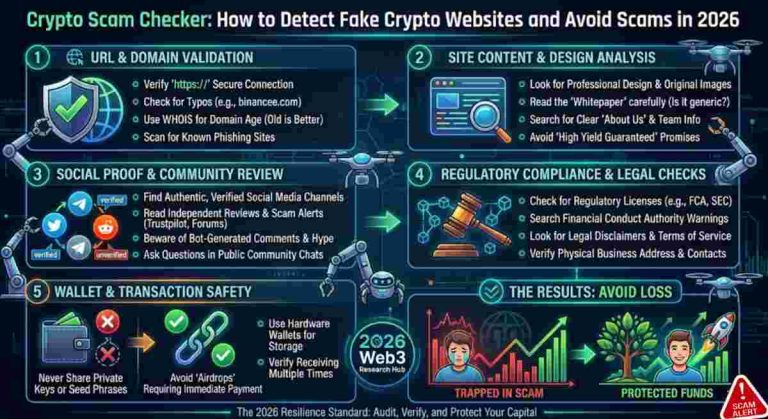
Standard antivirus software often fails to catch blockchain-specific threats. Effective bitcoin scam detection requires a protocol that analyzes more than just the URL; it must inspect smart contract permissions and domain longevity. This deep-layer analysis is a vital part of crypto fraud prevention because “flash scams” can disappear within hours, often stealing millions before they are flagged by public databases.
In a decentralized world, you are your own bank, and a proactive verification strategy is the most effective vault you can build. Learning how to avoid crypto scams starts with a “Zero-Trust” architecture—never signing a transaction on a platform that hasn’t passed a multi-point security audit. Maintaining high standards for crypto fraud prevention ensures that your Real Yield is never compromised by malicious code.
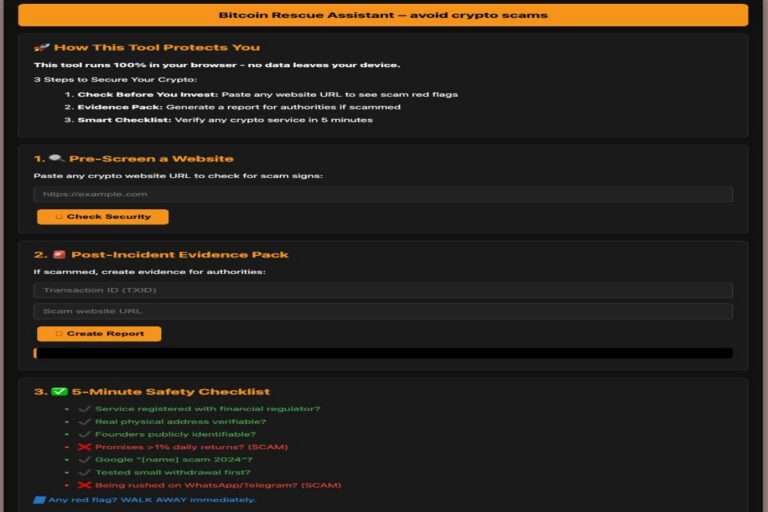
In the fast-paced world of cryptocurrency, scam risk is the number one pain point for investors. It’s often impossible to tell a legitimate platform from a sophisticated fake until it’s too late. As a proactive defense against the digital threats lurking in the crypto space, the Crypto Rescue Assistant provides an immediate, local, and private solution, acting as your personal “Bitcoin-Scam Firewall.”
This tool empowers you to verify opportunities and prepare for the worst, ensuring your time and funds are well spent on genuine investments.
The Crypto Rescue Assistant helps you identify and avoid cryptocurrency scams in 3 simple, local steps:
How it works: All analysis happens locally in your browser—no data is sent to servers. We check domains against known scam lists, analyze for suspicious patterns, and provide instant security scoring. Open the file, stay offline if you like—nothing leaves your computer unless you copy-paste it yourself.

| Problem | Objectives | Analysis / Situation | Implementation | Challenges | Results / Outcomes |
| Phishing Attack: A user accessed a perfect clone of a top DEX, leading to a total wallet drain. | Identify Fraudulent UI: Distinguish between a verified platform and a malicious copy. | The site used a “Typosquatting” domain that looked 99% identical to the original. | Applied a crypto scam checker that flagged the domain’s age as only 48 hours old. | The clone used a valid SSL certificate to mimic On-Chain Compliance. | Success: Assets were saved. The user realized how to avoid crypto scams by checking domain history. |
To secure your crypto: Always verify services through multiple sources, test small withdrawals first, never share private keys, and walk away from any “guaranteed returns” or pressure tactics.
Quick-Reference Anti-Scam Checklist Used in Every Story
Q: Can a website steal my crypto if I don’t give them my seed phrase?
A: Yes. Modern “Drainers” use malicious smart contract permissions. If you click “Approve,” you might be giving the site permission to move all your tokens. This is why crypto website verification is critical before connecting your wallet.
Q: Is there a way to automate crypto fraud prevention?
A: You can use “Security RPCs” or browser extensions that act as a crypto scam checker, simulating the transaction before you sign it to show you exactly what will leave your wallet.
Q: “What is the biggest red flag for a Bitcoin scam?”
A: High-pressure tactics and “Guaranteed” returns. Professional bitcoin scam detection often flags these “too good to be true” yield opportunities as high-risk Ponzi structures.
Rooted in Case Study Failure: As seen in the “Clone-Site” study, the biggest mistake is trusting a visual interface without performing a technical crypto website verification.
Welcome to OwnProCrypto (Own & Pro Crypto) — a next-generation Bitcoin and blockchain education platform where the science of finance meets the power of AI-driven automation.
Our mission is simple: to equip you with the knowledge, frameworks, and tools needed to make smarter financial and business decisions in the Web3 economy.
Beyond analysis, OwnProCrypto focuses on transparency, verifiable data, and practical frameworks that investors and builders can actually use. Our goal is not hype — but clear thinking, disciplined analysis, and long-term value creation in the decentralized economy.
Our Background: Salim (Sam) is the founder and lead researcher behind OwnProCrypto, a Web3 intelligence platform focused on crypto security, digital ownership, stablecoin systems, interoperability, and institutional blockchain infrastructure.
Crypto Tools & Analysis:
Crypto Fundamental Analysis Tool | Protocol Evaluation System | DeFi Risk Analysis Tools | Crypto Portfolio Dashboard | Token Risk vs Reward Tool
Guides:
Crypto Fundamental Analysis | Blockchain Project Evaluation | Tokenomics Analysis | DeFi Protocol Analysis | Capital Efficiency
© 2026 OwnProCrypto — Built for smarter crypto decisions