
Search by title, topic or phrase
Use our Crypto Search Engine 🔍 to find the topics and keywords you're looking for.
Simulate · Get Destroyed · Fix · Rise
Table of Contents
ToggleBrutal honesty: real failure patterns, emotional timeline.
Why Web3 Projects Fail? The “Blind Launch” remains the single most expensive error in the digital asset space. Most crypto project failure reasons are not rooted in a lack of vision, but in a failure to map technical dependencies against market volatility. For founders and researchers, understanding these startup mistakes to avoid is the difference between building a legacy and becoming a cautionary tale in a post-mortem report.
The Blockchain Decision Lab acts as a high-impact project risk analysis simulator, designed to stress-test Web3 startups before they go live. Instead of relying on assumptions, it models real-world failure patterns—highlighting exactly where architectural weaknesses will break under institutional pressure. Predicting failure points is a mandatory part of the architectural planning in our Web3 Development Guide (2026). Review CB Insights for the most recent post-mortem data on tech startups.
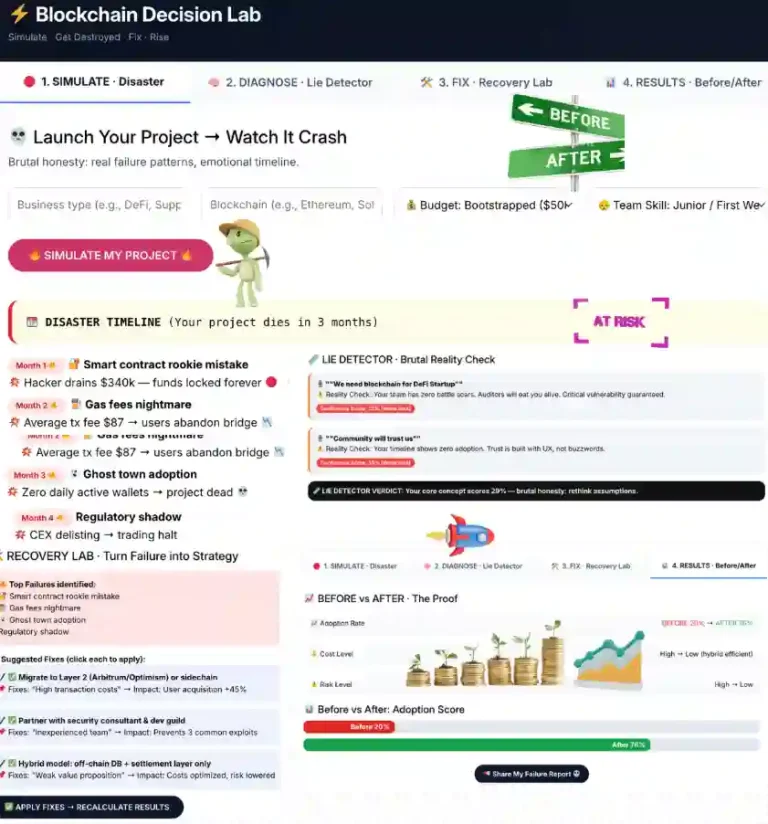
Many startups launch without fully quantifying their exposure. This lead to a deep dive into why defi projects fail—typically due to unforeseen gas fee spikes, fragmented liquidity, or recursive smart contract vulnerabilities. This simulator forces a reality check by exposing these risks early, allowing teams to fix structural issues before committing capital, reputation, or Real Yield potential.
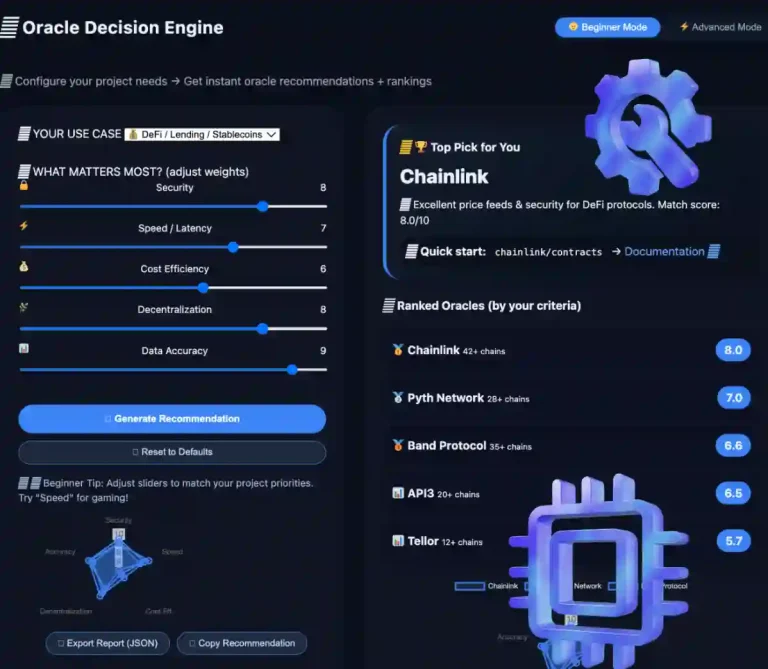
This system belongs to the Asset Strategy layer of the Web3 Decision Lab.
You may also explore:
– Generational Wealth Planning (Estate & Asset Protection)
– Blockchain Decision Lab: Financial Failure Fixer

This tool is not just about predicting failure—it’s about engineering success. By understanding where projects break, founders can redesign systems that are more scalable, efficient, and resilient in real-world conditions.
To further validate your financial sustainability, combine this simulator with our Startup Burn Rate Calculator, which helps you analyze cash flow, reduce burn, and extend runway before executing your launch strategy.
To ensure your architecture meets global institutional standards for digital ledger security and interoperability, refer to the technical guidelines provided by the National Institute of Standards and Technology (NIST).
It is a tool that models potential risks and failure scenarios to help founders identify and fix issues before launch.
Most fail due to poor execution, weak tokenomics, lack of user adoption, and technical vulnerabilities.
By validating your idea, managing costs, optimizing technology, and testing assumptions before scaling.
Overbuilding, ignoring users, poor financial management, and choosing the wrong infrastructure.
Yes. The core principles of risk analysis and validation apply to all types of startups.
It is rarely a hack. Most often, why defi projects fail is due to “Economic Exploits”—where the protocol functions exactly as written, but the incentives are gamed by sophisticated actors to drain liquidity.
Investors in 2026 are looking for On-Chain Compliance and risk mitigation. Showing a comprehensive project risk analysis report proves you have accounted for the “Black Swan” events that kill 90% of Web3 startups.
Absolutely. Identifying crypto project failure reasons in a live environment allows for “Hot-Fix” deployments to architecture, preventing a total collapse and preserving Sovereign Asset Strategy.
Rooted in Case Study Failure: As seen in the “Protocol Collapse” simulation, failing to stress-test your governance leads to “Frozen Assets” that no amount of marketing can fix.