
Table of Contents
ToggleThe crypto market of 2026 looks very different from the liquidity-driven environment that defined the 2020–2021 bull cycle.
During the previous cycle, investors often prioritized maximum APY over risk management. Double-digit yields from liquidity mining, token incentives, and leveraged DeFi strategies attracted billions of dollars in capital. Today, that model has largely disappeared.
Several major shifts have reshaped capital allocation across digital assets in 2026:
| Capital Efficiency Trend | 2021 | May 2026 |
|---|---|---|
| Stablecoin Lending APY | 10%–20%+ | 3%–7% |
| US Treasury Yield Benchmark | Near 0% | 4%–5% |
| Tokenized RWA Market | Under $1 Billion | $20B+ |
| Institutional Stablecoin Usage | Limited | Rapid Growth |
| Yield Source Preference | Token Emissions | Real Revenue & Cash Flow |
As traditional interest rates increased globally, investors began questioning whether a 4%–6% DeFi yield justified exposure to smart contract risk, oracle failures, governance attacks, liquidity shortages, and counterparty failures.
At the same time, tokenized Treasury products, money market funds, private credit instruments, and other real-world assets (RWAs) experienced significant growth. Instead of chasing speculative yield, capital increasingly moved toward transparent collateral, predictable cash flows, and sustainable revenue models.
This shift is also visible in institutional behavior. Treasury managers, family offices, crypto funds, and corporate balance sheets are now evaluating digital assets through a capital efficiency lens:
The result is a fundamental transition across the crypto industry. The conversation is no longer about finding the highest APY. The focus has shifted toward risk-adjusted returns, capital preservation, liquidity management, and long-term sustainability.
In short, 2026 is becoming the year that crypto matures from a yield-chasing market into a capital efficiency market.
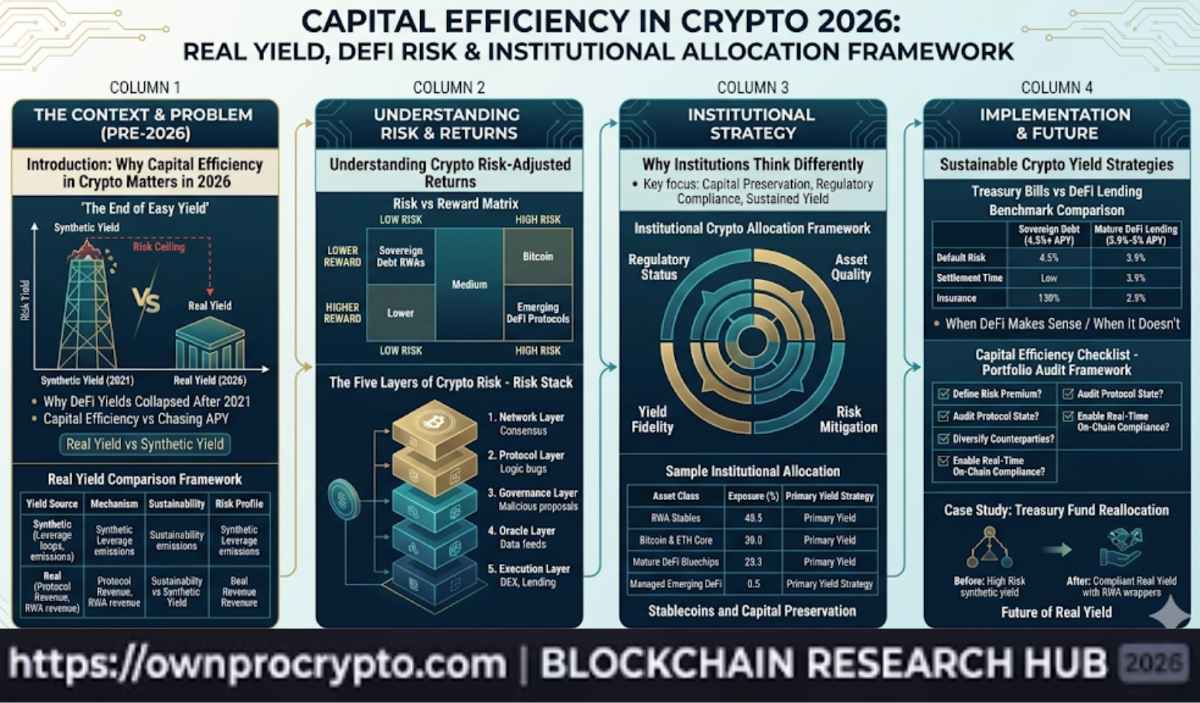
The biggest mistake many crypto investors make is measuring performance only by return percentage.
A 10% yield does not automatically mean a better investment than a 5% yield.
Professional allocators evaluate:
| Metric | Importance |
|---|---|
| Capital Preservation | Critical |
| Liquidity | Critical |
| Yield | Important |
| Volatility | Critical |
| Counterparty Risk | Critical |
| Transparency | Critical |
| Sustainability | Critical |
This is the foundation of capital efficiency in crypto.
The objective is not maximizing APY.
The objective is maximizing long-term wealth while minimizing unnecessary risk.
During 2020–2021, investors earned returns from:
| Strategy | Typical APY |
|---|---|
| Liquidity Mining | 50%-500% |
| Yield Farming | 20%-200% |
| Algorithmic Stablecoins | 15%-40% |
| Leveraged LP Positions | 50%-1000% |
Most of these systems depended on:
When liquidity conditions tightened globally, these models collapsed.
Many protocols discovered they had confused subsidy distribution with actual revenue generation.
New Users
    ↓
New Capital
    ↓
Token Emissions
    ↓
High APY
    ↓
More Users
    ↓
Price Decline
    ↓
Yield Collapse
    ↓
Capital Exit
This cycle destroyed billions in TVL across the industry.
Many investors still focus on headline yield.
Professional capital allocators focus on:
Capital
   │
   ├── Preservation
   ├── Liquidity
   ├── Yield
   └── Growth
The difference is massive.
A sustainable 6% annual return with low risk often outperforms a highly volatile 20% APY strategy over multiple market cycles.
One of the most important distinctions in modern crypto investing is understanding where yield actually comes from.
| Real Yield | Synthetic Yield |
|---|---|
| Transaction fees | Token emissions |
| Treasury income | Inflation rewards |
| Borrowing demand | Liquidity mining |
| Real-world assets | Subsidy programs |
| Sustainable | Temporary |
| Institutional friendly | Retail driven |
Real yield crypto strategies have become increasingly important because investors now demand genuine economic activity behind returns.
Not all returns are equal.
A 6% APY with low volatility may be superior to a 15% APY with extreme downside risk.
| Yield | Risk Level | Assessment |
|---|---|---|
| 4% | Very Low | Strong |
| 6% | Low | Attractive |
| 8% | Medium | Good |
| 12% | High | Speculative |
| 20%+ | Very High | Extreme Risk |
This framework is central to capital efficiency in crypto.
Many users compare stablecoin yields to traditional banking products without accounting for additional risks.
Stablecoin Lending
        │
        ├── Smart Contract Risk
        ├── Oracle Risk
        ├── Governance Risk
        ├── Liquidity Risk
        └── Counterparty Risk
Every additional layer requires additional compensation.
If Treasury bills yield 4.5%-5%, a protocol paying 5.5% may not justify the risk.
Institutional investors rarely ask:
“What’s the highest APY?”
Instead they ask:
This is why institutional crypto allocation increasingly focuses on:
| Asset Type | Allocation |
|---|---|
| Bitcoin | 30% |
| Stablecoins | 25% |
| Tokenized Treasuries | 20% |
| Ethereum | 15% |
| RWA Credit Products | 5% |
| High Risk DeFi | 5% |
Notice something important.
Only a small portion is allocated toward speculative yield.
This comparison changed dramatically after global rate increases.
| Metric | Treasury Bills | DeFi Lending |
|---|---|---|
| Yield | 4%-5% | 3%-8% |
| Insurance | Government Backed | None |
| Smart Contract Risk | No | Yes |
| Liquidity Risk | Low | Medium |
| Counterparty Risk | Low | Variable |
| Regulatory Clarity | High | Medium |
This comparison reshaped how institutions evaluate crypto risk adjusted returns.
Not all yield strategies are equal.
| Strategy | Sustainability |
|---|---|
| Tokenized Treasuries | Very High |
| Real Yield Protocols | High |
| Stablecoin Lending | Medium |
| Yield Farming | Low |
| Token Emissions | Very Low |
The strongest sustainable crypto yield models now involve real-world cash flow generation.
Stablecoins have evolved beyond trading instruments.
They now function as:
For many funds, stablecoins represent the foundation of modern capital efficiency in crypto.
One of the biggest developments in 2026 is the growth of tokenized real-world assets.
Examples include:
| Asset Type | Tokenized Version |
|---|---|
| Treasury Bills | Tokenized T-Bills |
| Money Markets | Tokenized Funds |
| Private Credit | On-Chain Credit |
| Corporate Debt | Digital Bonds |
The appeal is simple:
Investors gain:
while maintaining real-world yield generation.
Treasury Bills
      ↓
Tokenization Layer
      ↓
Smart Contract Wrapper
      ↓
Stablecoin Settlement
      ↓
Investor Yield
This model is becoming a cornerstone of institutional crypto allocation.
| Category | Target Allocation |
|---|---|
| Capital Preservation | 40% |
| Yield Generation | 25% |
| Growth Assets | 20% |
| Opportunistic Trades | 10% |
| Cash Reserves | 5% |
This structure prioritizes survival before performance.
A digital asset treasury held:
Treasury yields approached 5%.
The protocol risk premium became too small.
Capital was reallocated toward:
| Metric | Before | After |
|---|---|---|
| Yield | 3.8% | 4.5%-5% |
| Protocol Risk | High | Lower |
| Transparency | Medium | High |
| Liquidity | Medium | High |
Portfolio Size: $25,000
Original Strategy:
Result:
Rebalanced Strategy:
| Asset | Allocation |
|---|---|
| BTC | 35% |
| ETH | 25% |
| Stablecoins | 20% |
| RWA Yield | 10% |
| Speculative DeFi | 10% |
Outcome:
The next cycle may not reward the highest APY.
It may reward:
The strongest protocols will likely generate revenue from:
rather than token emissions.
| Question | Yes / No |
|---|---|
| Is yield above Treasury rates? | |
| Is revenue organic? | |
| Is collateral transparent? | |
| Has the protocol survived a bear market? | |
| Are audits current? | |
| Is liquidity sufficient? | |
| Is the yield sustainable? | |
| Is risk understood? |
Use this framework before allocating capital.
The crypto market is entering a maturity phase where raw APY is no longer enough.
The next generation of winners will likely be defined by capital efficiency in crypto, not speculative yield chasing.
Investors increasingly demand:
The future belongs to systems that balance growth, liquidity, preservation, and efficiency simultaneously.
For deeper research into real-world asset markets and tokenized finance trends, review resources from CoinGecko Research and Galaxy Research, which regularly publish institutional reports on digital asset markets.
Capital efficiency in crypto refers to generating the highest possible risk-adjusted return while preserving liquidity, minimizing unnecessary exposure, and maintaining sustainable portfolio growth.
Real yield crypto comes from actual economic activity such as transaction fees, lending demand, or real-world cash flows rather than token inflation.
Higher global interest rates and reduced speculative liquidity have compressed DeFi yields compared to the 2021 cycle.
Crypto risk adjusted returns measure performance relative to the amount of risk required to achieve that return.
Sustainable crypto yield is generated from real revenue sources that can continue operating without token emissions or subsidy programs.
Tokenized assets combine blockchain settlement efficiency with traditional financial instruments such as Treasury bills and private credit.
RWA tokenization is the process of representing real-world financial assets on blockchain infrastructure.
Yes. Modern Treasury yields have become a major benchmark for evaluating whether DeFi returns justify their additional risk.
Avoiding permanent losses often has a larger impact on long-term wealth than maximizing short-term returns.
Institutions focus on liquidity, collateral quality, transparency, regulation, and long-term sustainability rather than APY alone.
If this article changed how you think about DeFi yield and capital efficiency, the next step is understanding where sustainable returns actually come from.
Start with:
Then expand into:
Together these guides form the OwnProCrypto Capital Efficiency & Institutional DeFi Research Hub, helping investors separate sustainable cash flow from temporary yield incentives.
This guide focuses on DeFi yield quality, risk-adjusted returns, capital efficiency, and institutional allocation frameworks. To build a complete understanding of sustainable crypto investing, explore the related research hubs below.
Welcome to OwnProCrypto (Own & Pro Crypto) — a next-generation Bitcoin and blockchain education platform where the science of finance meets the power of AI-driven automation.
Our mission is simple: to equip you with the knowledge, frameworks, and tools needed to make smarter financial and business decisions in the Web3 economy.
Beyond analysis, OwnProCrypto focuses on transparency, verifiable data, and practical frameworks that investors and builders can actually use. Our goal is not hype — but clear thinking, disciplined analysis, and long-term value creation in the decentralized economy.
Our Background
Crypto Tools & Analysis:
Crypto Fundamental Analysis Tools | Protocol Evaluation System | DeFi Risk Analysis Tools | Crypto Portfolio Dashboard | Token Risk vs Reward Tool
Guides:
Crypto Fundamental Analysis | Blockchain Project Evaluation | Tokenomics Analysis | DeFi Protocol Analysis
© 2026 OwnProCrypto — Built for smarter crypto decisions