
One API for onramp → smart routing → blockchain → offramp. Practice safely before going live.
Fill form and click "Execute Payment"
Waiting for payment...
No transactions yet
No transactions
{
  "source_currency": "USD",
  "target_currency": "EUR",
  "amount": 1000,
  "recipient": {...}
}
Table of Contents
ToggleCross-border payments have historically been slow, expensive, and dependent on a complex network of correspondent banks. International transfers can take several days to settle, involve multiple intermediaries, and generate significant fees through banking charges and foreign exchange spreads.
This Stablecoin Payment System simulator demonstrates how modern payment orchestration platforms route transactions through stablecoin infrastructure, automatically selecting settlement networks based on cost, speed, and liquidity requirements.
The tool provides an educational environment for understanding how global stablecoin payment systems operate without using real funds. Stablecoins are changing how value moves globally. By combining blockchain settlement with fiat-backed digital assets, businesses can send payments across borders in seconds rather than days while maintaining price stability and reducing operational complexity.
Think of it as a flight simulator for stablecoin payments. You learn the process, understand routing decisions,
see how onramp → blockchain → offramp works, and build confidence – all with zero financial risk.
A stablecoin payment system is a financial infrastructure layer that uses stablecoins as the settlement asset for domestic and international payments.
Instead of relying solely on traditional banking rails, payments follow a streamlined process:
This architecture allows businesses to transfer value globally with greater speed and transparency than many traditional payment methods.
Here’s the reality: one typo in a wallet address = permanent loss. No bank to call. No chargeback. No customer support to reverse it.
Traditional finance has safeguards. Crypto doesn’t.
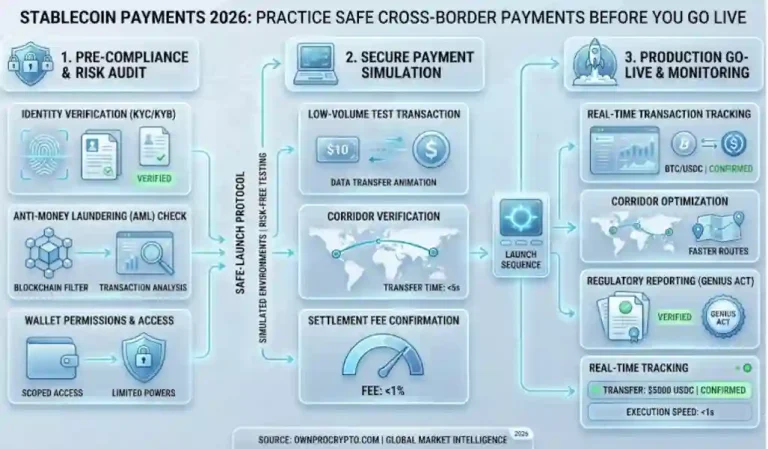
This tool solves that by giving you a safe sandbox where you can:
By the time you use a real platform, you’ll know exactly what to expect, which details matter, and how to avoid catastrophic errors.
Step 1: Enter Your Payment Details
Select source country, destination country, amount, routing priority (lowest fee / fastest / balanced), and recipient type (bank account, mobile wallet, or crypto wallet).
Step 2: The Routing Engine Decides
Behind the scenes, the system evaluates three blockchains – Solana (lowest fee), Stellar (fastest), and Ethereum (highest liquidity). It picks the optimal chain based on your priority and shows you exactly why.
Step 3: Watch the Orchestration Flow
You see each stage light up in real time:
Step 4: Review the Ledger & Result
Every transaction is recorded in the unified ledger. You see the final amount received, total fees, processing time, and a simulated transaction hash – just like a real API would return.
The simulator uses USDC as the settlement asset.
USDC has become one of the most widely adopted stablecoins for payment infrastructure due to:
In production environments, payment providers may support additional stablecoins, but this simulator focuses on USDC to demonstrate core payment workflows.
Optimized for low-cost transfers.
Characteristics:
Typical use case:
Designed specifically for payments.
Characteristics:
Typical use case:
The most established stablecoin ecosystem.
Characteristics:
Typical use case:
You wouldn’t fly a plane without simulator training. You shouldn’t send stablecoin payments without practice either.
The Stablecoin Payment System, The Orchestration Layer gives you a risk-free environment to master cross-border payments, understand routing decisions, and build confidence. Use it to train your team, test edge cases, or simply learn how modern payment infrastructure works.
Practice here. Then go live with confidence.
To ensure your Web3 Infrastructure and Sovereign Ownership Framework align with global compliance standards, we recommend referencing the official primary sources. This document provides the legal “navigator” for digital property rights in 2026. Official Regulatory Reference:
European crypto regulatory standards under MiCA. EU Markets in Crypto-Assets (MiCA) Regulation
To maintain topical clarity and avoid content overlap, this article should connect to a limited set of supporting authority hubs:
Each resource should address a distinct subject area while supporting a broader digital asset knowledge framework.

Does this Stablecoin payment System move real money?
No. This is a fully simulated environment for education and practice. No blockchain transactions occur. No bank accounts are connected. No real funds are transferred. It’s designed to help you learn the flow safely.
Can I practice sending to wrong addresses to see what happens?
Yes, that’s actually encouraged. In the simulator, you can test different recipient identifiers, see how the system validates them, and understand what real platforms would flag as invalid. Making mistakes here saves you from making them with real funds.
Is this the same as real payment APIs like Stripe or Crossmint?
Conceptually yes – the flow, routing logic, ledger structure, and API design mirror real orchestration layers. The difference is that real platforms connect to live banking rails and blockchains. This simulator gives you the exact same user experience without the financial risk.
What is MPC wallet architecture?
MPC (Multi-Party Computation) wallet architecture distributes private key control across multiple parties, reducing single-point failure risk and improving custody security.
Learn more: https://ownprocrypto.com/mpc-vs-multi-sig-crypto-custody/
Why is USDC used for cross-border payments?
USDC is widely used due to its stability, transparency, and efficient global settlement capabilities.
What is a stablecoin payment gateway?
It is infrastructure that allows businesses to accept and process stablecoin payments like traditional payment processors.
What does a stablecoin payments API do?
It enables developers to integrate stablecoin payment functionality directly into apps, platforms, and services.
Welcome to OwnProCrypto (Own & Pro Crypto) — a next-generation Bitcoin and blockchain education platform where the science of finance meets the power of AI-driven automation.
Our mission is simple: to equip you with the knowledge, frameworks, and tools needed to make smarter financial and business decisions in the Web3 economy.
Beyond analysis, OwnProCrypto focuses on transparency, verifiable data, and practical frameworks that investors and builders can actually use. Our goal is not hype — but clear thinking, disciplined analysis, and long-term value creation in the decentralized economy.
Our Background: Salim (Sam) is the founder and lead researcher behind OwnProCrypto, a Web3 intelligence platform focused on crypto security, digital ownership, stablecoin systems, interoperability, and institutional blockchain infrastructure.
Crypto Tools & Analysis:
Crypto Fundamental Analysis Tool | Protocol Evaluation System | DeFi Risk Analysis Tools | Crypto Portfolio Dashboard | Token Risk vs Reward Tool
Guides:
Crypto Fundamental Analysis | Blockchain Project Evaluation | Tokenomics Analysis | DeFi Protocol Analysis | Capital Efficiency
© 2026 OwnProCrypto — Built for smarter crypto decisions