
Search by title, topic or phrase
Use our Crypto Search Engine 🔍 to find the topics and keywords you're looking for.
Table of Contents
TogglePeople usually want to know what happened before they interact with a crypto wallet: Has the address shown unusual activity? What contracts did it interact with? Were approvals involved? Did funds move through several addresses? This simulator teaches the investigation workflow using controlled case studies.

A wallet address can reveal useful on-chain activity, but a single transaction rarely tells the whole story. A better review looks at the sequence of transactions, smart-contract interactions, token approvals, counterparties, and movement of funds. Wallet Time Machine turns that investigation process into an interactive learning exercise.
The purpose of this simulator is not to label an address as “good” or “bad.” Instead, it demonstrates how different patterns can create different levels of investigation priority. A high simulated score should be treated as a reason to investigate further, not as proof of malicious behavior.
Look for unusual transaction frequency, rapid movements, repeated contract calls, large transfers, and changes in activity patterns.
Check whether the wallet has granted broad or unnecessary token permissions to contracts. Approval exposure can remain relevant even when a user is no longer actively using a dApp.
Identify the types of protocols and contracts involved and determine whether the interaction needs additional verification.
Follow the sequence of transfers rather than looking at one isolated transaction. Multiple hops, bridges, or rapid movements may deserve additional context.
The underlying search intent is usually practical: users want to understand a wallet’s history before they send funds, approve a contract, interact with a dApp, or trust an address. This page therefore focuses on the investigation workflow rather than pretending to provide a live blockchain verdict.
If you eventually connect this interface to a genuine blockchain data provider, the input system can be upgraded to accept public wallet addresses and return live transaction history. Until that backend exists, keeping the simulator explicitly educational is more accurate and builds more trust with users and search engines.
Wallet Time Machine is an educational crypto wallet investigation simulator. It demonstrates how analysts can review transaction history, contracts, approvals, counterparties and fund flows.
No. This version uses deterministic case studies and does not query live blockchain data. The input should therefore be treated as a demo case ID rather than a real wallet address.
You can learn how to identify transaction patterns, contract exposure, token approvals, counterparty relationships and fund-flow patterns that may deserve deeper investigation.
No. The score is simulated. It does not establish ownership, intent, criminal activity or malicious behavior. Real wallet analysis requires current on-chain evidence and appropriate context.
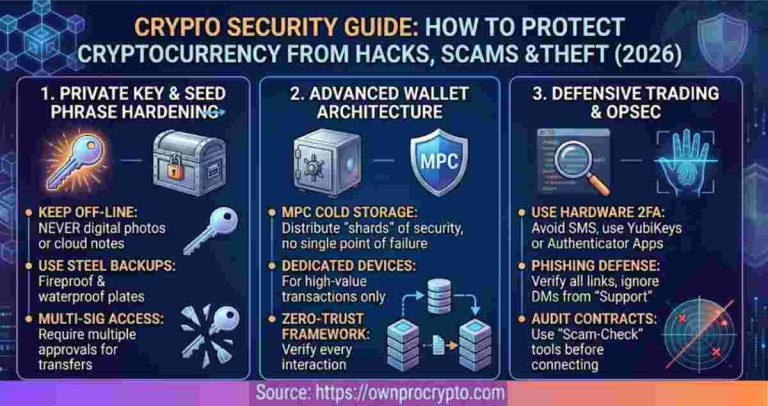
No. A wallet-history investigation should not require a seed phrase, recovery phrase, private key or password. Treat requests for those credentials as a serious security warning.
Continue your research through the related OwnProCrypto security, wallet-risk and transaction-analysis resources. These links are selected to move from wallet history → approvals → transactions → broader crypto security without repeating the same search intent.
When you move beyond this educational simulator, real blockchain investigation should be performed with independent sources. For public Ethereum transaction and address data, use Etherscan. For checking and revoking token approvals, users can also review Revoke.cash. Never provide either service with a seed phrase or private key.