
Don't wait for the crash to see if you're safe.
Assess security risks of cross-chain bridges — custodial, smart contract, liquidity, and validator trust
Bridges are the #1 attack vector in crypto — over $2.5B lost in bridge exploits. This analyzer evaluates risk factors like custody model, smart contract quality, liquidity concentration, and validator trust to help you choose safer bridges.
Cross-chain bridges have become one of the most critical—and vulnerable—components of the crypto ecosystem. By enabling assets to move between blockchains, they unlock interoperability, but also introduce new layers of risk that don’t exist in single-chain environments.
This Bridge Risk Analyzer tool helps you evaluate bridge security by analyzing key factors such as custody models, smart contract design, liquidity distribution, and validator structure. Instead of relying on assumptions, you can quickly assess risk exposure before moving funds across networks.
Securing your cross-chain movements is the highest priority in our Asset Security 2026: Setting Up Your Digital Fortress. Monitor real-time bridge hacks and vulnerabilities at Rekt.news.
Bridges are the #1 attack vector in crypto — over $2.5B lost in bridge exploits. This analyzer evaluates risk factors like custody model, smart contract quality, liquidity concentration, and validator trust to help you choose safer bridges.
Bridges expand interoperability but introduce additional attack surfaces across multiple networks.
Security depends heavily on who controls the assets during transfer.
Exploits often originate from flaws in bridge logic or incomplete audits. Read More :
Highly concentrated liquidity pools increase systemic exposure during attacks.
Safety depends on architecture, validator design, and historical exploit patterns.
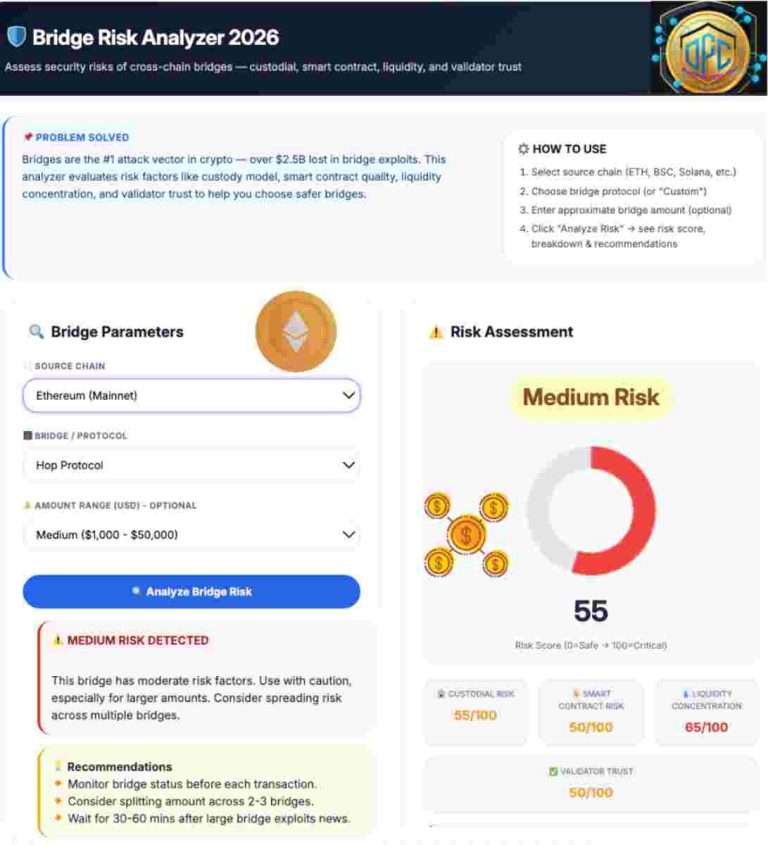
Source Chain Ethereum (Mainnet) BNB Chain Solana Arbitrum Optimism Avalanche Polygon Bridge / Protocol Wormhole Layer Zero Stargate Axelar Across Protocol Hop Protocol Synapse Multichain (legacy) Custom / Unknown Bridge Amount Range (USD) – Optional Small (< $1,000) Medium ($1,000 – $50,000) Large ($50,000 – $500,000) Whale (> $500,000) Analyze Bridge Risk
High Risk Detected: Analysis will appear after input
Recommendations: Risk scores based on bridge security history, custody model, audit status, and validator structure. Data is simulated for educational purposes. Always DYOR before bridging.
This system belongs to the Web3 Governance layer of the Web3 Decision Lab.
You may also explore:
– Best Blockchain Oracles (Chainlink, Pyth, Band Comparison)
– Oracle Explorer Dashboard (AI + Multichain Data)
– Modular Blockchain Architecture 2026: Build Layer 2 & Rollup
Crypto bridge risk refers to the potential loss of funds when transferring assets between blockchains. These risks include smart contract vulnerabilities, centralized custody failures, validator compromise, and liquidity issues.
Bridging crypto can be safe, but it depends heavily on the bridge’s architecture. Risks vary based on custody models, smart contract security, validator design, and past exploit history. Using well-audited and widely adopted bridges reduces risk, but no bridge is completely risk-free. Read More:
Bridges are high-value targets because they lock large amounts of assets while interacting across multiple blockchains. This complexity increases the attack surface, making them more susceptible to smart contract exploits and security failures.
The safest approach is to use reputable, audited bridges with strong security track records, avoid transferring large amounts in a single transaction, and verify all transaction details before confirming.
The primary risks include custodial risk (who controls funds), smart contract risk (code vulnerabilities), liquidity risk (pool concentration), and validator risk (network trust assumptions).
Yes. If a bridge is exploited or fails, users can lose funds permanently. This has happened in multiple high-profile incidents, which is why risk assessment is critical before bridging.
You can evaluate security by reviewing audit reports, understanding the custody model, analyzing validator decentralization, and checking historical performance. Tools like risk analyzers can simplify this process.
Even decentralized bridges rely on some level of trust—whether in validators, oracles, or smart contracts. The level of trust varies depending on the bridge design.
Cross-chain infrastructure is expanding rapidly, but so are the risks that come with it. Understanding how different bridge models handle custody, security, and liquidity is essential before moving capital across networks. While tools like this provide structured risk insights, informed decision-making remains critical. For deeper research on digital asset risks, security frameworks, and regulatory perspectives, you can refer to official resources from the U.S. Securities and Exchange Commission: https://www.sec.gov/crypto-assets
Welcome to OwnProCrypto (Own & Pro Crypto) — a next-generation Bitcoin and blockchain education platform where the science of finance meets the power of AI-driven automation.
Our mission is simple: to equip you with the knowledge, frameworks, and tools needed to make smarter financial and business decisions in the Web3 economy.
Beyond analysis, OwnProCrypto focuses on transparency, verifiable data, and practical frameworks that investors and builders can actually use. Our goal is not hype — but clear thinking, disciplined analysis, and long-term value creation in the decentralized economy.
Our Background: Salim (Sam) is the founder and lead researcher behind OwnProCrypto, a Web3 intelligence platform focused on crypto security, digital ownership, stablecoin systems, interoperability, and institutional blockchain infrastructure.
Crypto Tools & Analysis:
Crypto Fundamental Analysis Tool | Protocol Evaluation System | DeFi Risk Analysis Tools | Crypto Portfolio Dashboard | Token Risk vs Reward Tool
Guides:
Crypto Fundamental Analysis | Blockchain Project Evaluation | Tokenomics Analysis | DeFi Protocol Analysis | Capital Efficiency
© 2026 OwnProCrypto — Built for smarter crypto decisions