
Search by title, topic or phrase
Use our Crypto Search Engine 🔍 to find the topics and keywords you're looking for.
Crypto fundamental analysis is the process of evaluating what a blockchain network, protocol, or token actually does, how people use it, how value moves through the system, and what risks could prevent that activity from becoming durable. Price can tell you what the market is paying today. Fundamental analysis asks a different question: what evidence exists that the underlying system deserves attention at all?
A score is not a conclusion. A useful crypto analysis system should expose the evidence behind the score, distinguish facts from assumptions, identify material risks, and help the reader decide what deserves deeper research.
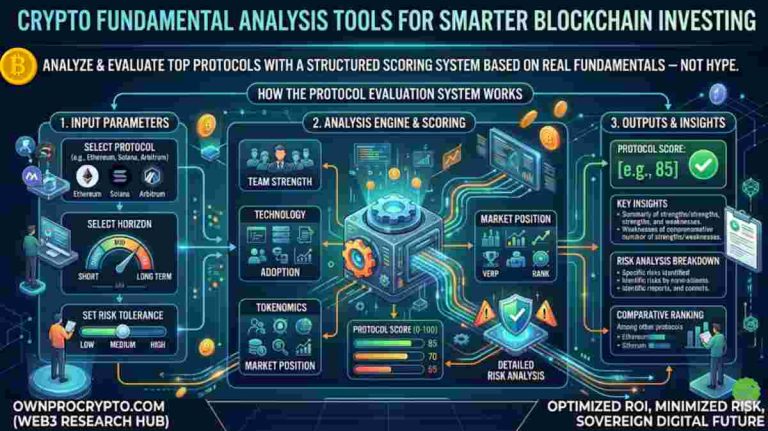
Table of Contents
ToggleCrypto fundamental analysis is a structured method for evaluating a digital asset or blockchain project using evidence about its technology, economic activity, users, token design, security, governance, competition, and market position.
The objective is not to predict tomorrow’s price. It is to determine whether the underlying project has real utility, measurable activity, credible development, sustainable economics, and identifiable risks.
| Evaluation Dimension | Fundamental Analysis | Price & Technical Analysis |
|---|---|---|
| Core Focus | Utility, adoption, revenue, tokenomics | Price history, volume, chart patterns |
| Primary Question | Does the underlying protocol hold real value? | Where is market momentum shifting next? |
Professional research often combines both approaches. Fundamental analysis can help determine what to study, while market analysis can help determine when and how to act.
A useful evaluation process should move from broad project identification toward measurable evidence and finally toward a decision. This prevents one attractive metric, such as TVL or a large community, from dominating the entire assessment.
What does it do, who uses it, and what problem is it trying to solve?
Review users, activity, fees, revenue, developers, liquidity, and other measurable signals.
Assess technology, tokenomics, security, governance, competition, and adoption.
Decide whether the project deserves deeper research, monitoring, comparison, or rejection.
This distinction is important because a fundamental-analysis tool should not pretend that a numerical score can replace professional judgment.
Research principle: the purpose of a framework is to organize evidence and expose uncertainty—not to manufacture certainty.
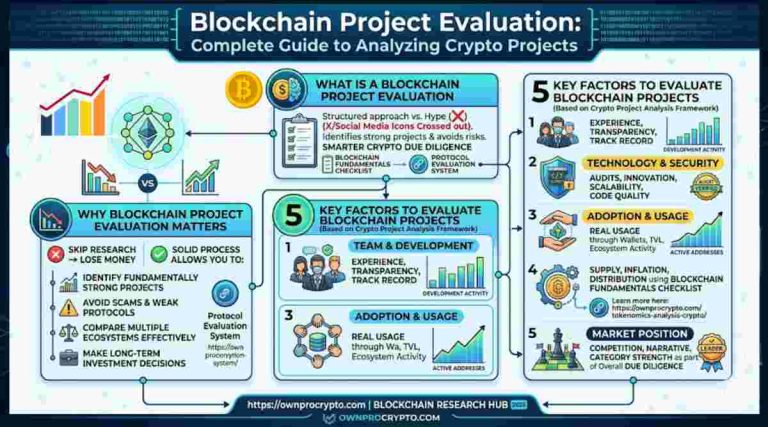
For practical analysis, the evidence can be organized into five major dimensions. These dimensions should be treated as interconnected rather than independent boxes.
| Dimension | What to Evaluate | Key Questions |
|---|---|---|
| 1. Technology | Architecture, scalability, execution environment, consensus or security model, upgrades, and technical dependencies. | Does the technology realistically solve the problem it claims to solve? |
| 2. Economic Activity | Users, transactions, TVL, fees, revenue, liquidity, and other measurable network or protocol activity. | Are people actually using the system, and is that activity economically meaningful? |
| 3. Tokenomics | Supply, distribution, emissions, unlocks, incentives, utility, demand, and value capture. | Does the token have sustainable demand, and how does value accrue to it? |
| 4. Security & Governance | Audits, incidents, admin permissions, upgrade controls, oracles, bridges, governance, and operational dependencies. | What could cause permanent or severe loss of capital or network functionality? |
| 5. Adoption & Competition | User growth, developers, integrations, liquidity, ecosystem strength, competitors, and market position. | Why would users, developers, and capital choose this project over alternatives? |
Why These Dimensions Matter
A project can score well in one dimension while remaining weak in another. For example, strong technology does not automatically create adoption, and high user activity does not automatically mean the token captures economic value.
These dimensions are deliberately broader than a simple checklist. A serious research system must also ask how those factors interact.

On-chain data can provide a valuable evidence layer because it allows researchers to observe activity rather than relying entirely on project marketing.
Total Value Locked, or TVL, generally represents the value of assets held in a protocol’s smart contracts. It can help measure the economic scale of DeFi applications, but TVL alone does not prove sustainable revenue, healthy token economics, or durable demand.
Fees represent what users pay for using a protocol, while revenue is the portion of those fees captured by the protocol or relevant stakeholders. Separating the two prevents analysts from confusing high economic activity with value actually accruing to the protocol or token.
| Metric | What It Measures | What It Can Tell You | Important Limitation |
|---|---|---|---|
| TVL | Assets deposited or otherwise secured within a protocol. | Approximate scale of capital participating in the protocol. | Can be affected by token prices, incentives, leverage, and temporary liquidity. |
| Active Users | Addresses or users interacting with a network or application. | Evidence of usage and potential product-market fit. | One person can control multiple addresses, and automated activity can distort counts. |
| Transactions | Number and value of transactions processed. | Indicates network or application activity. | Transaction count alone does not prove meaningful economic demand. |
| Fees | Amount users pay to use a protocol or network. | Shows willingness to pay for the service provided. | High fees do not necessarily mean the token captures those economics. |
| Revenue | Portion of economic activity retained by the protocol or designated stakeholders. | Helps evaluate whether activity produces sustainable economic value. | Revenue may not accrue directly to token holders. |
| Token Value Capture | The mechanisms connecting protocol activity to token demand or economic benefits. | Helps determine whether protocol growth can translate into token-level value. | Value-capture mechanisms can change through governance or protocol upgrades. |
A single day’s transaction count or TVL figure can be misleading. Stronger analysis examines how activity changes over time and whether growth remains visible after incentives, market-wide price movements, or temporary speculation are removed.
On-chain metrics become more useful when they are compared with market capitalization, fully diluted valuation, fees, revenue, and competitors. The goal is not to find one perfect ratio. The goal is to determine whether the market valuation appears supported by the scale and quality of the underlying activity.
Research rule: never treat one on-chain metric as proof of fundamental strength. The strongest evidence comes from several metrics pointing toward the same underlying conclusion.
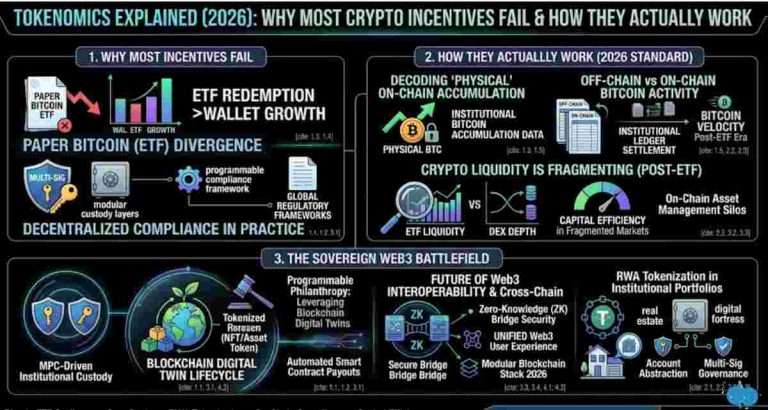
Tokenomics analysis examines how a token is created, distributed, used, released, and demanded. It is one of the most important parts of crypto fundamental analysis because a successful protocol does not automatically mean that its token is economically attractive.
| Measure | Basic Meaning | Why It Matters |
|---|---|---|
| Market Capitalization | Current token price multiplied by the circulating supply. | Provides a snapshot of the value assigned to tokens currently circulating. |
| Fully Diluted Valuation | Token price multiplied by the maximum or fully diluted supply, depending on the project’s supply design. | Shows the valuation implied if the relevant future token supply were already circulating. |
| Circulating Supply | Tokens currently considered available in the market. | Helps identify how much of the eventual supply is already in circulation. |
| Future Unlocks | Tokens scheduled to become transferable or enter circulation in the future. | Can create additional supply pressure and change the relationship between market capitalization and future valuation. |
A token may be used for governance, staking, transaction fees, collateral, access, or incentives. However, utility alone does not prove that the token will capture a meaningful share of the economic value created by the protocol.
Analysts should therefore ask whether users actually need the token, whether demand increases as protocol usage grows, and whether protocol economics create mechanisms that connect activity with token demand or ownership.
Distribution can influence governance, incentives, selling pressure, and long-term decentralization. Examine allocations for founders, team members, investors, treasury reserves, ecosystem programs, community rewards, and liquidity incentives.
A concentrated allocation does not automatically make a project unacceptable, but it does create an additional governance and supply-risk question that should be investigated.
Future token unlocks can materially increase circulating supply. The important question is not simply whether an unlock exists, but how large it is relative to current circulation, who receives the tokens, whether recipients have economic reasons to sell, and whether new demand is sufficient to absorb additional supply.
Tokenomics Research Questions
A token can have strong product adoption while its token economics remain unattractive. This is why protocol quality and token quality must be evaluated separately.
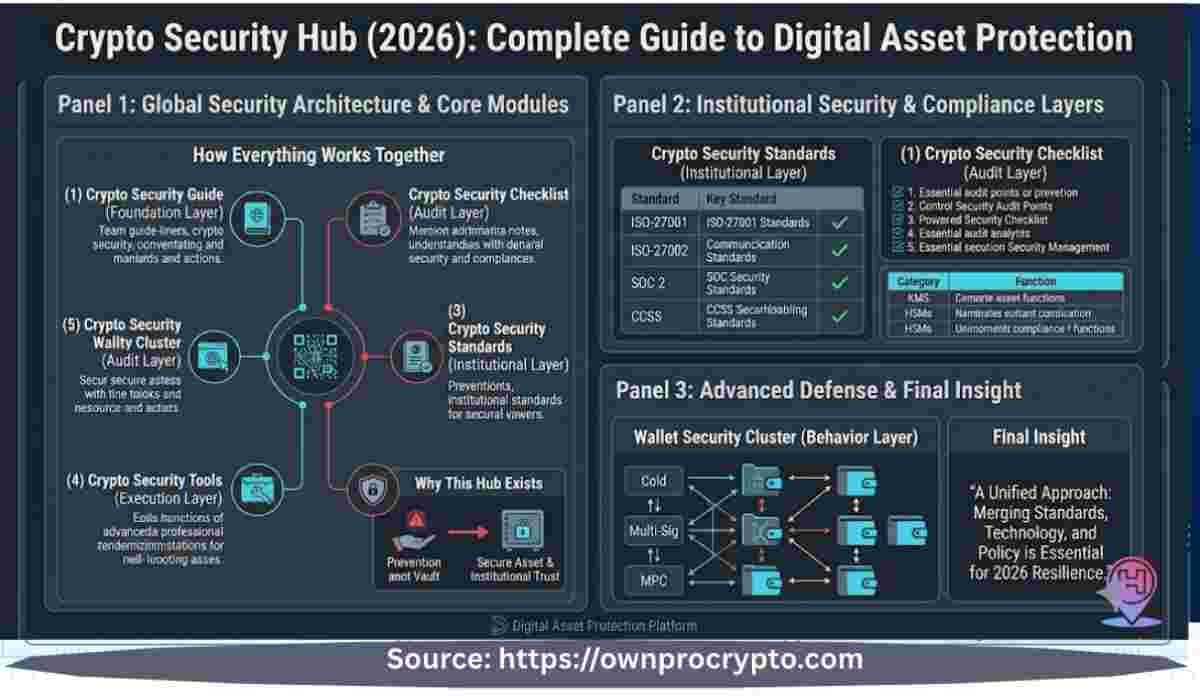
Technology analysis asks whether the underlying system can realistically deliver its stated purpose. It should cover architecture, execution environment, consensus or security model, scalability assumptions, smart-contract dependencies, upgrades, and operational risks.
An audit can identify classes of vulnerabilities, but an audit is not a permanent guarantee that a protocol cannot be exploited. Analysts should also examine upgrade authority, admin keys, oracle dependencies, bridge exposure, multisignature arrangements, bug bounty history, incident history, and system complexity.
Development activity can help answer whether a project is being maintained and improved. However, raw contributor counts should not be treated as a definitive measure of quality. The useful question is whether meaningful development is occurring and whether the project can execute its stated roadmap.
| Area | What to Examine | Key Research Question |
|---|---|---|
| Architecture | Network structure, execution environment, consensus design, data availability, and major dependencies. | Does the architecture support the project’s intended use case? |
| Scalability | Throughput, latency, execution costs, scaling mechanisms, and bottlenecks. | Can the system handle meaningful growth without compromising its core properties? |
| Smart Contracts | Contract architecture, upgradeability, dependencies, permissions, and external integrations. | What technical components could introduce failure or attack risk? |
| Security | Audits, incidents, bug bounties, admin keys, multisig controls, oracles, bridges, and operational procedures. | What could cause a loss of funds or critical system failure? |
| Development | Code activity, releases, contributors, roadmap execution, documentation, and maintenance. | Is the project actively maintained and capable of executing its technical plans? |
Governance determines who can influence or change important parts of a protocol. Analysts should identify whether upgrades require decentralized voting, multisignature approval, a small group of administrators, or another control mechanism.
Greater administrative control can allow faster responses to emergencies, but it can also introduce additional centralization and trust assumptions. Neither structure should be judged in isolation; the important question is whether the control model matches the risks and purpose of the protocol.
Many crypto applications depend on external systems such as price oracles, bridges, stablecoins, custodians, APIs, validators, sequencers, or other protocols. A project’s security therefore depends not only on its own code but also on the reliability of important components around it.
Researchers should map these dependencies and ask what happens if one of them fails, becomes compromised, becomes unavailable, or changes its economic terms.
Developer activity is most useful when viewed as a pattern rather than a vanity statistic. Consistent releases, active maintenance, meaningful code changes, responsive issue management, and roadmap execution can provide stronger evidence than simply counting contributors.
A project with many contributors can still have weak execution, while a smaller team can produce substantial technical progress. Context matters.
For deeper technical research, readers can consult Ethereum’s official developer documentation , which organizes topics such as the EVM, accounts, transactions, nodes, clients, consensus, smart contracts, security, and scaling into distinct technical layers.
Research rule: never convert “has an audit” into “is safe.” Security should be treated as a continuing risk-management process.
A blockchain can have excellent technology and still fail to attract meaningful users, developers, liquidity, integrations, or economic activity. Adoption therefore needs to be evaluated alongside competition.
| Adoption Signal | What It Can Indicate | What to Watch For |
|---|---|---|
| Users | Whether people are interacting with the product or network. | Growth, retention, recurring usage, and the quality of user activity. |
| Transactions | Level of network or application activity. | Persistent activity rather than short-lived spikes caused by incentives or speculation. |
| Developers | Strength and ongoing development of the ecosystem. | Meaningful development, application launches, maintenance, and continued technical activity. |
| Liquidity | Ability of users and markets to transact efficiently. | Depth, concentration, stability, and dependence on temporary incentives. |
| Integrations | Whether other applications, services, or infrastructure are building around the project. | Quality and persistence of integrations rather than headline partnership announcements. |
| Economic Activity | Whether adoption produces measurable financial or network activity. | Fees, revenue, transaction value, capital efficiency, and sustainable demand. |
A strong narrative can attract capital quickly, but narrative strength is not the same as fundamental strength. A serious comparison asks what the protocol does better, cheaper, faster, safer, or more efficiently than its alternatives.
Competition should be defined by the problem being solved rather than by token category alone. A blockchain should be compared with other networks serving similar users and use cases, while a DeFi application should be compared with protocols competing for the same economic activity.
The most important competitive questions are:
Some blockchain projects become more useful as additional users, developers, applications, liquidity providers, and infrastructure providers participate. These network effects can create a competitive advantage, but they should be demonstrated through actual ecosystem activity rather than assumed simply because a project has existed for a long time.
Research rule: adoption is strongest when independent signals agree. Rising users, developers, liquidity, integrations, and economic activity together provide a much stronger picture than any single growth metric.
A crypto fundamental analysis tool should reduce repetitive research without hiding the evidence. The best workflow begins with the research question, not the score.
Identify whether you are evaluating a layer-1 blockchain, layer-2 network, DeFi protocol, infrastructure project, stablecoin, application token, or another category. Different categories require different metrics.
A short-term trade and a multi-year investment require different evidence. A protocol may have promising long-term technology while facing near-term token unlock pressure.
Risk tolerance should influence how much uncertainty the analyst is willing to accept. It should not be used to make a risky asset appear safer.
Look beyond the headline number. Examine the individual dimensions, supporting metrics, methodology, data freshness, and major assumptions.
A numerical score can make a large amount of research easier to compare, but the score should be treated as a decision-support layer rather than an investment forecast.
Important: score ranges should describe the methodology of your own scoring system, not imply that a higher score guarantees better future performance.
Imagine two protocols both receiving 78/100. One might have excellent adoption but weak tokenomics. The other might have strong tokenomics but limited adoption. Their investment cases are completely different even though their headline scores match.
The following examples demonstrate how the framework should be used. They are analytical examples, not investment recommendations.
An analyst studying Ethereum would not stop at ETH’s market price. The research would examine the Ethereum protocol, its developer ecosystem, applications, transaction activity, security model, fee economics, governance processes, scaling architecture, and the role of ETH within the network.
The official Ethereum developer resources provide a useful example of how a complex blockchain can be evaluated through separate technical layers.
Suppose a DeFi protocol has rapidly growing TVL. A weak analysis might label this automatically as bullish.
A stronger analysis asks:
A protocol can demonstrate genuine user growth while simultaneously facing substantial future token supply entering circulation. In that situation, the fundamental research should not hide either side of the equation.
The correct conclusion might therefore be: “The protocol fundamentals are strong, but token supply dynamics require continued monitoring.”
TVL measures capital held in protocols, but it does not by itself establish profitability, token value capture, or sustainable demand.
Audits are valuable evidence, but protocols remain exposed to changing code, dependencies, governance decisions, economic attacks, and previously unknown vulnerabilities.
A whitepaper explains the intended design. On-chain activity, releases, users, developers, governance decisions, and actual economic behavior show what happened after the design met reality.
Future supply can materially change the relationship between market capitalization, circulating supply, and valuation.
A protocol may create significant economic activity while its token captures little of that value. Always ask where value is created and where value accrues.
A score compresses information. It should never replace the information itself.
No single crypto analysis platform contains every piece of evidence required for serious research. A professional workflow normally combines several data sources and then applies a consistent analytical framework.
The final purpose of analysis is not to produce more information. It is to improve the quality of a decision.
The Institute Decision Architecture
Evidence → Fundamental Quality → Risk Assessment → Valuation Context → Scenario Analysis → Decision
A high-quality protocol can be expensive. A weak protocol can be cheap. Fundamental analysis identifies quality; valuation analysis asks whether the current market price adequately reflects that quality and its risks.
A useful thesis should explain why the project deserves capital, what evidence supports the thesis, what could invalidate it, and which metrics should be monitored.
Before acting, identify the events that would make the original thesis wrong. Examples could include sustained loss of adoption, critical security failures, destructive token dilution, loss of competitive advantage, governance breakdown, or a major change in the protocol’s economic model.
The strongest use of a crypto fundamental analysis tool is not “the score says buy.” It is: “the score tells me where I need to investigate next.”
A professional-grade tool should make the analyst more skeptical, not more certain. The objective is to expose evidence, contradictions, uncertainty, and risk before capital is committed.
Crypto fundamental analysis is the process of evaluating a cryptocurrency, blockchain, or protocol using evidence about its technology, adoption, economic activity, tokenomics, security, development, competition, and risks. Unlike technical analysis, which focuses primarily on price and market behavior, fundamental analysis asks whether the underlying network or protocol has sustainable utility and economic value.
There is no single metric that works for every crypto asset. Depending on the project, analysts may examine active users, transaction activity, fees, revenue, TVL, liquidity, market capitalization, fully diluted valuation, token supply, unlocks, developer activity, staking participation, security, and value accrual. The most useful metrics are those that directly connect the project’s activity with its economic model.
Start by understanding what the project does, who uses it, and why the token exists. Then examine adoption, on-chain activity, fees and revenue, tokenomics, liquidity, technology, security, governance, competitors, valuation, and the risks that could invalidate the investment thesis. A structured process is more reliable than relying on a single score, chart pattern, or social-media narrative.
No. On-chain data provides valuable evidence about network and protocol activity, but it does not explain every part of an investment case. Analysts should combine on-chain metrics with tokenomics, technology, governance, security, competitive positioning, liquidity, and valuation. On-chain activity can also require context because transactions or addresses do not automatically represent genuine long-term users.
Token unlocks can increase the circulating supply available to the market. Their effect depends on the size and timing of the unlock, who receives the tokens, whether recipients are likely to sell, available market liquidity, and whether demand is growing quickly enough to absorb the additional supply. A strong protocol can therefore still have challenging token supply dynamics.
Market capitalization generally uses the current token price multiplied by the circulating supply. Fully diluted valuation, or FDV, applies the current price to the project’s relevant total or maximum future supply. Comparing both helps analysts understand how future token issuance could change the asset’s valuation and potential dilution.
Liquidity affects how easily an asset can be bought or sold without causing substantial price movement. A token with thin liquidity can have greater slippage, wider spreads, higher volatility, and greater exit risk. Liquidity should therefore be considered alongside market capitalization rather than assuming that a large market cap automatically means an asset is easy to trade.
Strong fundamentals usually involve several reinforcing signals rather than one impressive metric. These can include a clearly defined use case, functioning technology, measurable adoption, credible development, sustainable economic activity, reasonable token supply dynamics, adequate liquidity, transparent governance, manageable security risks, and a defensible competitive position. The evidence should also remain credible when tested against a bear-case scenario.
They answer different questions. Fundamental analysis is primarily concerned with the quality, economics, adoption, and risks of an asset or protocol, while technical analysis focuses on market behavior such as price trends, momentum, volume, and potential entry or exit conditions. Investors and traders can use both, with fundamental analysis helping determine what deserves research and market analysis helping evaluate timing and market conditions.
No. A fundamental analysis tool can organize evidence, calculate scores, compare projects, and highlight risks, but it cannot reliably predict future prices. Crypto markets can remain disconnected from underlying fundamentals for extended periods because of liquidity conditions, speculation, market cycles, regulation, sentiment, and unexpected events.
Common mistakes include relying on one metric, treating TVL as revenue, ignoring token unlocks, confusing a strong protocol with a valuable token, accepting marketing claims without verification, treating an audit as a permanent security guarantee, and ignoring competitors. Another major mistake is using a numerical score without examining the evidence and assumptions behind it.
Fundamental research should be reviewed whenever material conditions change. Important triggers can include major token unlocks, security incidents, governance changes, significant product releases, changes in adoption, declining or accelerating revenue, major liquidity changes, regulatory developments, or a change in the competitive landscape. For actively monitored assets, a periodic review can help identify whether the original investment thesis is still valid.
Fundamental analysis is strongest when it is combined with specialized research. Use the following resources to move from broad project evaluation into market data, DeFi analysis, portfolio risk, and security due diligence.
Research principle
No single dashboard should be treated as the complete investment case. Combine quantitative metrics with primary documentation, protocol data, security evidence, tokenomics, competitive research, and current market conditions.
External sources should be used to verify important claims rather than simply increase the number of links on the page. Prioritize official protocol documentation, primary blockchain data, recognized standards, and authoritative technical resources.
Verification rule: always check the current version of official documentation and live protocol data before relying on a metric, security claim, token-supply figure, or project-specific statement.