
Portfolio health • Security audit • Market pulse simulator • Wallet hygiene
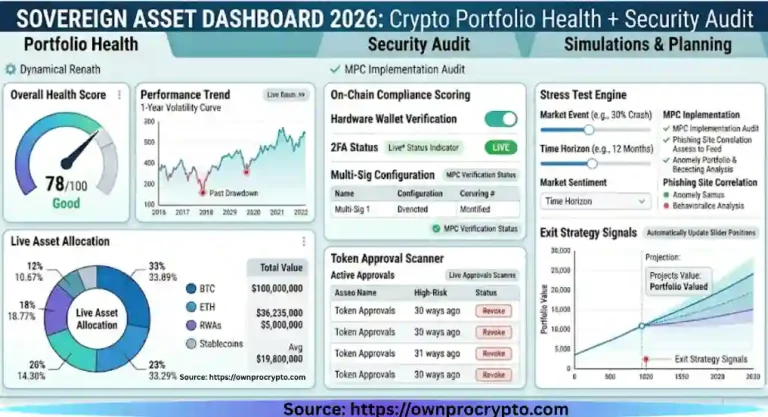
In the hyper-fragmented Web3 landscape of 2026, managing a digital portfolio is no longer just about checking prices—it is about monitoring systemic health. Most investors suffer from “Wallet Blindness,” with assets scattered across multiple chains, exchanges, and liquid staking protocols. This fragmentation creates a critical security vacuum: you cannot protect what you cannot see.
The Crypto Portfolio Tracker 2026 Asset Dashboard solves this by acting as a specialized Digital Asset Health Check. It moves beyond basic price alerts to provide a unified command center for portfolio allocation, real-time security auditing, and market pulse simulation. By consolidating these high-trust metrics into a single interface, you shift from a reactive state to a proactive position of Sovereign Control, ensuring your wealth is not just growing, but fortified against the evolving “Drainer” attacks of the modern era. learn more about Web3 development https://web3.foundation/projects/
The tool acts as a Digital Asset Health Check. Most crypto users have assets spread across multiple wallets and exchanges with no clear view of their total security posture.
Problem: Users often forget which dApps they’ve connected to (security risk) or don’t know how their portfolio might perform in different market conditions.
Solution: It consolidates portfolio tracking, security auditing, and market simulation into a single, gamified interface
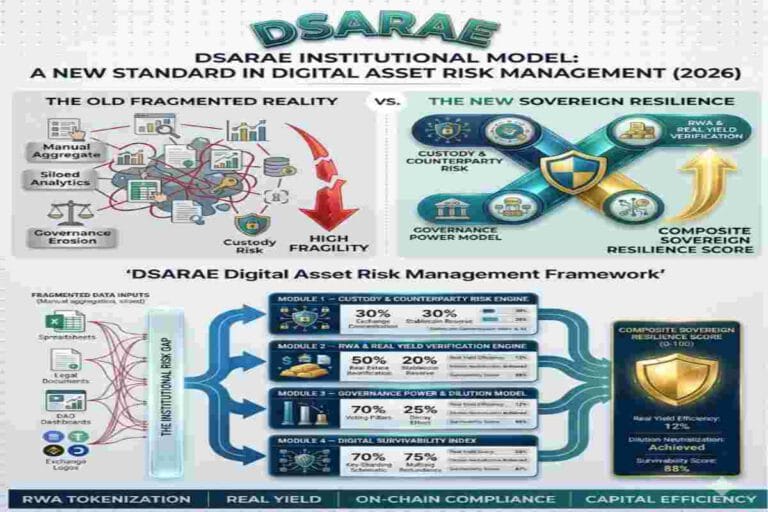
To achieve true Capital Efficiency, a tracker must do more than count coins. It must analyze the “structural integrity” of your holdings through four primary pillars:
The dashboard provides a “top-down” view of your total wealth. By aggregating holdings like Bitcoin, ETH, and emerging RWA Index tokens, it visualizes your diversification. This solves the lack of visibility that often leads to over-exposure in a single asset class, allowing for precise rebalancing based on real-time data.
This is your personal defense manual. By verifying the presence of hardware wallets, 2FA, and multi-sig setups, the tool generates a Sovereignty Security Score. If your score drops, the system issues a “Critical: Immediate Action Needed!” alert, preventing the catastrophic asset loss that occurs when security hygiene is ignored.
Volatility is a mathematical certainty, not a surprise. The Market Pulse Simulator allows you to adjust time horizons and bull/bear sentiment sliders. This removes “what-if” anxiety by projecting portfolio value under various volatility factors, helping you plan your exit strategies long before the market shifts.
The most technical layer of the dashboard is the Wallet Hygiene Checker. It scans for active token approvals and suspicious smart contract permissions. By providing a “Clean Wallet Score,” it empowers you to “Simulate Revoke” risky connections, effectively neutralizing “drainer” attacks before they can execute.
The path to a healthy portfolio follows a 4-step logic gate:

What is the best crypto portfolio tracker for security in 2026? The best tracker is one that prioritizes Wallet Hygiene over simple price tracking. A professional dashboard must include a Sovereignty Security Score and a live audit of smart contract permissions to ensure your assets are not just tracked, but protected from on-chain threats.
How do I check my crypto wallet for malicious smart contracts? You can use a Wallet Hygiene Checker to scan for active “Infinite Approvals.” These are permissions given to dApps that allow them to move tokens without further consent. Tools that provide a “Clean Wallet Score” help you identify and revoke these risks instantly.
Can a crypto portfolio tracker simulate future market crashes? Yes, advanced trackers now include a Market Pulse Simulator. By adjusting “volatility factors” and “market sentiment” sliders, you can see how a 30% or 50% drawdown would impact your specific allocation, allowing you to set stop-losses with institutional precision.
Why is ‘Real Yield’ visibility important in a 2026 dashboard? In 2026, simple price appreciation is not enough. You need to see your Real Yield (net of gas and inflation) from staked assets and RWA Tokenization holdings. This ensures your portfolio is actually outperforming the macro-environment, not just moving with the trend.
What are the biggest crypto project failure reasons related to security? Most failures stem from “Permission Overload,” where a user connects to a phishing site or a compromised dApp. A healthy dashboard prevents this by enforcing On-Chain Compliance standards at the user level, flagging suspicious contracts before you sign.
Welcome to OwnProCrypto (Own & Pro Crypto) — a next-generation Bitcoin and blockchain education platform where the science of finance meets the power of AI-driven automation.
Our mission is simple: to equip you with the knowledge, frameworks, and tools needed to make smarter financial and business decisions in the Web3 economy.
Beyond analysis, OwnProCrypto focuses on transparency, verifiable data, and practical frameworks that investors and builders can actually use. Our goal is not hype — but clear thinking, disciplined analysis, and long-term value creation in the decentralized economy.
Our Background: Salim (Sam) is the founder and lead researcher behind OwnProCrypto, a Web3 intelligence platform focused on crypto security, digital ownership, stablecoin systems, interoperability, and institutional blockchain infrastructure.
Crypto Tools & Analysis:
Crypto Fundamental Analysis Tool | Protocol Evaluation System | DeFi Risk Analysis Tools | Crypto Portfolio Dashboard | Token Risk vs Reward Tool
Guides:
Crypto Fundamental Analysis | Blockchain Project Evaluation | Tokenomics Analysis | DeFi Protocol Analysis | Capital Efficiency
© 2026 OwnProCrypto — Built for smarter crypto decisions