Infographic of Ownprocrypto OPC Logo for 2026 Web3 Ecosystem

Ownprocrypto:

Sovereign Asset Strategy & Web3 Institutional Research

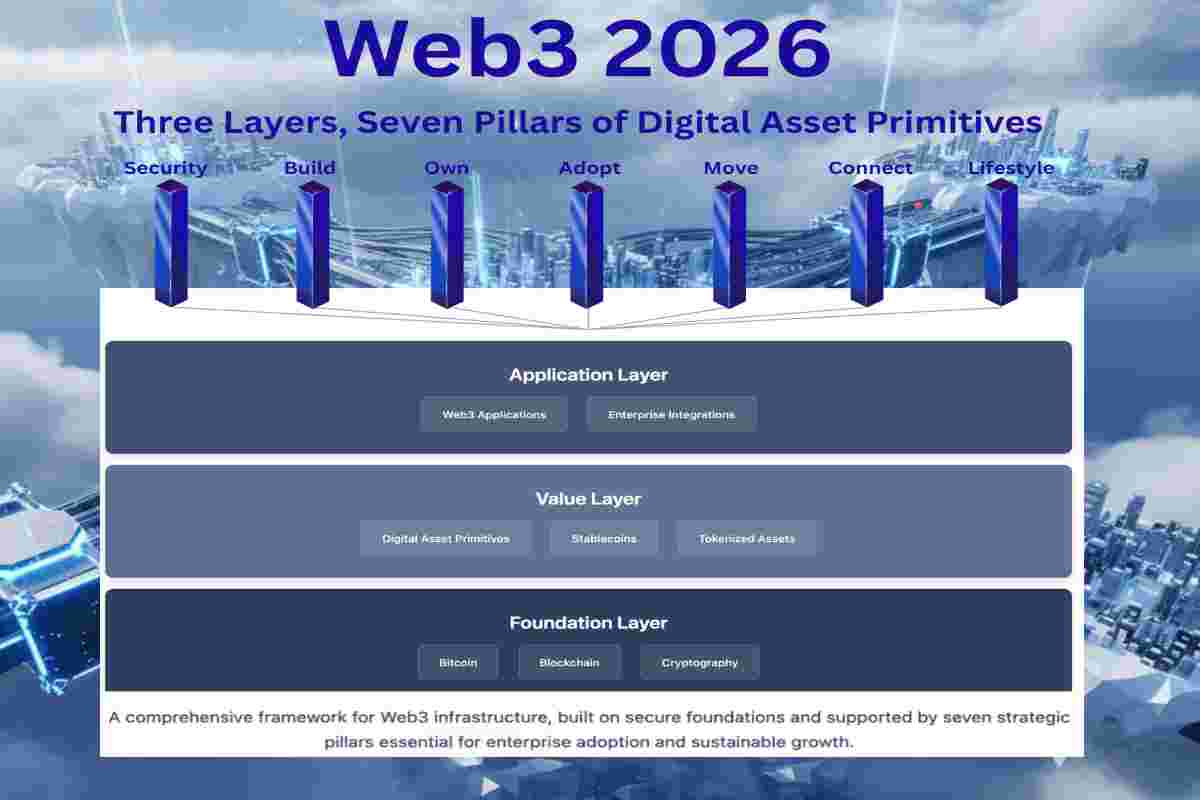
Infographic: blockchain primitives explained & 3-Layer Web3 Architecture The Ecosystem (2026) featuring Bitcoin, Blockchain, and Cryptography with the Seven Strategic Pillars.

Executive Summary: The 2026 Web3 Strategy  

problem → shift → solution → framework → outcome The Roadmap)

For Institutional Leaders, Family Offices, and Sovereign Builders.

Web3 Architecture is no longer a speculative experiment; it is the functional infrastructure of the 2026 global economy. This pillar breaks down the transition from centralized “fragile” systems to decentralized “resilient” ownership layers.

Key Takeaways:

  • Structural Repricing of the Internet:
    Value is shifting from platform-mediated access to protocol-level ownership, redefining how capital is created, captured, and controlled.
  • Stack Convergence in 2026:
    Settlement, execution, and identity layers are no longer discrete—they are integrating into a unified, interoperable system architecture.
  • Programmable Efficiency at Scale:
    Tokenized real-world assets and intelligent oracle systems are compressing friction, enabling real-time, trust-minimized financial operations.
  • Emergence of Sovereign Capital Structures:
    Institutions and families are transitioning toward self-custodied, borderless frameworks that embed governance, identity, and wealth preservation natively.

What is Web3 Architecture and Why it Matters in 2026

Web3 Architecture represents the next evolution of digital infrastructure—where digital ownership, not just information, becomes the core layer of the internet. As we move into 2026, the global shift toward Digital Sovereignty is no longer a theory; it is a structural transformation. Assets are becoming programmable, and economic coordination is moving permanently on-chain.

The Problem: Traditional financial systems rely on centralized gatekeepers and fragile trust layers, often exposing your capital to single points of failure. The Shift: In 2026, we are seeing a transition from “speculative hype” to “functional architecture.”

The Solution: Web3 Architecture emerges as a resilient response to these limitations. It enables systems that are scalable without intermediaries and governed by transparent, algorithmic rules. From decentralized financial rails to RWA Tokenization and embedded compliance, the focus has shifted to Capital Efficiency—how trust is enforced directly within protocol design.

The Roadmap: This Web3 Ecosystem Hub serves as your strategic map for this transformation. Structured across eight core domains—including asset security, governance, and institutional integration—this framework connects the foundational layers of the new economy. Whether you are building dApps or securing institutional wealth, this guide outlines how sovereignty and interoperability converge to define your next move in the digital economy.

Ultimately, the future of Web3 will not be defined by hype—but by the strength of its architecture.

2026 System Navigator: To master the 2026 digital landscape, this ecosystem is organized into five critical resilience layers. Explore the Adoption & Real-World Systems layer for institutional shifts, or secure your foundation via the Security, Risk & Compliance hub. For builders, our Web3 Development Guide provides the execution framework, while the Interoperability & AI and Digital Assets & Wealth sectors track the future of programmable value.

The 30-Day Digital Sovereignty Challenge: From Beginner to Web3 Pro.

Day 1: Web3 Architecture Map & Strategy Template

Don’t miss the opportunity to leverage my 9 years of field authority integrated into the Web3 & Emerging Web4 Ecosystem Template. This isn’t just a guide; it’s a professional-grade, 10-sheet strategic asset—valued at $499—designed for institutional-level portfolio architecture. We update our repository daily with fresh technical templates and internal case studies. To ensure you never miss a critical update, save this page to your mobile home screen or desktop and make it your daily starting point for On-Chain Compliance and wealth preservation.

Before we break down the 2026 technical layers, watch this 5-minute briefing to align on the core Web3 fundamentals that drive this entire ecosystem.

Web3 Architecture : Adoption & Strategic Impact (2026)

Welcome to Web3 Web3 Architecture in 2026 – Imagine an internet not owned by tech giants, but secured by blockchain networks and governed by its participants. In 2026, the Web3 ecosystem represents a mature decentralized digital economy powered by smart contracts, tokenized assets, decentralized finance (DeFi), DAO governance, and interoperable Layer 1 and Layer 2 infrastructure. Unlike Web2’s centralized platforms, Web3 operates on permissionless blockchain architecture where identity, liquidity, and value transfer are cryptographically verified and executed on-chain.

Adoption has expanded beyond crypto-native communities into enterprise blockchain integration, real-world asset (RWA) tokenization, stablecoin settlement, decentralized identity (DID), and compliant digital asset frameworks. Strategically, Web3 reshapes capital formation, digital ownership, programmable compliance, and global payment rails — shifting users into stakeholders within transparent, incentive-aligned networks. In 2026, the Web3 Architecture is not experimental infrastructure; it is a coordinated economic layer driving decentralized governance, institutional participation, and distributed value creation at scale.

By 2026, Web3 has moved beyond experimentation into operational maturity and institutional integration. It now functions as:

  • Institutional-grade blockchain settlement infrastructure
  • Decentralized identity (DID) and verifiable credential ecosystems
  • Real-world asset (RWA) tokenization frameworks
  • Global liquidity networks and blockchain-based payment rails
  • DAO-driven governance and on-chain coordination systems
  • Interoperable Layer 1 and Layer 2 scaling environments

Web3 Ecosystem vs. Architecture: Why the Difference Matters for Investors.

Web3 architecture refers specifically to the technical foundation — blockchain protocols, consensus mechanisms, smart contract execution layers, validator networks, cryptographic security, decentralized storage, and interoperability frameworks. It explains how decentralized systems function, how transactions are validated, and how trust is minimized without intermediaries.

The Web3 Architecture by contrast, is the broader economic and governance environment built on that architecture. It includes dApps, DeFi protocols, DAO coordination, token economies, digital asset markets, liquidity networks, and enterprise adoption. In simple terms, architecture is the infrastructure stack; the ecosystem is the decentralized economy operating on top of it. You can analyze Web3 architecture purely from a technical lens, but the Web3 ecosystem reflects how that infrastructure enables real-world adoption, capital efficiency, digital sovereignty, and strategic transformation in 2026.   ↓ Jump to 2026 Web3 Strategy: Expert FAQs & Troubleshooting.

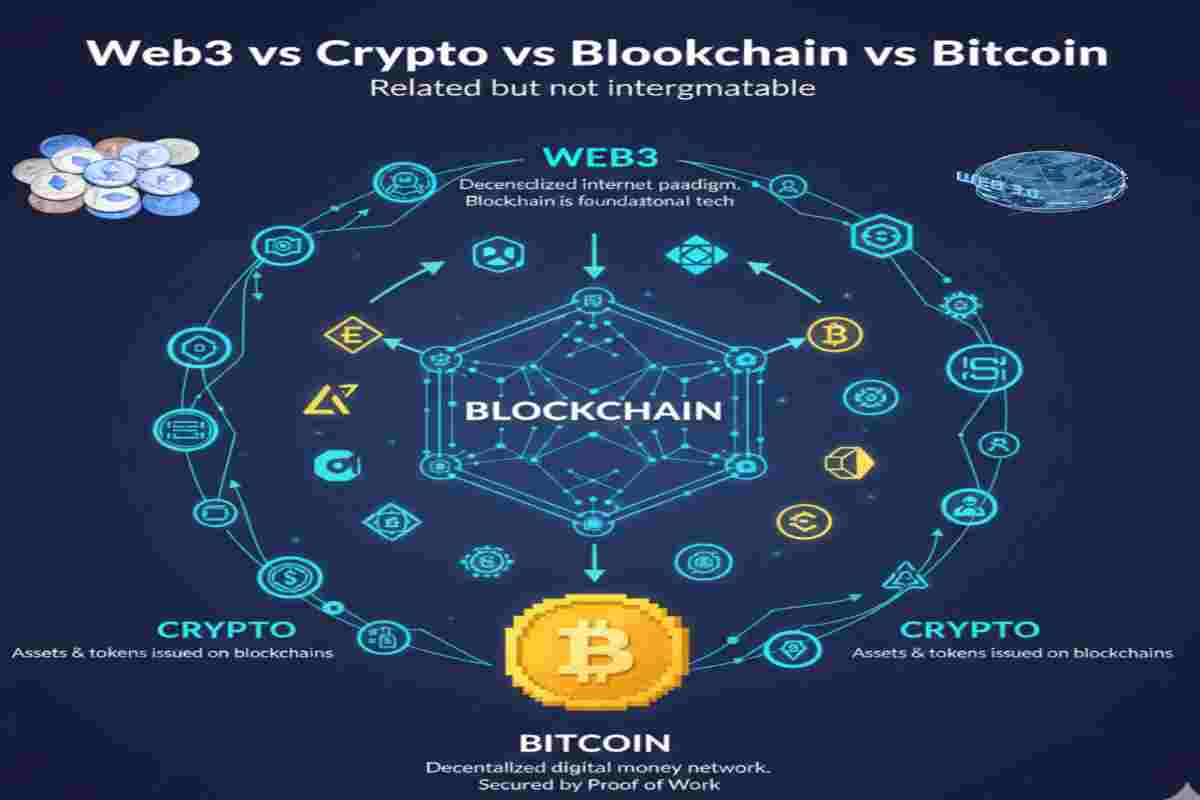
This Infographic of Web3 vs Crypto vs Blockchain vs Bitcoin Explaining in 2026. These items are related but not interchangeable

Web3 vs Crypto vs Blockchain vs Bitcoin

Confused by all the buzzwords? Let’s untangle Web3, crypto, blockchain, and Bitcoin because knowing the difference could change how you see money and the web forever.

These terms are related but not interchangeable:

  • Bitcoin is a decentralized digital money network secured by Proof of Work.
  • Blockchain is the underlying distributed ledger technology enabling transparent, trustless verification.
  • Crypto refers to assets and tokens issued on blockchains.
  • Web3 is the decentralized internet paradigm built with blockchain as foundational technology.

Web3 incorporates crypto and blockchain but extends far beyond them — into identity, governance, data ownership, and composable applications.


Why Web3 Exists

Why does Web3 even matter? It’s not just hype, it’s the rebellion against centralization, and it’s already reshaping industries you never guessed.

Web3 was born as a solution to structural problems in legacy systems:

  • Web2 platforms do not grant true ownership of data or assets.
  • Traditional financial infrastructure is slow, opaque, and siloed.
  • Centralized control creates single points of failure and censorship risk.
  • Traditional identity systems lack privacy and autonomy.

Web3 replaces platform trust with mathematical proof and decentralized coordination, enabling:

  • Permissionless participation
  • Crypto‑economic incentives
  • Global, trustless value exchange

In short:
Web2 gave us connection. Web3 gives us ownership.   ↓ Jump to 2026 Web3 Strategy: Expert FAQs & Troubleshooting.
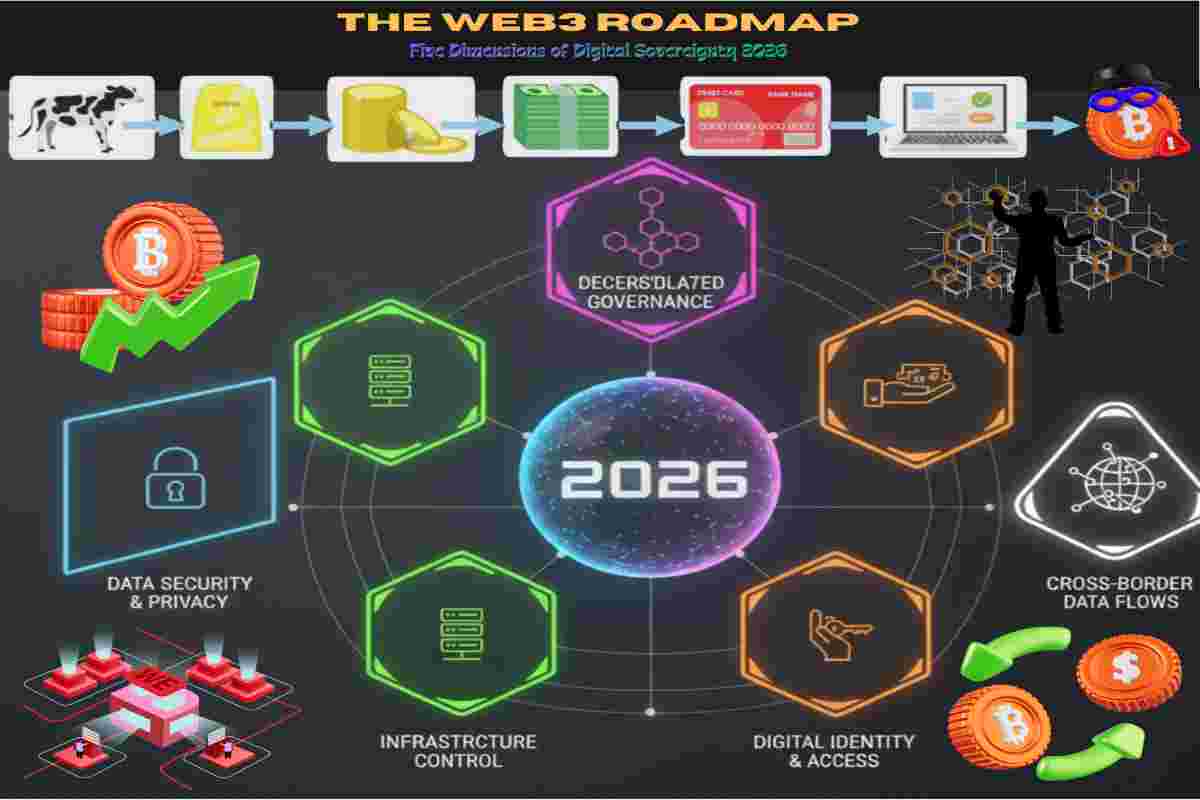
This infographic of Web3 Roadmap Blockchain & Web3 Explained: Bitcoin, Ethereum, & Decentralized Internet in 2026

Web3 Evolution: 2017 → 2026

From wild experiments to near-mainstream adoption, here’s the journey of Web3 Ecosystem, and why 2026 might just be its tipping point.

The shift from hype to infrastructure is the defining story of Web3:

2017–2020:

  • Speculation drove adoption
  • Token narratives outpaced fundamentals
  • Isolated protocols lacked composability

2021–2024:

  • L2s and modular designs emerged
  • RWA tokenization and institutional interest grew
  • Interoperability challenges surfaced

2025–2026:

  • Infrastructure matured
  • Compliance tools arrived
  • Real‑world usage (finance, identity, governance) became standard

Today, Web3 is evaluated on:

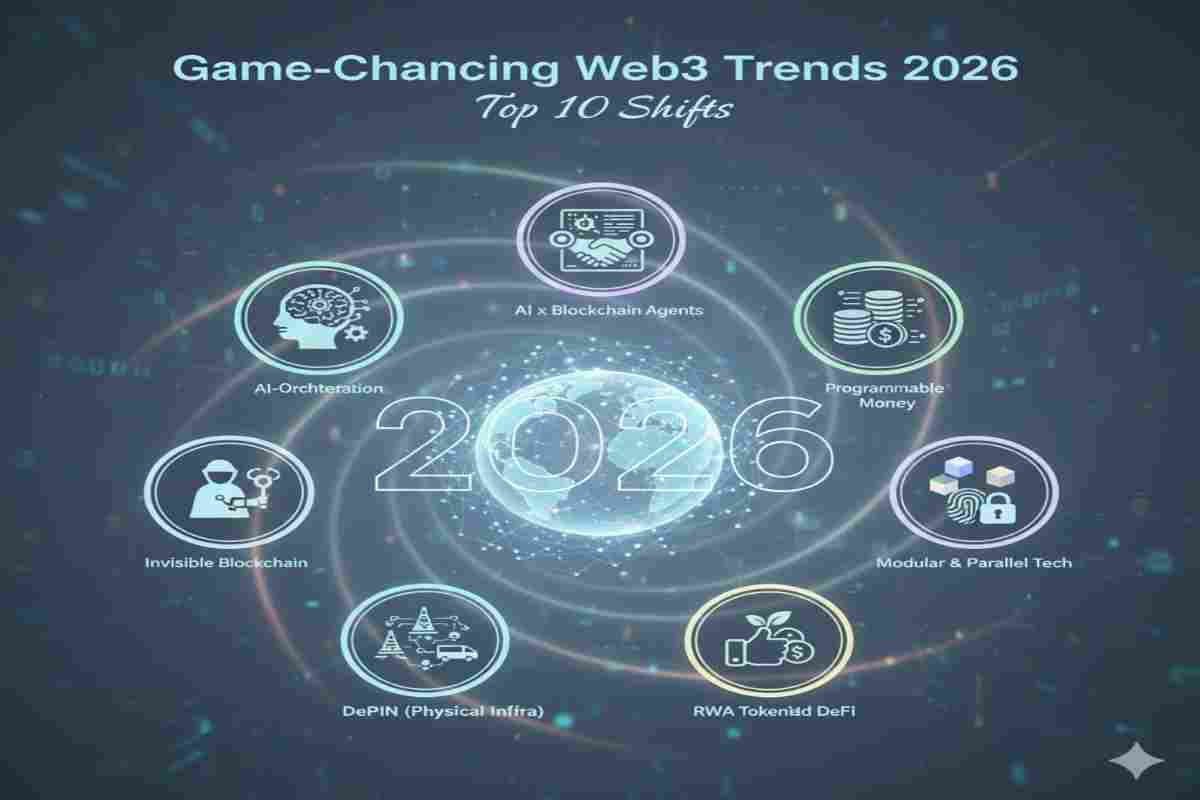
The Image showing Web3 Trends 2026: Shifts.

Web3: Trend or Infrastructure?

Is Web3 just a fad, or the backbone of the next internet? How you answer this could change your strategy—and your wallet.

By 2026, Web3 has clearly shifted from speculative trend to foundational infrastructure. Unlike short-lived tech fads, Web3 underpins real economic, social, and digital processes:

  • Economic layer: Tokenized assets and DeFi rails enable global settlement and programmable finance.
  • Governance layer: DAOs and protocol-level rules coordinate decentralized activity without intermediaries.
  • Identity & data layer: Decentralized identity (DID) systems give individuals and institutions control over personal and transactional data.

This means Web3 isn’t just a buzzword for early adopters — it is a core layer of modern digital architecture, comparable to cloud infrastructure or the TCP/IP stack in its long-term strategic impact. Organizations ignoring Web3 risk missing not just innovation, but foundational infrastructure that shapes the future of ownership, coordination, and trust. 

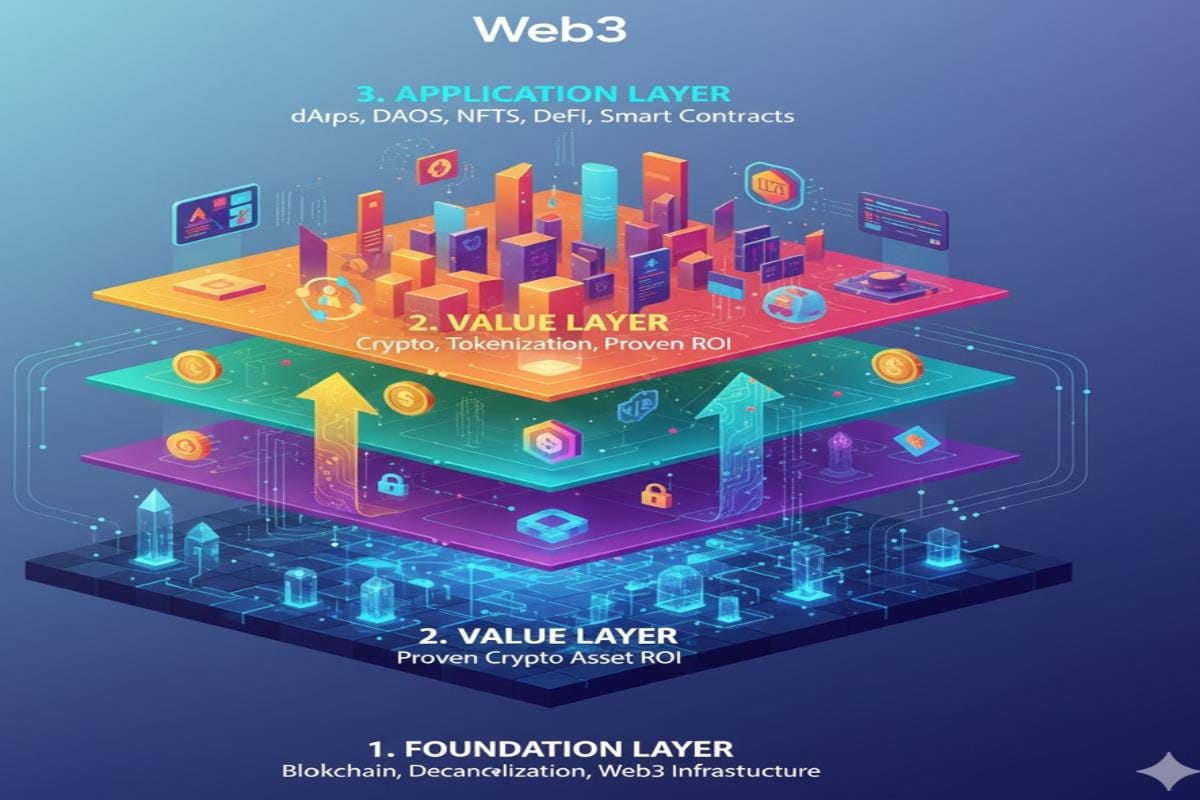
Infographic shows Mapping the Web3 Ecosystem 2026: Structural View Web3 Ecosystem: A 3-Layer Framework for Value, Utility, and Trust

Web3 Tech Stack & Architecture Layers

The Three‑Layer Web3 Stack

Web3 isn’t magic, it’s a stack. But these three layers are where the real power, opportunity, and risks hide.

Web3 systems are best understood through this foundational stack:

  1. Foundation Layer
    Consensus networks, validator sets, DID systems, data availability (e.g., Celestia).
  2. Value Layer
    Tokens, RWA tokenization, and programmable capital.
  3. Application Layer
    dApps, smart contracts, wallets, composable modules.

This layered view ensures scalability without compromising decentralization.   ↓ Jump to 2026 Web3 Strategy: Expert FAQs & Troubleshooting.

How Blockchain Powers Web3

Blockchain isn’t just for Bitcoin. Here’s why it’s the engine driving the new internet, and why skipping this step could cost you.

Blockchain enables:

  • Decentralization — no central controller
  • Transparency — verifiable execution and data
  • Immutability — shared, tamper‑resistant state
  • Trustlessness — consensus replaces intermediaries

Ethereum’s smart contracts power programmable finance, while Bitcoin delivers digital scarcity and settlement security.

This Image showing The Best Web3 Wallets for Beginners in 2026

Wallets, Keys & Digital Ownership

Your keys, your crypto, your identity—Web3 puts ownership back in your hands. But are you ready to hold it?

In Web3, wallets are more than storage—they’re your identity. Private keys define ownership, access, and control in a digital world where “not your keys, not your assets” is law. In 2026, true digital ownership means responsibility, sovereignty, and freedom—all in your hands.

  • Wallets store private keys for secure signing
  • Public keys identify addresses
  • Private keys grant ownership control

In Web3, self‑sovereign custody replaces platform account models.  

Evaluation & Adoption

Measuring Ecosystem Health (2026 KPIs)

How do you know Web3 is thriving? Forget hype—these are the metrics that actually show a healthy ecosystem in 2026.

Institutions use objective indicators to assess ecosystem viability:

  • Infrastructure Health  decentralization, finality, uptime
  • Economic Integrity — real yield, capital efficiency
  • Governance Transparency — DAO signals, upgrade processes
  • Compliance Readiness — on‑chain tools supporting regulatory demands

These KPIs distinguish sustainable ecosystems from speculative noise.  ↓ Jump to 2026 Web3 Strategy: Expert FAQs & Troubleshooting.

Ecosystem Health Metrics & Adoption Signals (2026)

Metric 2024 2026 (Est.) Primary Driver
Institutional TVL ~$15B $180B+ RWA Tokenization
Daily Active Wallets ~2.5M 15M+ Account Abstraction
On-Chain Compliance ~5% 65%+ Regulatory Clarity
Cross-Border Settlement 3–5 Days <2 Seconds Stablecoin Rails

Web3 Ecosystem Metrics That Matter

Some numbers lie. These metrics don’t. If you want to spot winners and losers in Web3, start here.

Metric 2024 2026 Est. Driver
Institutional TVL ~$15B $180B+ RWA Tokenization
Daily Active Wallets ~2.5M 15M+ Account Abstraction
On‑Chain Compliance ~5% ~65%+ Regulatory Clarity
Cross‑Border Settlement 3–5 Days <2 Seconds Stablecoin Rails     

Barriers to Web3 Adoption (2026)

Everyone talks about Web3 Ecosystem, but why isn’t everyone using it yet? The barriers are real and they’re evolving fast.

The remaining adoption hurdles are organizational:

  • Internal strategy resistance
  • Legacy compliance mindsets
  • Skill deficits
  • Regulatory uncertainty in some regions

Technological maturity exists; adoption now is strategic.   


Web3 Coordination Without Central Control

How do millions collaborate without a boss? Web3 has a secret: coordination without central control and it’s changing governance forever.

In 2026, ecosystems coordinate through:

  • Governance signals
  • On‑chain protocol rules
  • Off‑chain consensus layers
  • Interoperability standards

This replaces traditional command structures with decentralized cooperation.     

Infographic: blockchain primitives explained & 3-Layer Web3 Architecture The Ecosystem (2026) featuring Bitcoin, Blockchain, and Cryptography with the Seven Strategic Pillars.

Web3 Ecosystem Explained: Use Cases & Structure

The Web3 Architecture 2026 represents the next evolution of digital infrastructure, where architecture, adoption, and strategic impact converge to redefine institutional capital and digital sovereignty. This framework provides a clear view of the Web3 ecosystem explained through its core use cases, structural layers, and real-world applications.

I. The Security & Ownership Layer

II. The Utility & Adoption Layer

III. The Infrastructure Layer

IV. The Future & Continuity Layer

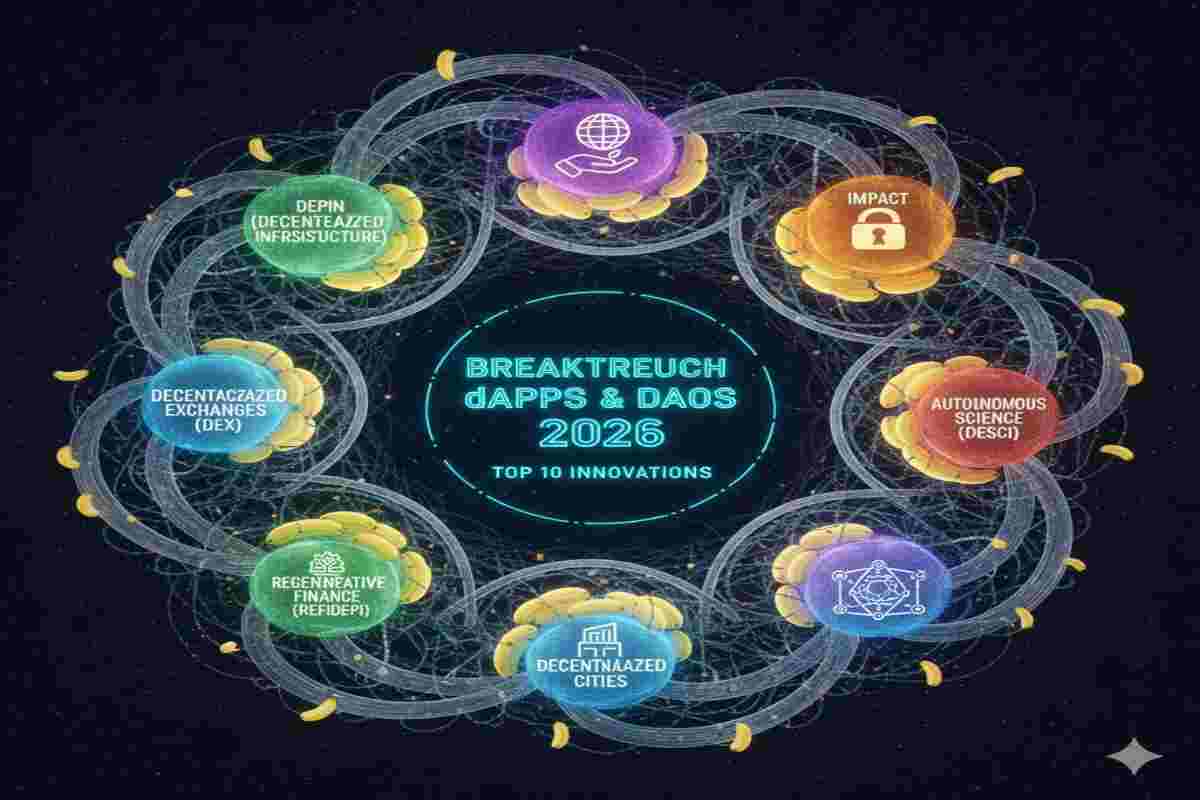
Showing Image of dApps and DAOs 2026

dApps as Ecosystem Interfaces

Apps you use today could vanish tomorrow. But dApps are the new portals connecting you to the Web3 universe.

dApps architecture are the interface layer, not the ecosystem itself. Early failures treated dApps like standalone products. In 2026, successful dApps are deeply integrated into identity, liquidity, compliance, and settlement layers. The value is no longer in the application alone, but in how well it composes with the broader ecosystem.

In mature web3 ecosystems, They integrate identity, compliance, liquidity, and settlement into cohesive workflows. Their value lies in composability, not isolation.

Web3 Interoperability: The Core Architecture Primitive

Interoperability in mature Web3 ecosystems is no longer implemented through fragile bridges or ad hoc integrations. Instead, it functions as a primitive—embedded at the architectural and governance level. Ecosystems that treat interoperability as a first-class design constraint outperform those that bolt it on after growth, especially under institutional load. 

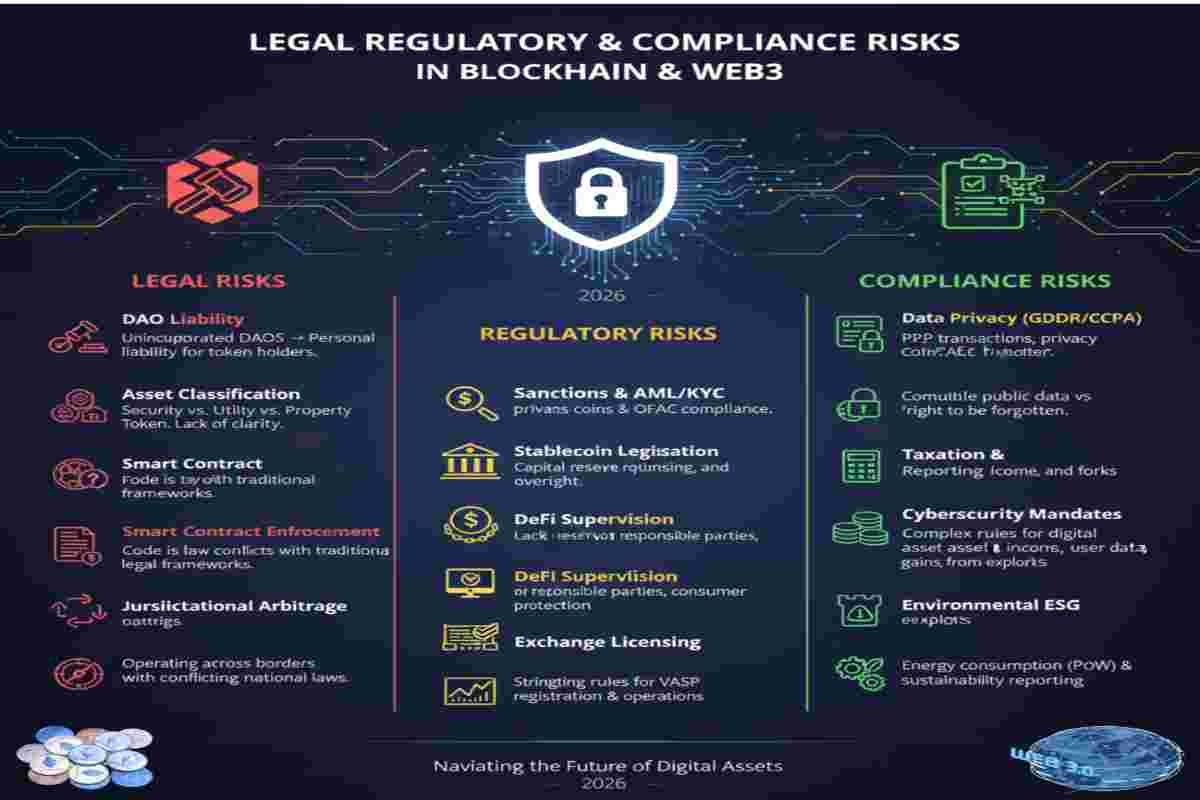
Infographic of Legal Regulatory & Compliance Risk in Blockchain & Web3 in 2026

Risk, Regulation & Sovereignty

Is Web3 Still Risky in 2026?

Everyone says Web3 is risky—but has it gotten safer? The answer might surprise you.

Risk has shifted:

  • Gone are many primitive hacks
  • Governance, upgrade, and jurisdictional risk remain
  • Fraud and UX pitfalls persist

However, risks are now measurable and engineerable, not speculative black boxes.    

Web3 Regulation in 2026

Regulators are finally catching up—but are they helping or hurting Web3’s growth? The 2026 rules could make or break it.

By 2026, regulation is no longer the enemy of Web3—it’s the filter. Clearer rules are separating serious builders from short-term speculation, giving institutions confidence while forcing projects to grow up or fade out. The wild west era is ending, and a regulated Web3 is beginning to scale.

Web3 legality varies but often thrives in:

  • UAE (VARA/ADGM)
  • Switzerland (Federal DLT Act)
  • Singapore (MAS frameworks)
  • EU (MiCA passporting)
  • El Salvador (Bitcoin legal tender)

Clear frameworks enhance institutional participation.    ↓ Jump to 2026 Web3 Strategy: Expert FAQs & Troubleshooting.
Persona & Case Study

Who the Web3 Ecosystem Is Built For: Strategic Persona

  • Institutional Allocators
  • Builders & CTOs: Design modular, interoperable stacks
  • Safety-First Investors: Prioritize governance, audits, RWAs
  • Global Citizens: Use Web3 for mobility, ownership, sovereignty 

Ecosystem Failure: The Interoperability Breach

  • Problem: A major cross-chain bridge was exploited, leading to a loss of $200M in user assets.
  • Objectives: The project aimed to provide “fast and cheap” transfers between competing ecosystems.
  • Analysis / Situation: The project prioritized speed over the SECURE pillar, using a centralized multisig (small group of people) instead of decentralized cryptographic proofs.
  • Implementation: A monolithic bridge architecture was used that lacked “circuit breakers” to stop suspicious outflow.
  • Challenges: Attempting to patch security flaws while the network was under active heavy load.  
  • Results / Outcomes: The exploit wiped out total value locked (TVL) and destroyed user trust. This failure led to the 2026 shift toward “Modular Security” and ZK-proof-based bridges.

Long-Term Sovereign Effects for Family Offices

30% portfolio migration eliminated 90% of management fees and preserved purchasing power above inflation.

  • Problem: A family office in 2024 was tied to a single jurisdiction’s banking system, facing 4% inflation and limited access to global private markets.
  • Objectives: To diversify wealth into a borderless, inflation-resistant stack with high-yield opportunities.
  • Analysis / Situation: Legacy wealth management was too slow and expensive, eating 2% of total assets in management fees alone.
  • Implementation: Shifted 30% of holdings into a curated Web3 Ecosystem stack featuring tokenized treasuries and decentralized liquidity pools.
  • Challenges: Education on self-custody and staying ahead of shifting global tax reporting for digital assets. 
  • Results / Outcomes: Eliminated 90% of management fees, achieved an average Real Yield of 7% (outperforming inflation), and secured a legacy that is transferable in seconds.           

Success Story: RWA Tokenization for Institutional Liquidity

  • Problem: Traditional private credit markets were highly illiquid, with capital locked behind 30-day manual settlement windows and high entry barriers.
  • Objectives: To tokenize $500M in private debt to allow for secondary market trading and 24/7 liquidity access.
  • Analysis / Situation: High-net-worth investors were seeking Real Yield but were deterred by the inability to exit positions quickly in a Web2 environment.
  • Implementation: The team deployed a tokenized fund on a compliant Layer-2 network with built-in KYC/AML protocols and smart-contract-based distributions.
  • Challenges: Navigating the complex regulatory intersection between US and EU investor requirements for on-chain assets.
  • Results / Outcomes: Secondary trading volume increased by 400%, and settlement time dropped from 30 days to near-instant.    

AI, Agents, and Autonomous Coordination

We are seeing the rise of Autonomous AI Agents—verifiable entities that operate on-chain to manage complex financial workflows. These agents use Web3 Interoperability 2026 to scan multiple networks for the best risk-adjusted returns, executing trades and rebalancing portfolios with millisecond precision. By integrating On-Chain Compliance directly into their logic, these agents ensure that institutional-grade security is maintained without manual oversight, making high-frequency coordination both safe and scalable.   ↓ Jump to 2026 Web3 Strategy: Expert FAQs & Troubleshooting.
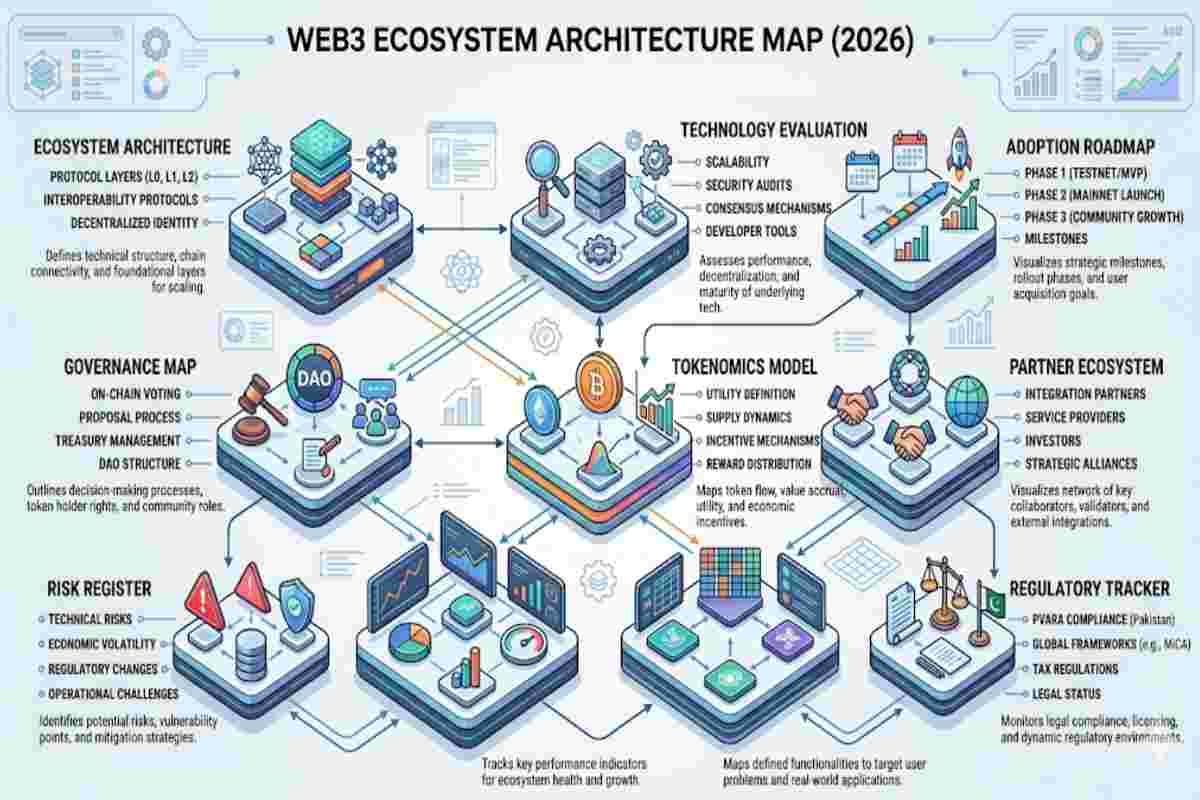
This Infographic of Web3 Ecosystem Architecture Map Template (2026)

Web3 Ecosystem Architecture Map Template (2026)

  • Ecosystem Architecture Sheet
    • Fact: Defines the interoperability layer (Layer 0) and execution layer (Layer 2).
    • Reason: Prevents “liquidity fragmentation” by ensuring assets can move across chains (e.g., Ethereum to Solana) without losing security.
  • Technology Evaluation
    • Fact: Audits the consensus mechanism (Proof of Stake vs. Proof of History).
    • Reason: To ensure the tech stack meets the “Digital Survivability” pillar—if the tech is too centralized, the sovereign asset is at risk.
  • Adoption Roadmap
    • Fact: Sets time-bound milestones for Testnet, Mainnet, and DAO handover.
    • Reason: Manages community expectations and prevents “token dump” events by aligning supply unlocks with actual utility growth.
  • Governance Map
    • Fact: Details the On-Chain Compliance and voting weight (Quadratic Voting).
    • Reason: Prevents “Whale Manipulation” where a few wealthy holders control the entire direction of the project.
  • Tokenomics Model
    • Fact: Calculates the Real Yield and deflationary “burn” mechanisms.
    • Reason: Ensures the token has a sustainable value floor and isn’t just a “ponzi” inflationary reward system.
  • Partner Ecosystem
    • Fact: Maps out Oracle providers (Chainlink) and Custody partners.
    • Reason: Identifies “Single Points of Failure”; if your only Oracle fails, your entire ecosystem price feed breaks.
  • Risk Register
    • Fact: Lists Smart Contract vulnerabilities and Counterparty Risk.
    • Reason: Essential for institutional-grade allocation; it dictates how much “Insurance Fund” capital must be set aside.
  • KPI Dashboard
    • Fact: Tracks Capital Efficiency and Active Developer count.
    • Reason: Real-time data is the only way to prove the ecosystem is alive; “Ghost Chains” have high TVL but zero daily transactions.
  • Use Case Matrix
    • Fact: Maps RWA (Real World Asset) Tokenization to specific investor profiles.
    • Reason: Ensures the project solves a real-world problem (like cross-border payments) rather than just being a speculative tool.
  • Regulatory Tracker
    • Fact: Monitors PVARA (Pakistan) and global SEC/MiCA compliance updates.
    • Reason: To avoid sudden “De-listing” or legal freezes; in 2026, being “Regulatory First” is a competitive advantage.

Web3 Ecosystem Architecture Sheets Overview 

  • Ecosystem Architecture Sheet
    • Fact: Defines the interoperability layer (Layer 0) and execution layer (Layer 2).
    • Reason: Prevents “liquidity fragmentation” by ensuring assets can move across chains (e.g., Ethereum to Solana) without losing security.
  • Technology Evaluation
    • Fact: Audits the consensus mechanism (Proof of Stake vs. Proof of History).
    • Reason: To ensure the tech stack meets the “Digital Survivability” pillar—if the tech is too centralized, the sovereign asset is at risk.
  • Adoption Roadmap
    • Fact: Sets time-bound milestones for Testnet, Mainnet, and DAO handover.
    • Reason: Manages community expectations and prevents “token dump” events by aligning supply unlocks with actual utility growth.
  • Governance Map
    • Fact: Details the On-Chain Compliance and voting weight (Quadratic Voting).
    • Reason: Prevents “Whale Manipulation” where a few wealthy holders control the entire direction of the project.
  • Tokenomics Model
    • Fact: Calculates the Real Yield and deflationary “burn” mechanisms.
    • Reason: Ensures the token has a sustainable value floor and isn’t just a “ponzi” inflationary reward system.
  • Partner Ecosystem
    • Fact: Maps out Oracle providers (Chainlink) and Custody partners.
    • Reason: Identifies “Single Points of Failure”; if your only Oracle fails, your entire ecosystem price feed breaks.
  • Risk Register
    • Fact: Lists Smart Contract vulnerabilities and Counterparty Risk.
    • Reason: Essential for institutional-grade allocation; it dictates how much “Insurance Fund” capital must be set aside.
  • KPI Dashboard
    • Fact: Tracks Capital Efficiency and Active Developer count.
    • Reason: Real-time data is the only way to prove the ecosystem is alive; “Ghost Chains” have high TVL but zero daily transactions.
  • Use Case Matrix
    • Fact: Maps RWA (Real World Asset) Tokenization to specific investor profiles.
    • Reason: Ensures the project solves a real-world problem (like cross-border payments) rather than just being a speculative tool.
  • Regulatory Tracker
    • Fact: Monitors PVARA (Pakistan) and global SEC/MiCA compliance updates.
    • Reason: To avoid sudden “De-listing” or legal freezes; in 2026, being “Regulatory First” is a competitive advantage.

  • Sheet 1 —  | Layer | Component | Protocol/Platform | Description | Dependencies | Maturity Level | Owner / Stakeholder |
  • Sheet 2 — Technology Evaluation Matrix   | Technology | Type | TPS | Fees | Security | Ecosystem | Score |
  • Sheet 3 — Adoption Roadmap
  • Sheet 4 — Governance Map
  • Sheet 5 — Tokenomics Model
  • Sheet 6 — Partner Ecosystem
  • Sheet 7 — Risk Register
  • Sheet 8 — KPI Dashboard
  • Sheet 9 — Use Case Matrix
  • Sheet 10 — Regulatory Tracker

For a completed Ecosystem Architecture Map Templates with Individual Sheet ready in Excel or Google Sheet worth $499 for free today join our Facebook Group 

Conclusion: Web3 Is Infrastructure — Not Trend

The shift from opaque legacy systems to a verifiable Web3 ecosystem explained is not incremental—it is structural.

In 2026, Web3 has completed its transition:

From experiment → to infrastructure
From hype → to measurable adoption
From platform control → to decentralized ownership

Capital efficiency, programmable compliance, and sovereign identity are now operational realities.

Web3 is not a trend.
It’s the architecture of the decentralized internet.      ↑Jump to 2026 Web3 Strategy: Expert FAQs & Troubleshooting.

EKey Takeaways:

  • The Paradigm Shift: Moving from “Web-as-a-Service” (centralized) to “Web-as-an-Infrastructure” (sovereign).
  • The 2026 Core Stack: A three-layer convergence of Settlement (Bitcoin/Ethereum), Utility (L2s/Interoperability), and Identity (Self-Custody).
  • The Efficiency ROI: Strategic integration of RWA Tokenization and AI-powered oracles to reduce counterparty risk and maximize capital efficiency.
  • The Sovereign Goal: Establishing a “Digital Family Office” structure that preserves wealth and identity beyond traditional banking borders.


Official Frameworks & Verified Sources

To ensure your Web3 Infrastructure and Sovereign Ownership Framework align with global compliance standards, we recommend referencing the official primary sources. This document provides the legal “navigator” for digital property rights in 2026.   

🔗 Official Regulatory Reference: