
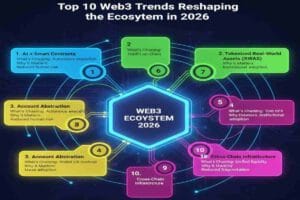
Problem → Shift → Solution → Framework → Outcome → Risks → Signals → Build.
Table of Contents
ToggleBuilding for a Unified, Agent-Driven Economy.
Web3 development in 2026 is no longer about isolated smart contracts; it is about building Sovereign Systems. As infrastructure moves toward complete chain abstraction, the developer’s role has evolved into that of a Protocol Architect—designing modular, secure, and interoperable frameworks that serve both human users and autonomous AI agents.
The 2026 Strategic Builders Stack:
Shift to High-Velocity Tooling: Why Foundry has become the gold standard for security-first protocol design, while Hardhat Ignition powers the enterprise-grade deployment layer.
Agentic-Ready Infrastructure: Designing dApps with “Intent-Centric” backends that allow AI agents to manage liquidity, portfolio rebalancing, and cross-chain execution.
Modular Architecture: The transition from “Monolithic” blockchains to a layered stack where Execution, Data Availability, and Settlement are decoupled for maximum scale.
Security as a Product: In a world of billion-dollar TVL, formal verification and real-time on-chain monitoring are no longer optional—they are the core product.
System Navigator: This development guide provides the blueprint for the Web3 Ecosystem Architecture. Once your protocol is built, learn how to secure its treasury in our Asset Security & Custody pillar or move its liquidity via Stablecoin Payments 2026.
The Web3 Development Guide 2026 empowers builders and institutions to move from theory to execution in decentralized ecosystems. In this era, developers are architects of capital, governance, and trust, building dApps, smart contracts, and interoperable Web3 architectures that withstand adversarial conditions and deliver real yield at scale.
Web3 Development Guide for 2026 begins with a mindset shift: you are no longer a user of the internet, you are its architect.
Web3 Development in 2026 confronts a fundamental challenge: most applications are still built on fragmented architectures, limited scalability, and tooling that struggles to keep pace with the demands of a multi-chain, user-owned digital economy—resulting in poor user experience, security vulnerabilities, and ecosystem silos. As the landscape evolves, a clear shift is underway from isolated smart contracts and single-chain deployments toward modular, interoperable systems—where applications function as composable layers within broader decentralized ecosystems. In response,
Web3 Development emerges as a structured discipline, enabling builders to move beyond experimentation and design scalable, secure, and user-centric decentralized applications. This is achieved through an integrated development framework that combines smart contract architecture, advanced dApp frameworks, cross-chain interoperability, developer tooling, and ecosystem design principles into a cohesive build strategy. The outcome is production-ready Web3 infrastructure—where decentralized applications are not only functional, but scalable, interoperable, and capable of supporting real-world adoption across networks, users, and evolving digital economies.
The decentralized economy will not be shaped by spectators. It will be shaped by those who understand how to build Web3 apps that secure capital, coordinate communities, and execute logic without intermediaries.
In Web3, code is not just product—it is policy, capital, and governance.
Why now? Because infrastructure has matured. Wallets are evolving into identity layers. Blockchains are becoming global execution environments. Chain abstraction is dissolving friction between ecosystems. The barrier is no longer access—it is execution.
After nearly a decade studying crypto markets and institutional infrastructure patterns, one conclusion stands out: knowledge without deployment compounds nothing. The developers, founders, and operators who thrive are those who ship, iterate, and govern on-chain. They treat smart contracts as infrastructure, not prototypes.
Architecture is rare. >>> And builders define the future.
Building in Web3 is no longer optional — it’s essential for anyone who wants to participate meaningfully in the decentralized economy.
Building Web3 applications today requires far more than deploying a basic smart contract. Modern Web3 development involves designing decentralized applications (dApps) that combine smart contracts, blockchain infrastructure, cryptographic security, and user-facing frontends. Developers must think beyond functionality and focus on architecting sovereign, trust-minimized systems that operate permissionlessly on networks like Ethereum and other blockchain platforms.
A successful Web3 app integrates secure smart contract development, wallet connectivity, token standards (such as ERC-20 or ERC-721), decentralized storage, and scalable infrastructure. Builders must also consider gas optimization, on-chain vs. off-chain design decisions, governance mechanisms, and long-term maintainability. The goal is to create resilient systems that remain functional, censorship-resistant, and community-driven—even if the original team steps away.
In the current landscape, designing for decentralization, transparency, and security is not optional—it is foundational.
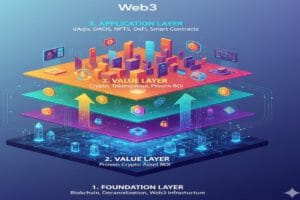
Building in Web3 is more than writing smart contracts — it’s understanding the foundational architecture that makes decentralized applications possible. Every production-grade Web3 system is built on three core layers: Infrastructure, Logic, and Access.
Web3 isn’t magic. It’s layers.
Miss one, and your dApp collapses like a Jenga tower. Master the architecture first, and everything else starts clicking faster.
Every successful Web3 product — whether DeFi protocols, NFT platforms, or DAOs — follows a predictable structural pattern. Grasping this architecture is the moment most developers stop feeling lost and start building with intention.
Web3 development is organized around these three foundational layers, each critical to creating scalable, secure, and user-centric decentralized applications. Together, they form the Web3 Builder Stack — the blueprint for trustless, composable systems.
The infrastructure layer forms the base of the Web3 stack. It includes blockchain protocols, nodes, networks, and developer tooling that power decentralized computation.
A strong understanding of infrastructure enables developers to build scalable, composable dApps and confidently deploy across multiple chains.
The logic layer is where Web3 applications come to life. This is the domain of smart contracts — the immutable execution engines of decentralized systems.
This layer is where theory turns into code. It bridges Web3 learning with real on-chain execution.
This is where Web3 becomes fundamentally different from Web2.
Smart contracts are autonomous execution engines. Once deployed, they enforce rules without permission, trust, or manual oversight. A lending protocol doesn’t “approve” loans — its smart contracts automatically lock collateral, issue loans, and calculate interest.
At this layer, mistakes are permanent. That’s why good builders treat smart contracts like financial infrastructure, not application code.
The execution layer is where business rules meet blockchain. Smart contracts enforce agreements without intermediaries, powering everything from DeFi lending to NFT marketplaces.
A deployed smart contract is more than code—it’s proof of skill on-chain.
Best Practices:
Example Table: Common On-Chain Logic Patterns
| Use Case | Contract Type | Key Libraries |
|---|---|---|
| ERC-20 Token Deployment | Fungible Token | OpenZeppelin |
| NFT Minting | ERC-721 / ERC-1155 | Ethers.js, Hardhat |
| DAO Governance | Voting & Treasury | Aragon, Snapshot |
Even the most secure smart contracts fail if users can’t interact with them effectively. The access layer connects humans to decentralized systems.
The experience layer is where users decide whether Web3 feels empowering or painful.
Wallets replace accounts. Signatures replace passwords. Transactions replace button clicks. When done right, users feel ownership. When done poorly, they feel confused and unsafe.
For example, a well-designed dApp shows users exactly what a transaction does before they sign — building trust instead of fear.
The experience layer connects humans to decentralized systems. A well-designed wallet and interface simplify blockchain complexity, ensuring smooth adoption.
Wallets as identity, authentication, and access control; frictionless onboarding; user-centric dApps.
A well-designed access layer ensures that decentralized applications are not only secure and scalable, but also usable by real users.
In 2026, blockchain efficiency is defined by the move from monolithic systems to specialized layers. Layer 1 (L1) acts as the foundational security and settlement layer, while Layer 2 (L2) scaling solutions—like ZK and Optimistic rollups—handle the heavy lifting of transactions off-chain to keep fees low and speeds high.
The breakthrough is Modular Architecture, which deconstructs the blockchain into separate parts: execution, settlement, and data availability. By using specialized providers for each function, networks no longer face the “congestion bottle-neck” of the past. This allows for an interconnected web of sovereign chains that can scale infinitely while maintaining the robust security of the base layer.
The rise of specialized dApp frameworks has simplified the bridge between complex on-chain logic and user-friendly front ends. These frameworks provide pre-built, audited modules for wallet connection, transaction state management, and cross-chain messaging, allowing developers to focus on unique value creation rather than reinventing foundational infrastructure.

Web3 Developer Tools
In 2026, the suite of Web3 developer tools has shifted toward modularity and speed. Beyond basic IDEs, modern builders utilize integrated environments like Foundry and Hardhat alongside real-time data indexing services. This tooling stack allows for rapid prototyping while ensuring the “Connected Stack” remains stable across multiple execution environments.
Popular tools: Aragon, Colony, Snapshot. Integrate these early to scale participation without friction.
Frameworks help developers write, test, and deploy smart contracts safely.
Foundry is often used for high-performance DeFi development, while Hardhat excels at structured testing and debugging. A serious builder never deploys directly to mainnet without simulations — that’s how protocols lose millions.
These frameworks accelerate dApp development with automated testing, deployment scripts, and contract debugging.
Don’t just code—build confidently, test rigorously, and ship securely.
Comparison Table:
| Feature | Hardhat | Truffle | Foundry |
|---|---|---|---|
| Language Support | Solidity | Solidity | Solidity & Rust |
| Testing | Mocha + Chai | Built-in | Forge + Cast |
| Deployment Automation | Plugins | Scripts | CLI & Scripts |
| Community Support | High | Medium | Growing |
Once you understand the layers, the next challenge is execution.
Raw Solidity won’t save you. The right tools multiply your speed, reduce mistakes, and let you ship like a small elite team instead of a solo dev. This is where ideas turn into deployed systems.
Web3 development stack has matured from experimental scripts into a robust, multi-layered ecosystem designed for scalability and sovereign ownership. For builders, the journey begins at the Protocol Layer, where choosing the right execution environment—whether it is the EVM (Ethereum Virtual Machine) for deep liquidity, Move for high-performance safety, or Solana’s Sealevel for speed—defines the technical constraints of the project. This is supported by Modular Infrastructure, utilizing tools like Celestia for data availability or EigenLayer for restaking security, allowing developers to “plug and play” security rather than building it from scratch.
Moving up the stack, Developer Environments like Foundry and Hardhat remain the gold standard for writing and testing smart contracts, now augmented by AI-driven auditing tools that flag vulnerabilities in real-time. To handle the “off-chain to on-chain” bridge, builders rely on Oracle Networks like Chainlink for real-time data feeds and Indexing Protocols like The Graph to ensure blockchain data is searchable and performant for user-facing applications. Finally, the User Interface (UI) Layer has shifted toward “Account Abstraction” SDKs, such as Privy or Biconomy, which eliminate the friction of seed phrases and allow builders to offer a seamless, Web2-like experience without sacrificing the core principles of self-custody.
Wallets act as your gateway to the Web3 ecosystem:
Libraries connect your frontend to the blockchain.
When a user clicks “Swap” on a decentralized exchange, libraries like Ethers.js translate that action into a signed transaction. Without these tools, dApps would be unusable for non-technical users.
Essential libraries for interacting with Ethereum and other EVM chains. They enable wallet connections, transaction signing, and contract calls.
Programmatically control assets, integrate DeFi logic, and track on-chain events.
Top Libraries:
Blockchains are not databases they’re ledgers.
Indexing tools transform raw blockchain events into usable data. That’s how analytics dashboards, NFT galleries, and DAO voting histories load instantly instead of timing out.
On-chain data is massive. Tools like The Graph allow developers to index, query, and render blockchain events efficiently.
Your dApp’s intelligence is only as good as your data pipeline.
Implementation Tip:
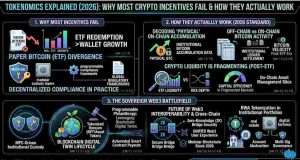
Tokens are coordination tools, not just assets.
Tokens are not just digital assets—they align incentives, reward contributors, and enable governance.
NFT memberships, utility tokens, DeFi staking rewards.
Example Template: NFT Incentive Matrix
| NFT Type | Purpose | Reward Mechanism | Example Use Case |
|---|---|---|---|
| Membership NFT | Access & Identity | Voting, Exclusive Access | DAO participation |
| Utility NFT | Product Interaction | Discounts, Loyalty Points | Gamified e-commerce |
| Collectible NFT | Branding & Scarcity | Secondary Market Value | Art & Community |
RWAs connect blockchain to the real economy.
Tokenized bonds, invoices, or real estate allow on-chain systems to generate off-chain cash flow — a critical evolution for sustainable Web3 finance.
Tokenizing physical assets like real estate, art, or commodities opens global access and liquidity.
Tip: Always comply with local regulations when bringing real-world assets on-chain.
Real DeFi value comes from usage, not emissions.
Protocols that generate fees from trading, lending, or liquidity provision can distribute real yield. This is where Web3 ownership becomes financial ownership.
DeFi is the most visible on-chain application of Web3. Understanding liquidity pools, AMMs, and yield strategies is essential for builders.
Liquidity is the lifeblood of decentralized finance; design your protocol to thrive, not just survive.
Once value exists, control becomes the question.
Governance systems enable decentralized coordination across contributors, users, and investors. DAOs replace centralized management with transparent, rule-based decision-making.
DAOs replace corporate boards with transparent governance.
Token-weighted voting, delegation, and quorum rules allow communities to make collective decisions without centralized leadership.
DAOs use governance tokens or reputation systems to allocate voting power. For example, protocol upgrades or treasury spending decisions are approved through token-weighted voting, ensuring collective ownership and accountability.
DAOs enable community-driven decision-making. Common models: quadratic voting, token-weighted voting, and delegated voting.
Governance fails when incentives are misaligned.
Successful DAOs reward long-term builders, not short-term voters. Vesting, reputation systems, and contributor rewards protect protocol longevity.
Effective DAOs align incentives through vesting, delegation, and reward structures. Contributors who build long-term value are rewarded over time, reducing governance attacks and short-term exploitation.
Ensure all stakeholders builders, investors, and users share aligned incentives via staking, revenue-sharing, or reputation tokens.
Governance platforms enable proposals, voting, and execution at scale — turning coordination into infrastructure.

Every smart contract is a public attack surface.
Audits, formal verification, and defensive design are non-negotiable. In Web3, security is product design.
Security is a core responsibility for Web3 builders. Audits, formal verification, and bug bounties help mitigate risks. A single vulnerability can drain protocol funds, making proactive security essential. In Web3, a single bug can cost millions—security is non-negotiable.
Template: Smart Contract Security Checklist
Adhering to smart contract best practices is the primary defense against protocol insolvency. This includes implementing rigorous “Circuit Breaker” logic, formal verification of code, and ensuring that all on-chain logic is optimized for gas efficiency. In the 2026 Sovereign Framework, security is not an afterthought; it is baked into the initial architectural design.
Key management defines survival.
Multi-sig wallets, permission boundaries, and transaction previews protect both users and treasuries from irreversible mistakes.
Wallet design affects both security and usability. Multi-signature wallets protect treasuries, while transaction simulations and permission controls reduce user error.
Your wallet is your identity, access key, and treasury—all in one.
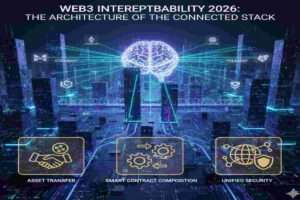
n 2026, the bottleneck of “slow and expensive” blockchain is being dismantled by the synergy of Next-Generation Scaling and Modular Deployment. Rather than forcing all activity onto a single chain, builders utilize Layer 2 Rollups and App-Chains to handle thousands of transactions per second, ensuring the “Sovereign Framework” remains performant even under heavy global demand.
The true breakthrough, however, is Native Interoperability. By moving away from risky third-party bridges and toward decentralized communication protocols (like CCIP or IBC), assets and data now move seamlessly between diverse networks. For builders, this means “Deploy Once, Reach Everywhere”—leveraging Edge Computing and Serverless Infrastructure to launch decentralized applications that feel as fast as Web2 but remain rooted in the security and trustlessness of the blockchain.
Rollups reduce costs while preserving security.
Most production dApps in 2026 deploy on Layer-2s first — because usability matters more than ideology.
Scaling isn’t optional—L1s alone can’t handle mass adoption.
Table: L2 Comparison
| L2 Solution | Tech Type | Avg Gas Cost | Finality Time |
|---|---|---|---|
| Optimism | Optimistic Rollup | <$0.50 | 7 days |
| Arbitrum | Optimistic Rollup | <$0.50 | 7 days |
| zkSync | ZK Rollup | <$0.05 | Instant |
Interoperability allows protocols to grow beyond single ecosystems.
Assets, liquidity, and users move where value flows.
Multi-chain is no longer optional.
Resilient protocols meet users where they are, not where builders prefer.
A protocol is future-proof when it lives across multiple ecosystems.
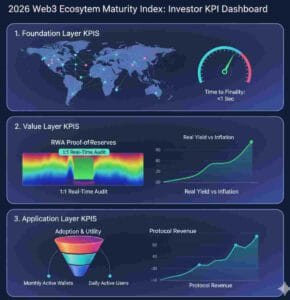
Successful builders measure outcomes. Key benchmarks include: security robustness, on-chain user retention, protocol revenue, governance participation, and composability with external systems. Real data — not hype — distinguishes resilient projects.
| Metric | Ideal 2026 Standard | Why It Matters |
|---|---|---|
| Smart Contract Deployment | Testnet first, mainnet audited | Minimizes risk, demonstrates skill |
| User Onboarding Retention | ≥90% for first 30 days | Shows smooth UX & wallet integration |
| Transaction Cost Efficiency | < $0.50 per action (L2 / modular chains) | Ensures scalable adoption |
| Security Audits | 2 independent audits per release | Protects funds and credibility |
| Governance Participation | ≥50% community vote turnout | Ensures active DAO engagement |
| Protocol Composability | Compatible with ≥3 L1/L2 chains | Enables future-proof expansion |
Transitioning from Web3 theory to real on-chain action requires moving beyond tutorials and actively interacting with live networks. Developers should start by deploying a simple smart contract on a testnet, connecting it to a wallet, and triggering real transactions such as contract calls, events, and state updates. Using block explorers, reading transaction logs, and handling failures helps build practical intuition around gas, confirmations, and network behavior. This hands-on feedback loop—deploy, transact, observe, iterate—is what turns conceptual Web3 knowledge into real on-chain building confidence.
Every great Web3 builder started with a single deployment.
Only trust-critical logic belongs on-chain.
Custody, settlement, and ownership go on-chain. Computation-heavy logic stays off-chain. This balance separates scalable systems from expensive failures.
Critical functions like asset custody, settlement, and governance should be on-chain, while computation-heavy or low-risk processes can remain off-chain. For example, order matching may occur off-chain, with final settlement recorded on-chain to reduce costs.
Not every process belongs on-chain—smart builders choose carefully.
Going on-chain is powerful but costly. Use this framework to decide:
| Task Type | On-Chain? | Reasoning |
|---|---|---|
| Governance voting | ✅ | Needs transparency & immutability |
| Token distribution | ✅ | Ensures trustless reward allocation |
| Heavy computation | ❌ | Off-chain is cheaper & faster |
| Confidential user data | ❌ | Privacy risk on public chains |
Tip: Reserve on-chain for critical state, verifiable actions, and token mechanics; everything else can remain off-chain.

Web3 careers require multidisciplinary skills.
Essential Web3 Career Skills You Need in 2026
Thriving in the Web3 ecosystem requires a mix of technical expertise, strategic thinking, and community engagement. On the technical side, developers should master blockchain fundamentals, smart contract programming (Solidity, Rust), and frontend development (React, ethers.js), while also understanding decentralized storage (IPFS) and security best practices.
Smart contract development, frontend integration, token economics, and governance design are core competencies for Web3 builders.
Mastering these skills positions you to thrive in the fast-evolving Web3 space.
Many developers start with testnet deployments, open-source contributions, and DAO participation before launching production systems.
A strong Web3 portfolio includes live contracts, GitHub contributions, and community involvement rather than resumes alone.
Web3 ecosystems consist of diverse participants whose incentives must align.
Builders design and maintain decentralized infrastructure, smart contracts, and applications. Their focus is on scalability, security, and composability.
Investors provide liquidity and capital in exchange for governance rights or yield. Sustainable protocols reward investors through real revenue rather than inflationary token emissions.
Product and community leads drive adoption, education, and governance participation, ensuring decentralized systems remain usable and inclusive.
Design user-first dApps and seamless onboarding.
Reduce 3% credit card merchant fees.
Ensure Resource Security while keeping costs low.
Build slowly, but deploy early. Separate learning wallets from storage wallets, and never test new contracts with meaningful capital. Prioritize clarity over complexity — simple, auditable smart contracts outperform clever but fragile designs. Design systems to survive worst-case scenarios, not best-case assumptions. Most importantly, treat every on-chain action as permanent: in Web3, discipline is a feature, not a limitation.
Security Audits
Governance Participation
Protocol Composability
Builders will increasingly leverage AI-assisted tools, automated integration layers, and composable protocols to reduce friction and accelerate ecosystem growth. The future is autonomous coordination, where systems build on one another to create global impact.
The final shift is already happening.
The future of Web3 is ownership that pays.
Not hype. Not speculation.
But programmable, composable, income-generating systems.

In 2026, the Web3 building philosophy has matured from speculative “liquidity mining” toward Real Yield Evolution. This shift moves away from inflationary token rewards and focuses on sustainable revenue generated from actual protocol utility—such as transaction fees, service subscriptions, or hardware rentals. For builders, this means creating Ownership Economics where token holders are no longer just passive speculators but active stakeholders receiving a share of the protocol’s organic cash flow.
The future of building in Web3 lies in this “Value Capture” mechanism. By aligning the success of the platform directly with the wallets of its users, builders create a “flywheel effect”: high utility leads to higher real yield, which attracts long-term committed capital rather than mercenary liquidity. This model prioritizes Capital Efficiency, ensuring that every token in circulation is backed by a verifiable revenue stream, effectively turning decentralized protocols into the transparent, community-owned “equity” of the digital age.
The Speculative Era (Old Model)
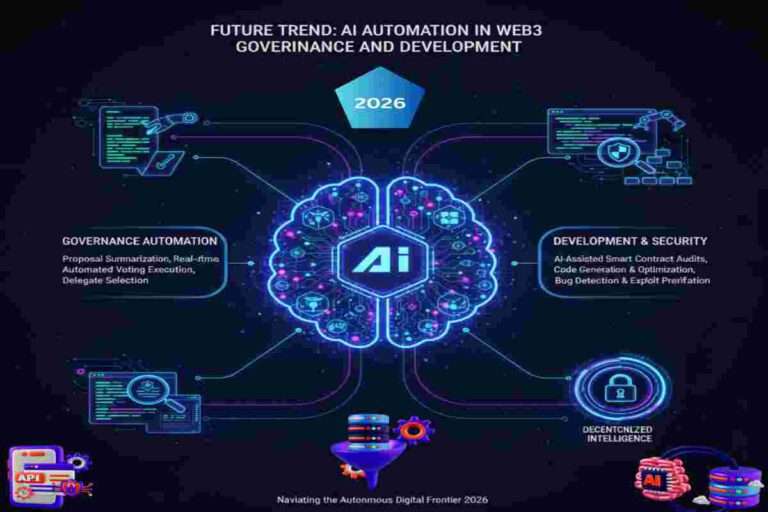
In advanced Web3 architectures, AI-automation functions as an execution layer rather than a decision authority. Human actors define strategy, governance rules, and risk parameters, while automated agents enforce those policies consistently across time, scale, and networks. In practice, AI-driven automation monitors on-chain activity, validates governance conditions, flags security anomalies, and executes pre-approved workflows such as transaction limits, treasury operations, or compliance checks.
This design strengthens operational resilience, reduces human error, and ensures continuity without compromising self-custody or sovereign control. By separating decision-making from execution, Web3 systems achieve scalable automation while preserving decentralization, accountability, and long-term digital sovereignty.
This table helps readers mentally place AI correctly — not as magic, but as infrastructure.
| Layer | Human Role | AI-Automation Role | Sovereignty Impact |
|---|---|---|---|
| Strategy | Define goals, risk limits, governance rules | None | Fully human |
| Policy | Encode rules into smart contracts & workflows | Validate rule consistency | Human-controlled |
| Execution | Approve systems & escalation paths | Execute tasks automatically | Delegated, reversible |
| Monitoring | Decide what matters | Watch thresholds & anomalies | Prevents silent failure |
| Recovery | Authorize intervention | Trigger alerts & pauses | Human override preserved |
AI agents will manage wallets, execute strategies, and participate in governance — autonomously.
Autonomous AI agents will become the brain of decentralized protocols.
Protocols will behave more like organisms than apps — adapting, interacting, and evolving without human control.
Builders carry responsibility: bugs on-chain cannot be undone. Security audits, formal verification, and layered testing are essential to protect users and assets. Risk management is not optional — it’s foundational.
Decentralization means no single point of control. Builders should design systems that are transparent, composable, and resistant to censorship or central failure — making trust an emergent property of architecture.
Web3 development faces technical complexity, interoperability issues, and security demands. Fragmentation, multiple execution environments, and costly deployment cycles make building production-grade solutions hard without rigorous discipline and tooling strategy.
Building in the Web3 ecosystem in 2026 remains a high-stakes endeavor, where technical brilliance must be balanced against systemic hurdles. Despite massive infrastructure leaps, developers face three primary friction points: Regulatory Fragmentation, User Onboarding Friction, and Smart Contract Security.
The “Sovereign Framework” requires navigating a “Compliance Tax”—the high cost of implementing AML/KYC and zero-knowledge privacy standards to satisfy global regulators without sacrificing decentralization. Furthermore, the shift from monolithic to modular chains has introduced Technical Fragmentation. Developers often face the “single-chain trap,” where choosing one ecosystem risks future obsolescence or high migration costs if that chain’s fee structure becomes unsustainable as the network scales.
Finally, the User Experience (UX) Gap remains the largest barrier to mass adoption. Even in 2026, the complexity of seed phrases, gas management, and multi-signature security often turns everyday users away. To succeed, builders are moving toward “Abstraction Layers” that hide the blockchain’s complexity, allowing users to interact with decentralized protocols as easily as they do with Web2 apps, while maintaining the underlying principles of self-custody and digital sovereignty.
To overcome these hurdles, the industry has shifted toward “Controlled Upgradeability” and Modular Security. Instead of rigid, immutable code that cannot be patched, builders now utilize Proxy Patterns and Pausable Contracts, allowing for emergency fixes without sacrificing the decentralized core. The talent gap is being bridged by the rise of AI-Assisted Auditing and No-Code Infrastructure, which allow “Bridge Architects” to focus on high-level logic while automated systems handle the complex, low-level security boilerplate.
Furthermore, the fragility of interoperability is being solved by Native Messaging Protocols (like Chainlink CCIP or LayerZero). These protocols replace risky, centralized third-party bridges with decentralized verification layers, effectively turning “Honeypots” into secure, trustless highways. By adopting a “Security-First” CI/CD pipeline, where every code commit is automatically scanned for economic exploits, builders in 2026 are finally able to ship decentralized applications with the same confidence and speed as traditional software.
Building in Web3 in 2026 is no longer about experimenting on the edges of technology—it is about engineering resilient digital systems that can operate at global scale. The Web3 ecosystem has matured into a layered stack of infrastructure, protocols, governance models, and developer tooling that demands intentional design, not shortcuts. Developers today are not just writing smart contracts; they are shaping economic systems, coordination mechanisms, and digital ownership frameworks that will persist for decades.
The builders who succeed in Web3 will be those who understand the ecosystem holistically—how infrastructure choices affect security, how governance impacts sustainability, and how developer decisions ripple across users, institutions, and regulators. As Web3 continues to integrate with traditional finance, enterprise systems, and public infrastructure, building responsibly becomes as important as building innovatively.
This guide exists to serve as a long-term reference for developers and ecosystem participants who are not chasing hype cycles, but committing to building durable, open, and sovereign digital systems. In 2026 and beyond, Web3 will not be defined by what is launched—but by what endures.
For a deeper perspective on succession planning and governance structures:
https://yourdomain.com/family-office-succession-governance-2026-trusts-heirs-frameworks
As we navigate the fiscal landscape of 2026, the mandate for institutional-grade stability has shifted from a “best practice” to a non-negotiable regulatory baseline. Central to this transition is the emphasis on high-quality liquid assets (HQLA) and rigorous risk management frameworks, as outlined in the U.S. Treasury TBAC Q4 2024 report. Whether managing traditional corporate treasuries or emerging digital value chains, the harmonization of global standards—such as MiCA in Europe and the Pillar 2 requirements—ensures that financial systems remain resilient against liquidity shocks. For the modern enterprise, maintaining this “compliance-first” posture is the only viable path to achieving long-term capital efficiency & safeguarding stakeholder trust in a borderless economy..👉 U.S. Treasury Digital Asset Report.
Q1. What is Web3 development in 2026?
Web3 development in 2026 refers to building decentralized applications (dApps), smart contracts, and blockchain-based systems that operate without intermediaries and enable trustless execution.
Q2. Why is Web3 important now?
Web3 is important now because infrastructure has matured, wallets function as identity layers, and blockchains act as global execution environments. The barrier is no longer access—it is execution.
Q3. Why should I learn Web3 development?
Learning Web3 enables you to participate in the decentralized economy by building systems that control capital, governance, and ownership.
Q4. What mindset is required to succeed in Web3?
You must shift from being a user to an architect—focusing on building, deploying, and maintaining decentralized systems.
Q5. Is Web3 development worth it in 2026?
Yes, because building—not speculation—is now the primary driver of value, influence, and income in Web3.
Q6. What is the biggest mistake in learning Web3?
Focusing only on theory without deploying smart contracts or interacting on-chain.
Q7. Why does execution matter in Web3?
Because only deployed code creates real impact, credibility, and value—knowledge alone does not.
Q8. How do I move from learning to building in Web3?
By writing smart contracts, deploying them on testnets, interacting with them, and iterating based on real usage.
Q9. What is the first step to becoming a Web3 developer?
Deploy a simple smart contract, connect it to a wallet, and execute real transactions.
Q10. What proves real skill in Web3?
On-chain actions like deployed contracts, live dApps, and DAO participation.
Q11. What are the three layers of Web3 architecture?
Infrastructure Layer, Logic Layer, and Access (Experience) Layer.
Q12. What is the infrastructure layer in Web3?
It includes blockchains, nodes, networks, and tools that power decentralized systems.
Q13. What is the logic layer?
The layer where smart contracts execute rules and automate processes on-chain.
Q14. What is the access layer?
The interface between users and blockchain systems, including wallets and frontend applications.
Q15. Why is Web3 architecture important?
Because missing any layer results in insecure, unusable, or non-functional applications.
Q21. What is a smart contract?
A self-executing program that enforces rules automatically on the blockchain.
Q22. Why are smart contracts important?
They replace intermediaries and enforce trustless execution of agreements.
Q23. What are smart contract best practices?
Audit code, test thoroughly, optimize gas, and treat contracts as financial infrastructure.
Q24. Why is security critical in Web3?
Because contracts are immutable and public—bugs can lead to irreversible losses.
Q25. How can developers secure smart contracts?
Through audits, testing, formal verification, and defensive design.
Q26. What are tokens in Web3?
Digital assets used for governance, incentives, and value exchange.
Q27. What are NFTs used for?
Membership, identity, governance, and ownership representation.
Q28. What is DeFi?
Decentralized finance systems enabling lending, trading, and liquidity without intermediaries.
Q29. What are DAOs?
Decentralized organizations governed by token holders through transparent voting.
Q30. How do DAOs make decisions?
Through token-weighted voting, delegation, and governance proposals.
Q31. What are Layer 1 and Layer 2 blockchains?
Layer 1 provides base security; Layer 2 improves scalability and reduces costs.
Q32. What are rollups in Web3?
Scaling solutions that process transactions off-chain and submit proofs on-chain.
Q33. What is modular blockchain architecture?
Separating execution, settlement, and data layers for better scalability.
Q34. Why is interoperability important in Web3?
It enables assets, users, and data to move across different blockchain networks.
Q35. What is multi-chain deployment?
Deploying applications across multiple blockchains for scalability and resilience.
Q36. What role do wallets play in Web3?
Wallets act as identity, authentication, and access control for users.
Q37. Why is UX important in Web3?
Because complex interfaces reduce adoption and trust.
Q38. What is onboarding friction in Web3?
Barriers like gas fees, seed phrases, and complex interfaces that hinder new users.
Q39. How can Web3 improve user experience?
Through abstraction layers, gasless transactions, and simplified interfaces.
Q40. When should you use on-chain vs off-chain logic?
On-chain for trust-critical actions; off-chain for computation-heavy or private processes.
Q41. What defines a successful Web3 project?
Security, scalability, real usage, sustainable tokenomics, and governance participation.
Q42. What are key Web3 builder metrics?
User retention, transaction cost efficiency, audits, and protocol composability.
Q43. What are common Web3 development challenges?
Security risks, technical complexity, interoperability issues, and UX barriers.
What is real yield in Web3?
Revenue generated from actual protocol usage rather than token inflation
Q45. How is AI used in Web3?
AI automates execution, monitors systems, and enforces predefined rules.
Q46. What is the future of Web3 development?
AI-assisted tools, autonomous protocols, modular systems, and scalable decentralized ecosystems.
Q47. What is the biggest shift in Web3 by 2026?
The transition from speculation to execution and real value creation.
Welcome to OwnProCrypto (Own & Pro Crypto) — a next-generation Bitcoin and blockchain education platform where the science of finance meets the power of AI-driven automation.
Our mission is simple: to equip you with the knowledge, frameworks, and tools needed to make smarter financial and business decisions in the Web3 economy.
Beyond analysis, OwnProCrypto focuses on transparency, verifiable data, and practical frameworks that investors and builders can actually use. Our goal is not hype — but clear thinking, disciplined analysis, and long-term value creation in the decentralized economy.
Our Background: Salim (Sam) is the founder and lead researcher behind OwnProCrypto, a Web3 intelligence platform focused on crypto security, digital ownership, stablecoin systems, interoperability, and institutional blockchain infrastructure.
Crypto Tools & Analysis:
Crypto Fundamental Analysis Tool | Protocol Evaluation System | DeFi Risk Analysis Tools | Crypto Portfolio Dashboard | Token Risk vs Reward Tool
Guides:
Crypto Fundamental Analysis | Blockchain Project Evaluation | Tokenomics Analysis | DeFi Protocol Analysis | Capital Efficiency
© 2026 OwnProCrypto — Built for smarter crypto decisions