

Table of Contents
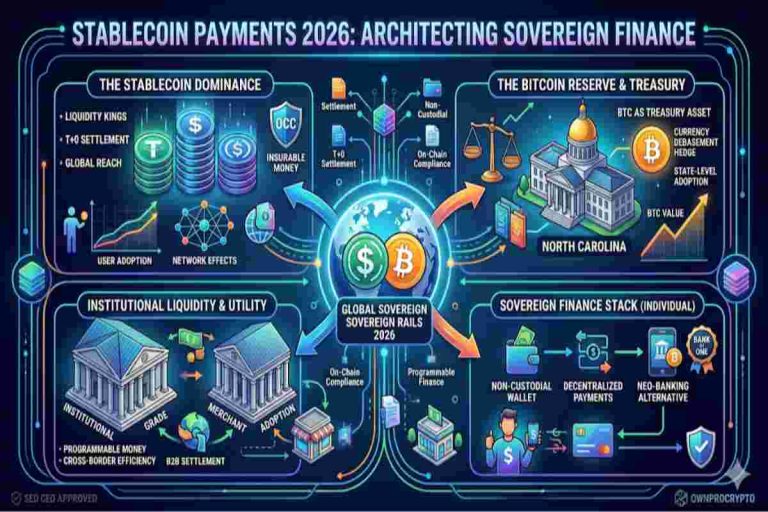
ToggleStablecoins have transitioned from niche crypto instruments into the foundational settlement layer of the digital economy. In 2026, programmable dollars enable real-time, borderless value transfer—redefining how capital moves, settles, and scales globally. This architecture is a specialized branch of the broader systems detailed in our Stablecoin Payments 2026: Why USDT & USDC Dominate. Monitor the evolution of digital dollars at the Federal Reserve’s official site.
By 2026, stablecoins have evolved from “crypto trading tools” into primary settlement rails for global commerce. This section analyzes the structural competition between USDT—the dominant liquidity engine—and USDC—the benchmark for regulatory alignment—alongside the rise of high-performance blockchain networks as the infrastructure layer for real-time payments.
What began as an alternative system is now converging with the core of financial infrastructure.
The competitive landscape has materially shifted:
Stablecoin payments are no longer a fintech experiment—they are the backbone of blockchain-based financial infrastructure.
Capital no longer moves in business hours; it moves at network speed. Processes that once required correspondent banks, clearinghouses, and multi-day settlement cycles now finalize within minutes—across borders, time zones, and jurisdictions.
Settlement speed is no longer a convenience. It is a competitive advantage.
For decades, businesses absorbed the friction of delayed wires, opaque fees, and liquidity trapped in transit. These inefficiencies were structural—legacy systems were never designed for a digital-first, always-on economy.
By 2026, stablecoin volumes have scaled into the trillions annually, quietly rivaling traditional payment networks while operating continuously. This is not parallel infrastructure—it is integrated infrastructure.
Stablecoin-powered payment flows are reshaping:
In B2B environments, stablecoins compress settlement cycles from days to minutes—unlocking working capital and enabling immediate capital redeployment.
The USDT vs USDC dynamic reflects a deeper structural divide:
Yet both operate on the same foundational breakthrough:
programmable digital dollars moving seamlessly across blockchain infrastructure without traditional intermediaries.
For decades, T+2 and T+3 settlement cycles constrained global commerce. In 2026, regulated stablecoin frameworks have transformed these instruments into trusted digital cash equivalents—fully integrated into institutional treasury and payment operations.
This is not a story about faster payments—it is about re-architecting settlement itself.
Because in the next phase of global commerce, the advantage will not belong to those who move money—
it will belong to those who settle it first. ↓ Jump to Expert FAQs & Troubleshooting.

Watch: Stablecoin Payment 2026 In just 4 minutes.
What is a stablecoin and why does it stay… stable?
How USDC and USDT became the world’s most trusted stablecoins
Why stablecoins are crucial for users in high-inflation economies
Real-world examples of stablecoins in USD, EUR, TRY, SGD and more
The global shift: MiCA in Europe and the GENIUS Act in the US
Stablecoins are no longer just entry ramps, they’re regulated, real-world financial tools that help power global crypto adoption.

In 2026, stablecoin payments function as the primary settlement layer of the internet economy. To a new reader, the simplest way to understand a Stablecoin is to think of it as a Digital Receipt for a Dollar.
While famous cryptocurrencies like Bitcoin are like Digital Gold, their price goes up and down every day, a stablecoin is designed to stay exactly at $1.00. It gives you the speed and borderless nature of crypto without the rollercoaster price swings
Not all digital coins are stable. To be a stablecoin, the asset must be pegged to a stable reserve. Here are the primary examples used in global payments today:

Unlike traditional bank transfers, stablecoin payments are programmable value packets, digital dollars that move globally at the speed of information. They settle in seconds, operate 24/7, and eliminate layers of intermediaries (like correspondent banks) that historically extracted value through fees, delays, and hidden exchange spreads.
By 2026, stablecoin payments have transitioned from a niche “crypto” tool to the primary settlement layer of the global digital economy. They matter because they bridge the gap between traditional banking hours and a 24/7 internet economy, allowing value to move with the same speed and transparency as information. Unlike legacy systems that rely on a chain of correspondent banks—each adding fees and delays—stablecoins utilize blockchain rails to settle transactions in seconds rather than days. This is particularly transformative for cross-border trade, where businesses can now avoid the 3–5% loss typically associated with hidden FX spreads and intermediary bank fees. Furthermore, stablecoins provide a critical lifeline in emerging markets, offering a stable, dollar-denominated “store of value” and a way to bypass failing local financial infrastructure. With the introduction of the GENIUS Act and MiCA frameworks, they now provide the regulatory safety that enterprises require to integrate programmable money into their daily operations, such as automated supplier payouts and real-time global payroll.
| Feature | Stablecoins (USDT/USDC) | Volatile Crypto (BTC/ETH) |
| Price Target | Always $1.00 | Market Driven (Fluctuates) |
| Primary Use | Payments & Daily Commerce | Investment & Store of Value |
| Risk Factor | Issuer Trust / Reserve Quality | Market Volatility |
| Speed | Instant (On-chain) | Instant (On-chain) |

Something big is happening in global payments, and most people haven’t noticed yet.
By 2026, stablecoin payments are no longer an experiment or a crypto-native niche. They are becoming core financial infrastructure, used for real settlement rather than speculation. Governments are watching, banks are integrating, and enterprises are quietly moving billions through blockchain rails every single day, a clear signal that stablecoin payments in 2026 represent a structural shift, not a trend.
At the center of this shift stand two names: USDT and USDC.
So why do USDT & USDC dominate stablecoin payments in 2026, while hundreds of alternatives struggle to gain relevance? And why are institutions increasingly treating stablecoins as payment rails, not speculative assets?
Let’s break it down — step by step — and uncover what most surface-level articles completely miss…
At its core, stablecoin payments refer to the transfer of value using blockchain-based digital currencies pegged to fiat money, most commonly the US dollar. Unlike traditional fiat payments that rely on banks and clearing windows, stablecoin payments settle directly on-chain, removing intermediaries and delays.
Unlike volatile cryptocurrencies, stablecoins are designed for:
USDT (Tether) and USDC (USD Coin) maintain a 1:1 peg to the US dollar, making them ideal for payments, remittances, and settlements rather than speculative trading.
USDT (Tether) and USDC (Circle) collectively represent more than 85% of global stablecoin circulation. Together, they form the monetary bridge between legacy fiat systems and blockchain-based payment rails—enabling global commerce without dependence on correspondent banking networks.
Their dominance is not accidental. It is the result of liquidity depth, network effects, exchange integration, and regulatory positioning that no competing stablecoin has been able to replicate at scale.

With a combined market capitalization exceeding $260 billion, USDT and USDC now settle more value daily than traditional card networks. This is a structural signal, not a temporary spike.
Stablecoins have crossed the threshold from alternative payment method to core financial infrastructure, supporting retail payments, enterprise settlement, and cross-border trade simultaneously.
Stablecoin payments don’t rely on banks, clearing houses, or correspondent networks. Instead, they move on blockchain rails like:
A transaction settles in seconds (sometimes milliseconds), operates 24/7, and can be verified on-chain. This architecture explains why stablecoin payments are faster than SWIFT or wire transfers and why they’re increasingly used for cross-border settlement.
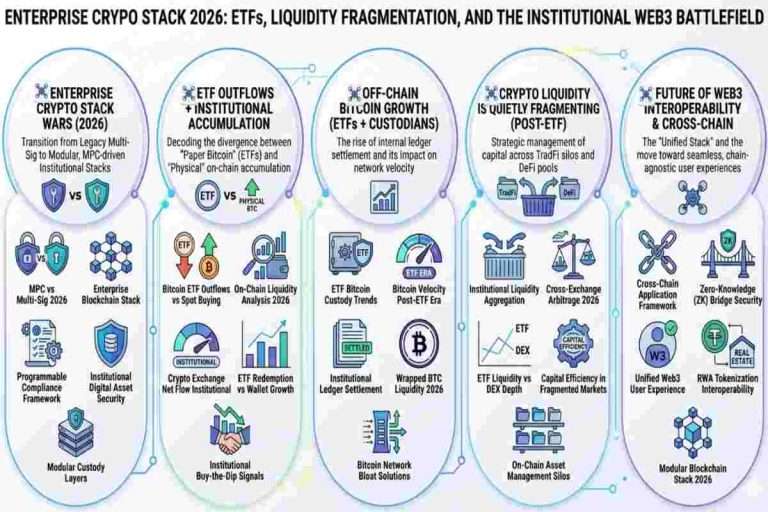
stablecoin payment stack has evolved into a modular, enterprise-grade architecture that bridges the gap between decentralized blockchains and legacy core banking. At the base layer, always-on blockchains like Solana, Base, and Tron provide the settlement finality, while the Orchestration Layer (powered by providers like Circle, Fireblocks, and Bridge) handles the heavy lifting of wallet management, gas abstraction, and multi-chain routing. This stack is unified by RESTful APIs that allow developers to embed stablecoin checkout and automated payouts directly into existing ERP systems without rebuilding their entire financial core. Complementing this are Real-Time Compliance Engines—such as those integrated into the x402 protocol—which automate KYC/AML screening and “Travel Rule” enforcement in milliseconds, ensuring that every transaction across the payment stack is both high-speed and fully auditable.
Stablecoin payments rely on high-performance infrastructure: APIs, smart contracts, custody layers, and compliance tooling. DeFi and TradFi integration allows enterprises to move value on-chain while maintaining regulatory alignment.
| Network | Actual TPS (Real-World) | Avg. Transaction Fee | Finality (Settlement Time) | Payment Strength |
|---|---|---|---|---|
| Solana | 700+ TPS | ~$0.00025 | < 1 second | High-speed retail, merchant payments |
| Ethereum (L2s: Base / Arbitrum / Optimism) | 110+ TPS | $0.05 – $0.20 | ~2 minutes | Institutional & enterprise settlement |
| Tron (TRC-20) | 113+ TPS | $1.00 – $2.00 | ~1 minute | USDT global remittance dominance |
| Stellar | 75 TPS | ~$0.00001 | 3 – 5 seconds | Cross-border & banking rails |
| Polygon (PoS) | 65+ TPS | <$0.01 | ~2 seconds | Merchant & consumer payments |
| Bitcoin (Lightning Network) | Theoretical 1,000,000+ | <$0.01 | Instant | Micro-payments & P2P transfers |
Stablecoin payments rely on high-performance infrastructure including wallets, APIs, smart contracts, custody layers, and compliance tooling. These tools allow enterprises and merchants to integrate on-chain payments into existing systems while maintaining security, observability, and regulatory alignment.
By 2026, USDT and USDC remain the dominant stablecoin settlement assets, driven by unmatched liquidity, global acceptance, and deep integration across blockchain payment rails. Their leadership is reinforced by enterprise adoption, cross-border payment demand, and evolving regulatory alignment, positioning them as core infrastructure rather than speculative instruments.
As of early 2026, the stablecoin market has achieved a historic milestone, with total market capitalization surpassing $300 billion. This growth is no longer driven by speculative trading but by a massive shift toward industrialized payments and corporate treasury management. Tether (USDT) remains the undisputed leader in global liquidity with a market cap of approximately $186 billion, continuing its dominance in high-velocity emerging markets and P2P remittances. However, USDC has seen a significantly faster growth rate of 73% over the past year, reaching $75 billion as it becomes the gold standard for regulated B2B settlements under the newly enacted GENIUS Act. While these two giants control the majority of the market, 2026 has also seen the rise of “utility-first” challengers: Ethena (USDe) has scaled to over $14 billion through DeFi yield optimization, and PayPal USD (PYUSD) has become a primary bridge for retail e-commerce. This diversified landscape signals that stablecoins have officially matured into the “Internet Fiat” era, moving trillions in annual volume across global borders.
Stablecoin transaction volume has already surpassed tens of trillions of dollars annually, rivaling major payment networks. Payment volume signals now act as a proxy for adoption, showing stablecoins transitioning from crypto-native usage into mainstream financial infrastructure.
But 2026 is different — because it marks the transition from:
“crypto-native usage” → “mainstream financial infrastructure.”
Stablecoin usage is moving from being used mostly by crypto enthusiasts (“crypto-native usage”) to being adopted as a standard part of global financial systems (“mainstream financial infrastructure”).
Key drivers behind the stablecoin payments growth forecast for 2026 include:
As stablecoin adoption accelerates, one question dominates every boardroom discussion…
Despite thousands of digital assets, USDT and USDC dominate global stablecoin payments — and not by accident.
Liquidity is everything in payments. USDT and USDC benefit from deep exchange liquidity, massive on-chain circulation, and acceptance across nearly every blockchain ecosystem. This liquidity advantage explains why USDT leads global payment volume even when its market cap fluctuates.
This creates a self-reinforcing loop:
more usage → more liquidity → more adoption. ↓ Jump to 2026 RWA Revolution: Expert FAQs & Troubleshooting.
USDC, in particular, has positioned itself as a regulated, compliance-first stablecoin, making it attractive for banks, payment processors, enterprises, and fintech platforms operating under US and EU law.
USDT, meanwhile, dominates in emerging markets and high-velocity payment environments, especially where access to USD banking is limited. Together, they cover both ends of the global payments spectrum.
In January 2026, Tether (the issuer of USDT) launched USAT. This is a federally regulated, dollar-backed stablecoin issued via Anchorage Digital Bank. Unlike the global USDT, USAT was designed specifically to comply with the US GENIUS Act, allowing Tether to compete directly with Circle (USDC) for U.S. institutional and corporate treasury flows.
| Feature | Tether (USDT) | USD Coin (USDC) |
| Primary Market | Global / Emerging Markets / P2P | US / EU / Institutional Finance |
| Regulatory Status | Offshore (BVI/HK), MiCA Restricted | US Federal (GENIUS Act) & MiCA Compliant |
| Settlement Speed | ~1-3 Mins (Tron/Solana/L2) | ~1-3 Mins (Solana/Ethereum L2/Base) |
| Reserve Backing | Treasuries, Gold, BTC, Repo | 100% Cash & US Treasuries (90-day) |
| Best For | High-volume trading & Global Remittance | Enterprise Treasury & Compliant B2B |
Stablecoins are increasingly used for cross-border payments, remittances, and merchant settlements, offering faster settlement and lower costs than traditional payment rails.
In emerging and global markets, stablecoins enable instant value transfer, reduce reliance on correspondent banking, and improve access to dollar-denominated liquidity.
Intent: consumer, migrant workers, SMEs, global money movement
Traditional cross-border payments are slow, expensive, and opaque. Stablecoin payments improve remittance efficiency by offering near-instant settlement, minimal fees, and peer-to-peer transfers without correspondent banks.
A merchant in Brazil can receive USD-denominated value instantly from a customer in Tokyo—without SWIFT, without correspondent banks, and without a 3% FX haircut. Stablecoins collapse geography into software.
This is why stablecoin payments have become the preferred rail for remittances, global payroll, and international trade settlement. ↓ Jump to 2026 RWA Revolution: Expert FAQs & Troubleshooting.
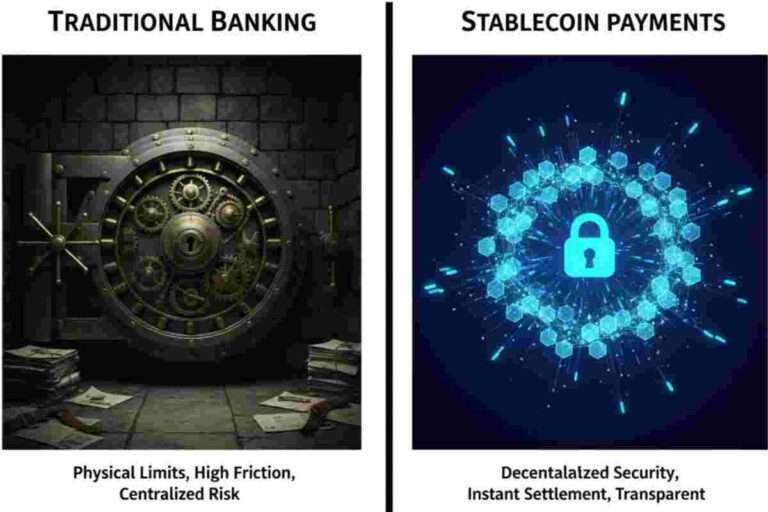
This table highlights why enterprises are switching to on-chain rails.
| Metric | Traditional Cross-Border (SWIFT) | Stablecoin Settlement (L2/Solana) |
| Settlement Time | 3 – 5 Business Days | 2 – 5 Minutes (T+0) |
| Avg. Transaction Fee | $25 – $50 + 3% FX Spread | <$0.01 – $1.00 (Flat) |
| Network Availability | Banking Hours (Mon–Fri) | 24 / 7 / 365 |
| Intermediaries | 3 – 5 Correspondent Banks | 0 (Peer-to-Peer) |
| Failure Rate | ~2% – 5% (Data Errors) | <0.1% (On-chain Validation) |
Businesses are using USDC for supplier settlements, international payroll, treasury management, and on-chain invoicing. Enterprises increasingly treat stablecoins as cash equivalents due to faster reconciliation and real-time liquidity visibility
By 2026, Fortune 100 companies use stablecoins for B2B settlement, supplier payments, and treasury optimization. The result is dramatically improved working-capital efficiency, faster balance-sheet velocity, and reduced dependency on legacy banking infrastructure.
This is why stablecoin remittances are growing fastest in Asia, Africa, and Latin America.
Intent: institutional, corporate, compliance-driven
Survey data showing the shift in corporate sentiment.
| Segment | Utilization Rate (2026) | Top Use Case |
| Fortune 500 Companies | 29% (Exploring/Active) | Cross-border Payroll & Treasury |
| SMBs (Global) | 34% (Active Users) | Supplier Payments & FX Savings |
| Financial Institutions | 15% (Live Services) | On/Off-Ramp & Custody |
| Professional Services | 23% (Active Users) | International Contractor Payouts |
From purchasing tokenized real estate to paying remote developers or settling global invoices, stablecoin payments have moved firmly into everyday commerce. They are no longer tools reserved for crypto traders—they are operational money.
Stablecoins have quietly become the settlement layer for everyday commerce. In 2026, merchants and consumers increasingly rely on them for faster, simpler payment flows.
Crypto-native merchants and global platforms increasingly accept USDT and USDC to avoid chargebacks, reduce processing fees, and reach customers globally without FX friction. ↓ Jump to 2026 RWA Revolution: Expert FAQs & Troubleshooting.
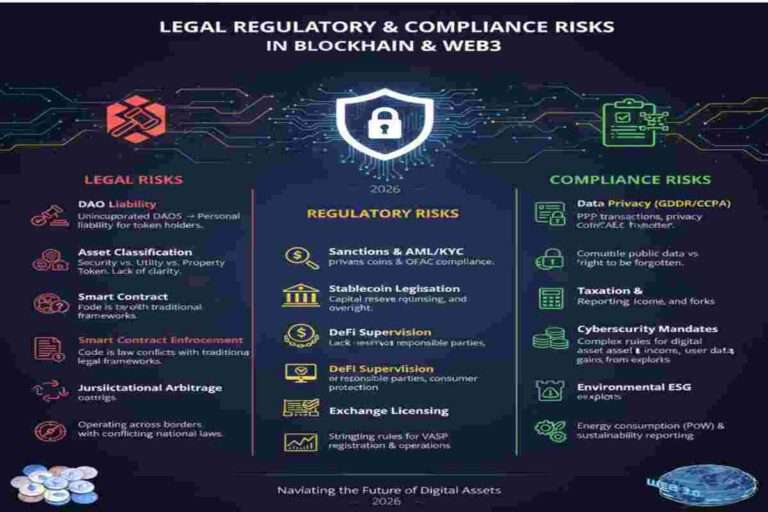
The defining regulatory event for this sector was the signing of the Guiding and Establishing National Innovation for US Stablecoins (GENIUS) Act in July 2025. By 2026, this law mandates that any payment stablecoin issuer with over $10 Billion in circulation must have strict federal oversight (via the OCC) and maintain 1-to-1 reserves in high-quality liquid assets like US Treasuries.
Stablecoin payments face risks related to custody, transparency, jurisdiction, and liquidity. However, these risks are increasingly measurable rather than unknown.
A primary concern for users is whether stablecoins can lose their dollar peg. History shows that without proper HQLA backing, de-pegging remains a technical and economic risk.
| Core Question | Risk Factor | Rooted in Case Study Failure |
|---|---|---|
| Is the collateral restricted to High-Quality Liquid Assets (HQLA)? | Custody Risk | 2023 SVB Crisis: Exposure to uninsured cash deposits revealed counterparty risk in stablecoin reserves. |
| Are reserves attested or audited on a regular basis? | Transparency Risk | Early Tether Era: Limited disclosures caused USDT to trade at a discount during market stress events. |
| Does the issuer hold a US or EU regulatory license? | Jurisdictional Risk | 2025 Regulatory Purge: Unlicensed offshore stablecoins were delisted, freezing corporate liquidity overnight. |
| What is the 24-hour trading and redemption volume? | Liquidity Risk | UST Collapse: Low exit liquidity prevented redemptions during sell-offs, leading to total peg failure. |

Smart contracts play a vital role in stablecoin security. Auditing the smart contract architecture ensures that minting, pausing, and transferring logic remains secure against exploits
| Audit Area | What to Verify | Why It Matters in 2026 |
|---|---|---|
| Smart Contract Architecture | Use of proxy patterns, emergency pause functions, and multi-sig or DAO-controlled minting | Prevents unilateral minting or irreversible contract exploits |
| Wallet Management | Account abstraction, spending limits, social recovery | Eliminates single-seed failure and improves enterprise custody |
| On-Chain Monitoring | Real-time alerts for large transfers, blacklist enforcement (OFAC / Chainalysis) | Reduces compliance and sanctions exposure |
| Compliance Automation | Auto KYC/KYB refresh for transactions above $10,000 | Aligns with 2026 AML and payment-rail mandates |
| Custody Segregation | Separation of operational funds and customer reserves | Protects users during issuer or custodian insolvency |
Competition from new regulated stablecoins is rising — but dethroning USDT and USDC requires matching liquidity, trust, and network effects simultaneously.
Compliance positioning is the biggest differentiator in 2026. USDC’s alignment with the GENIUS Act creates a “trust premium” that makes it the default for regulated B2B transactions.
In 2026, there is a clear legal separation between tokens used for payments (stablecoins) and tokens used for trading, reducing the regulatory burden on merchants. ↓ Jump to 2026 RWA Revolution: Expert FAQs & Troubleshooting.

Settlement speed is largely determined by the underlying blockchain rail (e.g., Solana vs. Ethereum), but USDC’s CCTP protocol gives it an edge in native cross-chain interoperability.
As of early 2026, the landscape has shifted dramatically. Solana has officially overtaken both Ethereum and Tron in monthly stablecoin volume, crossing the $1 Trillion/month milestone in February 2026. While Tron remains the leader for retail remittances, Solana has become the ‘Visa of Blockchain’ for institutional settlement.
Modern payments integrate Decentralized Identity (DID), allowing for automated KYC/AML checks that preserve privacy while satisfying bank partnership requirements.
Cross-chain settlement is now handled through “Burn-and-Mint” protocols and decentralized messaging layers, ensuring that stablecoins move between networks without the security risks of traditional bridges.
With Layer 2 solutions and high-throughput chains like Solana, stablecoin payments are now fully scalable for global retail adoption, matching the capacity of major credit card networks.
Stablecoin payments reduce transaction costs by up to 80% for international businesses by removing the “Percentage-based” fee model of traditional processors.
By providing instant finality, stablecoins improve cash flow management, allowing businesses to reinvest capital immediately rather than waiting for bank clearance.
Every stablecoin payment is traceable on a public ledger, providing a level of transparency for audits and tax compliance that traditional cash cannot match.
The forecast for merchant adoption shows a move toward “Unified Checkout” where stablecoins are treated as a native currency option alongside Apple Pay and Credit Cards.
New entrants, including bank-issued deposit tokens, challenge the current leaders, but USDT and USDC’s network effects remain a significant barrier to entry.
While USDT offers massive liquidity, its strategic weaknesses include offshore jurisdictional risks and less frequent public audits compared to its US-based competitors. This can lead to constraints in highly regulated enterprise environments.
USDC is preferred for enterprise settlement because of its deep integration with the US banking system and its adherence to strict transparency standards, ensuring every digital dollar is backed by verified cash equivalents.
While USDC often leads in institutional trust, USDT typically wins in pure transaction volume. This gap between market cap and actual payment volume highlights USDT’s high velocity in the global remittance market. ↓ Jump to Expert FAQs & Troubleshooting.
User experience differs significantly between these assets; USDT is integrated into almost every global exchange and OTC desk, while USDC offers superior integration with Western fintech APIs like Stripe.
The path to dominance is paved with regulatory compliance; the coins that survive the 2026 “Compliance Purge” will become the standard for the next decade.
While governments are issuing CBDCs, they are primarily used for wholesale settlement, leaving the retail and P2P markets to private stablecoin innovation.
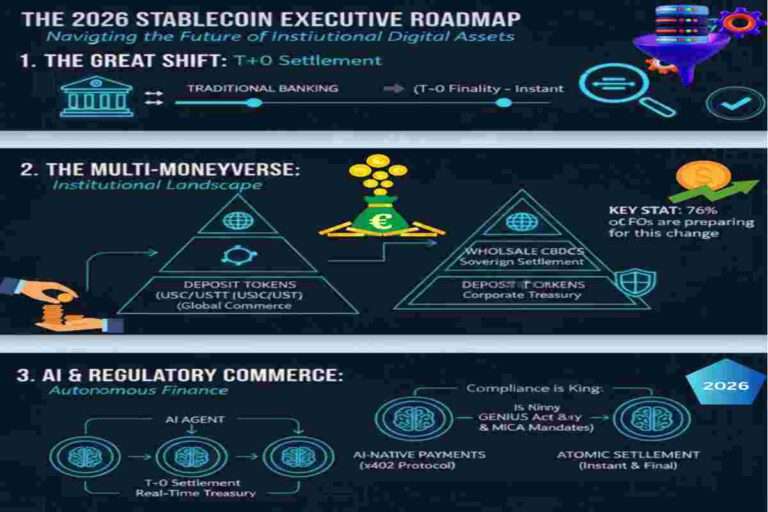
By 2026, the convergence of Agentic Commerce and stablecoin infrastructure has transformed the internet into a self-settling economy. We have moved beyond simple digital wallets into the era of Autonomous Finance, where AI agents act as decentralized treasurers, capable of executing end-to-end B2B workflow, from invoicing to Atomic Settlement, without human intervention. These AI entities utilize Programmable Money to navigate global markets, leveraging the GENIUS Act and MiCA compliant rails of USDC and USDT to eliminate the “liquidity friction” of the past.
This shift is powered by AI-Native Payments (like the x402 protocol), which allow machine-to-machine transactions to occur with T+0 Finality. For enterprises, this means Real-Time Treasury Management is no longer a goal but a baseline reality; AI-driven decision engines now optimize cross-border liquidity in milliseconds, routing capital through the most efficient blockchain layers to maximize Capital Efficiency. As we embrace this Hyper-Automated Future, stablecoins have graduated from being “crypto plumbing” to the invisible, high-speed heartbeat of a truly borderless and intelligent global financial system.
| Future Trend | Role of AI Automation | Impact on Stablecoin Payments |
| Agentic Commerce | AI agents authorized to “Buy for Me.” | Seamless, authenticated stablecoin checkout. |
| Predictive Treasury | Autonomous cash-flow forecasting. | Real-time rebalancing of USDT/USDC reserves. |
| Fincrime Fusion | Real-time on-chain fraud detection. | Instant blocking of illicit wallet clusters. |
| Smart Compliance | Automated Travel Rule enforcement. | 100% auditable “Reasoning Chains” for audits. |
By late 2026, expect stablecoin payments to rival traditional card networks in volume, while banks integrate stablecoins directly into settlement and treasury operations. Programmable payments will become standard, not experimental.
The transition from traditional banking rails to stablecoin infrastructure is no longer a “crypto trend”—it is a structural overhaul of global finance. By early 2026, the data confirms that on-chain settlement has moved from the fringes to the core of enterprise operations.
| Feature | Legacy Banking (SWIFT) | Stablecoin Rails (2026) |
| Typical Settlement | 3 – 5 Days | < 3 Minutes |
| Transparency | Opaque (Multiple Intermediaries) | 100% On-Chain Traceability |
| Avg. B2B Cost | 1.5% – 3% + Fixed Fees | < 0.5% Total |
| Network Uptime | M-F, 9-5 (Bank Holidays Apply) | 24 / 7 / 365 |
| Metric | Traditional Payments | Stablecoin Payments |
|---|---|---|
| Settlement Time | T+2 to T+5 business days | T+0, under 3 minutes |
| Transaction Fees | 3% – 7% (cross-border) | < 0.5% |
| Availability | Banking hours only | 24 / 7 / 365 |
| Intermediaries | Multiple correspondent banks | None (peer-to-peer) |
| Transparency | Opaque ledgers | Public on-chain verification |
The key personas driving adoption include the Global Merchant, the Institutional Treasurer, and the Remittance Worker, each utilizing stablecoins to solve specific financial pain points.
In Stablecoin Payments 2026 four distinct personas have emerged as the primary drivers of on-chain volume, each selecting their “digital dollar” based on specific needs for On-Chain Compliance and Capital Efficiency.
Stablecoin payments in 2026 should be treated as core financial infrastructure, not speculative exposure. Use USDC for regulated treasury management and audited reporting, and USDT for global liquidity and emerging-market reach.
Prioritize platforms with strong on-chain compliance, transparent reserves, and multi-chain support. When integrated correctly, stablecoin payments become a competitive advantage—unlocking capital efficiency, real yield, and jurisdictional resilience.
To secure your Stablecoin Payments & Finance 2026 market shifts, you need more than just theory—you need execution. I have developed the complete Digital Sovereignty Tool & Pillar Template Set, designed specifically for institutional-grade asset management and on-chain succession planning. This toolkit includes the RWA S-Curve Projection Model, the Smart Contract Will Framework, and the Capital Efficiency Audit.
Stablecoin Payments & Finance (11 sheets)
Purpose: Evaluate stablecoin networks, payments, and adoption metrics.
Stablecoin payments in 2026 are no longer about crypto hype, they’re about efficiency, access, and trust. In 2026, USDT and USDC dominate not because of hype, but because they solve real problems: settlement speed, cross-border friction, transparency, and global access to dollar-denominated value. They function as programmable cash, available 24/7, worldwide, and independent of legacy banking hours.Stablecoin payments are no longer a crypto use case. They are payment infrastructure. By 2026, USDT and USDC serve different but complementary roles: one optimized for global liquidity and access, the other for institutional trust and compliance. The shift is not about replacing banks overnight, but about routing around inefficiencies with programmable settlement layers.
Those who treat stablecoins as speculative assets will miss the opportunity. Those who understand them as payment architecture will build the next generation of financial systems. Stablecoin payments represent one of the most consequential evolutions in modern finance.
What You Gain
Next Steps
Stablecoin payments today are no longer experimental. They are regulated, scalable, and superior to legacy payment rails.
The future of payments belongs to those who design for flow, not friction. For organizations seeking speed, compliance, and capital efficiency, the future of payments is already here—and it runs on USDT and USDC.
U.S. Treasury Digital Asset Report — Official insights into stablecoins, regulation, and the future of digital money. U.S. Treasury Digital Asset Report
As finance evolves, stablecoins are becoming the invisible rails moving money worldwide. The question is no longer whether stablecoin payments matter — but how quickly the rest of the system adapts.
To help you navigate the complexities of decentralized decision-making in 2026, we have organized the most critical inquiries into thematic groups. This structure ensures you can quickly find expert insights rooted in real-world successes and historical failures.
Welcome to OwnProCrypto (Own & Pro Crypto) — a next-generation Bitcoin and blockchain education platform where the science of finance meets the power of AI-driven automation.
Our mission is simple: to equip you with the knowledge, frameworks, and tools needed to make smarter financial and business decisions in the Web3 economy.
Beyond analysis, OwnProCrypto focuses on transparency, verifiable data, and practical frameworks that investors and builders can actually use. Our goal is not hype — but clear thinking, disciplined analysis, and long-term value creation in the decentralized economy.
Our Background
As part of the Web3 Ecosystem Architecture pillar, this guide focuses on Sovereign Ownership Architecture in Web3. Explore related pillars: