
Table of Contents
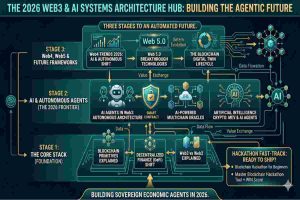
ToggleThe Web3 AI Build Guide 2026 is your strategic roadmap to building the next generation of decentralized, intelligent systems—where blockchain infrastructure meets autonomous decision-making. As we move into an agent-driven internet, developers are no longer just writing code—they are designing Autonomous Crypto Systems capable of executing, adapting, and evolving independently.
This hub is structured as a step-by-step journey—from foundational Web3 primitives to advanced AI agent orchestration—aligned with the emerging Web4 vs Web3 Developer Roadmap. You’ll also discover how innovation is accelerating through No-Code Blockchain Hackathon Tools, enabling faster experimentation and broader participation. At the core of this transformation lies Verifiable AI Execution, ensuring that every autonomous action remains transparent, auditable, and trustless.
This hub is designed as a modular learning + execution path:
Before building any structure, a family office must define its purpose. In 2026, wealth is no longer about accumulation—it is about independence from fragile financial systems.
Web3 Development Guide (2026): Building dApps & Ecosystems
Why read this: The master blueprint for building full-stack decentralized applications in the 2026 environment.
Blockchain Primitives Explained (2026)
Why read this: Understand the “Legos” of Web3—from consensus layers to cryptographic hashes.
Web3 vs Web2: How Decentralization Changes Finance
Why read this: A high-level comparison of legacy systems versus the new sovereign web.
Next Step: Once your philosophy is clear, build the system that supports it.
Once the philosophy is established, the next step is building the engine. A Digital Family Office replaces fragmented legacy systems with an integrated, real-time infrastructure.
AI Agents in Web3 (2026): Architecture & Autonomous Systems
Why read this: Learn how to build agents that can sign transactions and manage their own treasuries.
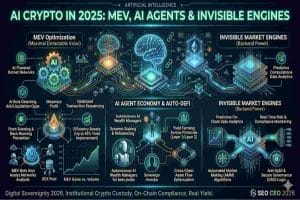
Artificial Intelligence Crypto: MEV & AI Agents
Why read this: Explore the intersection of AI reasoning and Maximum Extractable Value (MEV) in DeFi.
AI-Powered Blockchain Multichain Oracles
Why read this: How AI ensures real-world data remains verifiable and trustless across multiple chains.
Next Step: Secure your architecture to eliminate vulnerabilities.
Without security, architecture fails. In 2026, protecting wealth requires institutional-grade systems designed to eliminate single points of failure.
Web4 Trends 2026: AI & Autonomous Web4 vs Web3
Why read this: Discover the shift toward “Symbiotic Web” architectures and autonomous connectivity.
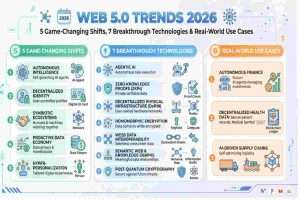
Web 5.0 Trends 2026: 7 Breakthrough Technologies
Why read this: A look at the decentralized identity (DID) layer and extra-personal data ownership.
The Blockchain Digital Twin Lifecycle
Why read this: Understanding how physical assets are tracked through their entire lifecycle on-chain.
Next Step: Put your capital to work while protecting long-term legacy.
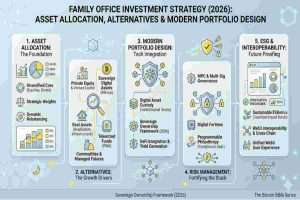
This is where ideas turn into action. The final phase focuses on rapid execution—deploying capital smartly while locking in governance rules that ensure your legacy lasts for generations.
Family Office Investment Strategy: Asset Allocation & Alternatives
Build modern portfolios that blend digital assets with tokenized real-world assets (RWAs), creating a balanced yet forward-looking wealth ecosystem.
Family Office Succession & Governance: Trusts & Heirs
Set up rock-solid governance frameworks and succession protocols that guarantee smooth transfers and protect your family’s long-term sovereignty.
Thanks to AI-assisted development and No-Code Blockchain Hackathon Tools, anyone—from seasoned developers to non-coders—can bring their ideas to life faster than ever.
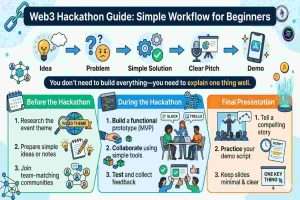
Ready to go from zero to launch?
These resources guide you through the ultimate hackathon journey:
Your fastest route from idea → prototype → winning build starts here—no shortcuts, just results.
This is your fastest path from idea → prototype → winning build
Most Web3 + AI projects don’t fail because of technology but they fail because of architecture.
Industry insights show:
The solution: a Digital Family Office 2026 built on governance, security, and education
Q. What is Web3 AI in 2026?
Web3 AI combines artificial intelligence with blockchain, enabling decentralized applications to operate autonomously, adaptively, and make verifiable decisions without human intervention.
Q. How do AI agents work in Web3?
AI agents integrate machine learning models with smart contracts to analyze data, make decisions, and execute blockchain actions such as trading, governance voting, and asset management.
Q. What are the real-world use cases of AI in Web3?
Use cases include automated DeFi trading and yield optimization, NFT pricing and market prediction, DAO governance automation, fraud detection, on-chain security, and personalized Web3 experiences.
Q. Why is blockchain important for AI systems?
Blockchain ensures trust by providing transparency, immutability, and verifiable execution. This makes AI actions auditable, secure, and resistant to manipulation.
Q. What is an Autonomous Crypto System?
An Autonomous Crypto System is a blockchain framework where AI agents independently manage financial operations such as trading, treasury management, and protocol interactions without manual oversight.
Q. What are the biggest challenges in building AI-powered dApps?
Key challenges include secure smart contract execution, preventing unintended AI behavior, ensuring reliable data through oracles, and designing scalable architectures.
Q. Do I need coding skills to build Web3 AI applications?
Not necessarily. No-code and AI-assisted tools allow non-developers to build and deploy basic Web3 AI applications using guided platforms.
Q. What is the difference between Web3, Web4, and Web5?
Web3 focuses on decentralization and ownership, Web4 introduces AI-driven automation and agent-based systems, and Web5 emphasizes identity, data sovereignty, and user-controlled data.
Q. What skills are needed to become a Web3 AI developer in 2026?
Key skills include blockchain fundamentals, AI/ML basics, DeFi and tokenomics knowledge, and familiarity with agent frameworks and orchestration systems.
Digital Wealth & Family Office FAQs
Q. What is a Digital Family Office in 2026?
A Digital Family Office is a technology-driven wealth management system that uses blockchain, automation, and governance frameworks to manage and preserve wealth transparently and efficiently.
Q. How does it differ from a traditional family office?
Unlike traditional offices that rely on intermediaries and manual processes, digital family offices use automated systems, real-time data, and decentralized infrastructure.
Q. What is Generational Sovereignty?
Generational Sovereignty ensures control over wealth, governance, and decision-making across multiple generations without relying on external institutions.
Q. What is the best wealth preservation strategy in 2026?
A hybrid approach combining traditional and digital assets, supported by strong governance frameworks and institutional-grade security.
Q. What is Institutional Crypto Security?
It includes advanced practices like multi-signature wallets, multi-party computation (MPC), asset segregation, and zero-trust architecture.
Q. Can traditional assets be integrated into a Digital Family Office?
Yes. Tokenization allows real estate, gold, and other assets to be managed alongside digital assets in a unified system.
Q. What is a Family Office Governance Framework?
It’s a structured set of rules and protocols defining how wealth is managed, decisions are made, and succession is handled.
Q. What are the biggest risks in digital wealth management?
Risks include security vulnerabilities, poor governance design, regulatory compliance gaps, and lack of technical understanding among heirs.
Q. Is a Digital Family Office compliant with global regulations?
Yes. Modern systems align with frameworks like the World Wide Web Consortium and emerging crypto reporting standards to ensure transparency and compliance.
Q. How does a Digital Family Office ensure long-term wealth transfer?
Governance and succession rules are embedded into legal structures and smart contracts, ensuring continuity regardless of human factors.
Welcome to OwnProCrypto (Own & Pro Crypto) — a next-generation Bitcoin and blockchain education platform where the science of finance meets the power of AI-driven automation.
Our mission is simple: to equip you with the knowledge, frameworks, and tools needed to make smarter financial and business decisions in the Web3 economy.
Beyond analysis, OwnProCrypto focuses on transparency, verifiable data, and practical frameworks that investors and builders can actually use. Our goal is not hype — but clear thinking, disciplined analysis, and long-term value creation in the decentralized economy.
Our Background: Salim (Sam) is the founder and lead researcher behind OwnProCrypto, a Web3 intelligence platform focused on crypto security, digital ownership, stablecoin systems, interoperability, and institutional blockchain infrastructure.
Crypto Tools & Analysis:
Crypto Fundamental Analysis Tool | Protocol Evaluation System | DeFi Risk Analysis Tools | Crypto Portfolio Dashboard | Token Risk vs Reward Tool
Guides:
Crypto Fundamental Analysis | Blockchain Project Evaluation | Tokenomics Analysis | DeFi Protocol Analysis | Capital Efficiency
© 2026 OwnProCrypto — Built for smarter crypto decisions