
AI agents in Web3 are evolving into autonomous systems that execute trades, manage assets, and coordinate across blockchains without human input. This shift is driving the rise of the agent economy, where machine-driven execution, interoperability, and real-time decision-making define how value moves in crypto.
AI agents in Web3 are rapidly transforming from simple automation tools into autonomous participants capable of executing strategies, managing liquidity, and interacting across multiple blockchains.
As crypto ecosystems expand into multi-chain environments, manual execution and fragmented tooling are becoming inefficient. In response, AI agents crypto systems are emerging to handle decision-making, execution, and coordination in real time.
This shift marks the beginning of an agent economy crypto model, where autonomous systems act as economic participants — optimizing yield, routing liquidity, and executing transactions faster than any human can.
This article breaks down how these systems work, the architecture behind them, and why AI agent interoperability Web3 is becoming a foundational layer for the next phase of decentralized infrastructure.
The modular shift of autonomous agents is a core component of the “Connected Stack” we detail in our Web3 Interoperability 2026 master guide. Check out the external reference: GOV.UK

AI agents are autonomous software programs that:
In crypto, these agents can:
Simple explanation:
AI agents are like automated traders + portfolio managers combined — but operating continuously, across multiple blockchains, at machine speed.
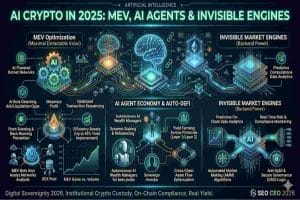
The crypto market may appear stable at a surface level, with slower price cycles and reduced narrative momentum. However, underlying infrastructure is evolving — particularly in execution and automation layers. Developments in MEV extraction and the increasing use of AI crypto agents are influencing how transactions are ordered, processed, and optimized on networks such as Ethereum.
Within the broader shift toward Artificial Intelligence Crypto, automated systems and AI-powered trading strategies are operating at speeds and scales beyond manual interaction. This is contributing to changes in DeFi execution models, settlement processes, and early forms of a machine-coordinated crypto environment.
(For a deeper breakdown, see our detailed analysis on MEV, AI agents, and invisible infrastructure.)
AI agents operate through a combination of:
In simple terms:
AI decides → Blockchain executes → Data feeds guide decisions
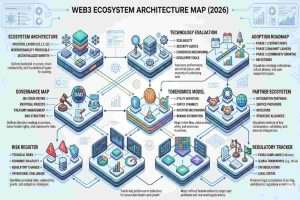
The architecture behind autonomous agents blockchain systems is modular and composable.
| Component | Function | Example |
|---|---|---|
| Agent Runtime | Executes autonomous logic | Smart contract agents |
| Communication Layer | Enables agent interaction | Cross-chain messaging |
| Governance Engine | Manages decisions | DAO logic |
| Security & Validation | Ensures trust | Staking, slashing |
| Data & Oracle Integration | Feeds real-world data | Oracle networks |
| Feature | Monolithic Blockchain | Internet of Agents Architecture |
|---|---|---|
| Autonomy | None | Fully autonomous agents |
| Interoperability | Limited | Multi-chain agent communication |
| Upgradeability | Hard | Modular agent modules |
| Composability | Low | High, plug-and-play modules |
| Enterprise Adoption | Moderate | High for automated workflows |
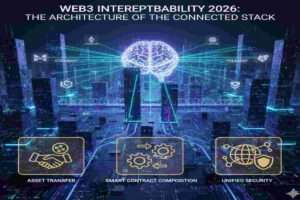
AI-driven Web3 systems are built on layered infrastructure:
This modular design enables scalable and composable autonomous systems.

AI agent interoperability Web3 is what allows agents to:
Without interoperability, agents remain isolated. With it, they become part of a coordinated, decentralized system.
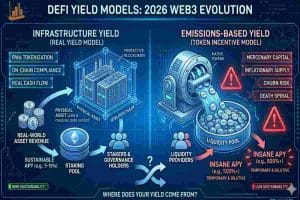
AI agents monitor liquidity pools and automatically move funds to higher-yield opportunities.
An AI agent detects a sudden increase in yield on a Layer-2 protocol and reallocates liquidity within seconds — capturing opportunities missed by manual strategies.
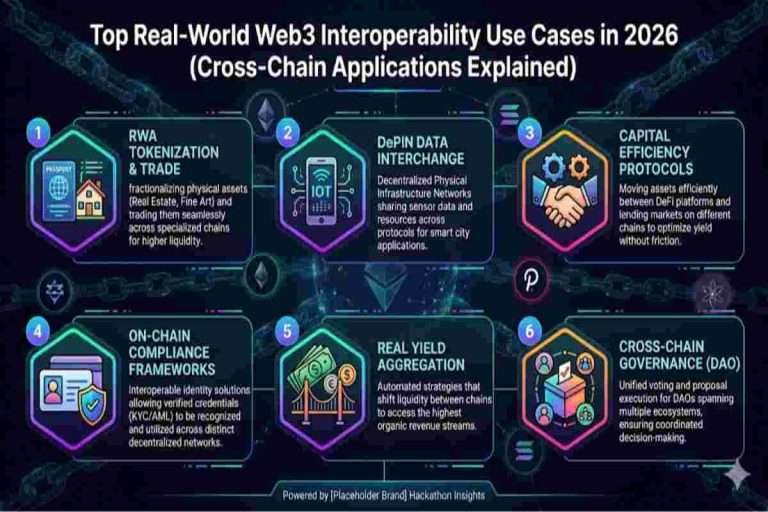
Agents execute token swaps and transfers across multiple chains in real time.
An agent identifies price discrepancies across chains and executes arbitrage trades automatically, improving capital efficiency.
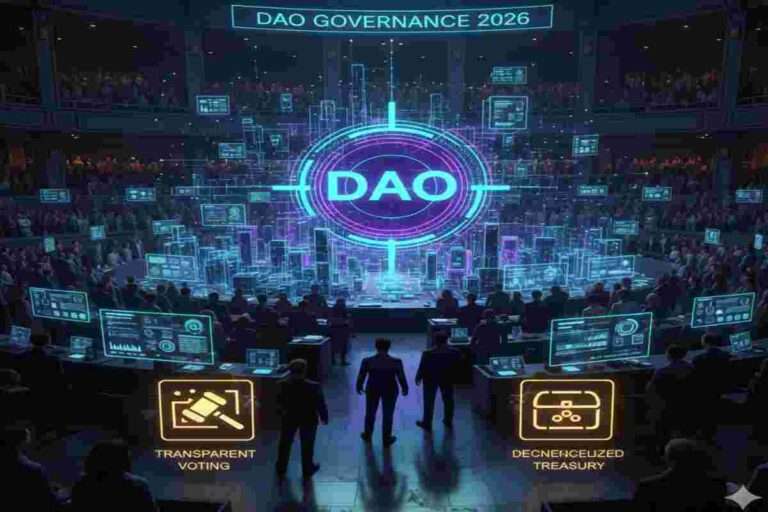
Agents can propose, vote, and execute governance decisions.
During a volatility spike, an AI agent exits risky positions based on liquidity and market signals, reducing exposure.
AI agents dynamically adjust liquidity positions to optimize returns.
Developers can build modular agent systems:
This modularity enables scalable adoption across ecosystems.
| Feature | Traditional Systems | AI Agent Systems |
|---|---|---|
| Execution | Manual | Autonomous |
| Speed | Slow | Real-time |
| Interoperability | Limited | Multi-chain |
| Decision-Making | Human | AI-driven |
| Scalability | Moderate | High |
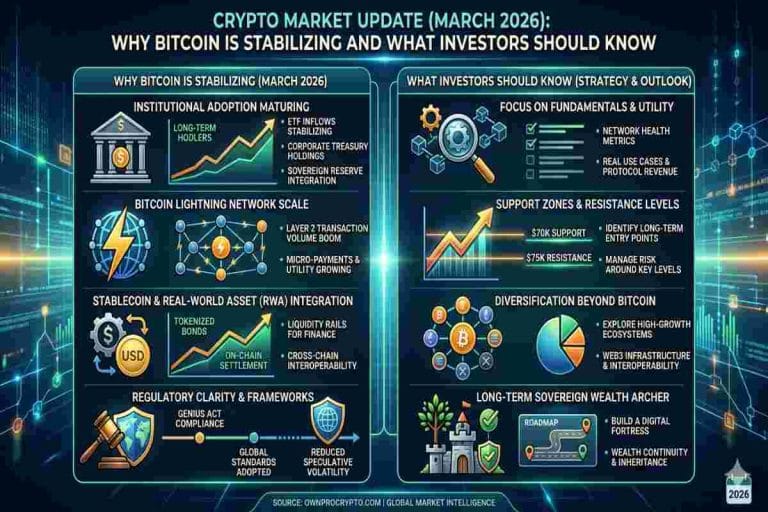
The rise of agent economy crypto systems means:
This is not just automation — it’s a shift toward machine-coordinated markets.
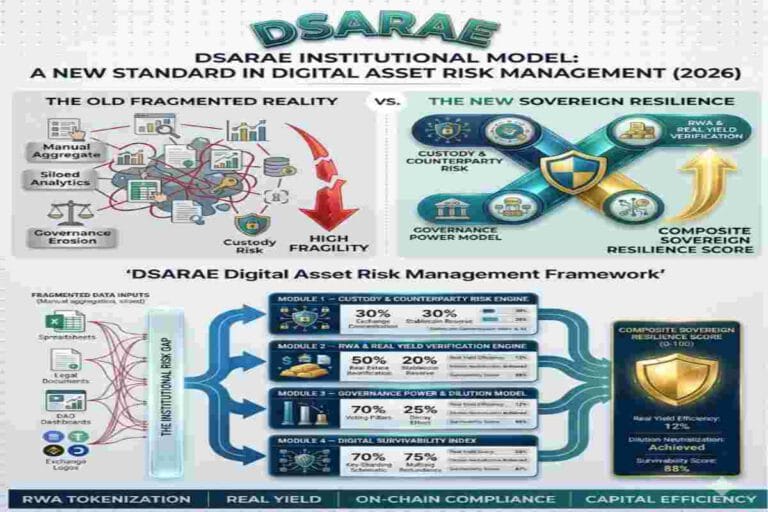
Despite advantages, challenges remain:
A modular, well-designed architecture helps mitigate these risks.
| Metric | 2024 | 2026 (Est.) | Growth |
|---|---|---|---|
| Autonomous agents | 12,000 | 120,000+ | 10x |
| Multi-chain workflows | 1,500 | 18,000+ | 12x |
| Enterprise adoption | Low | High | Rapid |
| Cross-chain messages | 3M | 45M+ | 15x |
| AI integration | Minimal | Expanding | Significant |
AI Agents in Web3 Tool is an all-in-one, next-generation On-Chain Asset Management dashboard. It is a unified command center designed for Digital Sovereignty 2026, where an investor can manage multi-chain portfolios, simulate AI-driven growth strategies, and benchmark human speed against autonomous agents. It aggregates five core modules (AI Agent ROI, Real-Time Gain, AI vs Human Speed, Web3 Portfolio Lite, and AI Strategy Advisor) into a cohesive interface, acting as the definitive Web3 portfolio yield monitor of its era.
The interface guide details a simple, three-step “How To Use” loop that makes complex portfolio management intuitive:
As the Web3 Ecosystem expands, managing assets across multiple Layer-1s, Layer-2s, and complex DeFi protocols becomes operationally fragmented and inefficient. The interface directly tackles this by providing:
The system delivers unparalleled advantages for achieving Digital Sovereignty 2026:
The dashboard is structured into logical layers that flow from input to outcome.
This central component, Web3 Portfolio Lite, acts as the engine for estimation. It takes user inputs—either via an “Optional Mock Wallet Address” or through direct entry of “DEMO MOCK” values like ETH, USDC, or “Other Tokens.” The tool then synthesizes this data to generate instantaneous Real-Time Gain metrics, including an automated Asset Breakdown & Risk summary.
The system immediately calculates and visualizes:
This module translates data into strategy. The system analyzes the “Your Profile” inputs (e.g., a “Medium-Balanced” risk appetite) and generates a tailored AI Strategy Recommendation (e.g., “Balanced Harvest AI”). The recommendation identifies target yield ranges (e.g., “8% – 15% APY”) and selects the optimal execution method (e.g., “Yield + Basis trading”) based on the current market architecture.
The growth of AI agents in Web3 is still in an early but measurable phase. While adoption varies across ecosystems, several indicators suggest increasing integration of autonomous systems, execution infrastructure, and machine-driven coordination within crypto markets.
Rather than rapid exponential claims, current data points reflect a gradual shift toward automation, particularly in trading, liquidity management, and cross-chain operations.
| Metric | Observation (2025–2026) | Implication |
|---|---|---|
| AI-driven transaction share | Increasing across DeFi protocols | Automation is becoming a larger part of execution flow |
| Adoption of AI crypto agents | Growing among advanced users and funds | Early-stage but expanding use in trading and strategy |
| MEV extraction complexity | Rising with more sophisticated strategies | Execution layer becoming more competitive and optimized |
| Cross-chain activity | Higher demand for automated routing | Interoperability requires machine-level coordination |
| Institutional experimentation | Ongoing pilots in AI + blockchain systems | Indicates long-term interest, not short-term hype |
| Infrastructure funding trends | Continued investment in AI + Web3 tooling | Focus shifting toward backend systems |
| Smart contract interaction frequency | Increasing via automated scripts/agents | Reduced reliance on manual user interaction |
| Data dependency (oracles, feeds) | Expanding importance | Reliable data is critical for agent decision-making |
Current trends suggest that AI agents in Web3 are not yet dominant, but their role is steadily increasing in areas where speed, coordination, and continuous execution provide advantages.
This positions AI-driven systems as a supporting layer in today’s market, with the potential to become a more central component of crypto infrastructure over time.
Q: What are AI agents in the 2026 Web3 ecosystem?
AI agents are autonomous programs that analyze data, make decisions, and execute transactions across blockchain networks without human input. In 2026, they serve as the “Automated Labor” layer of the Sovereign Internet Stack.
Case Study Failure: In 2024, “bots” were simple scripts that failed during high volatility. The Success: 2026 AI agents use Large World Models to maintain uptime and strategy during Correction Cycles, leading to 60% better risk-adjusted returns.
Q: How do AI agents work in the modern crypto market?
They combine neural-network decision-making with on-chain execution. By utilizing real-time data feeds, these agents monitor Support Zones and execute trades at millisecond speeds, far surpassing human reaction times.
Q: What is the “Agent Economy” in Web3?
It’s a system where autonomous agents act as independent economic participants. These agents earn, spend, and manage assets using on-chain wallets, creating a 24/7 “Machine-to-Machine” (M2M) marketplace.
Q: What is AI agent interoperability, and why does it matter?
This refers to the ability of agents to communicate and operate across multiple blockchains. It is the core of [Web3 Interoperability Architecture], allowing an agent to move liquidity from Ethereum to a Sovereign Reserve on another chain instantly.
Case Study Failure: Early 2025 agents were “Chain-Locked,” meaning they couldn’t move funds to safety when a network became congested. The Success: 2026 Cross-Chain Messaging Protocols allow agents to hop between ecosystems to find the highest yield and lowest risk.
Q: How are AI agents utilized within DeFi protocols?
Agents are the primary drivers of yield optimization, liquidity management, and risk monitoring. They act as “Digital Asset Managers” that never sleep, constantly rebalancing portfolios to maintain a Digital Fortress.
Q: Can AI agents manage DAO governance and voting?
Yes. In 2026, Governance Agents can vote on behalf of users in DAOs based on preset preferences, on-chain reputation, or custom logic, ensuring transparent and scalable decision-making.
Q: Are Web3 AI agents safe, or can they drain my wallet?
While 2026 architectures use TEE (Trusted Execution Environments) to keep private keys safe, they are still susceptible to session crashes or logic errors.
Case Study Failure: In February 2026, an autonomous social agent misread an X post and accidentally gave away 5% of its entire token supply ($450,000) because of a memory-wipe crash. The Success: Strict Account Abstraction boundaries and limit-vaults prevent agents from signing irreversible, massive transfers without human override.
Q: How do developers monetize AI agents in Web3? A: Token Launchpads (like Virtuals Protocol) allow creators to tokenize their agents. Users buy the agent’s token to gain a stake in its behavior, and a portion of the agent’s on-chain revenue is used to buy back and burn tokens.
Q: What are the main challenges for AI agents in blockchain today? A: The primary bottlenecks are Blockchain Scalability (high-frequency agent transactions can congest Layer 1 networks) and AI Hallucinations (where a small miscalculation in a smart contract audit can lead to real financial losses).
Q: Can I use an AI agent to build a defensive portfolio automatically? A: Yes. In a Crypto Market Update scenario, you can prompt your agent to “Make my portfolio more defensive,” and it will scan on-chain metrics, liquidate high-risk meme tokens, and buy stablecoins or interest-bearing RWAs.
AI agents in Web3 are redefining how blockchain systems operate — shifting from user-driven interaction to machine-driven execution.
As autonomous agents blockchain systems evolve, and AI agent interoperability Web3 improves, the foundations of a fully automated, multi-chain ecosystem are being established.
The transition toward an agent economy crypto model represents a fundamental change in how value is created, managed, and distributed — not by users alone, but by intelligent systems operating at scale.
Welcome to OwnProCrypto (Own & Pro Crypto) — a next-generation Bitcoin and blockchain education platform where the science of finance meets the power of AI-driven automation.
Our mission is simple: to equip you with the knowledge, frameworks, and tools needed to make smarter financial and business decisions in the Web3 economy.
Beyond analysis, OwnProCrypto focuses on transparency, verifiable data, and practical frameworks that investors and builders can actually use. Our goal is not hype — but clear thinking, disciplined analysis, and long-term value creation in the decentralized economy.
Our Background: Salim (Sam) is the founder and lead researcher behind OwnProCrypto, a Web3 intelligence platform focused on crypto security, digital ownership, stablecoin systems, interoperability, and institutional blockchain infrastructure.
Crypto Tools & Analysis:
Crypto Fundamental Analysis Tool | Protocol Evaluation System | DeFi Risk Analysis Tools | Crypto Portfolio Dashboard | Token Risk vs Reward Tool
Guides:
Crypto Fundamental Analysis | Blockchain Project Evaluation | Tokenomics Analysis | DeFi Protocol Analysis | Capital Efficiency
© 2026 OwnProCrypto — Built for smarter crypto decisions