
Search by title, topic or phrase
Use our Crypto Search Engine 🔍 to find the topics and keywords you're looking for.
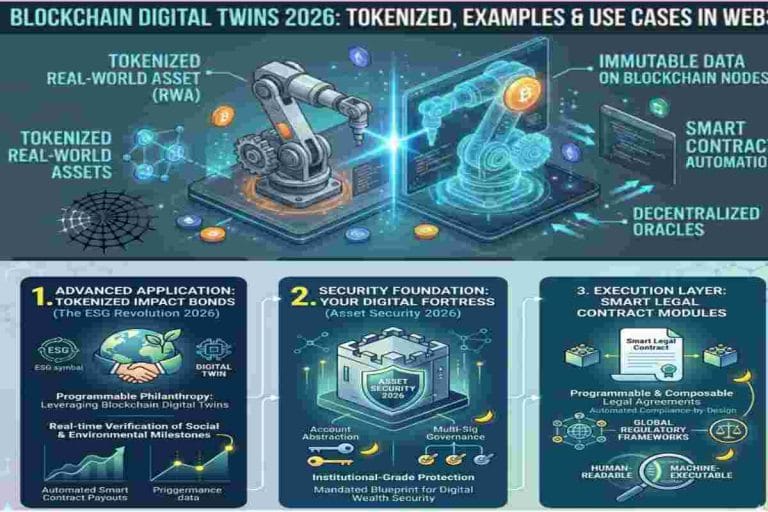
Table of Contents
ToggleThe Blockchain Digital Twin Lifecycle is emerging as a foundational framework for enterprises exploring tokenized real-world assets (RWA), industrial Web3 infrastructure, and decentralized asset management systems. As organizations increasingly digitize operational environments, the convergence of digital twin technology, blockchain networks, and IoT-enabled data infrastructure is enabling physical assets to evolve into programmable, data-driven financial instruments.
A blockchain-enabled digital twin creates a synchronized digital representation of a physical asset, infrastructure system, or industrial machine that continuously updates through IoT telemetry, data oracle/API feeds, and decentralized validation networks. By combining asset mirroring with Web3 infrastructure, real-time data synchronization, and smart contract automation, enterprises can maintain a transparent, tamper-resistant record of operational performance, ownership structures, and financial activity.
Within this framework, the digital twin becomes more than a monitoring model—it functions as an operational intelligence layer capable of interacting with tokenized markets and automated governance systems. Technologies such as sub-second oracle synchronization, smart contract automation for asset governance, and tokenization models for digital twin assets allow physical infrastructure to participate in decentralized ecosystems while maintaining a direct connection to real-world performance data.
As regulatory and technical standards evolve, innovations like ERC-7586 smart legal contracts for tokenized infrastructure are beginning to bridge the gap between blockchain automation and enforceable legal agreements. This integration enables organizations to design compliance-aware digital asset systems that support fractional ownership, automated revenue distribution, and transparent lifecycle management.
To understand how these technologies work together, this guide explores the core components of the Blockchain Digital Twin Lifecycle, including Web3-based asset mirroring, oracle-powered data synchronization, tokenization frameworks, smart contract governance, and enterprise deployment models. These components collectively form the technical foundation for operational intelligence systems built on blockchain digital twins, enabling organizations to transform physical infrastructure into programmable digital economic assets.
While the foundation of any scalable dApp starts with the Web3 Backend Infrastructure Stack, the next evolution for industrial enterprises is the integration of real-time physical data into the blockchain state.
This lifecycle is a practical application of the broader framework found in our RWA Tokenization 2026 (Same Tab). To understand the technical standards for these twins, review the Digital Twin Consortium (New Tab) guidelines.
The Blockchain Digital Twin Lifecycle integrates several technologies across both physical and digital environments.
These systems work together to maintain real-time synchronization between physical infrastructure and its on-chain digital representation.
| Infrastructure Layer | Role in Digital Twin Lifecycle |
|---|---|
| Physical Asset Layer | Industrial machines, logistics assets, energy systems |
| IoT Sensor Network | Collects real-world telemetry data |
| Edge Processing Systems | Cleans and structures operational signals |
| Oracle Data Networks | Transmit verified data to blockchain |
| Smart Contract Layer | Automates asset governance and triggers |
| Tokenization Layer | Represents ownership and financial rights |
| Decentralized Market Layer | Enables asset liquidity and trading |
This multi-layer architecture allows organizations to connect industrial IoT networks, digital twin simulation engines, and decentralized finance infrastructure.
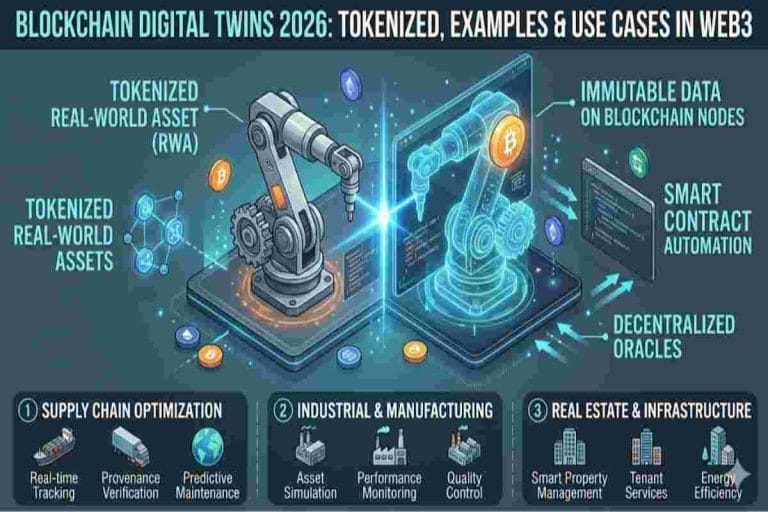
Asset mirroring is the first operational stage of the Blockchain Digital Twin Lifecycle. It involves creating a synchronized digital model that reflects the real-time condition and operational state of a physical asset.
Unlike traditional simulation models, Web3-enabled asset mirroring connects digital twin data streams directly to blockchain infrastructure, ensuring that asset activity becomes immutable, verifiable, and programmable.
| Layer | Description |
|---|---|
| Physical Asset | Machine, facility, energy grid component |
| IoT Sensors | Capture telemetry data and environmental signals |
| Digital Twin Engine | Simulates the asset in a virtual environment |
| Blockchain Network | Stores verified data events |
| Tokenization Protocol | Represents asset ownership and value |
Industries adopting blockchain digital twins include:
By establishing Web3 asset mirroring, enterprises create the operational foundation required for tokenized infrastructure.
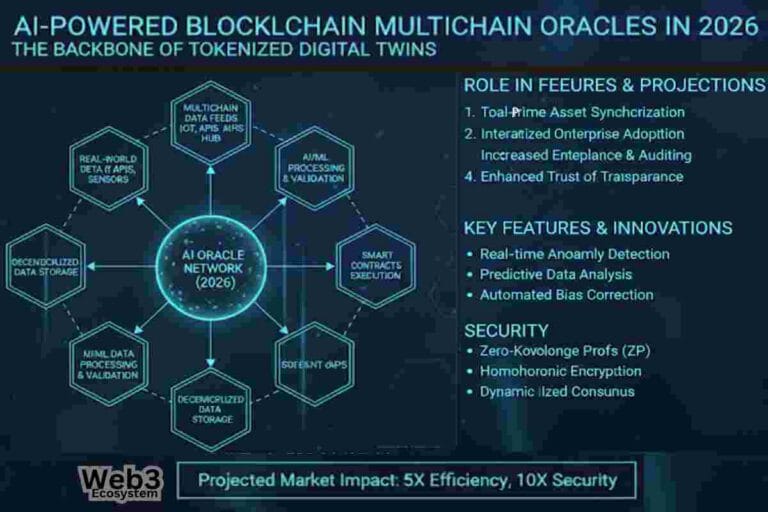
A critical component of the Blockchain Digital Twin Lifecycle is the integration of data oracle networks and API feeds.
Because blockchain systems cannot directly access external information, oracles act as trusted bridges between off-chain data sources and on-chain smart contracts.
For digital twins, these feeds deliver operational signals such as:
| Data Layer | Function |
|---|---|
| Sensor Input Layer | Captures operational signals |
| Data Aggregation Layer | Normalizes data formats |
| Oracle Validation Network | Confirms authenticity |
| Blockchain Smart Contract Layer | Executes automated actions |
Reliable oracle networks, decentralized data feeds, and API integrations ensure that the digital twin remains synchronized with real-world asset conditions.
High-performance digital twin environments require low-latency data transmission to maintain accurate synchronization.
If oracle update latency exceeds operational thresholds, smart contracts may respond too late to critical asset events.
| Metric | Enterprise Target |
|---|---|
| Data Update Frequency | < 1 second |
| Oracle Processing Time | 200–500 ms |
| Data Reliability | 99.9% uptime |
| Fault Tolerance | Multi-node validation |
Low-latency oracle infrastructure enables:
This synchronization capability is essential for high-frequency operational environments such as manufacturing plants, logistics networks, and energy grids.
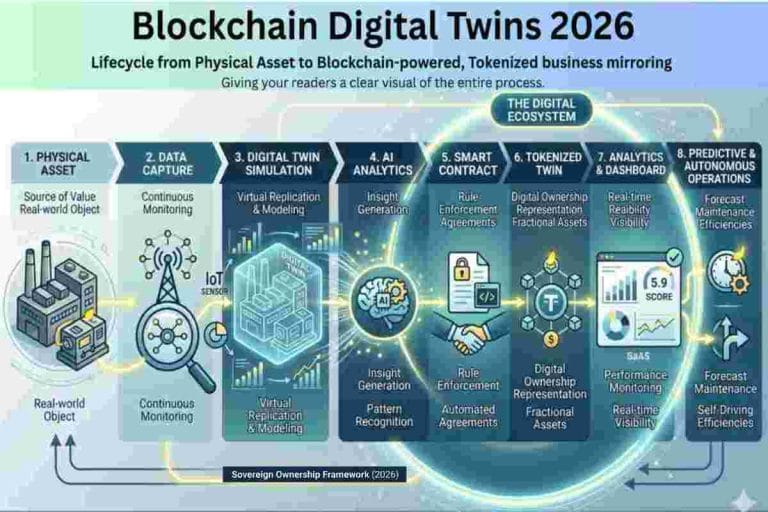
Once the digital twin is synchronized, the next stage of the Blockchain Digital Twin Lifecycle is tokenization.
Tokenization converts the digital twin into an on-chain financial representation of a real-world asset.
Common token structures include:
| Token Model | Purpose |
|---|---|
| NFT Digital Twin | Unique asset representation |
| Fractional Tokens | Shared asset ownership |
| Utility Tokens | Access to infrastructure services |
| Governance Tokens | Community voting rights |
Tokenization enables fractional investment, decentralized asset ownership, and increased liquidity for traditionally illiquid infrastructure assets.

Smart contracts function as the automation layer of the Blockchain Digital Twin Lifecycle.
They control asset behavior by executing logic based on real-time operational data received from oracle feeds.
| Trigger Condition | Automated Action |
|---|---|
| Machine temperature exceeds threshold | Initiate maintenance workflow |
| Energy output reaches target | Distribute yield to token holders |
| Lease payment deadline reached | Execute payment transfer |
| Asset ownership transfer request | Perform compliance verification |
Through programmable governance, digital twin assets become autonomous economic systems capable of executing operational decisions automatically.
One emerging innovation supporting the Blockchain Digital Twin Lifecycle is the introduction of ERC-7586 smart legal contracts.
This framework connects blockchain smart contracts with legally enforceable agreements, allowing digital assets to comply with jurisdictional regulations.
| Feature | Operational Impact |
|---|---|
| Embedded legal clauses | Contract enforcement |
| Compliance triggers | Regulatory adherence |
| On-chain documentation | Transparent legal records |
| Jurisdiction metadata | Regional compliance validation |
By embedding legal logic directly into asset tokens, organizations can deploy compliance-by-design infrastructure for tokenized industrial systems.
As the lifecycle matures, digital twins evolve into real-time operational intelligence systems.
By combining AI analytics, machine learning models, and blockchain data records, enterprises can extract predictive insights from asset performance.
| Metric | Estimated Improvement |
|---|---|
| Maintenance Costs | 25–35% reduction |
| Operational Downtime | 30–45% reduction |
| Energy Consumption | 15–20% reduction |
| Asset Utilization | 10–25% improvement |
These analytics capabilities transform digital twins into strategic infrastructure intelligence platforms.
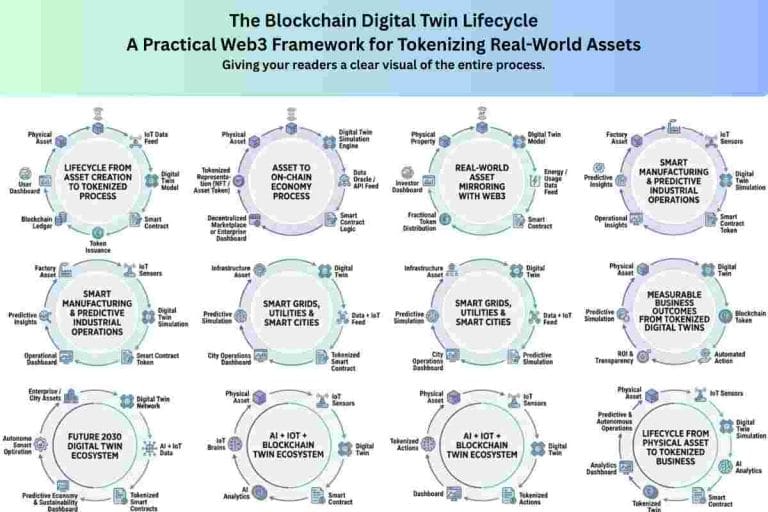
Organizations adopting the Blockchain Digital Twin Lifecycle often follow a phased deployment model.
| Phase | Objective |
|---|---|
| Asset Digitization | Deploy sensors and telemetry collection |
| Digital Twin Modeling | Create virtual asset simulation |
| Oracle Integration | Connect external data feeds |
| Tokenization | Issue asset-backed blockchain tokens |
| Smart Contract Automation | Implement operational governance |
| Market Activation | Enable decentralized trading and liquidity |
This structured approach helps enterprises deploy scalable digital twin infrastructure within Web3 ecosystems.
The final phase of the lifecycle focuses on capturing and distributing the value generated by the synchronized, optimized asset system.
Because every action, data point, and transaction is recorded immutably on the blockchain, this phase offers unprecedented transparency. Enterprises can access Measurable Business Outcomes through intuitive Operational Dashboards, where performance metrics are linked directly to token performance and revenue distribution. This eliminates the “trust gap” in complex supply chains or fractionalized investment vehicles.
The true financial innovation of this lifecycle is the enablement of Decentralized Marketplaces or Enterprise Dashboards. Since the asset is already represented by a verified, programmable token, it can be easily fractionalized, allowing a broader pool of investors to gain exposure to high-value industrial assets (like a single machine in a factory or a portion of a smart grid). Smart contracts manage the real-time distribution of ROI and ensure transparency for all stakeholders.
How the Blockchain Digital Twin Lifecycle Works
What is a blockchain digital twin?
A blockchain digital twin is a real-time digital representation of a physical asset that is synchronized with blockchain infrastructure. It combines IoT sensor data, decentralized oracle networks, and smart contracts to maintain a continuously updated record of an asset’s state, performance, and ownership.
Unlike traditional digital twins, blockchain-enabled twins create immutable records of operational data and financial activity, allowing organizations to securely manage asset tokenization, automated governance, and transparent performance tracking.
How do digital twins enable real-world asset (RWA) tokenization?
Digital twins enable real-world asset (RWA) tokenization by creating a verified digital model of a physical asset that continuously updates with operational data.
Once synchronized, the asset can be represented as on-chain tokens, allowing ownership to be fractionalized, traded, or integrated into decentralized finance systems.
This structure ensures that token value remains directly connected to the real-world performance and operational metrics of the underlying asset.
How does asset mirroring work in Web3?
Asset mirroring is the process of creating a blockchain-connected digital replica of a physical asset.
Sensors and monitoring systems collect telemetry data from the physical environment. Oracle networks then transmit the validated data to blockchain infrastructure, where the digital twin is updated in real time.
This mirrored representation allows assets to interact with smart contracts, decentralized applications, and tokenized asset markets.
What role do oracles play in digital twin infrastructure?
Oracles act as the data bridge between off-chain systems and blockchain networks.
In digital twin architectures, oracles collect and verify data from sources such as:
This verified information is transmitted to smart contracts, ensuring the digital twin remains accurately synchronized with its physical counterpart.
Why is sub-second latency important for digital twins?
Industrial digital twins often require near real-time operational updates.
Sub-second oracle latency ensures that sensor data reaches blockchain networks quickly enough to support:
Without low-latency data synchronization, the digital twin may become outdated, reducing its effectiveness for analytics and automation.
What are smart legal contracts in blockchain systems?
Smart legal contracts are blockchain-based agreements that combine traditional legal frameworks with automated smart contract execution.
These contracts embed legally recognized terms directly into programmable code, enabling automatic enforcement of rules such as:
This hybrid model improves legal transparency, auditability, and operational efficiency.
Can digital twins automate maintenance and operations?
Yes. One of the most powerful capabilities of digital twins is predictive operational automation.
By analyzing both real-time and historical operational data, AI models can detect patterns that indicate potential equipment failure.
Smart contracts can then automatically trigger actions such as:
This automation reduces downtime and improves long-term asset performance.
How do tokenized digital twins create investment opportunities?
Tokenized digital twins allow physical infrastructure to be fractionalized into digital ownership tokens.
Investors can purchase a share of the asset and receive proportional returns generated by its real-world performance.
This approach introduces liquidity into traditionally illiquid assets such as:
Through blockchain tokenization, physical assets can participate in decentralized financial ecosystems.
What industries benefit most from blockchain digital twins?
Several industries are exploring digital twin tokenization to improve operational efficiency and financial transparency.
| Industry | Digital Twin Application |
|---|---|
| Manufacturing | Predictive maintenance and asset optimization |
| Energy | Smart grid monitoring and energy trading |
| Real Estate | Tokenized property ownership |
| Logistics | Supply chain transparency |
| Infrastructure | Smart city asset management |
These sectors benefit from real-time operational intelligence, automated governance, and tokenized investment models.
What is the future of digital twins in Web3 ecosystems?
The future of digital twins in Web3 lies in the convergence of several emerging technologies, including:
As these technologies mature, digital twins may become the foundational infrastructure for managing physical assets within decentralized economic networks.
Organizations could eventually operate fully tokenized industrial ecosystems, where operational performance, asset ownership, and financial value are connected through blockchain-based digital twin systems.

Understanding digital twins is merely the foundational step in the broader migration toward on-chain institutional finance. To move from theoretical concepts to high-level execution, you must explore the real-world applications within our specialized report: Blockchain Digital Twins 2026: Tokenized Examples & Use Cases in Web3.
For a comprehensive strategic overview of how these digital twins integrate into diversified institutional portfolios, explore our pillar post: RWA Tokenization 2026: Guide to Real-World Asset Portfolios. This guide provides the definitive structural blueprint for managing tokenized bonds, funds, and physical assets within a secure, high-yield Web3 ecosystem.
Tokenized Impact Bonds represent the pinnacle of “Programmable Philanthropy.” By leveraging blockchain-based digital twins, these instruments facilitate the real-time verification of social and environmental milestones.
Instead of enduring months of opaque third-party audits, smart contracts trigger automated payouts the moment performance data is mirrored on-chain. This architecture creates a high-trust environment for institutional investors seeking transparent, data-driven ESG returns with zero settlement latency.
High-value impact bonds demand institutional-grade protection. Before allocating capital into these complex instruments, it is critical to ensure your underlying infrastructure is impenetrable.
Our comprehensive manual, Asset Security 2026: Setting Up Your Digital Fortress, provides the mandatory blueprint for Account Abstraction and Multi-sig Governance. You cannot effectively manage sovereign assets without first securing the gateway to your digital wealth.
The legal enforceability of a tokenized bond is only as resilient as its underlying code. To bridge the gap between “Code is Law” and traditional statutory systems, we utilize Smart Legal Contract Modules.
These composable building blocks allow for programmable legal agreements that are simultaneously human-readable and machine-executable. By integrating these modules, issuers can automate “Compliance-by-Design,” ensuring every tokenized instrument remains harmonized with global regulatory frameworks.
Master the Web3 Lifecycle:
The Blockchain Digital Twin Lifecycle represents a major shift in how organizations manage and monetize physical infrastructure. By combining asset mirroring, oracle data synchronization, smart contract automation, and decentralized marketplaces, enterprises can transform traditional industrial assets into programmable digital economic units.
This framework enables organizations to bridge the gap between operational technology (OT) and blockchain-based financial systems, creating new opportunities for transparency, efficiency, and asset liquidity.
As IoT networks, AI analytics, and Web3 infrastructure continue to mature, digital twins will likely become a core foundation for tokenized real-world asset ecosystems, enabling industries to track, automate, and finance physical assets through decentralized platforms.
For institutions exploring the regulatory and technical foundations of digital infrastructure, trusted research from public institutions such as the U.S. National Institute of Standards and Technology can provide valuable guidance on digital twin frameworks and industrial IoT systems:
| Topic | Key Insight |
|---|---|
| Blockchain Digital Twins | Enable real-time digital replicas of physical assets |
| Asset Mirroring | Connects industrial infrastructure to Web3 ecosystems |
| Data Oracles | Ensure accurate and verified real-world data on-chain |
| Smart Contracts | Automate governance, payments, and operational triggers |
| Tokenization | Allows fractional ownership and new liquidity models |
| Enterprise Impact | Improves transparency, predictive operations, and ROI visibility |
Organizations that adopt the Blockchain Digital Twin Lifecycle gain the ability to convert physical infrastructure into data-driven financial assets, unlocking operational efficiency while enabling decentralized investment models for real-world systems.