
Table of Contents
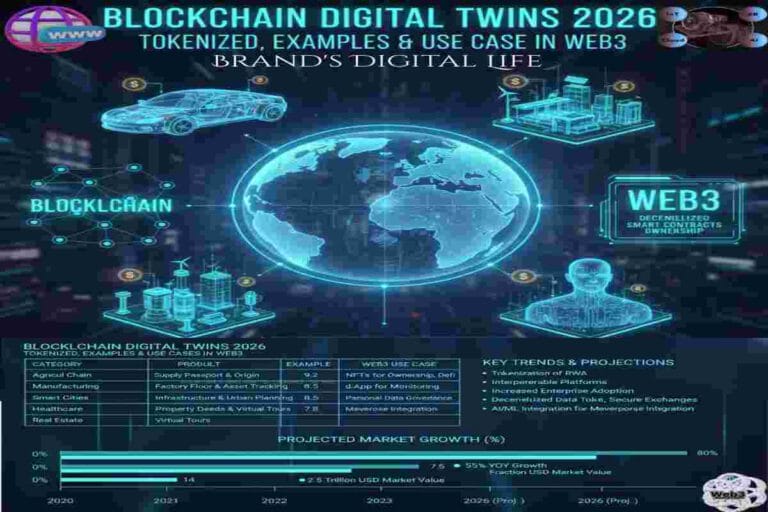
ToggleImagine having a digital shadow of your physical business — a dynamic replica that mirrors operations, predicts risks, and simulates outcomes before they happen. This concept lies at the heart of digital twin technology, which is now evolving rapidly within Web3 and blockchain ecosystems.
A digital twin is a virtual model of a real-world asset, system, or infrastructure that continuously updates using operational data. When integrated with blockchain networks, these models become verifiable, secure, and capable of supporting tokenized real-world assets (RWA). This new generation of systems—often called blockchain digital twins—allows organizations to manage physical assets through transparent, programmable digital infrastructure.
In Web3 environments, digital twins can move beyond simulation to become tokenized economic entities, enabling on-chain asset tracking, decentralized governance, and automated smart contract execution. As enterprises explore Web3 asset tokenization and industrial digital twins, understanding the architecture and use cases of these systems is becoming increasingly important.
April 2026 sees growing adoption of blockchain-powered digital twins across industries like supply chains, energy, and manufacturing, as enterprises push for greater transparency and real-time data integrity. With improved integration between IoT systems and decentralized ledgers, digital twins are evolving from experimental tools into operational assets that mirror physical infrastructure with verifiable data. The impact is significant: businesses are moving toward trust-minimized, data-driven decision-making, where blockchain-secured digital replicas enhance efficiency, reduce fraud, and enable more resilient global operations.In this guide, we will explore:
• What Are Tokenized Digital Twins in Web3?
• Core Components of Tokenized Digital Twins
• How Web3 Tokenizes Real World Assets Using Digital Twins
• Blockchain Digital Twin Examples Across Industries
• Real Estate & Infrastructure Tokenization
• Supply Chain & On-Chain Industrial Tracking
• Energy Grids & Smart Cities
• Digital Twin Tokenization Use Cases in 2026
• Smart Manufacturing & Predictive Industrial Operations
Together, these sections explain how blockchain digital twins are transforming physical infrastructure into programmable digital assets within decentralized ecosystems.
While the foundation of any scalable dApp starts with the Web3 Backend Infrastructure Stack, the next evolution for industrial enterprises is the integration of real-time physical data into the blockchain state.
Digital twins represent the bridge between physical assets and the RWA Tokenization 2026 framework. Discover real-world use cases through the UNDP Blockchain Academy.
Tokenized digital twins in Web3 are blockchain-secured digital replicas of physical assets that are represented by programmable tokens. Unlike traditional digital twins used only for simulation, tokenized twins integrate smart contracts to enable ownership tracking, automated updates, and decentralized verification.
In simple terms, a digital twin becomes economically functional once tokenized. It can represent machinery, infrastructure, real estate, logistics assets, or even energy systems — with its lifecycle recorded on-chain.
Web3 transforms digital twins from monitoring tools into autonomous, trustless digital assets.
This structure typically combines:
The result is real-time asset mirroring with programmable economic functionality.
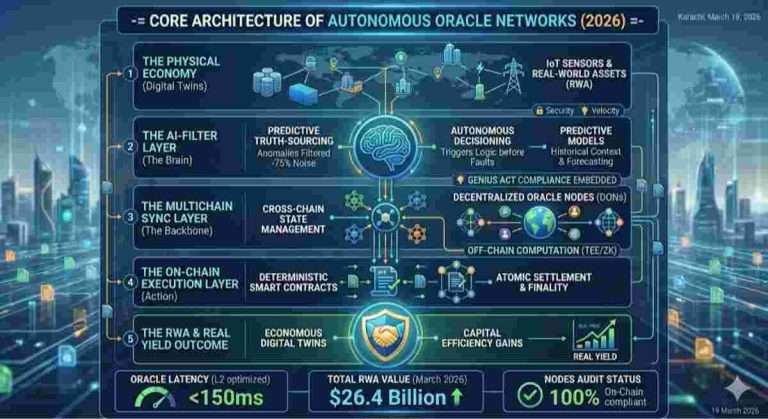
Below is a simplified structural model:
| Layer | Function | Technology Used |
|---|---|---|
| Physical Asset Layer | Real-world machinery, infrastructure, property | Sensors, IoT devices |
| Data Synchronization Layer | Real-time data transmission | APIs, Oracles |
| Digital Twin Model | Virtual replica & simulation engine | CAD, AI models |
| Tokenization Layer | Assigns digital ownership & programmability | NFTs, Asset tokens |
| Blockchain Layer | Immutable ledger & smart contract logic | Web3 protocol |
This layered architecture enables secure on-chain industrial tracking and real world asset mirroring without centralized databases.
| Metric | Projection / Industry Insight |
|---|---|
| Enterprise adoption of digital twins | Rapidly increasing in manufacturing & logistics |
| Tokenized real-world asset market growth | Multi-trillion dollar trajectory |
| Blockchain integration trend | Shift from pilot programs to infrastructure-level deployment |
| Key sectors adopting | Energy, Smart Cities, Real Estate, Industrial IoT |
These trends explain why digital twin tokenization use cases in 2026 are expanding beyond experimentation into operational systems.
|
Physical Asset |
→ |
IoT Data Feed |
→ |
Digital Twin Model |
→ |
Smart Contract |
→ |
Token Issuance |
→ |
Blockchain Ledger |
→ |
User Dashboard |
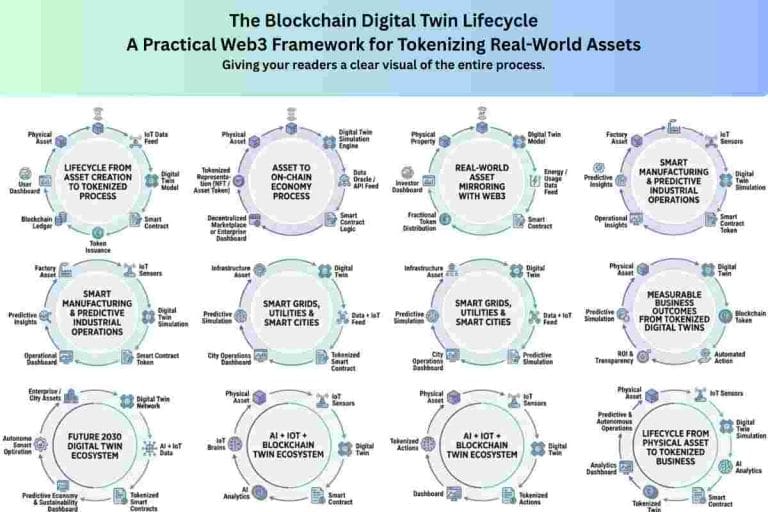
This simple linear diagram helps you understand the lifecycle from asset creation to tokenized representation.
Web3 tokenizes real world assets by transforming physical ownership and operational data into programmable blockchain representations. When combined with digital twins, this process creates a synchronized system where the physical asset and its on-chain counterpart evolve together.
Unlike traditional asset digitization, Web3 tokenization introduces:
In the context of blockchain digital twins, the token does not merely represent value — it represents the operational state, ownership rights, and lifecycle data of the physical asset.
This creates a system where industrial machinery, infrastructure, or property can be monitored, simulated, and economically transacted in decentralized environments.
| Step | Process | Outcome |
|---|---|---|
| 1 | Physical asset identified | Asset qualifies for digital modeling |
| 2 | Digital twin created | Virtual model mirrors structure & behavior |
| 3 | IoT data integrated | Real-time updates enabled |
| 4 | Smart contract deployed | Rules & automation defined |
| 5 | Token issued (NFT or asset token) | Ownership & programmability established |
| 6 | Blockchain recording | Transparent, immutable history created |
This process ensures that the digital twin token model is not static — it evolves with the physical system.
| Indicator | Strategic Impact |
|---|---|
| Growing demand for asset transparency | Drives adoption of on-chain industrial tracking |
| Increased institutional interest in RWAs | Expands tokenized infrastructure models |
| Automation of compliance processes | Reduces operational friction |
| Integration with AI analytics | Enables predictive forecasting |
The convergence of blockchain, IoT, and AI is accelerating digital twin tokenization use cases in 2026 across multiple industries.
|
Physical Asset |
→ |
Digital Twin Simulation Engine |
→ |
Data Oracle / API Feed |
→ |
Smart Contract Logic |
→ |
Tokenized Representation (NFT / Asset Token) |
→ |
Decentralized Marketplace or Enterprise Dashboard |
This diagram reinforces how Web3 tokenizes real world assets while maintaining synchronized asset mirroring.
Understanding the theory is important — but adoption proves value.
Blockchain digital twins are no longer experimental frameworks. In 2026, enterprises are integrating tokenized twin models into manufacturing, logistics, infrastructure, and energy systems to improve transparency and automation.
Below are practical examples showing how digital twins evolve when combined with blockchain tokenization.
Industrial Manufacturing & Predictive Maintenance
Factories are deploying digital twins of heavy machinery connected to IoT sensors. These twins simulate wear, forecast failures, and record operational performance on-chain.
When tokenized:
Fact & Figure Snapshot
| Metric | Operational Impact |
|---|---|
| Predictive maintenance accuracy | Reduces downtime significantly |
| Lifecycle data immutability | Improves resale asset valuation |
| Smart contract automation | Reduces manual compliance reporting |
| On-chain tracking | Strengthens supply chain trust |
This model combines industrial asset simulation blockchain systems with economic token logic.
Real estate portfolios are being mirrored as blockchain-based digital twins. Each building has a virtual model reflecting:
Tokenization enables:
Structural Flow Diagram
|
Physical Property |
→ |
Digital Twin Model |
→ |
Energy / Usage Data Feed |
→ |
Smart Contract |
→ |
Fractional Token Distribution |
→ |
Investor Dashboard |
This is real world asset mirroring enhanced by Web3 infrastructure.
Logistics networks now create digital twins of containers, fleets, and cargo systems. These blockchain-integrated twins provide:
Fact & Figure Table
| Feature | Benefit |
|---|---|
| On-chain timestamping | Eliminates document disputes |
| Sensor-linked twin updates | Reduces fraud risk |
| Automated settlement contracts | Speeds up payment cycles |
| Shared ledger visibility | Improves multi-party coordination |
This is where blockchain digital twin examples become economically transformative — not just technically interesting.
Energy infrastructure is increasingly mirrored as tokenized digital twins to manage decentralized grids.
Applications include:
Emerging Trend Snapshot
| Sector | Why Digital Twins + Blockchain Matter |
|---|---|
| Renewable energy | Transparent carbon credit accounting |
| Smart infrastructure | Predictive maintenance automation |
| Public utilities | Decentralized governance models |
| Urban planning | Data-backed infrastructure simulations |
This is where digital twin tokenization use cases 2026 expand beyond enterprise into civic-scale ecosystems.
By 2026, tokenized digital twins in Web3 are no longer just experimental prototypes — they are operational, economic, and predictive tools across industries. Businesses, cities, and governments are using them to reduce risk, automate operations, and unlock decentralized value.
Tokenization enables programmable ownership of assets, while digital twins provide predictive simulations. Together, they create autonomous, self-verifying systems where physical assets are mirrored on-chain for transparency, efficiency, and monetization.
Factories of the future use tokenized digital twins to simulate production lines, forecast equipment wear, and manage supply chain bottlenecks.
| Use Case | Benefit | Tokenization Role |
|---|---|---|
| Equipment lifecycle simulation | Reduces downtime & maintenance cost | NFT or fractional token represents each machine |
| Supply chain risk prediction | Minimizes delays & losses | Smart contracts automate alerts & settlement |
| Factory energy optimization | Reduces waste | Twins record energy usage & tokenized credits for energy savings |
Diagram Template:
|
Factory Asset |
→ |
IoT Sensors |
→ |
Digital Twin Simulation |
→ |
Smart Contract Token |
→ |
Operational Dashboard |
→ |
Predictive Insights |
Buildings, bridges, and campuses are mirrored digitally and tokenized, enabling fractional investment, automated compliance, and real-time monitoring.
| Use Case | Benefit | Tokenization Role |
|---|---|---|
| Fractional property ownership | Democratizes investment | Tokens represent ownership shares |
| Automated maintenance scheduling | Reduces operational risk | Twins simulate asset wear & trigger contracts |
| Energy & utility management | Optimizes costs | On-chain tracking of real-time usage |
This extends real world asset mirroring into financial and operational transparency.
Tokenized twins transform traditional logistics into trustless, transparent networks:
| Use Case | Benefit | Tokenization Role |
|---|---|---|
| Container & cargo tracking | Reduces theft/fraud | Tokens track location & status |
| Automated customs clearance | Speeds up transit | Smart contracts handle documentation |
| Predictive inventory management | Optimizes stock levels | Digital twin simulates consumption & replenishment |
This is exactly where industrial asset simulation blockchain meets operational efficiency.
Smart grids and municipal infrastructure now have tokenized twins that manage decentralized assets in real time:
| Use Case | Benefit | Tokenization Role |
|---|---|---|
| Renewable energy credit tracking | Transparent carbon reporting | Tokenized credits linked to twins |
| Traffic flow & urban planning | Reduces congestion & pollution | Simulated twins optimize routing |
| Predictive maintenance of utilities | Prevents outages | Blockchain records all activity & triggers contracts |
Diagram Template:
|
Infrastructure Asset |
→ |
Digital Twin |
→ |
Data + IoT Feed |
→ |
Tokenized Smart Contract |
→ |
City Operations Dashboard |
→ |
Predictive Simulation |
Tokenized digital twins are not just technical tools — they are game-changers for decision-makers, engineers, investors, and urban planners alike. By combining digital shadow modeling, real-world asset mirroring, and blockchain tokenization, businesses gain unprecedented insight, automation, and economic value.
In 2026, the difference from older 2025 models is clear:
This shift transforms digital twins from a visualization tool into a strategic operational and economic asset.
| Benefit | Description | Semantic Keywords Applied |
|---|---|---|
| Predictive Operations | Forecast machinery wear, supply chain disruptions, and energy consumption before they happen | industrial asset simulation blockchain |
| Transparency & Trust | Immutable records for audits, investors, and regulators | on-chain industrial tracking, real world asset mirroring |
| Economic Flexibility | Tokenized assets enable fractional ownership, monetization, and trading | digital twin token models, blockchain digital twin examples |
| Strategic Planning | Use simulations to test new business strategies safely | digital twin tokenization use cases 2026 |
| Regulatory Compliance | Automated reporting reduces errors and penalties | tokenized digital twins in web3 |
| Sustainability Tracking | Monitor energy, emissions, and resource usage in real-time | digital twin tokenization, real world asset mirroring |
| Metric | Expected Improvement | Industry Example |
|---|---|---|
| Operational downtime | ↓ 30–50% | Manufacturing machinery twins |
| Maintenance costs | ↓ 20–40% | Industrial plants |
| Investment transparency | ↑ 90% | Tokenized real estate assets |
| Decision-making speed | ↑ 2–3x | Logistics & supply chains |
| Sustainability metrics | ↑ 25% | Energy grids & smart cities |
This data shows tangible ROI — a crucial differentiator from 2025 content, which mostly focused on theory or pilot studies.
|
Physical Asset |
→ |
Digital Twin |
→ |
Blockchain Token |
→ |
Predictive Simulation |
→ |
Automated Action |
→ |
OI & Transparency |
This visual framework reinforces how each layer contributes to measurable business outcomes, making the content practical, not just conceptual.
By 2030, tokenized digital twins are expected to reshape entire industries, economies, and cities. The combination of Web3, blockchain, IoT, AI, and predictive modeling will make digital twins fully autonomous, self-optimizing, and economically programmable.
No longer confined to single assets or factories, they will:
The future is not just digitized — it’s tokenized, mirrored, and economically intelligent.
| Industry | Use Case | Semantic Keywords Applied |
|---|---|---|
| Smart Cities | Fully tokenized urban infrastructure for traffic, utilities, and energy | digital twin tokenization use cases 2026, real world asset mirroring |
| Energy & Utilities | AI-driven predictive grids with on-chain energy credits | on-chain industrial tracking, blockchain digital twin examples |
| Manufacturing | Entire factories simulated & optimized in real time | industrial asset simulation blockchain |
| Real Estate & Infrastructure | Fractionalized, tokenized ownership for commercial and residential assets | digital twin token models, blockchain digital twin examples |
| Logistics & Supply Chains | Global networks tracked & automatically re-routed using predictive twins | real world asset mirroring, on-chain industrial tracking |
By 2030, your business won’t just predict the future — it will simulate, own, and transact it before a decision is made.
Imagine cities where energy, traffic, and public services run autonomously on tokenized digital twin networks — no human friction, just predictive intelligence.
| Metric | 2030 Projection | Notes |
|---|---|---|
| Enterprise adoption of tokenized twins | 70–80% of Fortune 500 & global smart cities | Predictive twin integration |
| Fractionalized asset value on-chain | $5–10 trillion | Real estate, infrastructure, industrial assets |
| Operational efficiency gains | ↑ 3–5x | AI-driven predictive optimization |
| Regulatory & compliance automation | 95% automated | Smart contract integration for all tokenized assets |
| Carbon footprint reduction | ↑ 30% | Energy & logistics twins simulate sustainability |
|
Enterprise / City Assets |
→ |
Digital Twin Network |
→ |
AI + IoT Data |
→ |
Tokenized Smart Contracts |
→ |
Autonomous Optimization |
→ |
Predictive Economy & Sustainability Dashboard |
This diagram shows how individual twins evolve into interconnected, self-governing digital ecosystems.
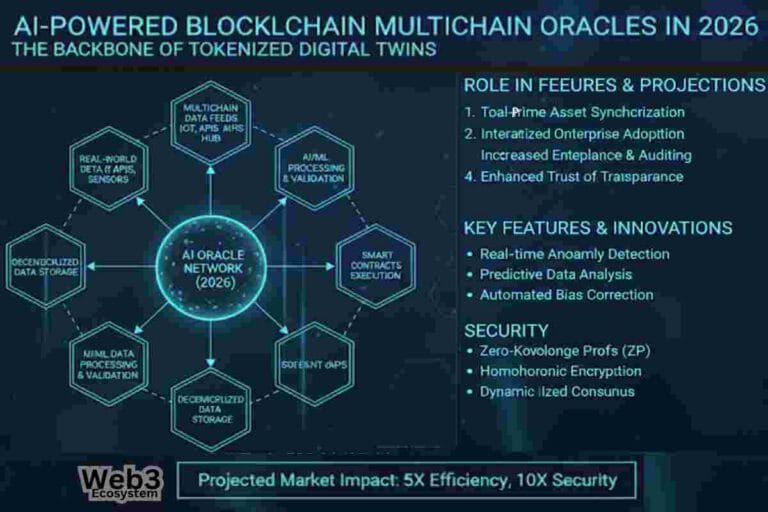
Tokenized digital twins do not operate in isolation. Their effectiveness in Web3 ecosystems relies on a network of complementary technologies that feed, secure, and enhance the digital twin environment. Understanding these technologies allows businesses to maximize benefits from real world asset mirroring, on-chain industrial tracking, and predictive operations.
Oracles act as secure bridges between off-chain data and on-chain smart contracts, ensuring that blockchain digital twins reflect accurate, real-time information from the physical world. Without oracles, digital twins cannot synchronize IoT sensor data or execute automated contracts reliably.
Key Roles of Oracles in Tokenized Twins:
| Role | Benefit | Example |
|---|---|---|
| Data Verification | Ensures on-chain updates match real-world changes | Chainlink oracles feeding industrial sensor data |
| Smart Contract Trigger | Automates maintenance or settlement based on real-time conditions | Automatic equipment repair orders |
| Decentralized Accuracy | Reduces single-point failure | Multi-source oracle networks for cross-validation |
Oracles transform industrial asset simulation blockchain into actionable, verifiable systems.
Digital twins rely on IoT devices to mirror their physical counterparts. Sensors capture data on temperature, movement, energy consumption, wear-and-tear, and operational metrics, feeding digital twins for simulation and predictive analysis.
Semantic Cluster Highlights:
Example Table – IoT Sensors in Digital Twins:
| Sensor Type | Data Captured | Use Case |
|---|---|---|
| Vibration | Equipment wear | Predictive maintenance |
| GPS / RFID | Asset location | Supply chain & logistics |
| Energy meters | Consumption metrics | Sustainable operations & energy tokenization |
| Environmental sensors | Temperature, humidity | Smart manufacturing & infrastructure |
AI integration enables tokenized digital twins to predict failures, optimize workflows, and recommend decisions automatically. The combination of AI with blockchain ensures autonomous operations with full auditability.
AI-driven Twin Benefits:
Diagram Template – AI + IoT + Blockchain Twin Ecosystem:
|
Physical Asset |
→ |
IoT Sensors |
→ |
Digital Twin |
→ |
AI Analytics |
→ |
Smart Contract |
→ |
Tokenized Actions |
→ |
Dashboard |
While blockchain provides immutability, cloud and edge computing enable computation-heavy simulations and real-time updates. Enterprises can run digital twin simulations at scale without latency issues while maintaining tokenized integrity on-chain.
Q: What are Blockchain Digital Twins?
A: Blockchain Digital Twins are decentralized digital replicas of physical or digital assets recorded on a blockchain. In the 2026 Web3 ecosystem, these twins allow real-world assets like buildings or industrial machines to be monitored and managed through secure, tamper-proof ledgers.
Q: What is the difference between a traditional digital twin and a blockchain digital twin?
A: A traditional digital twin is a virtual model used for simulation. A blockchain digital twin adds a layer of decentralized infrastructure, enabling secure data verification, asset tokenization, and immutable ownership tracking through smart contracts.
Q: How do Blockchain Digital Twins work in Web3?
A: They function by integrating IoT data, digital modeling, and blockchain infrastructure. While the twin mirrors the real-world asset’s state, the blockchain ensures that every update, ownership change, and transaction history is transparent and cryptographically secure.
Q: What are tokenized digital twins in Web3?
A: These are blockchain-resident representations of physical assets linked to smart contracts. They allow Real-World Assets (RWA) to be mirrored and traded as digital tokens, enabling fractional ownership and high-speed liquidity in decentralized markets.
Q: How does blockchain enable digital twin tokenization?
A: Blockchain assigns a unique identifier (such as an NFT or a specialized asset-backed token) to the digital replica. Smart contracts then manage the logic of ownership and synchronize data between the physical object and its on-chain counterpart.
Q: What are real-world asset mirroring systems?
A: Mirroring refers to the continuous synchronization of a physical asset’s sensor data with its blockchain twin. Using APIs and decentralized oracles, the system ensures the on-chain record reflects the asset’s real-time status, such as temperature, location, or operational health.
Q: What are common blockchain digital twin examples in 2026?
A: Current high-impact examples include industrial equipment monitoring, automated supply chain tracking, smart real estate platforms, decentralized energy grid management, and manufacturing simulations with on-chain verification.
Q: How does on-chain industrial tracking work?
A: Industrial tracking links heavy machinery or logistics assets to blockchain tokens. Live data from IoT sensors is recorded on-chain, facilitating predictive maintenance, transparent lifecycle management, and audit-ready tracking that cannot be tampered with.
Q: Which industries benefit most from this technology?
A: Key industries include:
Q: What role do smart contracts play in these systems?
A: Smart contracts act as the “brain” of the digital twin. They automate interactions, such as triggering an ownership transfer when a payment is received or updating asset data when specific IoT thresholds are met.
Q: Are Blockchain Digital Twins secure?
A: Yes, they leverage the inherent security of blockchain, including immutability and decentralized verification. However, total security is also dependent on the integrity of the initial data sources (oracles) and the audit quality of the underlying smart contracts.
Q: What is the future of Blockchain Digital Twins in Web3?
A: By 2026, they are set to become the backbone of “Digital Sovereign” infrastructure. This includes autonomous supply chains, AI-driven asset management, and smart city governance where every physical asset has a verifiable, tokenized digital identity.
Understanding digital twins is merely the foundational step in the broader migration toward on-chain institutional finance. To move from theory to execution, you must master The Blockchain Digital Twin Lifecycle: A Practical Web3 Framework for Tokenizing RWA.
For a comprehensive strategic overview of how these digital twins integrate into diversified institutional portfolios, explore our pillar post: RWA Tokenization 2026: Guide to Real-World Asset Portfolios. This guide provides the definitive structural blueprint for managing tokenized bonds, funds, and physical assets within a secure, high-yield Web3 ecosystem.
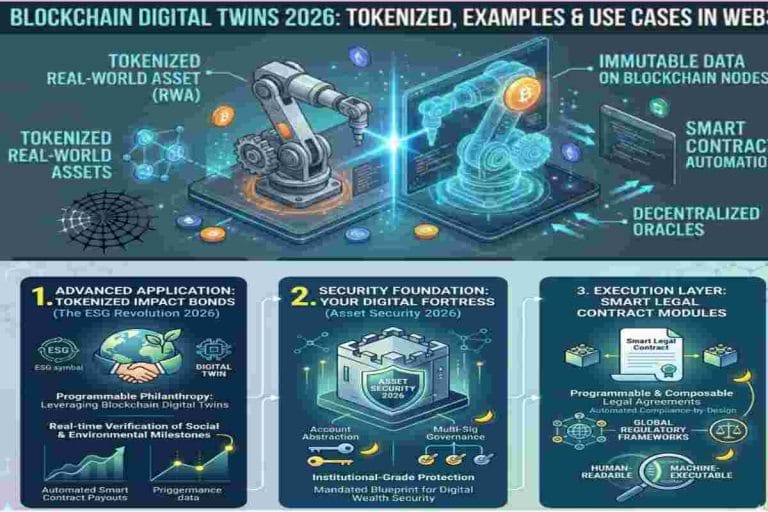
Tokenized Impact Bonds represent the pinnacle of “Programmable Philanthropy.” By leveraging blockchain-based digital twins, these instruments facilitate the real-time verification of social and environmental milestones.
Instead of enduring months of opaque third-party audits, smart contracts trigger automated payouts the moment performance data is mirrored on-chain. This architecture creates a high-trust environment for institutional investors seeking transparent, data-driven ESG returns with zero settlement latency.
High-value impact bonds demand institutional-grade protection. Before allocating capital into these complex instruments, it is critical to ensure your underlying infrastructure is impenetrable.
Our comprehensive manual, Asset Security 2026: Setting Up Your Digital Fortress, provides the mandatory blueprint for Account Abstraction and Multi-sig Governance. You cannot effectively manage sovereign assets without first securing the gateway to your digital wealth.
The legal enforceability of a tokenized bond is only as resilient as its underlying code. To bridge the gap between “Code is Law” and traditional statutory systems, we utilize Smart Legal Contract Modules.
These composable building blocks allow for programmable legal agreements that are simultaneously human-readable and machine-executable. By integrating these modules, issuers can automate “Compliance-by-Design,” ensuring every tokenized instrument remains harmonized with global regulatory frameworks.
Master the Web3 Lifecycle:
We’ve explored what digital twins are, how they become tokenized on blockchain, and why Web3 integration is the game-changer for businesses in 2026 and beyond. From industrial factories and logistics networks to real estate portfolios and smart city infrastructure, tokenized digital twins bridge the physical and digital worlds while creating programmable economic value.
The benefits are clear: predictive operations, operational transparency, fractional ownership, automated compliance, and sustainability tracking. By 2030, these systems will form self-optimizing digital ecosystems capable of simulating, managing, and transacting assets autonomously.
For institutions exploring the regulatory and technical foundations of digital infrastructure, trusted research from public institutions such as the U.S. National Institute of Standards and Technology can provide valuable guidance on digital twin frameworks and industrial IoT systems:
Here’s a practical roadmap for enterprises or innovators ready to implement blockchain digital twins:
| Step | Action | Outcome |
|---|---|---|
| 1 | Identify critical assets | Determine which machinery, property, or infrastructure can be mirrored |
| 2 | Create digital twins | Build virtual replicas using CAD models, IoT data, and AI simulation engines |
| 3 | Integrate IoT & real-time data | Ensure continuous mirroring of physical asset state |
| 4 | Deploy blockchain layer | Use smart contracts to automate ownership, tracking, and data integrity |
| 5 | Tokenize digital twin | Assign NFT or fractional tokens to represent ownership and value |
| 6 | Implement dashboards & analytics | Visualize operational metrics, predictive simulations, and token performance |
| 7 | Scale & optimize | Expand across assets, departments, or even city-wide infrastructure |
| 8 | Future-proof | Integrate AI, predictive analytics, and Web3 protocols for autonomous optimization |
Imagine your entire business mirrored digitally, predicting risks, optimizing performance, and creating economic value before a decision is even made.”
With tokenized digital twins, what was once reactive management becomes autonomous, transparent, and strategic.
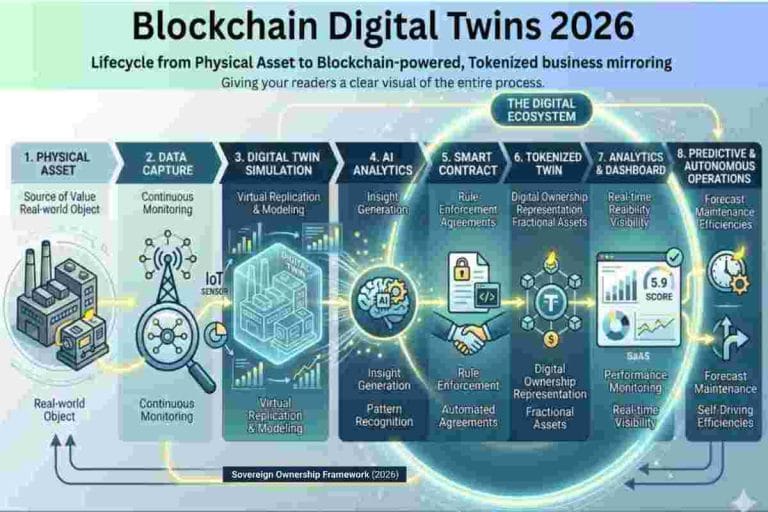
|
Physical Asset |
→ |
IoT Sensors |
→ |
Digital Twin Simulation |
→ |
AI Analytics |
→ |
Smart Contract |
→ |
Tokenized Twin |
→ |
Analytics & Dashboard |
→ |
Predictive & Autonomous Operations |
This shows a full lifecycle from physical asset to blockchain-powered, tokenized business mirroring, giving your readers a clear visual of the entire process.
Welcome to OwnProCrypto (Own & Pro Crypto) — a next-generation Bitcoin and blockchain education platform where the science of finance meets the power of AI-driven automation.
Our mission is simple: to equip you with the knowledge, frameworks, and tools needed to make smarter financial and business decisions in the Web3 economy.
Beyond analysis, OwnProCrypto focuses on transparency, verifiable data, and practical frameworks that investors and builders can actually use. Our goal is not hype — but clear thinking, disciplined analysis, and long-term value creation in the decentralized economy.
Our Background: Salim (Sam) is the founder and lead researcher behind OwnProCrypto, a Web3 intelligence platform focused on crypto security, digital ownership, stablecoin systems, interoperability, and institutional blockchain infrastructure.
Crypto Tools & Analysis:
Crypto Fundamental Analysis Tool | Protocol Evaluation System | DeFi Risk Analysis Tools | Crypto Portfolio Dashboard | Token Risk vs Reward Tool
Guides:
Crypto Fundamental Analysis | Blockchain Project Evaluation | Tokenomics Analysis | DeFi Protocol Analysis | Capital Efficiency
© 2026 OwnProCrypto — Built for smarter crypto decisions