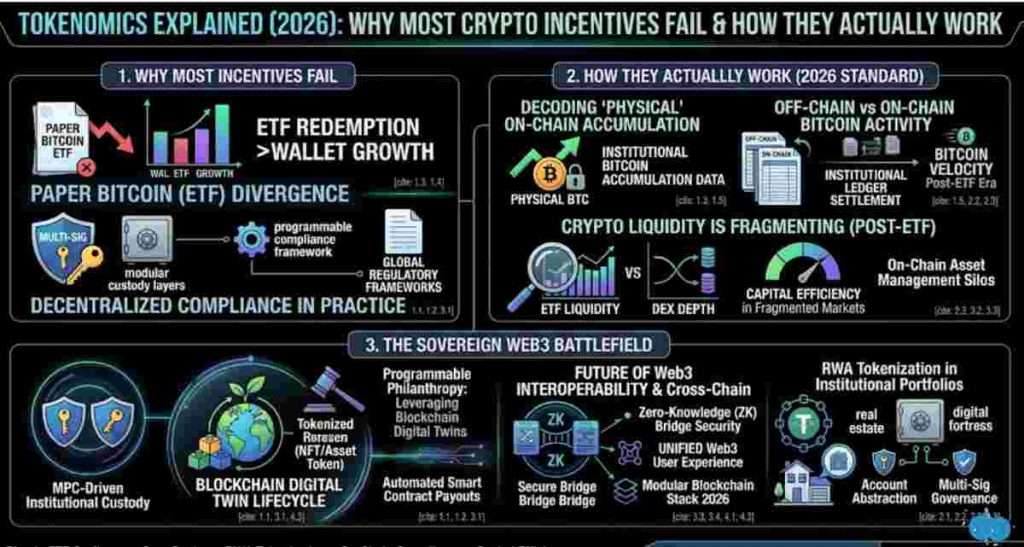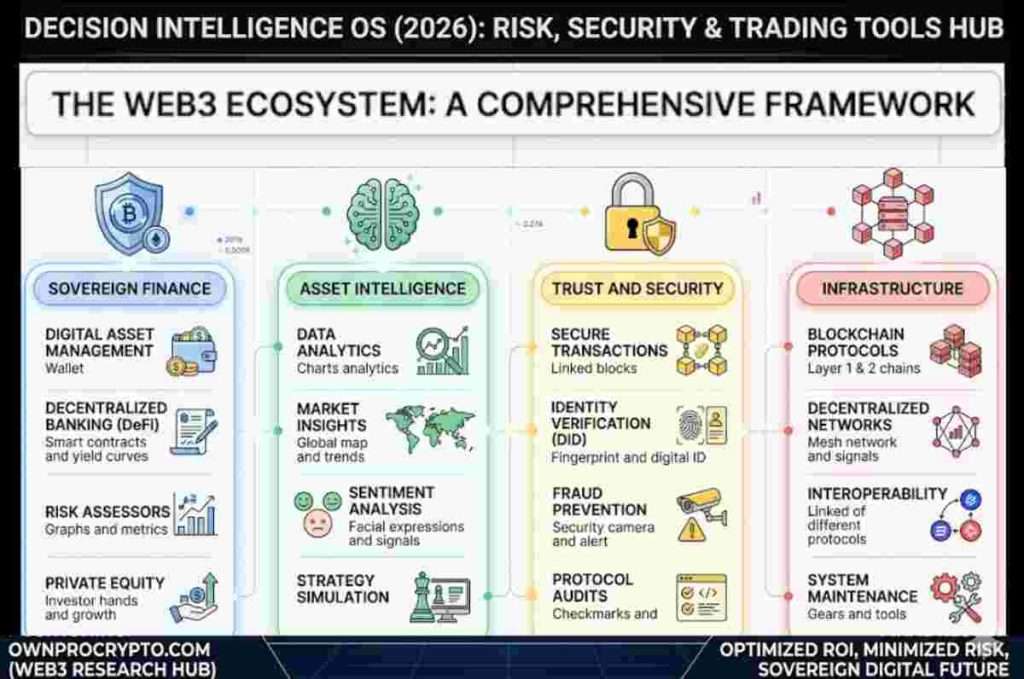
Infographic of Ownprocrypto OPC Logo for 2026 Web3 Ecosystem

Ownprocrypto:

Sovereign Asset Strategy & Web3 Institutional Research

Real Yield vs. Token Incentives: The Future of Sustainable DeFi Tokenomics (2026 Guide)

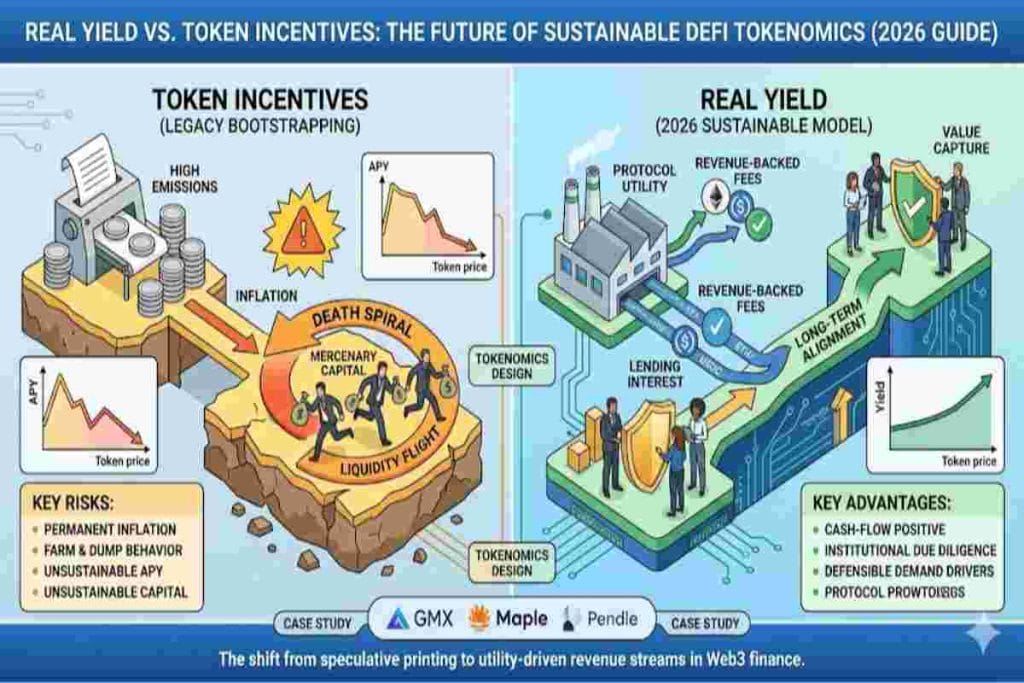
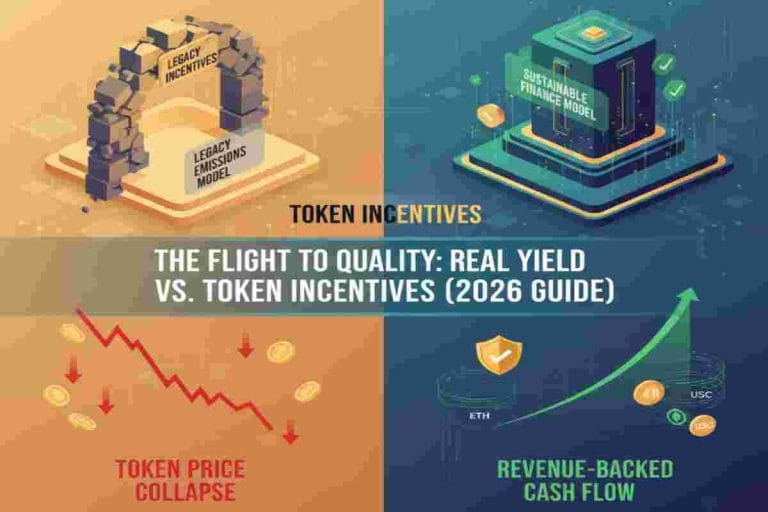
This Introduction Infographic Image of Real Yield vs. Token Incentives (2026)

Real Yield vs. Token Incentives

Table of Contents

In the 2026 financial landscape, the “DeFi Summer” era of printing tokens to buy liquidity has officially collapsed. The mandate has shifted toward revenue-backed tokenomics and sustainable DeFi yield, moving away from inflationary token rewards and toward value-driven protocols. This guide breaks down the critical transition from token incentives crypto models to the real yield finance model, examining how protocol revenue distribution versus token emissions shapes a project’s long-term survivability. We highlight why real yield vs. yield farming is the ultimate litmus test for institutional investors and how identifying real yield crypto projects is essential for building or investing in Web3 without falling prey to ephemeral mercenary capital.

April 2026 highlights a continued shift in crypto markets from inflationary token incentives toward sustainable “real yield” models backed by actual revenue. As tighter liquidity conditions persist and institutional participation grows, protocols relying on token emissions are facing declining user retention, while those generating fees from real economic activity are gaining traction. The impact is clear: capital is becoming more selective, rewarding fundamentally sound projects and accelerating the transition toward sustainable, revenue-driven DeFi models over short-term incentive schemes.

Real Yield = (Protocol Revenue – Token Emissions) / Total Value Locked

Token emissions → high APY →dump → high → price collapse vs. Revenue → fee distribution → long-term holders → long-term holders → stable token value

Sustainable DeFi models are the technical backbone of the performance metrics in our Digital Ownership in 2026 report. Review the PwC 2026 Global Crypto Report for data.

The DeFi Yield Illusion

For years, DeFi attracted billions through an illusion: high APYs fueled by token incentives in crypto explained as “rewards.” However, these were often just inflationary token rewards with no underlying value. When token emissions cause inflation, the token price eventually collapses under sell pressure, leading to the “death spiral” many 2024 protocols faced.


Example of the DeFi Emission Death Spiral

In 2024 several DeFi protocols offered yields above 800% through aggressive token emissions. When emissions slowed, liquidity providers rapidly withdrew funds and sold reward tokens, causing token prices to collapse by more than 90%. This phenomenon became known as the DeFi Emission Death Spiral.

Real Yield Metrics from Leading Protocols (2026)

Protocol Revenue Source Avg Annual Revenue Yield Distribution
GMX Perpetual trading fees $90M+ ETH/AVAX rewards
Maple Finance Institutional lending $40M+ Stablecoin yield
Pendle Yield trading fees $25M+ Token + fee share
Ethena Delta-neutral funding rates $60M+ Stablecoin yield
Infographic shows Real Yield vs. Token Incentives and Explain The Future of Sustainable DeFi Tokenomics (2026 Guide)

What Is Real Yield in DeFi?

Real yield in DeFi refers to rewards generated from actual protocol revenue—such as trading fees, lending interest, or derivatives premiums—rather than newly minted tokens. Unlike the defi token emission model, real yield distributes income generated by real economic activity.

Definition: Real yield crypto is the net protocol revenue distributed to stakeholders after operational costs, proving the protocol has a functional business model.

Real Yield Key Points

  • Revenue-Based Rewards:
    Real yield comes from protocol fees or real income, not from newly minted tokens.
  • Sustainable Returns:
    Because rewards come from real usage of the platform, the yield is considered more sustainable.
  • Protocol Fee Sharing:
    DeFi platforms distribute trading fees, borrowing interest, or service fees to users.
  • Example Sources of Real Yield:

    • Trading fees from decentralized exchanges
    • Borrowing interest from lending platforms
    • Liquidation fees in lending protocols
  • Lower Inflation:
    Unlike traditional DeFi incentives, no excessive token printing occurs.
  • Long-Term Value:
    Real yield helps support the actual economic value of the token.
  • Investor Attraction:
    Many investors prefer protocols with real revenue streams.

Sustainable DeFi Yield

Sustainable DeFi yield refers to returns generated from real economic activity—such as trading fees, lending interest, or staking rewards—rather than temporary token emissions. This model focuses on long-term value creation and stability within decentralized finance.

Mercenary Capital in DeFi

Mercenary capital in DeFi describes liquidity that moves rapidly between protocols in search of the highest short-term rewards. These users typically leave once incentives decline, making such liquidity unreliable for long-term ecosystem growth.

Revenue-to-Emission Ratio Table

Protocol Revenue ($M) Token Emission ($M) Revenue-to-Emission Ratio Real Yield ✅/❌
Aave 120 30 4.0
Compound 95 50 1.9
SushiSwap 40 60 0.67
GMX 25 5 5.0
Uniswap V2 80 90 0.89

Notes:

  • Ratio >1 typically indicates revenue-backed sustainability.
  • Ratio <1 suggests rewards rely more on token emissions than actual revenue.

Real Yield Models in 2026

y 2026, decentralized finance (DeFi) has shifted toward real yield models, where returns are generated from actual economic activity rather than inflationary token emissions. Real yield refers to income derived from protocol revenues—such as trading fees, lending interest, staking rewards, or real-world asset (RWA) income—and distributed to users or token holders. This approach is considered more sustainable because rewards come from genuine demand and usage instead of newly minted tokens that dilute value.

Several dominant real-yield models have emerged. Lending protocols, such as Aave, generate yield from borrowers paying interest for liquidity. Decentralized exchanges (DEXs) like Uniswap distribute trading fees to liquidity providers. Liquid staking protocols, including Lido Finance, generate rewards from blockchain staking and share them with participants while maintaining asset liquidity. Derivatives platforms such as GMX also distribute trading fees to token stakers, often paid in major cryptocurrencies or stablecoins instead of native tokens.

Another growing category in 2026 is RWA-backed yield, where tokenized real-world assets such as government bonds or credit markets provide stable returns that are distributed on-chain. These models help anchor DeFi yields to real financial markets and reduce reliance on speculative incentives. As a result, real yield systems are increasingly viewed as the foundation for sustainable DeFi ecosystems, supporting long-term liquidity, stronger token economics, and more stable returns compared with earlier incentive-driven yield farming models.

Sustainable protocols now use several models to generate revenue-backed defi yield:

  • RWA Lending: Real-world asset interest (e.g., tokenized T-Bills).
  • Staking Derivatives (LSDs): Yield from network validation.
  • Yield Trading: Capturing premiums from volatility and derivatives.

Revenue Source Token Reward Risk

Revenue Source 

Token Reward 

Risk

RWA Lending  

Protocol Tokens

Low-Medium

Staking Derivs

Derivative Tokens

Medium

Yield Trading

Fee Distribution

igh


Challenges of Real Yield Models

Despite their advantages, real yield models also face several challenges in decentralized finance (DeFi). One major challenge is revenue dependency—real yield can only exist if a protocol generates sufficient fees or income. If user activity declines, the revenue available for distribution also drops, which can reduce yields and discourage participation. Another issue is market competition, as many DeFi platforms compete for the same liquidity and users, making it difficult to maintain consistent revenue streams. Additionally, regulatory uncertainty surrounding DeFi and tokenized real-world assets (RWAs) may affect how protocols operate in different jurisdictions. Security risks, including smart contract vulnerabilities and potential exploits, also remain a concern because any loss of funds can undermine trust and disrupt yield distribution.

Top Real Yield Crypto Projects (Case Studies)

To better understand how sustainable tokenomics works in practice, it helps to examine real-world protocols that generate revenue-backed yield instead of relying solely on token incentives.

The following DeFi projects demonstrate how real economic activity can support long-term token value and user rewards.


GMX – Revenue from Decentralized Perpetual Trading

GMX is widely recognized as one of the earliest DeFi protocols to popularize the real yield model.

The platform operates a decentralized perpetual exchange where traders pay fees for leveraged positions. Instead of distributing newly minted tokens, GMX redistributes a portion of these trading fees directly to liquidity providers and token stakers.

Key Real Yield Mechanisms

  • Trading fees generated from perpetual swaps
  • Fee distribution to GMX and GLP stakers
  • Revenue paid in ETH or AVAX rather than inflationary tokens

Because rewards come from actual trading activity, GMX created a more sustainable reward structure compared to traditional liquidity mining.


Pendle Finance – Yield Trading and Tokenized Future Returns

Pendle introduced an innovative approach to DeFi by allowing users to tokenize and trade future yield.

Instead of simply farming rewards, users can separate yield from principal and trade these components independently. This system creates real demand for yield exposure, which generates protocol fees.

Key Real Yield Mechanisms

  • Trading fees from yield token markets

  • Structured yield strategies

  • Active participation from DeFi traders and institutions

Pendle demonstrates how financial innovation can create sustainable revenue streams within decentralized finance.


Maple Finance – Institutional Lending Revenue

Maple Finance focuses on institutional DeFi lending, connecting capital providers with institutional borrowers such as trading firms and market makers.

The protocol generates revenue through interest payments and service fees, which are then shared with liquidity providers.

Key Real Yield Mechanisms

  • Interest from institutional loans
  • Lending pool management fees
  • Transparent on-chain credit markets

This model closely mirrors traditional finance while maintaining on-chain transparency and decentralization.


Ethena Labs – Synthetic Dollar Yield Strategy

Ethena Labs introduced a synthetic dollar protocol designed to generate yield through delta-neutral strategies using crypto derivatives.

Instead of relying solely on token incentives, the protocol earns revenue from funding rates and hedged trading strategies, which can be redistributed to users.

Key Real Yield Mechanisms

  • Derivatives funding rate capture
  • Hedged positions to stabilize yield
  • Revenue-backed rewards for stakers

This approach highlights how advanced trading strategies can support sustainable on-chain yield generation.


Uniswap Labs – Fee-Based Liquidity Provision

One of the most well-known DeFi platforms, Uniswap generates revenue through swap fees paid by traders.

Liquidity providers earn a share of these fees whenever trades occur in the pools they support. This fee-based model represents one of the purest examples of real yield in decentralized finance.

Key Real Yield Mechanisms

  • Swap fees generated by decentralized trading
  • Liquidity provider fee distribution
  • Large-scale on-chain trading volume

Uniswap demonstrates that real yield can emerge naturally from decentralized market infrastructure.


The Inflationary Failure (Token Incentives Model)

Category Details
Problem High user churn and “Mercenary Capital” draining protocol value once high-emission rewards decreased.
Objectives To bootstrap liquidity rapidly by offering 500% APY in native governance tokens.
Analysis / Situation The protocol relied on “circular logic” where the token’s only value was for further staking, leading to a massive oversupply without underlying revenue.
Implementation Aggressive minting of native tokens to reward Liquidity Providers (LPs) without any lock-up or vesting requirements.
Challenges As the token price dropped due to constant selling pressure (sell-pressure), LPs exited, causing a “death spiral” in Total Value Locked (TVL).
Results / Outcomes 95% TVL loss within 3 months; the token lost its Capital Efficiency and became a “zombie protocol” with no organic users.

The Sustainable Success (Real Yield Model)

Category Details
Problem Building long-term staker loyalty without relying on unsustainable token printing.
Objectives To distribute 20% of actual protocol platform fees (in ETH/USDC) to long-term governance participants.
Analysis / Situation Focused on RWA Tokenization revenue and trading fees to provide a “Real Yield” backed by external economic activity.
Implementation Integrated a “Fee-Switch” mechanism where protocol revenue is redirected to a staking vault for On-Chain Compliance and reward distribution.
Challenges Initially slower TVL growth compared to high-emission competitors; required educating users on “Quality over Quantity.”
Results / Outcomes 30% Annualized Real Yield sustained for over a year; achieved high Digital Survivability and attracted institutional-grade “Sticky Capital.”

Key Takeaways from Real Yield Protocols

Across these examples, several common characteristics define successful real yield models:

  • Revenue comes from actual user activity, such as trading or lending.
  • Rewards are funded by protocol income rather than token inflation.
  • Sustainable tokenomics encourage long-term participation instead of short-term farming.

As decentralized finance continues to mature, protocols that generate consistent on-chain revenue are more likely to build resilient ecosystems and attract institutional capital.

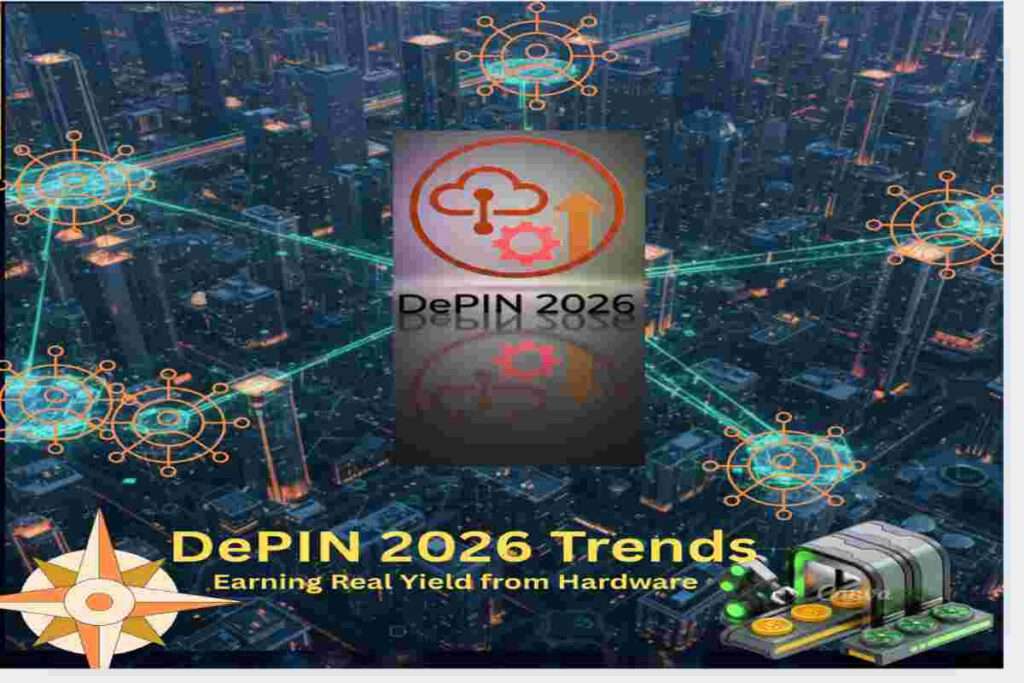
This infographic of DePIN 2026 Trends- Earning Real Yield from Hardware

Earning Real Yield from DeFi Hardware

Earning real yield from hardware in decentralized finance refers to generating income through physical infrastructure that supports blockchain networks or decentralized services. Instead of relying purely on token emissions, participants deploy devices such as validator nodes, staking servers, decentralized storage hardware, or network routers that help maintain blockchain operations. These systems earn real yield through network fees, staking rewards, or service payments from users who rely on the infrastructure. This emerging model—often called DeFi hardware or DePIN (Decentralized Physical Infrastructure Networks)—connects real-world equipment with on-chain financial incentives, allowing participants to capture revenue from actual network usage. As Web3 evolves, hardware-backed yield models are becoming an important bridge between digital finance and real-world infrastructure, providing more sustainable and utility-driven returns compared to purely inflationary token incentives.

This infographic of Real Yield 2026: The New Standard for Sustainable Crypto Income

How Real Yield Mechanisms Work?

Real Yield Technique is a DeFi strategy where protocols generate and distribute rewards from real revenue instead of creating new tokens. It focuses on sustainable income from actual platform usage.


Real Yield Technique Key Aspects 

  • Revenue-Based Rewards:
    Rewards come from real fees and profits generated by the protocol.
  • Protocol Fee Distribution:
    Fees from activities like trading, borrowing, or lending are shared with users.
  • No Excess Token Printing:
    Unlike traditional yield farming, it avoids inflation caused by minting new tokens.
  • Sustainable DeFi Model:
    Encourages long-term economic stability for the protocol.
  • User Incentives:
    Liquidity providers, stakers, or token holders earn rewards based on actual platform usage.
  • Higher Transparency:
    Revenue sources are visible on the blockchain, increasing trust.
  • Stronger Token Value:
    Because income is real, the token value may be more stable over time.

Example Protocols Using Real Yield

  • GMX – shares trading fees with stakers.
  • Uniswap – liquidity providers earn swap fees.
  • Aave – users earn interest from borrowers.
  • Many of these operate on blockchains like Ethereum.

Protocol Revenue Distribution

Protocol revenue distribution is the process by which DeFi platforms share a portion of their generated income—such as fees or interest—with token holders, stakers, or liquidity providers. This mechanism aligns user incentives with the protocol’s real performance.


Real Yield Crypto Projects

Real yield crypto projects are DeFi protocols that generate returns from genuine financial activity and distribute those earnings to participants. These projects prioritize sustainability, transparent revenue models, and long-term ecosystem growth.

Key Aspects of Token Incentives

Token incentives crypto are native tokens distributed to users to encourage specific behaviors, such as providing liquidity or voting. While they are a powerful tool for bootstrapping, they are often inflationary rewards.

  • Purpose: Attract “Liquidity Mining” participants.
  • Risk: Creates mercenary capital that exits the moment the “emissions” dry up.

Tokenization incentives refer to the strategic mechanisms used to encourage participation, adoption, and long-term engagement within tokenized ecosystems, particularly in blockchain-based platforms. By distributing digital tokens as rewards, projects motivate users, developers, investors, and validators to contribute value to the network. These incentives often take various forms such as staking rewards, governance rights, liquidity mining, and performance-based token allocations. A well-designed token incentive model aligns the interests of all stakeholders by promoting network growth, security, and sustainability


What Are Token Key Aspect?

Key aspects of tokenization incentives include fair token distribution, transparent reward structures, long-term value creation, and mechanisms that prevent market manipulation or excessive token inflation. When implemented effectively, tokenization incentives not only drive user participation but also strengthen decentralized governance, enhance ecosystem resilience, and support the overall economic viability of the platform.

  • Digital Asset: A token is a digital unit of value created on a blockchain.
  • Built on Existing Blockchains: Tokens often run on platforms like Ethereum instead of their own blockchain.
  • Utility: Can represent currency, assets, access rights, or voting power.
  • Smart Contracts: Tokens are created and managed using smart contracts.
  • Types of Tokens:
    • Utility Tokens – access to services
    • Security Tokens – represent investment assets
    • Governance Tokens – voting rights
    • Stablecoins – value pegged to assets
  • Transferability: Tokens can be sent, traded, or stored in digital wallets.
  • Popular Examples: Tokens like USDT or Chainlink.

Tokenomics: How Token Economies Work in DeFi

Token Economy (often called Tokenomics) refers to the system that designs how a cryptocurrency token is created, distributed, used, and managed within a blockchain ecosystem.

Key Aspects 

  • Token Creation: Tokens are created on a blockchain such as Ethereum using smart contracts.
  • Supply Mechanism: Defines the total supply, circulating supply, and issuance rules of the token (fixed or inflationary).
  • Distribution Model: Explains how tokens are allocated, e.g., to developers, investors, community, or through mining/staking.
  • Utility in Ecosystem: Tokens provide specific functions like payments, governance voting, or access to services in DeFi platforms.
  • Incentive Mechanism: Users are rewarded with tokens for activities such as staking, liquidity providing, or validating transactions.
  • Governance Rights: Token holders may vote on protocol decisions in decentralized platforms like Uniswap.
  • Liquidity & Trading: Tokens can be traded on decentralized exchanges (DEXs) or centralized exchanges.
  • Deflation or Burn Mechanisms: Some systems burn tokens to reduce supply and potentially increase value.
  • Staking & Yield: In DeFi, users can lock tokens to earn rewards or interest.
  • Security & Transparency: All token transactions are recorded on the blockchain for transparency and trust.

Revenue-Backed Tokenomics

Revenue-backed tokenomics is a design approach where a token’s value and rewards are supported by actual protocol revenue rather than inflationary emissions. This structure helps maintain long-term token value and reduces dependence on speculative incentives.


Why Token Incentives Fail

Token incentives in decentralized finance (DeFi) are often used to rapidly attract users, liquidity providers, and developers by distributing newly minted tokens as rewards. While this strategy can initially boost participation and create strong short-term growth, it frequently fails over time due to structural weaknesses. One major reason is token inflation, continuous token emissions increase supply faster than demand, which can significantly reduce the token’s market value. As prices fall, the real value of rewards declines, causing participants to withdraw their liquidity and move to other platforms offering higher incentives. Additionally, many users who join purely for rewards become mercenary capital, meaning they have no long-term commitment to the protocol and leave once incentives drop. This creates unstable liquidity and weakens the ecosystem. Without genuine revenue generation or product demand, token incentives essentially become unsustainable subsidies, leading to declining token prices, reduced participation, and in many cases the eventual collapse or stagnation of the protocol.

The primary reason token incentives fail in crypto is the lack of a Post-Emission Reality Layer.

  • Mercenary Capital: Farmers “farm and dump” tokens, creating permanent sell pressure.
  • Liquidity Flight: As soon as the APY drops, liquidity moves to the next inflationary protocol.
  • Protocol Dilution: Token emissions vs. protocol revenue often show that the protocol is “paying” more to users than it is actually earning.

Token Incentive Examples Table

Protocol APY (%) Emission Type Duration Post-Emission Outcome
SushiSwap 50 Newly minted tokens 12 months Liquidity dropped 40% after rewards ended
Compound 15 COMP tokens 24 months Gradual stabilization; liquidity remained moderate
Curve Finance 8 CRV tokens Ongoing Liquidity remained steady due to protocol fees
GMX 20 Fee-sharing tokens Ongoing Sustained liquidity; minimal emission reliance
Balancer 12 BAL tokens 18 months Short-term boost; post-emission yields fell

Notes:

  • Highlight the difference between temporary APY boosts via token incentives versus long-term, revenue-backed yields.
  • Helps visually demonstrate why real yield crypto projects are more sustainable than purely token-incentive-driven models.

Warning: The APY Trap

A protocol advertising extremely high APY often signals aggressive token emissions rather than genuine revenue generation. If rewards are paid entirely in the protocol’s native token, the yield may simply represent dilution rather than profit.

Real Yield vs. Token Incentives Comparison

In decentralized finance (DeFi), real yield and token incentives represent two different approaches to rewarding users and attracting liquidity. Real yield refers to returns generated from actual revenue produced by a protocol—such as trading fees, borrowing interest, or service charges—which are distributed to token holders or liquidity providers. Because these rewards come from real economic activity, they are generally considered more sustainable and aligned with long-term protocol growth. In contrast, token incentives rely on the distribution of newly minted native tokens to encourage participation, liquidity provision, or staking. While this method can rapidly bootstrap user adoption and liquidity, it often leads to inflationary pressure on the token supply and may become unsustainable once incentives decrease. Overall, real yield tends to promote healthier, revenue-backed ecosystems, whereas token incentives are often used as short-term growth mechanisms during the early stages of a protocol.

Feature Token Incentives (Liquidity Mining) Real Yield (Sustainable Model)
Source of Funds Newly Minted Tokens (Inflation) Protocol Revenue (Fees/Interest)
Sustainability Low (Leads to token inflation) High (Tied to usage/growth)
Investor Type Mercenary Capital / Farmers Long-term Holders / Institutions
Value Impact Dilutes Token Supply Supports Token Value via Buybacks/Payouts
Market Condition Bull Market Dependent Resilient in All Market Cycles

Image showing the DeFi Echosystem 2026

How to Design Sustainable Web3 Finance

To build a sustainable tokenomics model, builders must follow this framework:

  • Revenue Source: Identify a “Job to be Done” that users will pay for (Fees).
  • Token Supply: Implement burn-and-mint or capped supply to prevent token inflation.
  • Incentive Alignment: Ensure rewards are only given to users who provide long-term value.
  • Treasury Design: Build a revenue-sharing model that survives bear markets.

Designing sustainable Web3 finance requires balancing user incentives, revenue generation, and long-term ecosystem health. Here are key principles and strategies:

  1. Revenue-Backed Models: Prioritize real yield over inflationary token incentives. Protocols should generate income from genuine activity—trading fees, lending interest, staking rewards, or tokenized real-world assets (RWAs)—and distribute it to users. This ensures returns are tied to actual demand rather than speculative token emissions.
  2. Balanced Tokenomics: If tokens are used for governance or incentives, their supply should be carefully managed to prevent inflation. Mechanisms like token burn, vesting schedules, and fee-sharing can maintain value and align user behavior with the protocol’s health.
  3. Incentive Alignment: Design rewards to encourage long-term engagement rather than mercenary liquidity. For example, staking rewards could increase with duration, or early users could receive governance privileges that reinforce commitment.
  4. Risk Management and Security: Use robust smart contract audits, insurance mechanisms, and risk mitigation strategies. Sustainable Web3 finance requires protocols to withstand market volatility, hacks, or exploit attempts without jeopardizing user funds.
  5. Interoperability and Layered Ecosystems: Supporting cross-chain integration and composability ensures broader adoption, liquidity, and resilience. Protocols that can interact with other platforms or traditional finance systems are more adaptable to evolving markets.
  6. Transparency and Governance: Clear reporting on revenues, yields, and token supply dynamics builds trust. Decentralized governance mechanisms allow users to participate in decision-making, creating stronger alignment between protocol operators and the community.
  7. Hybrid Models: Combining on-chain revenue with selective token incentives can bootstrap early adoption while transitioning to sustainable, fee-based returns. For example, using tokens for initial liquidity attraction but gradually shifting to fee-distributed rewards ensures stability over time.

By integrating these principles, Web3 finance can move beyond speculative growth and create ecosystems where liquidity, user engagement, and token value are sustainable, transparent, and resilient—forming a foundation for long-term decentralized economic systems.


Phase Category Implementation Details
1. Foundation Token Purpose & Role Define functions for Governance (voting), Utility (access/discounts), and Rewards (participation). Avoid “catch-all” tokens.
2. Issuance Supply Mechanics Manage Total Supply (fixed or dynamic) and Emission Schedules (vesting/decay-based). Include Burn Mechanisms for inflation control.
3. Motivation Incentive Alignment Reward Liquidity Providers via usage fees and Long-term Holders via multipliers. Prevent “Mercenary Capital” by favoring continuous engagement.
4. Revenue Real Yield Integration Identify revenue from Protocol fees, Liquid Staking, or RWA income. Distribute real revenue to stakers instead of inflationary minting.
5. Value Utility & Demand Drivers Create intrinsic demand through service payments and premium access. Avoid demand driven solely by speculation.
6. Oversight Governance & Transparency Use on-chain voting and transparent reporting of emissions and revenue to maintain community trust.
7. Security Risk Management Implement smart contract audits, bug bounties, and reserve funds. Utilize DAO-based treasury management.
8. Health Sustainability Metrics Monitor inflation vs. demand, real yield coverage, and holder distribution stability over time.
9. Evolution Iterative Adjustment Maintain flexibility to tune reward rates, governance weights, and emission schedules based on community approval.

Real Yield Evaluation Checklist

Investors should verify the following before committing capital:

  • Does the protocol generate organic revenue?
  • Is the yield paid in stablecoins or blue-chip assets?
  • Is the Revenue-to-Emission ratio positive?
  • Does the protocol maintain TVL stability during bear markets?
  • Are incentives designed for long-term participation?

Real Yield Protocol Scoring Template

To help investors and builders evaluate whether a DeFi protocol truly generates sustainable real yield, you can use the following Real Yield Sustainability Scoring Template. This framework converts the evaluation checklist into a simple scoring system that measures the economic strength of a protocol.

Each category should be rated from 1 to 5, where:

  • 1 = Very Weak / Unsustainable
  • 3 = Moderate / Needs Improvement
  • 5 = Strong / Sustainable

After scoring each category, add the results to calculate the Total Sustainability Score.

Evaluation Factor Score (1–5) What to Evaluate
Revenue Generation   Does the protocol generate consistent fees from real usage (trading, lending, derivatives)?
Token Supply Model   Is the token supply capped, deflationary, or controlled to prevent excessive inflation?
TVL Stability   Does the protocol maintain stable Total Value Locked during market downturns?
Incentive Alignment   Are rewards designed to encourage long-term participation rather than short-term farming?
Revenue-to-Emission Ratio   Does the protocol earn more in revenue than it distributes in token emissions?

Total Sustainability Score = Sum of all category scores


How to Interpret the Score

Total Score Sustainability Rating Interpretation
21 – 25 Strong Real Yield Protocol Revenue-backed and likely sustainable long-term
16 – 20 Moderate Sustainability Some reliance on incentives but improving
11 – 15 Weak Model Revenue insufficient to support tokenomics
5 – 10 Unsustainable Protocol depends heavily on token emissions

Using this scoring method allows investors to quickly identify real yield crypto projects that generate genuine revenue rather than relying on short-term token incentives. Over time, protocols with higher sustainability scores are more likely to attract institutional liquidity and long-term participants.


Ready to Audit Your Protocol’s Real Yield?
Use our 2026 Sustainable Tokenomics Playbook to benchmark your protocol’s revenue vs. emission ratio, evaluate TVL stability, and design incentives for long-term adoption. [Download Now / Learn More]

30-Second Test: How to Detect Real Yield vs Fake Yield

Not every high-yield DeFi protocol generates sustainable revenue. Many platforms advertise extremely high APYs that rely primarily on token emissions rather than real economic activity.

Use the following 30-second quick test to determine whether a protocol is generating real yield or artificial yield.

Step 1: Check the Source of Rewards

Ask a simple question: Where does the yield come from?

  • Real Yield: Trading fees, lending interest, liquidation fees, or other on-chain economic activity.
  • Fake Yield: Newly minted tokens distributed to liquidity providers.

If most rewards come from protocol revenue, the yield is more likely sustainable.


Step 2: Compare Revenue vs Token Emissions

A key sustainability metric is the Revenue-to-Emission Ratio.

  • Healthy Protocol: Revenue ≥ Token Emissions
  • Risky Protocol: Token Emissions > Revenue

When emissions significantly exceed revenue, the protocol may depend on continuous token inflation to maintain APY.


Step 3: Evaluate User Demand

Real yield protocols usually have organic user demand, meaning people use the platform even without high incentives.

Signs of genuine demand include:

  • Consistent trading volume
  • Stable or growing Total Value Locked (TVL)
  • Active user participation

If liquidity disappears when incentives drop, the protocol may rely on mercenary capital.


Step 4: Analyze Token Utility

A sustainable protocol token should provide clear economic utility, such as:

  • Governance rights
  • Fee sharing
  • Staking rewards funded by protocol revenue
  • Access to platform features

Tokens with limited real utility often depend heavily on emissions to maintain value.


Quick Real Yield Detection Checklist

Use this quick checklist when evaluating any DeFi project:

✅ Yield comes from real protocol revenue
✅ Revenue is equal to or higher than token emissions
✅ The platform has consistent user activity and volume
✅ The token provides meaningful utility or governance value
✅ Incentives reward long-term participants rather than short-term farmers

If most of these boxes are checked, the protocol likely generates sustainable real yield instead of temporary incentive-driven returns.


Pro Tip for Investors

Before allocating capital, review protocol dashboards, on-chain analytics, and revenue reports to verify whether yield comes from real economic activity. Protocols that consistently generate revenue tend to be more resilient during market downturns.

This infographic of DePIN 2026 Trends- Earning Real Yield from Hardware

Future of Real Yield in DeFi (2026-2030)

The future of real yield in DeFi is expected to focus on sustainability, transparency, and integration with traditional financial systems. As the industry matures, more protocols are likely to adopt fee-based revenue models, where token holders share in profits generated from platform usage. The expansion of tokenized real-world assets, such as bonds, treasury bills, and credit markets, could further strengthen real yield by linking blockchain returns to established financial instruments. Moreover, improvements in tokenomics design, governance mechanisms, and cross-chain infrastructure may enhance stability and user trust. Overall, real yield is increasingly viewed as a key foundation for the next generation of DeFi protocols, enabling long-term growth while reducing reliance on unsustainable token emission strategies.

By 2030, decentralized finance (DeFi) is likely to evolve into a far more mature and diversified financial ecosystem, with real yield models and token incentives taking on clearly differentiated roles. Real yield DeFi—where returns are generated from actual economic activity such as protocol fees, lending interest, liquidation profits, and tokenized real‑world asset (RWA) income—is expected to become the dominant foundation of sustainable decentralized finance. As more protocols prove that revenue‑backed models can attract long‑term liquidity and produce stable returns, investors and liquidity providers will increasingly prefer platforms with predictable, durable cash flows over those reliant on inflationary token emissions. This transition will strengthen the overall health of DeFi markets, reduce speculative volatility, and align incentives between users, developers, and token holders.

Meanwhile, token incentives will not disappear but will evolve into more refined and purpose‑specific tools. Rather than broad, open‑ended emission schedules that dilute value, token rewards will be used strategically for targeted growth, such as incentivizing participation in new product launches, governance engagement, cross‑chain bridges, or ecosystem partnerships. These incentives will likely be time‑limited, performance‑based, and structured with vesting or decay mechanisms to prevent long‑term inflation and mercenary liquidity. This shift mitigates many of the drawbacks seen in earlier yield‑farming eras, where unchecked token emissions led to price pressure and unsustainable liquidity cycles.

By 2030, we can expect several key trends shaping DeFi’s future:

  • Integration with traditional financial markets: Tokenized real‑world assets (e.g., government bonds, commercial paper, real estate credit) will provide stable, regulated revenue streams that underpin robust real yield, expanding DeFi’s appeal to institutional capital.
  • Regulatory clarity: Mature regulatory frameworks across major jurisdictions will provide clearer boundaries for token issuance, revenue distribution, and investor protections, making real yield protocols more accessible and reducing speculative excess.
  • Enhanced tokenomics design: More sophisticated incentive structures will balance scarcity, utility, and governance participation, reducing inflationary pressure while rewarding constructive ecosystem behaviors.
  • Layered and interoperable ecosystems: Cross‑chain infrastructure and composability will allow liquidity and yield strategies to flow between networks, improving capital efficiency and enabling seamless integration of real yield products across multiple blockchains.

Overall, by 2030 DeFi is likely to resemble a hybrid financial system where real yield anchors sustainable economic value and token incentives act as finely tuned growth levers rather than broad subsidy engines—unlocking more stable returns, deeper liquidity, and broader adoption across both retail and institutional participants.

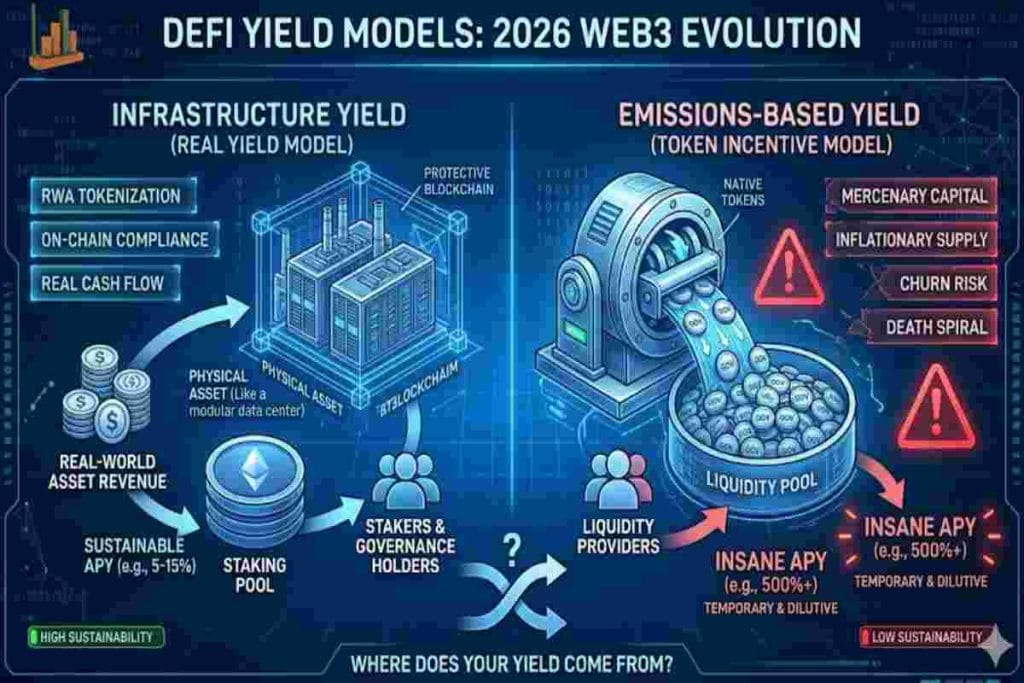
This Infographic of Defi Yield Models- 2026 Web3 Evolution

Evolution of DeFi Yield Models

Year DeFi Trend
2020 Liquidity Mining Explosion
2021 Yield Farming Mania
2023 Token Emission Collapse
2024 Market Correction
2025 Institutional DeFi
2026 Real Yield Tokenomics
 

This infographic of Soulbound Tokens (SBTs) for the year 2026

Real Yield vs Yield Farming: Key Differences

Short table:

Metric Yield Farming Real Yield
Source Token emissions Protocol revenue
Stability Highly volatile More stable
Token supply Inflationary Often deflationary
Investor type Short-term farmers Long-term investors
 

Frequently Asked Questions: Sustainable DeFi & Real Yield

Fundamental Concepts & Definitions

Q: What is real yield in DeFi?

A: Real yield in DeFi refers to rewards generated from actual protocol revenue—such as trading fees, lending interest, or derivatives premiums—rather than newly minted tokens. Unlike inflationary rewards, real yield distributes income generated by real economic activity, making it a more sustainable model for long-term protocols. Rooted in Case Study Failure: Early “DeFi Summer” protocols often boasted 1,000% APYs that were 100% token emissions; when the printing stopped, the value vanished because there was no “real” income.

Q: How real yield works in crypto?

A: It works by capturing a portion of the value flowing through a protocol. When a user swaps tokens on a DEX or takes out a loan, they pay a fee. That fee (usually in a blue-chip asset like ETH or a stablecoin) is then distributed to the token holders or liquidity providers who secure the network.

Q: What is the difference between real yield and token incentives? A: The main difference is the source of rewards. Real yield comes from genuine protocol revenue like trading fees or lending interest. Token incentives rely on issuing (minting) new tokens to attract liquidity. While incentives dilute the total supply, real yield aligns rewards with real economic activity and protocol growth.

Q: What is real yield in crypto protocols? A: It is essentially the “dividend” of the Web3 world. It is the net profit of a protocol that is shared with those who provide capital or governance, ensuring the token has fundamental value based on cash flow.


Sustainability & Tokenomics Design

Q: What makes a sustainable tokenomics model?

A: A sustainable model is defined by a Positive Revenue-to-Emission Ratio. It means the protocol earns more in organic fees than it pays out in newly minted token incentives. Key elements include capped supply, burn mechanisms, and utility-driven demand.

Q: Why are token incentives often unsustainable in DeFi?

A: They become unsustainable when protocols distribute rewards through high token emissions without generating enough revenue. This creates a “death spiral” of inflation and selling pressure, as yield farmers sell reward tokens immediately, leading to declining prices and reduced protocol value.

Q: Why do token emissions cause inflation?

A: Simple supply and demand economics. When a protocol constantly mints new tokens to pay for liquidity (emissions) without an equal increase in demand or a “burn” mechanism, the value of each individual token is diluted, leading to price depreciation.

Q: How protocol revenue supports token value?

A: Protocol revenue creates a “Value Floor.” When revenue is used to buy back tokens from the market or distributed as stablecoin yield, it creates a constant buy-pressure and a fundamental reason for investors to hold the asset, regardless of market speculation.

Q: Are token incentives sustainable in DeFi?

A: Only as a temporary bootstrapping tool. They are sustainable only if they successfully attract a “sticky” user base that eventually generates enough organic revenue to replace the need for further emissions.


Risks & Market Behavior

Q: Why does mercenary capital harm DeFi protocols?

A: Mercenary capital refers to users who only provide liquidity to “farm” high-emission rewards. They have no loyalty to the protocol and will pull their liquidity and dump their tokens the moment a higher APY appears elsewhere, causing massive slippage and price volatility.

Q: What are the risks of relying on token incentives for yield?

A: The primary risks include permanent token inflation, aggressive sell-side pressure from farmers, and “liquidity flight”—where the protocol’s Total Value Locked (TVL) collapses once the artificial incentives are reduced.

Q: Why do token incentives fail in crypto?

A: They fail when there is no transition plan to move from “emissions” to “revenue.” If the protocol’s service (trading, lending, etc.) isn’t useful enough to generate fees once the rewards stop, the project becomes a “ghost chain.”


Identification & Institutional Strategy

Q: How to identify real yield in crypto?

A: Look at the “Fee-to-Emission” data on platforms like DeFiLlama. If a protocol is paying out $1M in rewards but only earning $100k in fees, that yield is “fake.” Real yield is identified by transparent, on-chain revenue that covers the cost of rewards.

Q: Which DeFi protocols generate real yield?

A: Leading examples in 2026 include GMX (fees from perpetual trading), Maple Finance (institutional lending interest), and Aave (organic lending fees). These protocols share a portion of actual earnings with their token stakers.

Q: How can investors identify real yield in a crypto protocol?

A: Check if the rewards are paid in the native token (likely incentive) or in a different asset like ETH, SOL, or USDC (likely real yield). Real yield models prioritize distributing value that the protocol earned, not value it printed.


The Future of Web3 Finance

Q: Why is real yield important for sustainable DeFi?

A: It shifts the industry from “Ponzi-nomics” to Value Capture. By tying rewards to actual economic activity, it ensures that protocols are built to be profitable businesses, which is the only way to attract long-term institutional capital.

Q: How do DeFi protocols create sustainable yield?

A: By providing a valuable service—such as RWA tokenization, decentralized insurance, or efficient trade execution—where users are willing to pay a fee. That fee revenue is the engine of sustainable yield.

Q: Is real yield the future of DeFi tokenomics?

A: Absolutely. As the market matures and moves into the Institutional Era, revenue-backed incentives are becoming the industry standard. Analysts believe that by 2030, only protocols with proven real-world revenue streams will remain viable.

Advanced Topics

Deep Dive: RWA Tokenization 2026 Guide

Understanding digital twins is merely the foundational step in the broader migration toward on-chain institutional finance. To move from theoretical concepts to high-level execution, you must explore the real-world applications within our specialized report: Blockchain Digital Twins 2026: Tokenized Examples & Use Cases in Web3.

For a comprehensive strategic overview of how these digital twins integrate into diversified institutional portfolios, explore our pillar post: RWA Tokenization 2026: Guide to Real-World Asset Portfolios. This guide provides the definitive structural blueprint for managing tokenized bonds, funds, and physical assets within a secure, high-yield Web3 ecosystem.


The ESG Revolution

Tokenized Impact Bonds in 2026

Tokenized Impact Bonds represent the pinnacle of “Programmable Philanthropy.” By leveraging blockchain-based digital twins, these instruments facilitate the real-time verification of social and environmental milestones.

Instead of enduring months of opaque third-party audits, smart contracts trigger automated payouts the moment performance data is mirrored on-chain. This architecture creates a high-trust environment for institutional investors seeking transparent, data-driven ESG returns with zero settlement latency.


The Sovereign Stack: Security & Execution

Security Foundation: Your Digital Fortress

High-value impact bonds demand institutional-grade protection. Before allocating capital into these complex instruments, it is critical to ensure your underlying infrastructure is impenetrable.

Our comprehensive manual, Asset Security 2026: Setting Up Your Digital Fortress, provides the mandatory blueprint for Account Abstraction and Multi-sig Governance. You cannot effectively manage sovereign assets without first securing the gateway to your digital wealth.

Execution Layer: Smart Legal Contract Modules

The legal enforceability of a tokenized bond is only as resilient as its underlying code. To bridge the gap between “Code is Law” and traditional statutory systems, we utilize Smart Legal Contract Modules.

These composable building blocks allow for programmable legal agreements that are simultaneously human-readable and machine-executable. By integrating these modules, issuers can automate “Compliance-by-Design,” ensuring every tokenized instrument remains harmonized with global regulatory frameworks.

Master the Web3 Lifecycle:

Conclusion: The Future of Sustainable Web3 Finance

The transition from inflationary “Vampire Attack” rewards to Sustainable Tokenomics marks the maturity of the decentralized economy. In 2026, the “yield” is no longer a magical number created in a vacuum; it is a transparent reflection of protocol utility and real-world cash flow. By understanding the Real Yield vs. Token Incentives dynamic, investors and builders can distinguish between protocols that are merely “printing” value and those that are truly “capturing” it. The key takeaway for 2026 is simple: Protocol Revenue is the only defensible moat. As institutional capital continues its “flight to quality,” the projects that survive will be those that treat their token not as a marketing expense, but as a sovereign asset backed by a productive, revenue-generating engine.

For institutions exploring the regulatory and technical foundations of digital infrastructure, trusted research from public institutions such as the U.S. National Institute of Standards and Technology can provide valuable guidance on digital twin frameworks and industrial IoT systems:

http://www.nist.gov


Key Takeaways  

  • Priority 1: Always verify the Revenue-to-Emission Ratio before committing institutional capital.
  • Priority 2: Shift your builder mindset from “Liquidity Mining” to Value Capture through organic fees.
  • Priority 3: Implement On-Chain Compliance-by-Design to ensure your real yield is accessible to regulated entities.

Ready to Evaluate Your Protocol’s Yield Model?

If you are building or investing in Web3 infrastructure, understanding whether a protocol generates real yield or artificial incentives is critical.

Explore our deeper research:

  • Asset Security 2026 Guide
  • Sovereign Digital Asset Framework
  • Institutional DeFi Infrastructure Playbook