
Search by title, topic or phrase
Use our Crypto Search Engine 🔍 to find the topics and keywords you're looking for.

Finding useful crypto airdrops is becoming harder as new campaigns appear across multiple blockchain networks. Whalebyte combines a crypto airdrop scanner with historical crypto research so you can discover airdrop opportunities while also reviewing the history and status of the assets behind them.
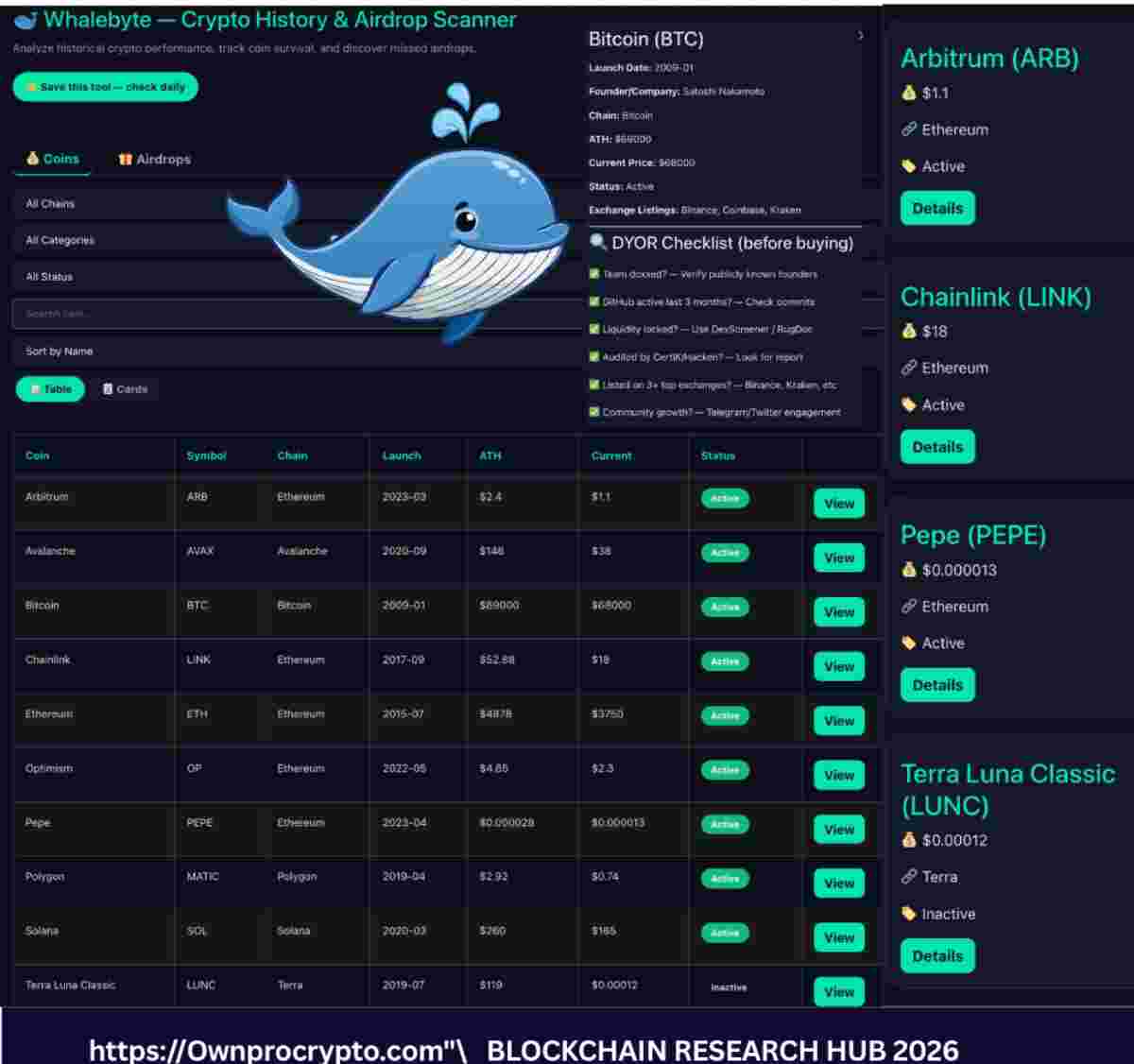
Use the tool to browse active airdrops, review estimated rewards and eligibility information, and explore historical coin data such as launch dates, all-time highs, current prices, blockchain networks, exchange listings, and project status.
Airdrop research is not only about finding the next campaign. Looking at crypto airdrop history can help you understand how projects have distributed rewards and how different campaigns have evolved.
Whalebyte provides a place to review available historical airdrop information alongside project and coin data, helping you compare the broader history of an asset or ecosystem.
Many users discover an airdrop after the campaign has already ended. Reviewing missed crypto airdrops can still be useful for understanding which projects have previously rewarded users and identifying ecosystems worth researching for future opportunities.
Historical information can also help you distinguish between a newly appearing campaign and a project with an established record of user rewards.
The crypto history side of Whalebyte lets you examine information including:
This makes the tool useful as a crypto history scanner as well as an airdrop discovery tool.
Historical data should not be treated as a prediction of future performance, but it can provide useful context when researching a cryptocurrency or Web3 project.
Whalebyte brings two related research tasks together:
Airdrop research: discover active campaigns, review estimated rewards, check eligibility information, and explore airdrop history.
Crypto history research: review launch information, historical performance, project status, blockchain data, and exchange listings.
This combination can help you move from discovering an airdrop to researching the underlying project without treating the tool as a general crypto investment or scam detector.

A Crypto Airdrop Scanner is a useful tool for checking whether a public wallet address is eligible for unclaimed tokens, NFTs, retroactive rewards, or other blockchain distributions. These scanners can search activity across several networks, including Ethereum, Solana, and various Layer 2 ecosystems, without requiring users to expose their private keys.
The Whalebyte airdrop section helps you organize airdrop opportunities by project, chain, estimated value, eligibility, and status.
Instead of treating every campaign as equally valuable, use the available information to identify opportunities worth researching further. Airdrop availability and eligibility can change, so always verify important campaign details through the project’s official sources before participating.
The tool can also support research into upcoming crypto airdrops and campaigns that may already be active or completed.
Security should always be a priority when checking for crypto rewards. A legitimate Crypto Airdrop Scanner generally only needs your public wallet address to perform an eligibility search.
By using a Crypto Airdrop Scanner carefully, users can investigate potential rewards across multiple networks while reducing unnecessary security risks. It is also helpful to determine whether you are primarily interested in finding older, unclaimed airdrops or tracking new projects and potential future opportunities.
Have questions about finding crypto airdrops? Let us know in the comments which networks you use, such as Solana, Ethereum, or Layer 2s, and whether you’re searching for past unclaimed airdrops or keeping an eye on upcoming projects. We’ll be happy to suggest the right Crypto Airdrop Scanner and tracking approach for you.
For users interested in deeper market insights and data-driven research, it is also recommended to cross-check market fundamentals with trusted crypto data sources such as CoinMarketCap.
What is a crypto airdrop scanner?
A crypto airdrop scanner is a tool that helps users discover and review cryptocurrency airdrop opportunities. Depending on the platform, it may provide information about projects, blockchain networks, eligibility, estimated rewards, campaign status, or historical airdrops.
How do I find upcoming crypto airdrops?
You can research upcoming crypto airdrops by monitoring project announcements, blockchain ecosystems, airdrop trackers, and reward campaigns. Whalebyte can be used to review available airdrop information by project, chain, estimated value, eligibility, and status.
Can I track crypto airdrop history?
Yes. A crypto airdrop tracker can help organize information about previous and current campaigns. Whalebyte combines airdrop information with historical crypto data so you can research both the campaign and the related project.
How can I find missed crypto airdrops?
Review historical airdrop information and compare completed campaigns with projects you previously interacted with. Finding a missed campaign does not necessarily mean you can still claim it, so always check the official project for current claim deadlines and eligibility.
What does a crypto history scanner do?
A crypto history scanner helps users research information about a cryptocurrency’s history, such as its launch date, previous all-time high, current price, blockchain, project status, and exchange listings.
Is a crypto airdrop guaranteed to be profitable?
No. Airdrops are not guaranteed profits. Estimated reward values can change, campaigns can end, eligibility can vary, and some projects may never distribute tokens. Treat airdrop information as research rather than a guarantee of future rewards.
Whalebyte is most useful when it is used as one layer of a broader research workflow. For security questions, use a dedicated security tool rather than turning historical data into a risk score.
For example, you can continue from historical research into the Crypto Security Checklist when you need to review wallet and self-custody practices.
For broader crypto research and multi-tool analysis, explore the Crypto Research Workspace as a separate research layer.
For security-specific research, the Crypto Security Hub provides a broader framework covering wallet security, threat intelligence, custody, and risk research.
These tools should complement Whalebyte rather than replace its core purpose. Whalebyte answers historical and airdrop research questions; security tools answer security questions.
For independent verification and deeper market research, readers can also consult established crypto data and educational resources. CoinMarketCap’s Airdrops directory provides current, upcoming, and previous campaign information, while CoinGecko’s crypto airdrop research provides educational and market context around current and potential campaigns.
For basic airdrop safety education, CoinMarketCap’s crypto airdrop guide explains common airdrop mechanisms and discusses phishing, dusting, and other risks that users should understand before participating.