
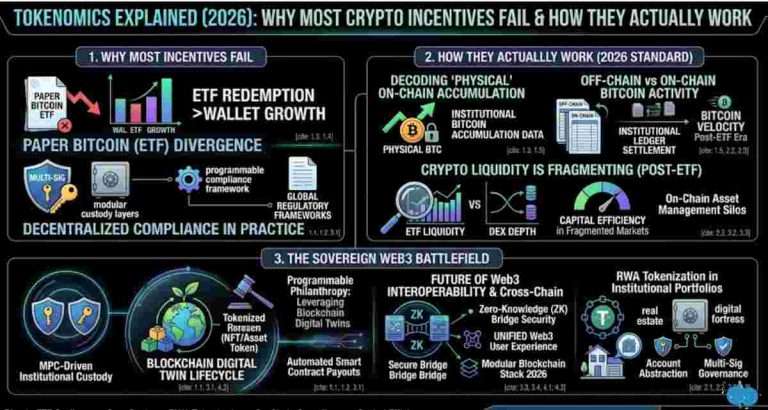
Most crypto projects don’t fail because of bad technology — they fail because of bad tokenomics.
On the surface, tokenomics is explained as supply, distribution, and utility. But in practice, it is something far more critical:
👉 incentive design that controls user behavior, capital flow, and long-term sustainability
In Web3 systems, tokens are not just assets — they are coordination mechanisms that replace centralized control with programmable incentives.
This is where the real problem begins.
Because while tokenomics is designed to align users, developers, and protocols, most systems instead create:
This guide explains tokenomics properly — not just how it works, but why most token models fail, and what is actually changing in 2026.

At a basic level, tokenomics refers to:
But this definition is incomplete.
Tokenomics is the system that determines who gets rewarded, when, and why in a crypto network.
Unlike Web2 systems where companies control outcomes, Web3 relies on incentives instead of authority.
This shift is part of the broader move from centralized systems to decentralized ones, where users gain ownership and participation rights.
Link to : Web3 vs Web2: How Decentralization Changes Finance (2026 Guide)
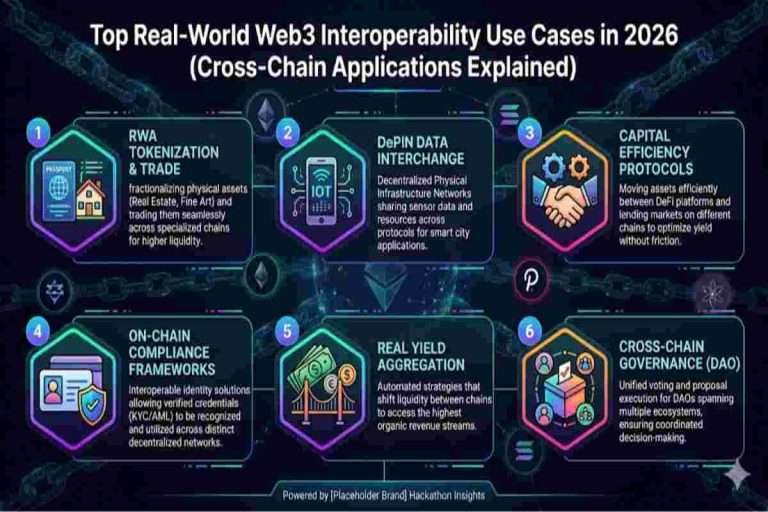
This is the section competitors completely miss.
Most protocols reward:
Not long-term value creation
Result:
Many tokens rely on:
But without real demand:
supply grows faster than value
Token incentives often create:
A major issue:
Many projects are still Web2 systems with tokens added on top.
From community discussions:
“Same centralized backend… just a token added”
This breaks the entire premise of tokenomics.
Instead of theory, think in systems:
| Stage | Function |
|---|---|
| Creation | Token supply defined |
| Distribution | Tokens allocated |
| Incentives | Behavior shaped |
| Adoption | Network grows (or fails) |
Tokenomics works by:
This replaces intermediaries with economic logic instead of control systems.

| Type | Purpose | Risk |
|---|---|---|
| Participation | Growth | Short-term users |
| Security | Network safety | Centralization risk |
| Governance | Decision-making | Low engagement |
| Speculation | Capital inflow | Volatility |
Incentives don’t just attract users — they define what kind of users you get.
This is where most beginners misunderstand tokenomics.
Token value depends on:
| Model | Impact |
|---|---|
| Fixed | Scarcity-driven |
| Inflationary | Growth-focused |
| Deflationary | Value retention |
Without demand, no model works.
This is where your existing post connects perfectly.
Internal link placement: For a deeper breakdown, see our analysis of Real Yield vs Token Incentives

Tokenomics only makes sense in the context of Web3.
In Web2:
In Web3:
This reflects the broader shift toward decentralized systems where ownership and control move from platforms to users.
| Aspect | Web2 | Web3 |
|---|---|---|
| Control | Platforms | Protocols |
| Value Capture | Companies | Users |
| Incentives | Hidden | Transparent |
| Finance | Permissioned | Permissionless |

Even today:
And importantly:
Not all “Web3” systems are truly decentralized
Many rely on:
| Metric | Why It Matters |
|---|---|
| Supply | Scarcity |
| Utility | Demand driver |
| Incentives | Behavior |
| Revenue | Sustainability |
The direction is clear:
Tokenomics is evolving from:
growth hack → economic system

To understand the legal logic and governance standards driving the 2026 decentralized economy, refer to the full Sovereign Framework below:
From this foundation, eight operational pillars translate sovereign ownership into execution. Together, these layers form a unified navigation system for the on-chain economy, outlining how individuals, builders, and institutions secure digital assets, establish ownership, transfer value, tokenize real-world assets, build infrastructure, enable interoperability, and preserve digital continuity over time.
The Web3 Ecosystem 2026 Pillars
Each pillar functions independently, while collectively defining the sovereign Web3 lifecycle—from asset security and ownership to long-term digital preservation.
For essential regulatory context, explore the latest global financial stability standards guiding the Tokenomics landscape.
External Resource: Read the Global Financial Stability Report at IMF.org
Most people think crypto is about:
But in reality:
Tokenomics is the hidden engine that determines everything
Understanding tokenomics explained through incentives is not optional anymore — it’s essential to understanding how Web3 actually works.
Tokenomics is the system that defines how a cryptocurrency works, including supply, incentives, and value distribution.
Because they rely on short-term incentives and inflation rather than sustainable demand and real value creation.
Crypto incentives reward users for participation, security, and governance, shaping behavior within a network.
Token incentives are reward-based, while real yield comes from actual protocol revenue, making it more sustainable.
Yes — even strong technology can fail if the incentive system is poorly designed.
Token supply directly impacts scarcity. Limited supply can increase value if demand rises, while excessive supply can reduce token price over time.
Welcome to OwnProCrypto (Own & Pro Crypto) — a next-generation Bitcoin and blockchain education platform where the science of finance meets the power of AI-driven automation.
Our mission is simple: to equip you with the knowledge, frameworks, and tools needed to make smarter financial and business decisions in the Web3 economy.
Beyond analysis, OwnProCrypto focuses on transparency, verifiable data, and practical frameworks that investors and builders can actually use. Our goal is not hype — but clear thinking, disciplined analysis, and long-term value creation in the decentralized economy.
Our Background: Salim (Sam) is the founder and lead researcher behind OwnProCrypto, a Web3 intelligence platform focused on crypto security, digital ownership, stablecoin systems, interoperability, and institutional blockchain infrastructure.
Crypto Tools & Analysis:
Crypto Fundamental Analysis Tool | Protocol Evaluation System | DeFi Risk Analysis Tools | Crypto Portfolio Dashboard | Token Risk vs Reward Tool
Guides:
Crypto Fundamental Analysis | Blockchain Project Evaluation | Tokenomics Analysis | DeFi Protocol Analysis | Capital Efficiency
© 2026 OwnProCrypto — Built for smarter crypto decisions