Infographic of Ownprocrypto OPC Logo for 2026 Web3 Ecosystem

Ownprocrypto:

Sovereign Asset Strategy & Web3 Institutional Research

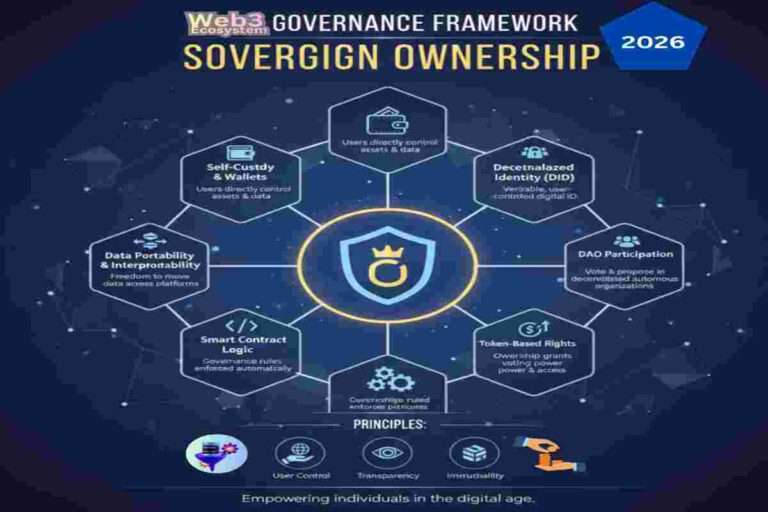
Web3 Governance Framework: Sovereign Ownership (2026)

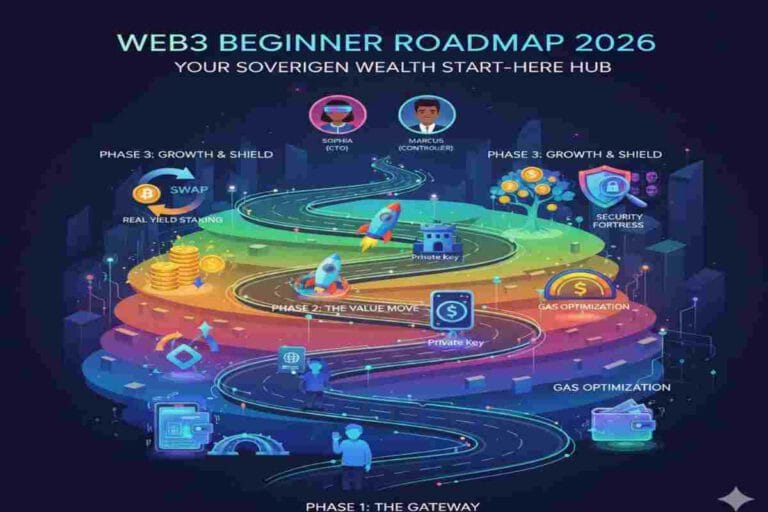
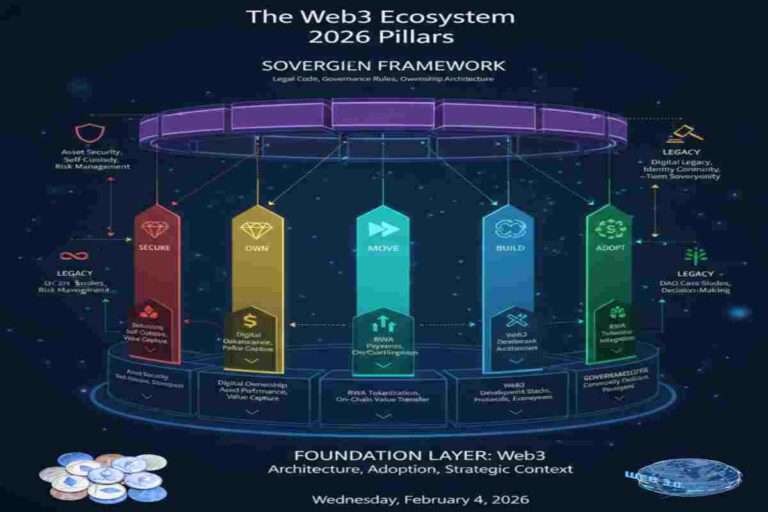
Infographic of the 2026 Web3 Ecosystem showing the 7 Pillars: Secure, Build, Own, Adopt, Move, Connect, and Legacy." The Image showing Web3 ecosystem Roadmap 2026

Problem → Shift → Solution → Framework → Outcome → Risks → Signals → System.

Executive Summary: The Sovereign Operating System (2026)

Table of Contents

From Token-Weighted Chaos to Professionalized Ownership.

By 2026, Web3 governance has transitioned from an experimental feature to the primary infrastructure for global coordination. As “Sovereign Ownership” becomes the standard, this pillar explores how decentralized systems balance throughput legitimacy—the ability to execute decisions—with accountability mechanisms that protect individual asset rights.

The 2026 Governance Drivers:

  • Intent-Centric Intent: The shift from “how to vote” to “what outcome is desired,” using AI Agents as autonomous finishers for complex governance workflows.
  • Quadratic & Reputation-Based Logic: Over 100 major DAOs (including Gitcoin and Optimism) have now adopted Quadratic Voting to neutralize “Whale” dominance and empower the long-tail community.
  • Legal Personality & Liability: The rise of “New Code” regulatory proposals that treat DAO decisions as binding legal contracts, providing a bridge between code and courts.
  • Modular Decision-Making: Decoupling strategic oversight from day-to-day operations to solve the “Coordination Bottleneck” that typically reduces efficiency by 30% in large DAOs.
  • System Navigator: Governance is the decision layer of the Web3 Ecosystem Architecture. See how these rules protect your Digital Legacy or drive the value capture in RWA Tokenization 2026.

Why Web3 Governance Framework Matters in 2026

Web3 Governance Framework design is now the decisive layer of power in the decentralized economy.

Web3 Governance Framework in 2026 addresses a critical structural problem: as digital assets, protocols, and capital scale across decentralized networks, most systems still lack enforceable coordination mechanisms—leaving decision-making fragmented, incentives misaligned, and ownership rights vulnerable to capture or failure. As the ecosystem matures, a decisive shift is underway from experimental governance and informal consensus toward structured, enforceable models—where authority, accountability, and economic rights are explicitly designed into the system rather than assumed. In response, the Web3 Governance Framework emerges as a solution layer, enabling institutions, DAOs, and enterprises to secure assets, coordinate stakeholders, and manage protocol evolution through transparent, rules-based systems. This is operationalized through a Sovereign Ownership Framework that integrates on-chain governance models, token-weighted voting, treasury management logic, and legal enforceability into a cohesive architecture of control. The outcome is resilient, scalable coordination—where decentralized systems can align incentives, enforce rights, and sustain long-term value without relying on centralized authority, transforming governance from a point of failure into the foundation of the digital economy.

Blockchains scale. Infrastructure matures. Capital flows on-chain. But none of it endures without rules that coordinate decision-making, protect rights, and align incentives across stakeholders.

Technology doesn’t fail first, governance does.

The future of the digital economy will not be secured by code alone.

It will be secured by the frameworks that define authority, ownership, accountability, and sovereign control in a borderless world.

Because in 2026, governance is no longer a feature of Web3.  It is its foundation.  

Watch Video: Web3 Ecosystem Explained 2026 in 5 Minutes : Data Governance

Understanding the Web3 Governance Framework 2026 

The Web3 ecosystem in 2026 represents a structural evolution of the internet itself—one defined by sovereign ownership, programmable trust, and on-chain coordination rather than platforms and intermediaries. Unlike earlier crypto cycles driven by speculation, the modern Web3 ecosystem is shaped by infrastructure maturity, real economic activity, and institutional-grade governance. Understanding this ecosystem requires moving beyond tokens and narratives to examine how value is created, secured, and distributed across networks, applications, and users.

 it is a functional reality defined by a robust Sovereign Ownership Framework. While the “good news” is that we have moved past speculative cycles, the “unique solution” for users lies in the transition from platform dependency to a fully Decentralized Digital Economy. This Web3 Ecosystem 2026, the Blockchain-Based Web Environment ensures that assets, identity, and data are secured within a Trustless Web Architecture that operates independently of traditional Big Tech silos. By leveraging a Permissionless Web Ecosystem, participants can now interact within a Web3 Network Landscape where ownership is hard-coded into the protocol, ensuring that the Decentralized Internet Framework remains a resilient foundation for long-term digital sovereignty.

It presents a clear, ecosystem-level map of Web3, organized into seven strategic pillars that define how security, infrastructure, ownership, adoption, finance, connectivity, and long-term sovereignty work together as a unified system.

This is not about speculation.
It is about architecting digital sovereignty

What Is Web3 Governance Framework? (Definition & Core Principles) 

Web3 Governance Framework refers to the mechanisms through which decentralized networks make decisions, enforce rules, upgrade protocols, and allocate power — without relying on centralized authorities.

At its core, Web3 governance is built on four principles:

  • Transparency: rules and decisions are publicly verifiable
  • Programmability: governance logic is enforced by smart contracts
  • Participation: stakeholders can influence outcomes
  • Sovereignty: ownership grants rights, not permissions

Unlike Web2 platforms, where governance happens behind closed doors, Web3 governance is embedded directly into code, protocols, and on-chain voting systems.

This Infographic of RWA Tokenization Guide 2026 to Real-World Asset Portfolios

Governance vs Decentralization vs Tokenomics 

These terms are often confused, but they are not the same.

  • Decentralization describes where control is distributed
  • Tokenomics describes how incentives are structured
  • Governance defines who decides and how decisions are enforced

A network can be decentralized but poorly governed.
A token can have strong economics but weak governance.

In 2026, governance — not decentralization alone — determines whether a Web3 ecosystem survives. 

How Governance Functions in the Modern Web 

In the modern web, governance operates across three layers:

  1. Code layer: smart contracts enforce rules automatically
  2. Social layer: communities debate proposals and values
  3. Legal layer: jurisdictions define liability and compliance

Successful Web3 governance aligns all three.
Failures happen when code, community, and law diverge.     ↓ Jump to 2026 Legacy: Expert FAQs & Troubleshooting.

How Web3 Governance Framwork Differs from Traditional Systems  

Traditional governance relies on:

  • Centralized authority
  • Legal enforcement after the fact
  • Slow, opaque decision-making

Web3 governance replaces this with:

  • Predefined execution logic
  • On-chain voting and signaling
  • Automatic enforcement
  • Global participation

In Web3, rules are executed before disputes arise — not litigated after. 

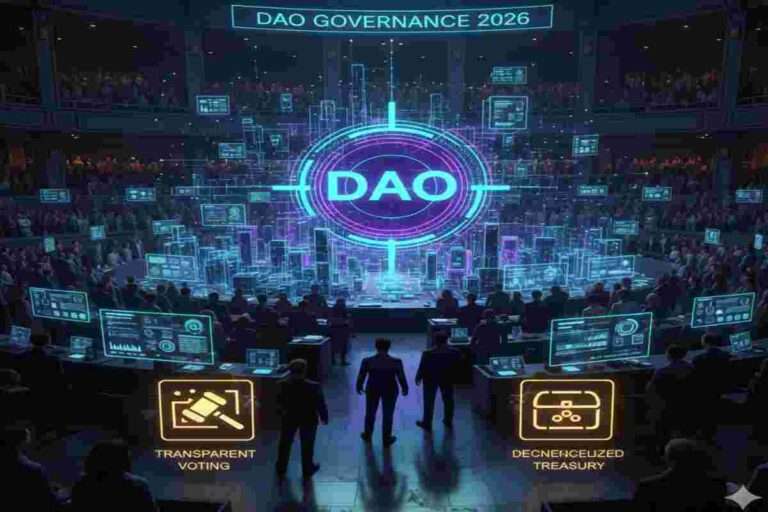
The Infographic of DAO Governance 2026. The Architecture of Collective Ownership

Types of dao governance models 

DAO governance models define how decisions are proposed, voted on, and executed within a Decentralized Autonomous Organization. The main types are:

The main DAO governance models include:

  1. Token-based governance, where voting power is proportional to the number of tokens held.
  2. Reputation-based governance, where voting power depends on a member’s contributions and reputation.
  3. Delegated governance, where members delegate their voting rights to representatives.
  4. Multisignature (multisig) governance, where decisions require approval from a predefined group.
  5. Hybrid governance models, which combine multiple governance mechanisms.

DAOs (Decentralized Autonomous Organizations) use these models to enable transparent, programmable decision-making through member proposals, on-chain voting, and automated execution.

In summary, DAOs replace traditional corporate boards with transparent, programmable governance where proposals are submitted by members, votes are cast using tokens or reputation, and approved actions are executed automatically via smart contracts. 

DAO-Centric Governance Models 

DAOs (Decentralized Autonomous Organizations) are governance-native entities where:

  • Proposals are submitted by members
  • Votes are cast using tokens or reputation
  • Approved actions are executed automatically

DAOs replace corporate boards with transparent, programmable governance. 

Intent-Based Execution: Moving from Direct Voting to Autonomous Finality

A pure on-chain governance model automates the entire lifecycle of a proposal, from the initial vote to the final smart contract execution. By removing the need for a “centralized multisig” to implement results, this model ensures that the will of the community is enforced by the protocol’s code, achieving true transparency and trustlessness.

This infographic image of Benefit of an On-Chain Reputation System thats why Institutional Investors Are Moving On-Chain in 2026

Comparison Between On-chain and Off-chain Governance

On-chain governance is a governance mechanism where proposals, voting, and execution are carried out directly on the blockchain using smart contracts, ensuring high transparency, security, and automatic enforcement of decisions, though it can be expensive and less flexible due to transaction fees and immutable code. In contrast, off-chain governance takes place outside the blockchain through discussions, forums, and voting platforms, offering greater flexibility and lower costs, but its decisions rely on social consensus and must be manually implemented on-chain by developers or governing bodies. 

Aspect On-chain Governance Off-chain Governance
Location On the blockchain Outside the blockchain
Execution Automatic via smart contracts Manual
Cost High (gas fees) Low
Transparency Very high Depends on process
Flexibility Low High

Token-Weighted Voting Explained 

In token-weighted voting, influence is proportional to token ownership.

Strength: aligns incentives with capital at risk
Risk: enables plutocracy and governance capture

By 2026, pure token voting is considered insufficient on its own. ↓ Jump to 2026 Legacy: Expert FAQs & Troubleshooting.

This infographic image of Career Asset in 2026 as Role of Smart Contracts & Reputation Tokens

Reputation-Based & Quadratic Voting

  • Reputation systems: weight influence by participation and contribution
  • Quadratic voting: reduces whale dominance by increasing vote cost non-linearly

These models aim to balance fairness with efficiency.

Hybrid Governance Systems 

Hybrid governance combines:

  • Tokens
  • Reputation
  • Delegation
  • Time-based voting

Most institutional-grade DAOs now use hybrid frameworks. 


Sovereign Ownership Framework

The Sovereign Ownership Framework represents the shift from passive token holding to active protocol stewardship. In 2026, this framework ensures that digital rights are not just granted by a platform, but are architecturally guaranteed through self-custody and on-chain identity, allowing users to exit or fork protocols without losing their underlying asset value. 

Emerging Governance Models in 2026 

New models include:

  • DAO 3.0: adaptive governance with upgradeable rules
  • Adaptive governance: parameters change based on network behavior
  • Constitutional DAOs: governance constrained by immutable core rules

Governance itself has become programmable. 

What Is Sovereign Ownership in Web3?

Sovereign ownership means that users directly control their assets, identity, and participation rights without intermediaries.

Ownership is enforced by cryptography, not contracts of service

Sovereign Ownership for Users and Networks

Sovereign ownership means that users and networks have full control and authority over their digital assets, identities, and data without relying on centralized intermediaries. For users, it ensures true ownership, privacy, and the freedom to manage assets or identities independently. For networks, it enables decentralized governance and self-sustaining ecosystems where rules are enforced by code and community consensus rather than centralized control, increasing resilience, trust, and censorship resistance. 

The mind blowing Image shows Asset Security 2026- Setting Up Your Digital Fortress with Account Abstraction as Emergency Freeze

Digital Asset Rights, Identity & NFTs

NFTs, tokens, and decentralized identity (DID) systems enable:

  • Verifiable ownership
  • Transferable rights
  • Permissionless participation

Ownership is no longer symbolic — it is executable.

Data Sovereignty & Self-Custody

Self-custody ensures:

  • No platform seizure
  • No unilateral censorship
  • No dependency on centralized databases

In Web3, losing custody means losing sovereignty. 

How Ownership Translates into Governance Power

In Web3:

  • Ownership = voting rights
  • Participation = influence
  • Contribution = reputation

Governance power flows directly from ownership structures.  

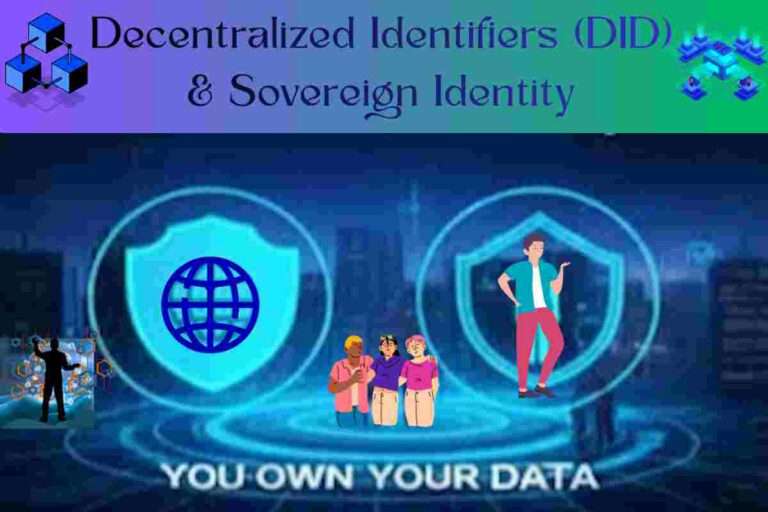
This infographic Image of Decentralized Identifiers (DIDs) Digital Identity 2026- Own Your Persona in the Web3 Era

The Rules That Govern Decentralized Networks

Decentralized networks operate based on protocols and governance rules encoded in software, rather than centralized authorities. These rules define how participants interact, validate transactions, propose changes, and make decisions, ensuring fairness, security, and transparency. Governance can be on-chain, where smart contracts automatically enforce decisions, or off-chain, relying on community consensus and social coordination. Clear rules help prevent disputes, incentivize cooperation, and maintain network integrity, allowing decentralized ecosystems to function reliably while empowering users with control and accountability.

How Do Smart Contracts Act as Governance Rules?

Smart contracts automate governance by encoding rules, voting thresholds, and execution conditions directly on-chain. Once conditions are met, outcomes happen automatically, reducing manual intervention and increasing transparency.

Smart contracts encode:

  • Voting thresholds
  • Upgrade conditions
  • Treasury controls

Once deployed, these rules execute automatically.  

How Protocols Encode Decision Logic

Protocols define:

  • Who can propose
  • Who can vote
  • What can be changed
  • What is immutable

Governance is architecture — but expressed as rules, not infrastructure.  

What Does a Typical Governance Process Look Like (Proposal → Execution) 

A typical process:

  1. Proposal creation by community or stakeholders
  2. Discussion (off-chain or on-chain)
  3. Voting via tokens, reputation, or hybrid methods
  4. Execution through smart contracts if thresholds are met
  5. Feedback & iteration to refine rules and participation. 

Governance Tokens & Voting Mechanics

Governance tokens enable:

  • Proposal creation
  • Voting participation
  • Delegation

They are political instruments, not just financial assets. ↓ Jump to 2026 Legacy: Expert FAQs & Troubleshooting.

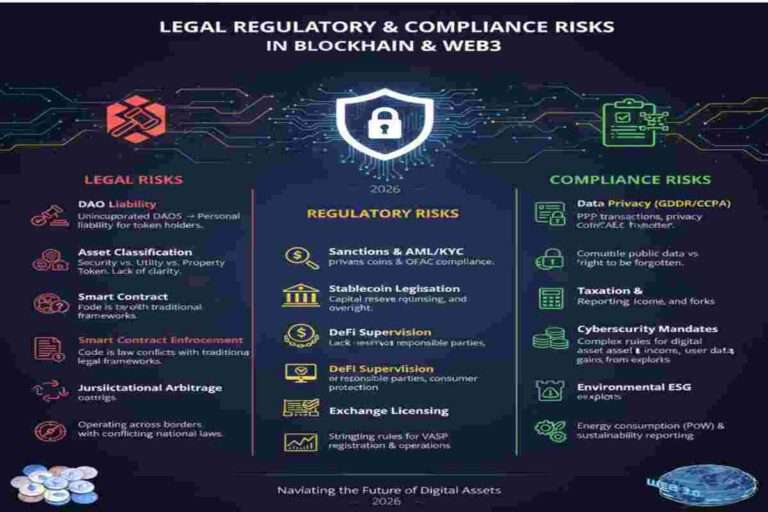
Infographic of Legal Regulatory & Compliance Risk in Blockchain & Web3 in 2026
This infographic image of Top Sovereign Jurisdictions: Where Web3 is Legal & Regulated in 2026

Current State of Web3 Regulation 

By 2026, regulation targets:

  • Interfaces
  • Custodians
  • Token issuance

Not the underlying protocols.  

Web3 Legal Architecture

Developing a robust Web3 legal architecture is now essential for navigating the 2026 regulatory landscape. This involves integrating “legal wrappers” and off-chain compliance requirements directly into the DAO’s code, creating a bridge between decentralized execution and traditional liability protections for token holders.

Liability, Tax & Risk Considerations

Risks include:

  • Unclear liability
  • Cross-border taxation
  • Regulatory arbitrage

Governance design now includes legal strategy. 

Centralization Risks in Token Voting

Whales, VCs, and insiders can dominate governance without safeguards.

Voter Apathy & Low Participation

Low participation undermines decentralization more than attacks. 

Governance in Practice: Persona & Case Studies 

Who the Web3 Governace Framwork Is Built For: Strategic Persona

  • Institutional Allocators
  • Builders & CTOs
  • Safety-First Investors
  • Global Citizens & Digital Nomads

Successful Decentralized Ownership Models

Well-designed DAOs align incentives, participation, and execution.

Decentralized governance is the operational backbone of Web3, moving beyond the “read-write” capabilities of Web2 into a “read-write-own” paradigm. By utilizing blockchain technology, organizations can distribute power among stakeholders, ensuring that those who contribute to the ecosystem also have a say in its direction. Below are two distinct case studies reflecting successful implementations of decentralized ownership. 


MakerDAO and the “Continuous Approval” Model

The Problem Traditional stablecoins are often managed by centralized entities, creating single points of failure and requiring users to trust a corporate board for collateral management and peg stability.

  • The Objectives MakerDAO sought to create a permissionless, decentralized credit system (the Maker Protocol) that could maintain a stable peg for the DAI token while allowing a global community to manage risk parameters without a central CEO.
  • Analysis & Situation MakerDAO operates as a Decentralized Autonomous Organization (DAO) where decision-making is tied to the MKR governance token. The system requires over-collateralization (typically 150%) to ensure every unit of DAI is backed by more than its value in assets.
  • Implementation The organization implemented a unique “Continuous Approval Voting” system. Unlike traditional elections with a start and end date, MKR holders can change their vote at any time. A new proposal only becomes active once it attracts more “locked” MKR tokens than the currently active proposal. This ensures the protocol is always aligned with the current majority will of its stakeholders.
  • Challenges The model faces significant “voter apathy,” as the technical complexity of risk management can discourage participation. Furthermore, data indicates power concentration, with a small percentage of token holders often controlling a significant portion of the voting weight.
  • Results & Outcomes Despite these challenges, MakerDAO has successfully managed over $5 billion in market capitalization. It has demonstrated that decentralized governance can effectively handle complex financial tasks, such as selecting collateral types, adjusting stability fees, and triggering emergency shutdowns during market volatility.↓ Jump to 2026 Legacy: Expert FAQs & Troubleshooting.

The Optimism Collective and “Bicameral” Governance

  • The Problem Many DAOs suffer from “plutocracy,” where wealthy token holders (whales) make all the decisions, often prioritizing short-term financial gains over long-term ecosystem health and public goods.
  • The Objectives Optimism aimed to create a sustainable “Impact = Profit” engine that rewards contributors who build public goods for the Ethereum ecosystem, ensuring that power isn’t solely concentrated in the hands of capital providers.
  • Analysis & Situation To balance the interests of different stakeholders, Optimism launched a Bicameral (two-house) governance system:
    1. The Token House: Governed by OP token holders who vote on protocol upgrades and incentive distributions.
    2. The Citizens’ House: A reputation-based house that uses a “one-person-one-vote” system to decide on retroactive public goods funding.
  • Implementation Through its Retroactive Project Funding (RetroPGF), the Collective has distributed over $100 million in OP tokens to developers and researchers. The Citizens’ House ensures that even those without massive capital can exercise equal “sovereign” power based on their verified contributions to the network.
  • Challenges Defining “citizenship” in a verifiable and scalable way without compromising privacy is an ongoing hurdle. The system requires constant iteration (moving through “Seasons”) to fine-tune the balance of power between the two houses.
  • Results & Outcomes Optimism has established a new benchmark for “governance minimization.” By using “Optimistic Approvals,” most expert-led decisions pass automatically unless a stakeholder group explicitly vetoes them. This reduces the voter fatigue found in other DAOs while maintaining a high level of accountability & decentralization.
Web3 Governance Framework 2026: A Blueprint for Sovereign Ownership, DAO Legal Wrappers, and AI-Driven Multi-Agent Orchestration.

Web3 Governance Framework Failures & Lessons Learned  

Most failures trace back to:

  • Poor voting design
  • Centralized control
  • Weak legal planning

Governance mistakes compound faster than technical ones.

While decentralized governance offers immense potential, the transition from code-based ideals to human-driven reality has led to several high-profile failures. In Web3, governance mistakes often compound faster than technical ones because they involve the social layer—where incentives, power, and legal liabilities intersect.


The Beanstalk Farms Flash Loan Attack (2022)

  • The Problem: Poor Voting Design Beanstalk Farms, a stablecoin protocol, utilized a governance model that allowed for “emergency executions” if a proposal reached a super-majority (two-thirds) vote. However, the system did not account for the sheer speed and temporary liquidity of the DeFi ecosystem.
  • The Implementation & Challenge In April 2022, an attacker used a Flash Loan—a massive, uncollateralized loan that must be repaid within the same block—to instantly acquire $1 billion worth of assets. By depositing these assets into the protocol, the attacker temporarily gained over 67% of the voting power. They then passed a malicious proposal to drain the protocol’s treasury and repaid the flash loan, all in a single transaction.

The Lesson: Rooted in Case Study Failure

  • Q: Why did the attack succeed?
  • The governance design lacked a voting delay or “cooldown period” between token acquisition and voting power activation.

Rooted in Case Study Failure: By treating governance power as an instant commodity rather than a long-term commitment, the protocol became vulnerable to “economic takeover.” Modern DAOs now use timelocks and checkpoints to ensure only long-term holders can influence critical decisions. 


The Solend “Whale” Takeover (2022)

  • The Problem: Centralized Control (The “Panic Pivot”) Solend, a lending protocol on Solana, faced a systemic risk when a single user (a “whale”) held a massive position that was close to liquidation. If liquidated on-chain, it threatened to crash the price of SOL and leave the protocol with bad debt.
  • The Analysis & Implementation The Solend team launched an emergency governance vote to grant themselves power to take over the user’s account and liquidate the position privately (OTC). The proposal passed almost instantly, largely because a single large wallet provided 90% of the “Yes” votes.

The Lesson: Rooted in Case Study Failure

  • Q: What was the primary governance failure?
  • The failure was two-fold: a concentration of voting power (plutocracy) and a breach of trust regarding user property rights.

Rooted in Case Study Failure: The community backlash was so severe that a second vote was immediately launched to invalidate the first. This case study teaches that “Emergency Powers” must be strictly defined before a crisis, and that a DAO is only as decentralized as its most influential voter.↓ Jump to 2026 Legacy: Expert FAQs & Troubleshooting.


Analysis of Common Failure Points

In decentralized systems, the hardest thing to fix is a broken incentive.

  • Weak Legal Planning: Many DAOs operate as “Unincorporated Associations,” which can lead to joint and several liability for token holders. Without a legal wrapper (like a Wyoming DAO LLC or a Marshall Islands DAO), members may find themselves personally liable for the organization’s debts or regulatory breaches.
  • Voter Apathy: When only 1–5% of token holders vote, the system is no longer a democracy; it is an oligarchy. Successful models now use delegation (letting experts vote on your behalf) to ensure high participation levels without requiring every user to be a policy expert.
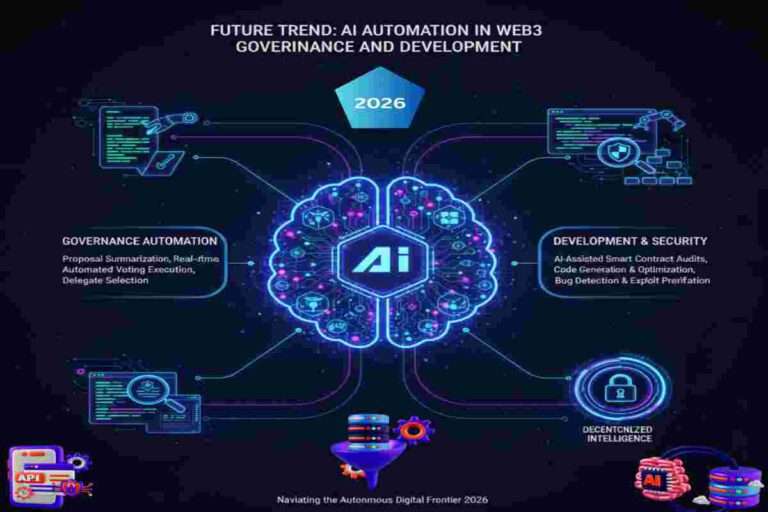
This Infographic of Future Trend & AI Automation in 2026

Multi-Agent Orchestration: Solving the DAO Governance Crisis with AI Sub-Agents

In advanced Web3 architectures, AI-automation functions as an execution layer rather than a decision authority. Human actors define strategy, governance rules, and risk parameters, while automated agents enforce those policies consistently across time, scale, and networks. In practice, AI-driven automation monitors on-chain activity, validates governance conditions, flags security anomalies, and executes pre-approved workflows such as transaction limits, treasury operations, or compliance checks. This design strengthens operational resilience, reduces human error, and ensures continuity without compromising self-custody or sovereign control. By separating decision-making from execution, Web3 systems achieve scalable automation while preserving decentralization, accountability, and long-term digital sovereignty. ↓ Jump to 2026 Legacy: Expert FAQs & Troubleshooting.

AI-Automation Understanding Table (System View)

This table helps readers mentally place AI correctly — not as magic, but as infrastructure.

Layer Human Role AI-Automation Role Sovereignty Impact
Strategy Define goals, risk limits, governance rules None Fully human
Policy Encode rules into smart contracts & workflows Validate rule consistency Human-controlled
Execution Approve systems & escalation paths Execute tasks automatically Delegated, reversible
Monitoring Decide what matters Watch thresholds & anomalies Prevents silent failure
Recovery Authorize intervention Trigger alerts & pauses Human override preserved

Next-Generation Governance Tokens

Next-generation governance tokens go beyond simple voting power to provide more flexible, secure, and meaningful participation in decentralized networks. Unlike traditional tokens that only represent a vote, these tokens can be staked, delegated, or weighted based on reputation, contribution, or expertise, enabling smarter decision-making. They often incorporate time-locks, quadratic voting, or cross-chain compatibility to prevent centralization and promote fairness. Additionally, some tokens integrate economic incentives or rewards for active participation, aligning community interests with network growth. These innovations aim to make governance more inclusive, effective, and resilient, shaping the future of decentralized ecosystems. 

The 2026 Web3 Readiness Audit: Your Web3 Ecosystem Explained

Don’t just read theory—audit your infrastructure.

  • Self-Custody: Multi-sig or non-custodial recovery plans
  • Verification: On-chain proof of yield and RWA holdings
  • Compliance: Automated compliance logic vs manual review
  • Liquidity: Ability to off-ramp 10% of treasury in <60 minutes
  • Data Sovereignty: ZK-based privacy with regulatory transparency.

Navigate Your Digital Sovereignty

To secure your Web3 Governance Framework 2026 market shifts, you need more than just theory—you need execution. I have developed the complete Digital Sovereignty Tool & Pillar Template Set, designed specifically for institutional-grade asset management and on-chain succession planning. This toolkit includes the RWA S-Curve Projection Model, the Smart Contract Will Framework, and the Capital Efficiency Audit.

Web3 Governance Framework (12 sheets)

  1. Governance Structure Map
  2. Stakeholder Registry
  3. DAO Proposal Tracker
  4. Voting & Decision Records
  5. Token Governance Distribution
  6. Treasury Governance Oversight
  7. Governance Risk Register
  8. Compliance & Regulatory Monitoring
  9. Governance Participation Metrics
  10. Delegation & Voting Power Tracking
  11. Community Engagement & Feedback
  12. Governance Performance KPI Dashboard

Purpose: Implement decentralized, sovereign governance frameworks for DAOs and protocols. This isn’t just a guide; it’s a professional-grade, 10-sheet strategic asset valued at $499, designed for institutional-level portfolio architecture. We update our repository daily with fresh technical templates and internal case studies. To ensure you never miss a critical update, save this page to your mobile home screen or desktop and make it your daily starting point for On-Chain Compliance and wealth preservation.For a completed Ecosystem Architecture Map Templates with Individual Sheet ready in Excel or Google Sheet worth $499 for free today join our Facebook Group https://www.facebook.com/groups/2430833834044955

Conclusion: Governance Is the Operating System of Web3

In 2026, the Web3 governance framework defines legitimacy, not technology. Networks rise or fall based on how power is distributed, constrained, and exercised.

Web3 is no longer about removing rules — it is about rewriting them transparently and effectively.

The Decentralized Internet Framework of 2026 is an architecture built for freedom, not just a set of new tools for old problems. By embracing a Permissionless Web Ecosystem and a Sovereign Ownership Framework, you step out of the era of digital feudalism and into an Open Web Infrastructure where you truly hold the keys. The evolution of the Tokenized Digital Ecosystem and the Decentralized Digital Economy represents a permanent shift of power back to the individual. Those who master the Distributed Web Environment will architect a future where digital property rights are as enforceable as physical ones.

Are you ready to stop renting your digital existence and start owning it?

Those who understand governance will shape the next digital order.
Those who ignore it will be governed by it.

Key Takeaways

  • Governance > speculation
  • Ownership = power
  • Rules are code
  • Sovereignty is programmable

↑ Back to FAQs Menu

FAQs Web3 Governance Framework: Solving the ‘Whale’ Dominance and Voter Apathy Paradox

To help you navigate the complexities of decentralized decision-making in 2026, we have organized the most critical inquiries into thematic groups. This structure ensures you can quickly find expert insights rooted in real-world successes and historical failures.


The Core of Web3 Governance Framework


Exercising Power: Voting Models


The Sovereignty & Ownership Layer


Governance Rules & Execution (That Govern Decentralized Networks)


The 2026 Regulatory Reality


Challenges, Risks & Mitigation


Learning from the Governance Frontlines


Future Trends & Token  

This Infographic of Navigating the Web3 Ecosystem in 2026: The Sovereign Framework

Navigating the Web3 Governance Framework: The Sovereign Framework

As part of the Web3 Ecosystem Architecture, this pillar focuses on Web3 Governance Framework 2026, detailing how sovereign ownership, on-chain governance, and DAO tokenomics coordinate real-world capital and accountability.

Explore related pillars:

Each pillar functions independently while forming a complete sovereign Web3 lifecycle model.

Deep Drive External Trust Link 

LearnWeb3 is a beginner-friendly platform offering structured, hands-on Web3 learning resources trusted by the developer community. U.S. Treasury Digital Asset Report.