
Search by title, topic or phrase
Use our Crypto Search Engine 🔍 to find the topics and keywords you're looking for.
Build an eight-layer financial infrastructure architecture for tokenized deposits, real-time settlement, programmable finance and institutional digital-asset operations.
Select the operating environment you want to model. The selection changes how the architecture is interpreted.
Choose the architecture capability that best represents the infrastructure you want to model.
Identity, authentication, permissions and participant access.
KYC, AML, sanctions, transaction controls and risk logic.
Deposits, digital ledgers, tokenized money and asset representation.
Liquidity positioning, treasury automation and intraday management.
Instant payment, DLT and continuous settlement capabilities.
Banking APIs, middleware, messaging and multi-rail connectivity.
Analytics, anomaly detection, forecasting and operational automation.
Key management, governance, recovery, controls and operational resilience.
Select an event to see which architectural layers become involved. This is a dependency simulation, not a prediction of actual system behavior.
Generate a concise architecture profile from your selected scenario and eight-layer configuration.
A structured representation of your selected infrastructure model.
This tool is an educational architecture simulator based on the OwnProCrypto eight-layer conceptual framework. It does not provide regulatory, legal, investment, cybersecurity, or operational advice. Scores represent the configuration selected by the user and should not be interpreted as an objective measure of institutional readiness.
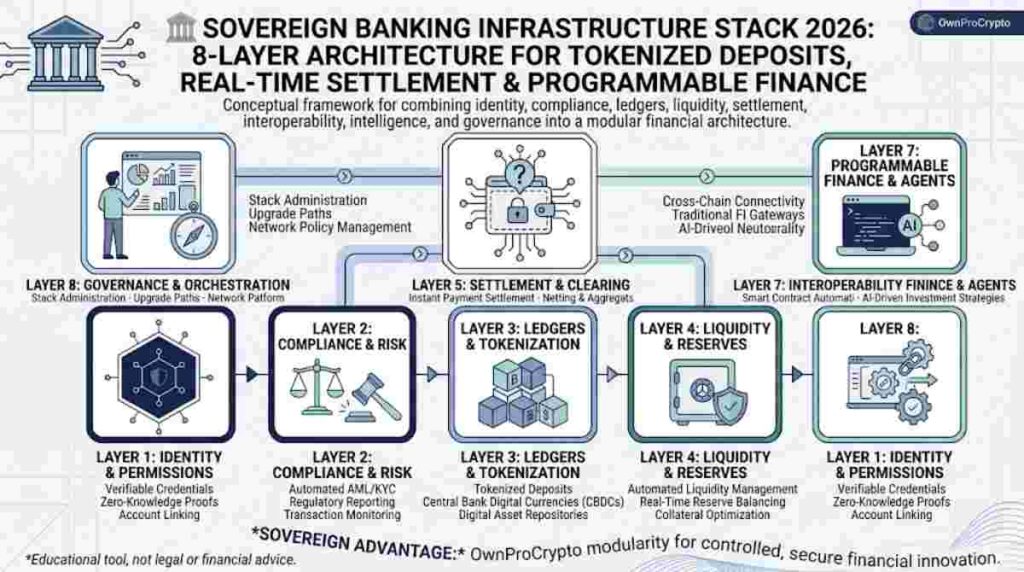
The following framework illustrates how an enterprise financial institution modernized its settlement layer using an 8-layer modular architecture:
| Phase & Scope | Core Parameters & Execution | Strategic Outcomes & Lessons |
|---|---|---|
| Problem | A regional commercial bank experienced severe liquidity bottlenecks and 48-hour clearing delays due to batch-processed legacy core messaging. | High intraday capital costs and inability to support corporate client demands for 24/7 cross-border liquidity management. |
| Objectives | Deploy a permissioned tokenized deposit ledger capable of sub-second settlement while maintaining ISO 20022 compliance and 100% core synchronization. | Achieve 24/7 intraday liquidity, eliminate batch window dependencies, and enable programmable conditional payments. |
| Analysis / Situation | Evaluated 8 distinct infrastructure layers. Identified critical gaps in Layer 2 (Programmable Compliance) and Layer 6 (Interoperability Bridges). | Determined that direct database replacement was unfeasible; a middleware ledger adapter strategy was required for legacy preservation. |
| Implementation | Integrated a permissioned ledger via REST/gRPC APIs, embedding automated KYC/AML checks directly into smart contract execution loops. | Phased rollout: Initial corporate treasury pilot converted $50M in standard commercial deposits into tokenized deposit claims. |
| Challenges | Handling real-time balance reconciliation between continuous token ledgers and end-of-day legacy accounting GLs. | Resolved by establishing an automated dual-entry shadow accounting service operating at Layer 5 (Settlement). |
| Results / Outcomes | Cut settlement clearing times from T+2 days to real-time (under 3 seconds), reducing intraday reserve capital requirements by 38%. | Successfully scaled to handle over $1.2B in annualized transaction volume with zero compliance or reconciliation overrides. |

Q: Is the Sovereign Banking Infrastructure Stack an official regulatory or international standard?
A: No. It is an analytical framework created by OwnProCrypto to help financial professionals, developers, and institutions conceptualize how modular components interact across legacy and digital asset ecosystems.
Q: How does programmable compliance differ from traditional post-trade AML checks?
A: Programmable compliance executes rules pre-settlement via automated engines or smart-contract logic, preventing non-compliant transactions before they finalize rather than auditing them after execution.
Q: Does adopting tokenized deposits require replacing established RTGS rails like FedNow or CHIPS?
A: No. Tokenized deposits and distributed ledgers rely on Layer 6 interoperability APIs to bridge state updates with traditional settlement networks for final Fiat liquidity backstopping.
Q: What role does AI play in Layer 7 of this stack?
A: AI assists with operational intelligence—such as predictive liquidity modeling, real-time fraud anomaly detection, and automated reconciliation—while deterministic rules enforce ledger accounting.
