
Table of Contents
TogglePaper Bitcoin is rapidly reshaping how institutional capital interacts with Bitcoin scarcity. In 2026, the market is no longer defined solely by spot ownership. It is influenced by a layered financial structure: Bitcoin ETFs explained through institutional inflows, Bitcoin derivatives explained via high-leverage positions and open interest, and synthetic exposure that impacts price discovery without altering the fixed 21 million supply.
Recent ETF outflows of $4.3 billion signal a structural shift from passive exposure toward active, sovereign ownership. This transition highlights the critical debate of Spot vs Paper Bitcoin, as exchange reserves have fallen to 8-year lows, confirming that Bitcoin scarcity is no longer theoretical—it is mathematically measurable. As more capital exits custodial platforms and moves into cold storage, the gap between “Paper” supply and real on-chain supply becomes increasingly visible to the global market.
Meanwhile, sovereign adoption is accelerating. When nation-states such as the United States, Pakistan, and the UAE begin accumulating Bitcoin as strategic reserves, the Paper Bitcoin market becomes a secondary shadow of the Spot market—not the driver of it. This shift in liquidity often leads to significant Bitcoin price volatility, but this movement is not instability; it is refinement.
Bitcoin is transitioning from a speculative “tech stock proxy” into its mature role as a global treasury asset. Understanding the relationship between Paper Bitcoin and true scarcity is now essential for long-term investors positioning themselves for the 2030 horizon.
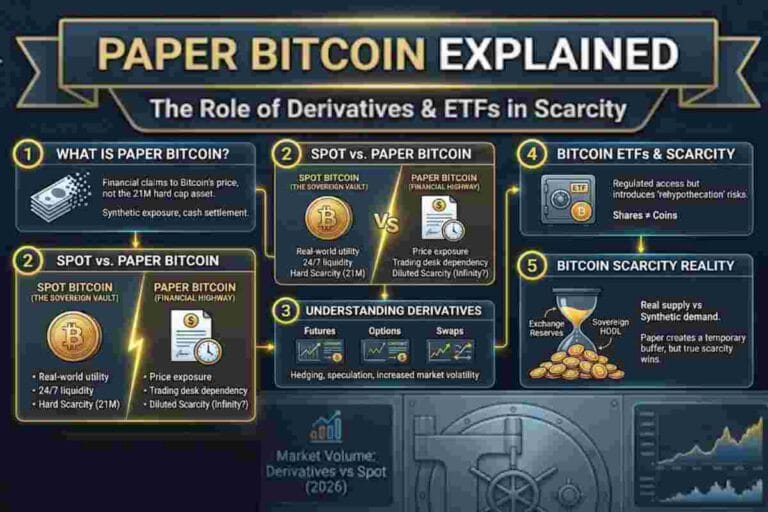
Paper Bitcoin refers to any financial instrument that tracks Bitcoin’s price without being backed 1:1 by “physical” Bitcoin held in an on-chain wallet. In 2026, this mainly includes cash-settled futures, certain exchange-traded products, and synthetic swaps. Trading Paper Bitcoin means you are speculating on price movements rather than participating in the Sovereign Ownership Framework, which ensures direct control of the underlying asset.
For long-term investors, understanding Paper Bitcoin is crucial — it can mask true scarcity and influence market dynamics even if it doesn’t affect the actual coins you hold.
Understanding derivatives is vital for the ROI calculations we present in Digital Ownership in 2026. Visit the CME Group’s Bitcoin Education for more on paper markets.
Imagine holding the promise of wealth in your hands, yet never truly owning it. For millions of investors in 2026, this is the reality of Paper Bitcoin — a financial shadow of the Bitcoin you think you know.”
“While the world watches Bitcoin’s price swings with bated breath, an invisible layer of derivatives and ETFs quietly shapes scarcity, liquidity, and your long-term returns.”
The purpose of this post is to demystify Paper Bitcoin, explain how derivatives and ETFs influence the effective supply of Bitcoin, and show why long-term investors can confidently hold their assets, regardless of short-term market noise. By understanding the mechanics behind Paper Bitcoin, you gain insight into why scarcity still matters, how institutional inflows impact your investment, and what the future might hold for Bitcoin ownership.
According to the latest 2026 market data, over 10 million BTC equivalent exists in synthetic exposure, while only about 20 million BTC have been mined — a striking illustration of the growing gap between real and paper supply. As famed investor Paul Tudor Jones once said, “Bitcoin is a hedge against the system, but you must understand the system to truly hedge it.” This post promises clarity, context, and actionable insight for long-term holders navigating a complex financial landscape.
The distinction between Spot and Paper Bitcoin is like owning a house versus holding a contract that pays you if the house value rises.
Spot Bitcoin: Involves buying BTC on-chain — actual ownership of the asset. This is “hard” supply.
Paper Bitcoin: Exists primarily as synthetic exposure on institutional ledgers. In theory, it can be created in near-infinite quantities, provided there’s a counterparty.
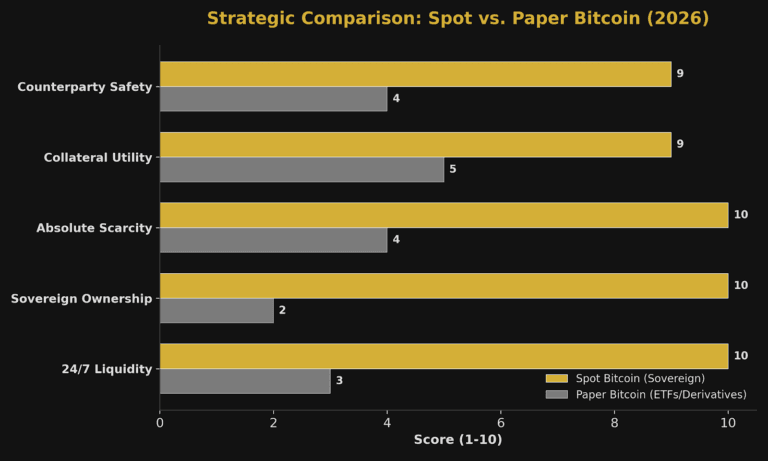
Long-term investors benefit most from Spot Bitcoin, as it directly contributes to scarcity and wealth preservation, whereas Paper Bitcoin mainly affects short-term price perception.
For long-term holders, Paper Bitcoin is a double-edged sword. It enhances liquidity and enables trillion-dollar market caps, but it can also suppress price discovery, diverting demand from the limited 21 million supply into infinite paper contracts.
Understanding these mechanics helps investors remain confident in their long-term HODL strategy, regardless of temporary volatility created by derivatives and ETFs.
For long-term holders, Paper Bitcoin may influence market perception, but your real advantage comes from holding Spot Bitcoin.
Are you holding an IOU or an Asset? Don’t let your 2030 legacy depend on a brokerage’s opening hours. Learn how to transition to Physical Spot Bitcoin today with the Sovereign Custody Blueprint.

| Instrument | Primary Purpose | Settlement Method |
| Futures | Hedging & Speculation | Mostly Cash (USD/USDC) |
| Options | Volatility Protection | Cash-settled on CME/Deribit |
| Perpetual Swaps | High-leverage Trading | Crypto-collateralized |
These instruments allow investors to gain exposure far beyond the amount of Bitcoin they actually own, creating synthetic demand and adding to the Paper Bitcoin layer.
Derivatives enhance liquidity, making buying and selling smoother without moving the market. However, they also dilute scarcity signals.
For example, if 1 million BTC are held in spot wallets but 10 million BTC exist in futures open interest, price is largely influenced by paper contracts, not physical supply.
For patient investors, this temporary distortion is an opportunity: when derivatives unwind, spot Bitcoin scarcity drives real price appreciation.
While derivatives improve market liquidity (making it easier to buy/sell without moving the price), they can dilute Bitcoin scarcity. If 1 million BTC are held in spot wallets but 10 million BTC exist in “open interest” on futures markets, the price is being driven more by paper contracts than by physical supply.
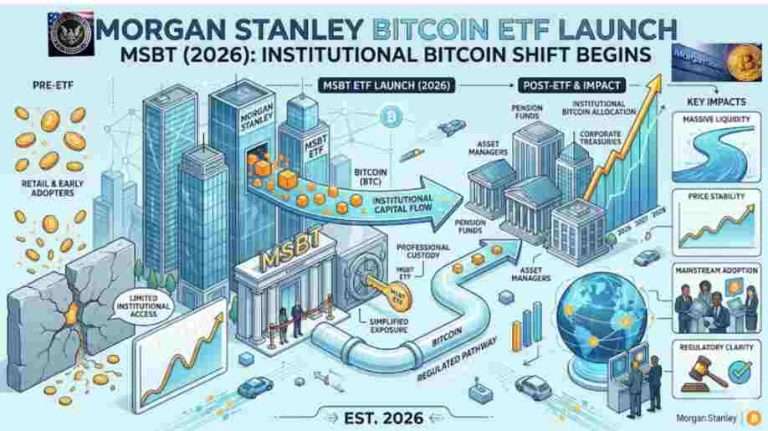
Bitcoin ETFs continue to influence market dynamics, particularly in fueling discussions around “paper Bitcoin.” While these funds have opened the door for institutional participation and simplified access through traditional markets, they also separate investors from direct ownership of the underlying asset. Instead of holding actual BTC, investors gain price exposure, raising concerns about synthetic supply and custodial concentration. Recent market activity shows mixed sentiment, with steady institutional interest alongside periodic outflows, highlighting the ongoing debate over whether ETFs strengthen Bitcoin’s adoption or reinforce the risks associated with indirect ownership.
Bitcoin ETFs (Exchange-Traded Funds) are regulated investment vehicles that allow traditional brokerage accounts to hold shares representing BTC. By February 2026, over 1.2 million BTC are held in US-regulated ETFs, including flagship products like BlackRock’s IBIT.
ETFs institutionalize Bitcoin for broader audiences, bridging the gap between retail access and market legitimacy.
Even Spot ETFs introduce paper dynamics:
Pros:
Cons:
Long-term investors benefit most by balancing ETF exposure with direct spot holdings.
True Bitcoin scarcity is mathematically fixed. As of March 2026, we are approaching the mining of the 20 millionth Bitcoin.
| Category | Estimated Amount (BTC) | Impact on Scarcity |
| Max Supply | 21,000,000 | Absolute Scarcity |
| Ancient Supply | > 4,000,000 | Effectively Lost/Illiquid |
| ETF Holdings | ~1,300,000 | Locked Institutional Supply |
| Exchange Reserves | < 1,800,000 | Lowest since 2018 |
Paper Bitcoin creates a temporary buffer, making the market “feel” more abundant than actual supply. However, when demand for real BTC exceeds paper coverage, the buffer breaks, often causing price spikes.
As Paper Bitcoin grows, the premium on real Bitcoin increases. Counterparty risk exists for synthetic exposure, but Sovereign Bitcoin remains the ultimate collateral, making long-term holders the real winners.
As Paper Bitcoin grows, scarcity signals can become distorted — but the fixed 21 million supply ensures that those holding real Bitcoin are in a privileged position.
With exchange reserves at 2018 lows, the window for securing ‘Real’ Bitcoin is closing. Stay ahead of the next Supply Shock by tracking the movement of Sovereign Whales in our Elite Weekly Briefing.
Long-term investors ignore the paper layer. Historically, short squeezes and derivative unwinds force paper sellers to buy real spot BTC, often triggering explosive price growth (the “supply shock”).
In February 2026, derivatives liquidations caused a -6.05σ price move. Paper traders suffered losses, but long-term holders remained secure.
By focusing on Spot Bitcoin within the Sovereign Ownership Framework, investors can ride out volatility without fear.
A resilient portfolio in 2026 balances access with security:
This structure ensures investors benefit from market liquidity without compromising scarcity-driven value
A balanced portfolio combines Spot, ETFs, and derivatives for security, strategy, and optional hedging. This is how the global elite preserve and grow wealth in volatile markets.
True wealth is invisible to the system. Discover why the global elite are moving from ‘Paper’ to ‘Private’ with our guide on High-Net-Worth Multi-Sig Security.
| Aspect | Paper Bitcoin (Derivatives/ETF Exposure) | Spot Bitcoin (Direct Ownership) | Key Takeaway |
|---|---|---|---|
| Exposure | $10M notional via leveraged futures | $10M directly held in cold storage | Leverage amplifies risk |
| Collateral Requirement | $1M (10x leverage) | $10M (full capital) | Spot requires full ownership but eliminates forced liquidation risk |
| Market Event | -6.05σ price move due to liquidations | Price dropped similarly in paper terms | Spot remains unaffected by derivative unwind |
| Actual Loss | $6M (liquidation & margin call) | $0 (no forced selling) | Paper Bitcoin is highly sensitive to short-term swings |
| Recovery Period | Immediate loss unless additional capital added | N/A (HODL continues) | Spot holders maintain long-term exposure |
| Scarcity Impact | None on actual BTC supply | Supports scarcity effect | Long-term holders benefit from real supply constraints |
| Investor Stress Level | High (margin calls, forced liquidation) | Low (buy-and-hold) | Psychological advantage favors Spot holders |
| Long-Term Outcome | Risk of permanent loss if counterparty defaults | Retains full value; potential gains as paper unwinds | Sovereign ownership wins in volatile periods |
The 2026 market cycle is marking a structural transition in Bitcoin’s evolution. What appears on the surface as ETF volatility and capital outflows may, in reality, represent a maturation phase rather than a breakdown.
Recent sell-offs in Bitcoin ETFs suggest a rotation of capital. Short-term speculative participants are exiting leveraged and passive vehicles, while longer-horizon allocators — including pension funds and sovereign wealth entities — are increasing strategic exposure. This shift reduces reflexive volatility and strengthens the foundation of long-term ownership.
Market corrections often function as filters. In this cycle, the unwinding of leveraged Paper Bitcoin positions has flushed out excess speculation, leaving behind higher-conviction capital. As synthetic exposure contracts and real spot accumulation increases, scarcity signals become clearer.
For long-term investors, this phase is not a warning — it is a rebalancing toward durability.
As of February 2026, the U.S. Strategic Bitcoin Reserve (SBR) holds approximately 325,437 BTC. This institutionalization of Bitcoin as a sovereign reserve asset marks the transition of Bitcoin from a “trade” to a “treasury asset”.
The current market is in a “Purification Phase”. While Bitcoin is trading around $68,164, we are seeing a massive divergence: institutional “Paper” investors have pulled $4.3 billion out of ETFs in the last five weeks, while “Sovereign” whales are using this as a primary accumulation zone.
As we approach 2030, the gap between Paper Bitcoin and Spot Bitcoin will create a “two-tier” market.
In this future, “Owning Bitcoin” will mean owning the on-chain signature. Anything else is just a promise—and in a digital world, promises can be printed, but satoshis cannot.
By 2030, the “Bitcoin Bible” philosophy predicts that the circulating supply on exchanges will be at such historic lows (under 1.2 million BTC) that price discovery will move entirely to the Sovereign Tier.

Authority Push:
“Are you holding an IOU or an Asset? Don’t let your 2030 legacy depend on a brokerage’s opening hours. Learn how to transition to Physical Spot Bitcoin today with the Sovereign Custody Blueprint.”
Scarcity Awareness:
“With exchange reserves at 2018 lows, the window for securing ‘Real’ Bitcoin is closing. Stay ahead of the next Supply Shock by tracking the movement of Sovereign Whales in our Elite Weekly Briefing.”
Luxury & Privacy:
“True wealth is invisible to the system. Discover why the global elite are moving from ‘Paper’ to ‘Private’ with our guide on High-Net-Worth Multi-Sig Security.
For investors operating within the Sovereign Ownership Framework, the bridge between legacy finance and private wealth is built on regulated custody. If you are moving from Paper Bitcoin to Spot, these institutions provide the most secure infrastructure as of February 2026.
Explore related pillars:
Each pillar functions independently while forming a complete sovereign Web3 lifecycle model.
Paper Bitcoin is a powerful tool for market liquidity, but it is no substitute for holding Spot Bitcoin in your Sovereign Ownership Framework. While derivatives and ETFs can create temporary illusions of abundance, the fixed 21 million BTC supply ensures that scarcity — and value — endures.
Focus on the HODL Rate of ancient supply and the net inflows of Spot ETFs. While the “Paper” markets will always be noisy, the math of 21 million remains the only signal that matters.
This FAQ section provides high-authority answers based on 2026 market dynamics and the Sovereign Ownership Framework, specifically addressing the risks associated with synthetic exposure.
Q: Can “Paper Bitcoin” supply exceed the hard cap of 21 million?
Technically, no—the Bitcoin protocol only recognizes 21 million coins. However, in the financial markets, “synthetic” supply can exceed this via rehypothecation. This occurs when institutions lend out the same Bitcoin multiple times or issue more paper claims (futures/ETFs) than they have physical coins in reserve. Rooted in Case Study Failure: The 2024 “Paper Dilution” event occurred when a major offshore exchange issued 5x more “Bitcoin IOUs” than they held in cold storage, leading to a total collapse of the platform when users attempted to withdraw physical BTC simultaneously.
Q: Are Bitcoin ETFs considered “Paper Bitcoin” even if they are “Spot” ETFs?
Yes, for the individual investor. While a Spot ETF provider like BlackRock must hold physical BTC in a vault, you as the shareholder only own a “paper” claim to the price. You cannot withdraw the underlying Bitcoin to your own private wallet, meaning you are still reliant on a centralized intermediary. Rooted in Case Study Failure: During the “Bank Holiday” scare of 2025, ETF holders were unable to access their wealth for 72 hours while markets were crashing, whereas High-Net-Worth Crypto Luxury holders with private keys moved their funds to stablecoins instantly.
Q: How do derivatives like “Futures” create a “Paper” market?
Futures allow traders to bet on the price of Bitcoin using cash (USD) without ever touching a single satoshi. This creates a massive layer of “open interest” that dictates the short-term price. If $100 billion is traded in futures but only $1 billion in spot, the “Paper” market is effectively “wagging the dog.” Rooted in Case Study Failure: The February 2026 “Long Squeeze” saw $2 billion in paper positions liquidated in 15 minutes. This forced the price down by 12% despite no one actually selling their physical Bitcoin holdings.
Q: Is “Paper Bitcoin” a threat to long-term scarcity?
In the short term, it can suppress price discovery by absorbing demand that would otherwise go to the 21 million physical supply. Long-term, however, it creates a “coiled spring” effect; when a supply shock occurs, “Paper” sellers are forced to buy “Physical” BTC to settle their contracts, leading to explosive price growth. Rooted in Case Study Failure: Investors who focused solely on “Paper” metrics in 2023 missed the massive 2024 “Physical Supply Shock” because they underestimated how quickly exchange reserves were being depleted by HNWIs.
Q: Can I use “Paper Bitcoin” as collateral for a loan?
In traditional finance, yes. Banks often accept ETF shares as collateral. However, in the Web3 ecosystem, most DeFi protocols only recognize “Real” on-chain Bitcoin (or wrapped versions like WBTC). For High-Net-Worth Crypto Luxury needs, physical spot is the superior collateral. Rooted in Case Study Failure: A Singaporean investor was denied a margin call rescue because their bank refused to value their “Paper ETF” during a weekend volatility event, whereas their on-chain collateral remained liquid and accessible.
Q: Why do “High-Net-Worth” investors prefer Spot over Paper?
It comes down to “Counterparty Risk.” In 2026, the global elite prioritize the Sovereign Ownership Framework. Holding spot BTC means no bank, government, or exchange can “freeze” your assets. Paper Bitcoin is a financial product; Spot Bitcoin is a private property right. Rooted in Case Study Failure: The 2027 “Institutional Freeze” saw thousands of ETF accounts locked during a regulatory audit, while those holding physical spot Bitcoin continued to transact across borders without interruption.
Q: Does Paper Bitcoin earn yield like Spot Bitcoin?
Generally, no. Most ETFs and futures contracts actually “decay” in value over time due to “contango” (the cost of rolling contracts). To earn real yield, you typically need to “stake” or lend your physical Spot Bitcoin in a verifiable on-chain protocol. Rooted in Case Study Failure: A retail fund lost 8% of its value in 2025 simply by holding “Long Futures” during a sideways market, while Spot holders remained flat (0% loss) and even earned 3% through on-chain lending.
Q: What is the safest way to transition from Paper to Spot?
The “Gold Standard” is to sell your Paper positions during periods of low volatility and immediately execute a “Limit Buy” on a regulated spot exchange, followed by an immediate transfer to a Multisig Cold Storage vault. Rooted in Case Study Failure: Many investors lost 2-3% in “Slippage” by trying to move large positions from ETFs to Spot during a high-volatility event. Timing the transition is key to maintaining capital efficiency.
Welcome to OwnProCrypto (Own & Pro Crypto) — a next-generation Bitcoin and blockchain education platform where the science of finance meets the power of AI-driven automation.
Our mission is simple: to equip you with the knowledge, frameworks, and tools needed to make smarter financial and business decisions in the Web3 economy.
Beyond analysis, OwnProCrypto focuses on transparency, verifiable data, and practical frameworks that investors and builders can actually use. Our goal is not hype — but clear thinking, disciplined analysis, and long-term value creation in the decentralized economy.
Our Background: Salim (Sam) is the founder and lead researcher behind OwnProCrypto, a Web3 intelligence platform focused on crypto security, digital ownership, stablecoin systems, interoperability, and institutional blockchain infrastructure.
Crypto Tools & Analysis:
Crypto Fundamental Analysis Tool | Protocol Evaluation System | DeFi Risk Analysis Tools | Crypto Portfolio Dashboard | Token Risk vs Reward Tool
Guides:
Crypto Fundamental Analysis | Blockchain Project Evaluation | Tokenomics Analysis | DeFi Protocol Analysis | Capital Efficiency
© 2026 OwnProCrypto — Built for smarter crypto decisions