
Search by title, topic or phrase
Use our Crypto Search Engine 🔍 to find the topics and keywords you're looking for.
Evaluate a tokenized real-world asset through three connected trust dimensions: Legal Trust, Data Trust and Technical Trust.
Quick answer:
The RWA Trust Simulator helps users stress-test the trust architecture of a tokenized real-world asset. Instead of asking only whether an asset can be tokenized, it examines whether the underlying arrangement has sufficient Legal (L), Data (D), and Technical (T) trust.
Tokenization can create a reliable digital record, but the token still depends on legal agreements, external information, custodians, administrators, smart contracts and operational systems. The simulator provides a structured way to make those dependencies visible.

Table of Contents
ToggleThe simulator uses the L × D × T framework to examine three different questions.
| Layer | Question | Example Dependency |
|---|---|---|
| L — Legal | What rights does the token holder actually have? | Ownership, contractual claim, redemption, insolvency treatment |
| D — Data | Can the underlying asset information be trusted? | Valuation, reserves, ownership records, attestations |
| T — Technical | Can the digital system enforce the intended rules? | Smart contracts, permissions, oracles, upgrades, monitoring |
The important point is that these are different trust problems. A technically secure token does not automatically establish legal ownership, and a strong legal structure does not guarantee accurate external data.

Define the Asset
Identify the tokenized asset or contractual claim being evaluated.
Score Legal Trust
Assess clarity, enforceability and ownership or redemption rights.
Score Data Trust
Assess whether important external information is verified and reconciled.
Score Technical Trust
Evaluate smart contracts, controls, dependencies and operational resilience.
Stress-Test
Lower individual assumptions and observe how the overall trust profile changes.
Use the simulator to model your assumptions and identify which trust layer deserves the most attention.

RWA trust is better understood as a system than as three unrelated checkboxes.
where L, D and T are normalized trust scores.
This geometric-mean approach is useful because it prevents a very high score in one dimension from completely hiding a serious weakness in another.
| Legal | Data | Technical | What the Profile Suggests |
|---|---|---|---|
| 90 | 90 | 90 | Balanced trust profile |
| 95 | 95 | 40 | Technical weakness requires investigation |
| 40 | 95 | 95 | Legal weakness requires investigation |
Important:
The RWA Trust Simulator is an analytical and educational decision-support tool. Its score is not a credit rating, investment recommendation, legal opinion, regulatory determination or substitute for institutional due diligence.
A real assessment may require legal opinions, asset verification, financial analysis, custody review, smart-contract audits, regulatory analysis, governance review and independent evidence.
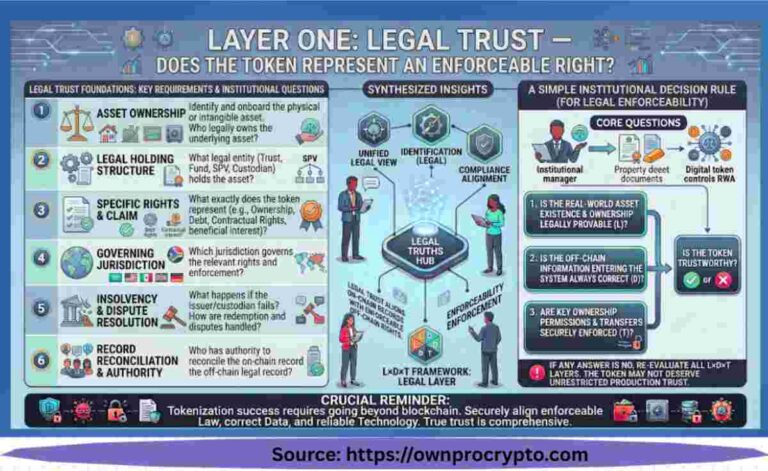
The simulator provides a practical way to assess an RWA trust profile, but the underlying methodology deserves a deeper look. For the complete framework, read RWA Tokenization Trust: The Three Core Layers of Trust — L × D × T.
The pillar article explains how Legal Trust, Data Trust, and Technical Trust interact throughout the tokenization lifecycle, why weakness in one layer can affect the overall trust model, and why putting an asset on-chain does not by itself establish ownership, data accuracy, or enforceability.
Move from the simulator’s practical assessment to the complete L × D × T framework and understand how institutional RWA trust should be evaluated across legal, data, and technical layers.
The importance of this framework is increasing as tokenization moves toward institutional financial infrastructure.
The Basel Committee’s current framework for cryptoasset exposures includes specific treatment for tokenised traditional assets and emphasizes legal rights, enforceability and the characteristics of the underlying arrangement. BIS / Basel Framework.
That institutional perspective reinforces the central idea behind the simulator: the blockchain representation is only one component of the trust architecture.
The strongest RWA analysis does not stop at asking whether an asset has been tokenized.
It asks:
The RWA Trust Simulator turns those questions into a structured analytical exercise, helping users identify trust gaps before treating a tokenized asset as a complete digital representation of the underlying real-world asset.
Complete institutional overview of RWA tokenization architecture, lifecycle, asset classes, infrastructure, risk and implementation.
CLUSTER
Dedicated analysis of Legal, Data and Technical Trust in tokenized real-world assets.
APPLIED TOOL
Explore liquidity, redemption and collateral-mobility scenarios for tokenized assets.
APPLIED TOOL
Explore institutional custody, control and recovery dependencies.
INFRASTRUCTURE TOOL
Compare blockchain oracle and external-data infrastructure relevant to tokenized systems.
EXTERNAL RESOURCE
Official protocol documentation for compliant permissioned token standards, on-chain identity integration, and automated transfer restrictions.
EXTERNAL RESOURCE
Enterprise implementation standards for real-world asset smart contracts, identity verification stacks, and compliance validation modules.