
Search by title, topic or phrase
Use our Crypto Search Engine 🔍 to find the topics and keywords you're looking for.
Table of Contents
ToggleReal-world crypto adoption is entering a more practical phase in 2026. The important question is no longer simply how many people own cryptocurrency or how high digital-asset prices can rise. The more useful question is where blockchain infrastructure is creating measurable value through payments, settlement, tokenized assets, financial services, business operations, digital ownership and other real economic activity.
Adoption is also becoming less visible. A consumer may receive a payment through a stablecoin-enabled system without knowing which blockchain processed it. An institution may hold a tokenized Treasury product without describing the activity as “using crypto.” A company may use blockchain-based verification without asking employees or customers to interact directly with a wallet.
This makes crypto adoption in 2026 harder to measure with a single number. On-chain activity, transaction value, institutional participation, stablecoin usage, tokenized assets, business integrations and consumer applications all provide different signals.
Chainalysis’ latest published Global Crypto Adoption Index, based on its 2025 methodology, continues to show strong geographic differences in how crypto is used. Its research identifies distinct adoption drivers across regions, including remittances, savings, investment, institutional activity and stablecoin use. As of August 2026, that 2025 index remains an important benchmark rather than a substitute for a single “2026 adoption number.”
Real-world crypto adoption means that blockchain-based assets, networks or applications are being used to perform an economic or operational function that matters outside pure token speculation. That definition is intentionally broader than “people buying cryptocurrency.” Someone purchasing Bitcoin as an investment is participating in the crypto market, but that alone does not demonstrate that blockchain has replaced or improved an existing real-world process.
The central shift is therefore from ownership as an endpoint toward blockchain as infrastructure.
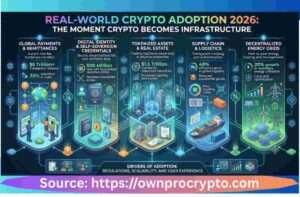
There is no single metric that accurately describes global crypto adoption. Different datasets measure different behaviors, and each has limitations.
Blockchain transaction data can show how much value moves across networks and how frequently addresses interact with protocols. This is useful because the data is generated by actual network activity, but transaction volume does not automatically equal economic value. Trading, arbitrage, automated transactions and internal transfers can generate substantial activity without representing everyday adoption.
Geographic adoption indexes attempt to estimate how ordinary users interact with crypto services. Chainalysis’ 2025 Global Crypto Adoption Index combines several sub-indices and ranks countries based on estimated cryptocurrency usage rather than simply measuring raw transaction volume. Its methodology also distinguishes grassroots activity from larger institutional transfers.
Real adoption becomes more convincing when users + transactions + economic value + repeat usage appear together.
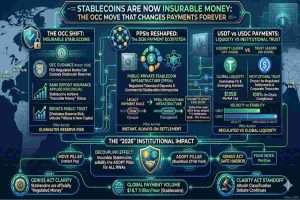
Stablecoins are one of the most important components of the 2026 crypto adoption story, particularly for cross-border value movement, crypto-market settlement and access to dollar-denominated digital liquidity. However, ECB analysis published in 2026 found that crypto trading and related activity continued to dominate stablecoin use, while payments and tokenized-asset settlement represented much smaller shares.
At the same time, Visa’s July 2026 research described stablecoins as increasingly relevant to enterprise payment flows, treasury planning and global money movement, while Mastercard highlighted the convergence of stablecoins with real-time payments and AI-enabled transaction systems.
Stablecoins act as the primary bridge connecting traditional fiat capital to on-chain financial operations.

Institutional crypto adoption in 2026 is defined less by speculative trading and more by the migration of traditional financial instruments onto digital ledger networks. Tokenized Treasury funds, private credit platforms, money market products, and structured bonds are creating a direct link between traditional capital and decentralized rails.
Real-world asset tokenization provides the structural bridge turning public blockspace into global financial infrastructure.
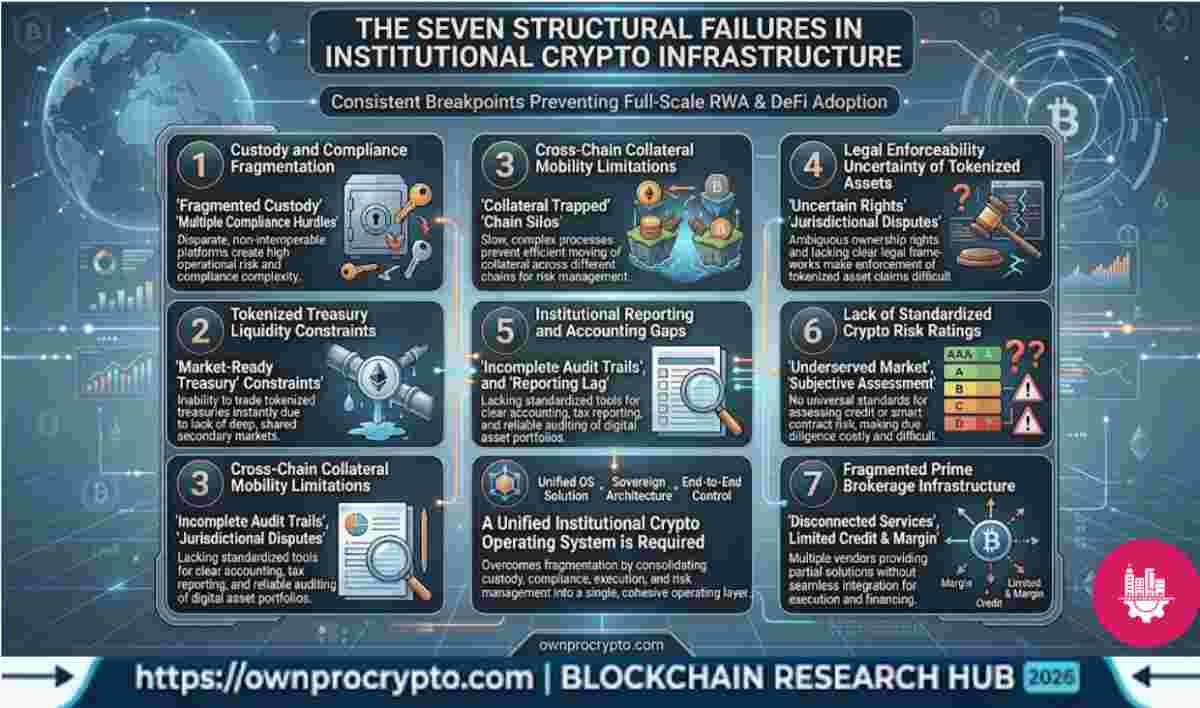
Enterprise blockchain adoption is often less visible than retail crypto activity because companies rarely market every internal infrastructure change as “crypto.” A business may simply describe the result as faster settlement, better verification, automated reconciliation or digital asset management.
Consumer adoption is following a similar pattern. The strongest products increasingly hide technical complexity rather than asking consumers to become blockchain specialists. Examples include embedded wallets, blockchain-powered loyalty systems, digital ownership, stablecoin payment experiences, gaming assets and applications where blockchain settlement happens behind the interface.
THE INVISIBLE ADOPTION PRINCIPLE
Traditional problem → Blockchain infrastructure → Simpler user experience → Measurable economic benefit → Repeat usage
Crypto adoption is not geographically uniform. Different regions use digital assets for different reasons, and the same technology can represent very different economic needs.
Chainalysis’ geographic research demonstrates why a single global adoption narrative can be misleading: drivers vary substantially by local economic conditions.
Real-world crypto adoption is growing, but several barriers remain. A credible 2026 analysis should not treat adoption as inevitable.
The best way to evaluate crypto adoption in 2026 is to look beyond headlines and token prices.
THE 2026 ADOPTION TEST
Real users + recurring usage + measurable economic benefit + sustainable infrastructure is a much stronger adoption signal than price appreciation, social-media attention or token launches.
A freelancer serving international clients may face payment delays, correspondent-bank fees and currency-conversion friction. A stablecoin-enabled payment rail can shorten the path between payer and recipient while giving both parties a transparent transaction record. The adoption signal is solving a cross-border problem, not cryptocurrency ownership.
An asset manager can use tokenized financial products to explore programmable issuance, transfer, settlement and reporting. The value proposition comes from improving financial-market infrastructure rather than simply creating another digital representation of an existing asset.
Companies use shared blockchain records to improve traceability and authenticity across supply chains without forcing end customers to interact with tokens. Simultaneously, consumer applications embed loyalty and digital ownership behind simple interfaces where users never manage raw blockchain mechanics.
Core Principle: Adoption happens when blockchain becomes useful enough to justify its infrastructure costs and complexity.
The next stage of adoption is unlikely to be a single event in which “crypto goes mainstream.” It is more likely to be a gradual integration of blockchain capabilities into existing financial and digital systems.
Mastercard’s 2026 payments research describes stablecoins, AI and real-time payments as increasingly interconnected parts of a converging payments ecosystem. The future direction is blockchain operating underneath familiar products.
Q: What is real-world crypto adoption?
A: Real-world crypto adoption is the use of blockchain, crypto assets or tokenized financial infrastructure for practical economic activities such as payments, settlement, asset ownership, financial services, business operations and digital identity. It is broader than simply buying or holding cryptocurrency.
Q: Is crypto adoption actually increasing in 2026?
A: Yes, but adoption is uneven and should be measured by use rather than headlines. Current evidence shows continued growth in institutional activity, stablecoin infrastructure, tokenized finance and regional crypto usage, while the strongest use cases vary by market.
Q: Are stablecoins being used for real-world payments in 2026?
A: Yes, stablecoins are increasingly integrated into payment and money-movement infrastructure. However, ECB analysis indicates crypto trading remains dominant while payments represent a smaller, growing share.
Q: What changed for stablecoin regulation in the United States?
A: The GENIUS Act was signed into U.S. law on July 18, 2025, establishing a federal framework for payment stablecoins, including reserve and disclosure requirements.
Q: Does tokenizing an asset automatically make it liquid?
A: No. Tokenization makes an asset easier to represent and transfer digitally, but liquidity requires actual buyers, sellers, and suitable market infrastructure.

Real-world crypto adoption in 2026 is best understood as an infrastructure transition rather than a single mainstream-adoption event.
Stablecoins are becoming relevant to global money movement, although much of their current activity remains connected to crypto markets. Institutions are experimenting with tokenized securities, tokenized deposits and programmable settlement. Enterprises are using blockchain where shared records, automation or global settlement can create measurable value. Consumers are increasingly encountering blockchain through applications that hide technical complexity.
THE 2026 ADOPTION FRAMEWORK
Real problem → Reliable infrastructure → Regulatory compatibility → Simple user experience → Measurable benefit → Repeat usage.
That is the real story of crypto adoption in 2026: not everyone needs to become a crypto expert. The technology only needs to become reliable enough that people can use the resulting financial and digital services without thinking about the blockchain underneath.
This article is part of our RWA & Tokenized Real Estate 2026 Research Library, a connected group of resources designed to help investors and institutions understand real-world asset tokenization, property-backed income, legal structures, portfolio allocation, liquidity, risk and on-chain financial infrastructure in 2026.