
Search by title, topic or phrase
Use our Crypto Search Engine 🔍 to find the topics and keywords you're looking for.
Table of Contents
Toggle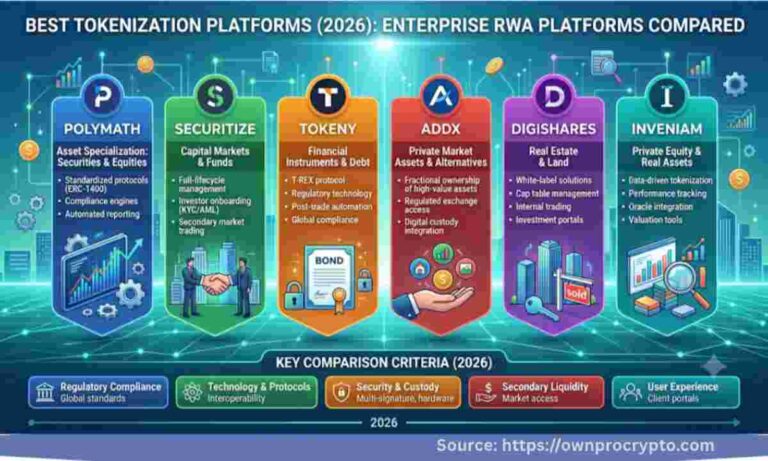
The Best Tokenization Platforms are transforming how enterprises issue, manage, and trade digital assets across regulated financial markets. From real estate tokenization and private equity to treasury bills, carbon credits, funds, and digital securities, institutional organizations now require platforms that combine regulatory compliance, secure custody, smart contract automation, and multi-chain infrastructure.
According to industry estimates, the tokenized real-world asset (RWA) market could reach multi-trillion-dollar scale before 2030, driven by financial institutions, asset managers, banks, and enterprise issuers adopting blockchain-based infrastructure. Modern platforms such as Securitize, Tokeny, Brickken, Centrifuge, Fireblocks, Taurus, and Zoniqx now provide complete ecosystems covering token issuance, lifecycle management, KYC/AML, transfer restrictions, investor onboarding, governance, custody integration, and regulatory reporting.
This guide evaluates the leading enterprise tokenization platforms using institutional criteria including compliance, security, scalability, supported asset classes, blockchain compatibility, APIs, token standards, and deployment flexibility. Whether you’re building an enterprise tokenization platform, launching an RWA marketplace, or selecting white-label tokenization software, this comparison provides a structured framework for choosing the right solution.
A tokenization platform is enterprise software that converts ownership rights of real-world or digital assets into blockchain-based tokens while managing issuance, compliance, investor onboarding, lifecycle events, custody integrations, and regulatory controls.
Instead of manually recording ownership through paper certificates or fragmented databases, organizations issue programmable blockchain tokens representing fractional or complete ownership of assets.
Modern enterprise tokenization platforms typically integrate:
Rather than being simple token generators, today’s institutional platforms function as complete digital asset operating systems.
Digital asset tokenization refers to the process of representing ownership, rights, or economic value through blockchain tokens. These tokens may represent financial instruments, tangible assets, intellectual property, or native digital assets.
Common tokenized assets include:
| Asset Category | Typical Tokenization Purpose | Institutional Adoption |
|---|---|---|
| Commercial Real Estate | Fractional Ownership | Very High |
| Residential Property | Investment Access | High |
| Treasury Bills | Yield Distribution | Very High |
| Bonds | Digital Securities | High |
| Private Equity | Liquidity | Very High |
| Venture Capital | Cap Table Digitization | Growing |
| Commodities | Ownership Tracking | High |
| Carbon Credits | ESG Trading | Growing |
| Infrastructure Assets | Long-term Investment | Emerging |
| Fine Art | Fractional Investment | Medium |
| Intellectual Property | Royalty Distribution | Emerging |
Digital ownership enables:
Although these terms are frequently used interchangeably, they solve different institutional requirements.
| Feature | Digital Asset Tokenization Platform | Security Token Platform |
|---|---|---|
| Primary Focus | Physical & Financial Assets | Regulated Securities |
| Typical Users | Enterprises | Banks |
| Regulatory Depth | High | Very High |
| Transfer Restrictions | Yes | Extensive |
| Corporate Actions | Supported | Advanced |
| Shareholder Registry | Optional | Required |
| Transfer Agent Support | Sometimes | Usually Required |
| Investor Accreditation | Optional | Mandatory in many jurisdictions |
In practice, most enterprise-grade platforms now combine both capabilities within a single infrastructure.
Institutional requirements differ significantly from retail-focused token creation tools.
| Capability | Enterprise Platform | Retail Platform |
|---|---|---|
| KYC/AML | Built-in | Limited |
| Regulatory Compliance | Extensive | Basic |
| Custody Integration | Yes | Rare |
| Institutional Wallets | Supported | Limited |
| Governance | Advanced | Basic |
| APIs | Comprehensive | Limited |
| Multi-user Roles | Yes | Usually No |
| Corporate Actions | Yes | Rare |
| Lifecycle Management | Complete | Minimal |
| White-label Deployment | Available | Rare |
Enterprise organizations prioritize governance, compliance, scalability, and interoperability rather than simply minting blockchain tokens.
Enterprise tokenization extends beyond token issuance into continuous lifecycle management.
Asset Selection
        ▼
Legal Structuring
        ▼
Asset Due Diligence
        ▼
Valuation
        ▼
Compliance Review
        ▼
KYC / AML
        ▼
Smart Contract Deployment
        ▼
Token Issuance
        ▼
Custody Integration
        ▼
Distribution
        ▼
Secondary Trading
        ▼
Corporate Actions
        ▼
Reporting & Auditing
Large enterprises typically automate more than 80% of this lifecycle using integrated tokenization platforms, reducing operational overhead while improving transparency and regulatory reporting.
 TOKENIZATION PLATFORM
        Asset
          ▼
   Legal Structuring
          ▼
 Compliance Engine
(KYC • AML • Rules)
          ▼
 Smart Contracts
          ▼
 Token Issuance
          ▼
 Wallet + Custody
          ▼
 Investors
          ▼
 Lifecycle Management
          ▼
Reporting & Governance| Component | Enterprise Importance | Business Impact |
|---|---|---|
| Compliance Engine | Critical | Regulatory Approval |
| Smart Contracts | Critical | Automation |
| Custody | Critical | Asset Protection |
| APIs | High | System Integration |
| Governance | High | Institutional Control |
| Lifecycle Management | Critical | Operational Efficiency |
| Multi-chain Support | High | Scalability |
| Investor Portal | Medium | User Experience |

Choosing the best tokenization platform depends on your organization’s regulatory requirements, asset classes, blockchain strategy, and operational scale. Some platforms specialize in digital securities, while others focus on real-world assets (RWAs), institutional custody, or enterprise infrastructure.
For this comparison, we evaluated platforms based on compliance capabilities, supported token standards, blockchain compatibility, lifecycle management, security, developer tools, custody integrations, and enterprise readiness.
Whether you’re tokenizing real estate, private equity, funds, treasury bills, commodities, or carbon credits, the platforms below represent some of the strongest enterprise solutions available in 2026.
| Platform | Pricing Model |
|---|---|
| Securitize | Custom Enterprise Quote |
| Tokeny | Contact Sales |
| Brickken | Contact Sales |
| Centrifuge | Enterprise Pricing |
| Zoniqx | Custom Quote |
| Polymath | Enterprise Licensing |
| Fireblocks | Enterprise Pricing |
| Taurus | Enterprise Pricing |
| ADDX | Private Enterprise |
| Ondo Infrastructure | Enterprise |
| Plume | Custom Deployment |
| Maple | Institutional Pricing |
| Platform | Best For |
|---|---|
| Securitize | Regulated Digital Securities |
| Tokeny | Enterprise Tokenization |
| Brickken | SMEs & Business Asset Tokenization |
| Centrifuge | Institutional RWA Finance |
| Zoniqx | Large Enterprise Infrastructure |
| Polymath | Security Token Projects |
| Fireblocks | Institutional Custody |
| Taurus | Banks & Financial Institutions |
| ADDX | Private Markets |
| Ondo Infrastructure | Tokenized Financial Products |
| Plume | RWA Ecosystem Builders |
| Maple | Institutional Lending |
                  Choose Your Platform

                 Need Digital Securities?
                        │
                 ┌──────┴──────┐
                 │             │
               Yes            No
                 │             │
     Securitize / Tokeny       │
                               │
                   Need RWA Infrastructure?
                               │
                    ┌──────────┴──────────┐
                    │                     │
                  Yes                    No
                    │                     │
         Centrifuge / Zoniqx        Need Custody?
                                          │
                                 ┌────────┴────────┐
                                 │                 │
                              Yes                 No
                                 │                 │
Fireblocks / Taurus Brickken / PlumeBest For: Institutional digital securities and regulated asset tokenization
Securitize is one of the most established enterprise tokenization platforms, offering a complete ecosystem for issuing, managing, and servicing tokenized securities. It combines investor onboarding, compliance workflows, lifecycle management, and distribution within a regulated environment, making it well suited for financial institutions and asset managers.
Highlights
Pros
Cons
Pricing: Custom enterprise quote
Our Rating: 9.7/10
Best For: Enterprise security token issuance
Tokeny provides an end-to-end tokenization platform designed for regulated financial assets. It emphasizes compliance automation, identity management, and lifecycle controls while supporting enterprise deployments through APIs and white-label capabilities.
Highlights
Pros
Cons
Pricing: Contact Sales
Our Rating: 9.6/10
Best For: Businesses tokenizing real-world assets
Brickken offers a streamlined approach to asset tokenization platform, making it suitable for companies seeking to digitize ownership of real estate, equity, funds, or other business assets. Its interface is designed to simplify issuance while still providing enterprise-friendly features such as compliance workflows and asset management.
Highlights
Pros
Cons
Pricing: Contact Sales
Our Rating: 9.2/10
Best For: Institutional real-world asset finance
Centrifuge focuses on connecting real-world assets with decentralized finance infrastructure. It enables organizations to tokenize assets and access blockchain-based financing while supporting institutional participation through structured workflows and governance.
Highlights
Pros
Cons
Pricing: Enterprise pricing
Our Rating: 9.3/10
Best For: Enterprise tokenization infrastructure
Zoniqx provides enterprise-grade infrastructure for organizations building tokenization solutions across multiple asset classes. It emphasizes interoperability, compliance, and scalable architecture suitable for banks, financial institutions, and large enterprises.
Highlights
Pros
Cons
Pricing: Custom quote
Our Rating: 9.4/10
Best For: Security token issuance and regulated capital markets
Polymath focuses on simplifying the issuance and management of security tokens through standardized token frameworks and compliance controls. It is a suitable choice for organizations launching regulated digital securities while maintaining investor eligibility and transfer restrictions.
Highlights
Pros
Cons
Pricing: Enterprise licensing
Our Rating: 8.9/10
Best For: Institutional custody and digital asset infrastructure
Unlike traditional tokenization platforms, Fireblocks specializes in securing and managing digital assets. Many enterprises integrate Fireblocks with tokenization software to handle wallet management, key security, settlement, and institutional custody rather than token issuance itself.
Highlights
Pros
Cons
Pricing: Enterprise pricing
Our Rating: 9.5/10
Best For: Banks and regulated financial institutions
Taurus delivers enterprise infrastructure for banks, custodians, and financial institutions seeking digital asset issuance, custody, and lifecycle management. Its banking-focused architecture supports secure operations while integrating with existing financial systems.
Highlights
Pros
Cons
Pricing: Enterprise pricing
Our Rating: 9.5/10
Best For: Private markets and alternative investments
ADDX focuses on bringing private market investments onto blockchain infrastructure through tokenization. The platform supports institutional investors seeking improved accessibility and operational efficiency for alternative assets.
Highlights
Pros
Cons
Pricing: Private enterprise model
Our Rating: 8.8/10
Best For: Tokenized financial products
Ondo Infrastructure supports tokenized financial assets with a focus on institutional-quality products. Organizations looking to launch blockchain-native investment products may find its infrastructure suitable for regulated financial use cases.
Highlights
Pros
Cons
Pricing: Enterprise pricing
Our Rating: 9.0/10
Best For: Building RWA ecosystems
Plume is designed to simplify the creation of real-world asset ecosystems by providing blockchain infrastructure optimized for asset tokenization. It supports developers and enterprises building marketplaces, investment platforms, and RWA applications.
Highlights
Pros
Cons
Pricing: Custom deployment
Our Rating: 8.8/10
Best For: Institutional lending infrastructure
Maple specializes in institutional credit markets rather than general asset tokenization. It provides blockchain infrastructure that enables institutional lending, on-chain credit products, and capital market innovation.
Highlights
Pros
Cons
Pricing: Institutional pricing
Our Rating: 8.9/10
Quick Comparison Snapshot
| If You Need… | Choose… |
|---|---|
| Best Overall | Securitize |
| Best Compliance | Tokeny |
| Best for SMEs | Brickken |
| Best Banking | Taurus |
| Best Custody | Fireblocks |
| Best RWA | Centrifuge |
| Best APIs | Zoniqx |
Choosing the right platform ultimately depends on your business model, regulatory obligations, and the types of assets you plan to tokenize. While no single platform is ideal for every organization, several stand out in specific enterprise scenarios.
| Requirement | Recommended Platform |
|---|---|
| Overall Enterprise Platform | Securitize |
| Compliance & Regulation | Tokeny |
| Business Asset Tokenization | Brickken |
| Institutional RWA | Centrifuge |
| Enterprise Infrastructure | Zoniqx |
| Security Tokens | Polymath |
| Custody & Wallet Infrastructure | Fireblocks |
| Banking & Financial Institutions | Taurus |
| Private Markets | ADDX |
| Tokenized Financial Products | Ondo Infrastructure |
| RWA Ecosystem Development | Plume |
| Institutional Lending | Maple |
Editor’s Note: If your organization requires a complete end-to-end solution, prioritize platforms that combine token issuance, compliance automation, lifecycle management, custody integrations, and enterprise APIs. If you already have internal custody or compliance systems, modular infrastructure providers may offer greater flexibility.
                    Platform Selection Matrix
                    Need Full Tokenization?
                           │
               ┌───────────┴───────────┐
               │                       │
              Yes                     No
               │                       │
     Securitize • Tokeny        Need Custody?
     Brickken • Zoniqx              │
               │             ┌───────┴────────┐
               │             │                │
      Institutional?        Yes              No
               │             │                │
Taurus • Centrifuge Fireblocks Plume • Maple| Evaluation Factor | Highest Rated Options |
|---|---|
| Compliance | Tokeny, Securitize |
| Security | Fireblocks, Taurus |
| RWA Capabilities | Centrifuge, Zoniqx |
| White-label Deployment | Tokeny, Brickken |
| API & Integration | Fireblocks, Zoniqx |
| Institutional Readiness | Securitize, Taurus |
| Developer Flexibility | Plume, Zoniqx |
| Banking Support | Taurus |
| Overall Enterprise Score | Securitize |
Enterprise tokenization platforms deliver significantly more than token creation. Financial institutions, asset managers, banks, and enterprise issuers require a complete operational framework that supports the full lifecycle of digital assets—from issuance and compliance to custody, governance, and post-issuance servicing.
The following features consistently distinguish enterprise-grade tokenization software from basic token creation tools.
Token issuance is the foundation of every tokenization platform. Enterprise platforms allow organizations to configure asset details, ownership structures, supply models, permissions, and distribution rules while ensuring compliance from day one.
Common issuance capabilities include:
Issuing tokens is only the beginning. Enterprise platforms must also support every operational event throughout an asset’s lifecycle.
Typical lifecycle events include:
| Lifecycle Stage | Business Value |
|---|---|
| Issuance | Asset creation |
| Distribution | Investor onboarding |
| Trading | Liquidity |
| Corporate Actions | Governance |
| Redemption | Exit management |
| Reporting | Compliance |
Compliance automation helps reduce manual work while ensuring that token transfers follow applicable regulations.
Modern compliance engines commonly support:
Organizations operating across multiple jurisdictions benefit from configurable compliance rules that can adapt to changing regulatory requirements.
Identity verification protects issuers and investors by confirming eligibility before transactions occur.
Common verification components include:
Institutional custody remains one of the most important requirements for enterprise tokenization.
Leading platforms typically integrate with qualified custodians or enterprise wallet providers to protect private keys, secure digital assets, and support regulated operational workflows.
Essential custody features include:
After issuance, many organizations seek controlled liquidity through secondary trading mechanisms.
Enterprise platforms may support:
Cap table management ensures ownership records remain accurate throughout the investment lifecycle.
Capabilities often include:
Corporate actions automate routine events that would otherwise require manual processing.
Examples include:
Enterprise organizations rarely operate tokenization platforms in isolation. APIs enable integration with existing technology stacks, reducing manual processes and improving operational efficiency.
Common integrations include:
White-label tokenization platforms allow organizations to launch branded digital asset solutions without building infrastructure from scratch.
Typical deployment options include:
Permissioned blockchain environments provide greater control over participants, governance, and compliance.
They are commonly preferred by:
                 Enterprise Tokenization Stack

        Asset
          ▼
   Token Issuance
          ▼
 Compliance Engine
          ▼
 Identity Verification
          ▼
 Smart Contracts
          ▼
 Custody
          ▼
 Lifecycle Management
          ▼
 Secondary Trading
          ▼
Reporting & Governance| Enterprise Feature | Priority | Business Impact |
|---|---|---|
| Token Issuance | Critical | Asset Creation |
| Compliance | Critical | Regulatory Approval |
| Identity Verification | Critical | Investor Protection |
| Custody | Critical | Asset Security |
| Lifecycle Management | Critical | Operational Efficiency |
| APIs | High | System Integration |
| White-label | High | Faster Deployment |
| Corporate Actions | High | Automation |
| Secondary Trading | Medium | Liquidity |
| Permissioned Networks | High | Enterprise Governance |
One of the biggest advantages of enterprise tokenization platforms is their ability to support a wide range of real-world and digital assets. While every platform differs in specialization, leading solutions can tokenize multiple asset classes using programmable smart contracts, compliance controls, and lifecycle management.
Organizations should choose a platform based on the specific assets they intend to digitize, the applicable regulations, and long-term operational requirements.
Real Estate
Real estate remains the largest use case for asset tokenization because it enables fractional ownership, simplified investor onboarding, and improved liquidity compared to traditional property investment models.
Tokenization is commonly used for:
Benefits
| Real Estate Use Case | Tokenization Benefit |
|---|---|
| Commercial Property | Fractional investment |
| Residential Projects | Wider investor access |
| Hotels | Shared ownership |
| Industrial Assets | Portfolio diversification |
| Mixed-use Developments | Capital raising |
Private equity investments traditionally involve complex ownership structures and lengthy administrative processes. Tokenization simplifies ownership records while improving operational efficiency throughout the investment lifecycle.
Typical use cases include:
Enterprise Benefits
Venture capital firms increasingly explore tokenization to improve fund administration and investor reporting while maintaining regulatory compliance.
Common applications include:
| Venture Capital Feature | Business Value |
|---|---|
| Digital Equity | Simplified ownership |
| Investor Registry | Better governance |
| Smart Contracts | Process automation |
| Cap Table Management | Administrative efficiency |
Investment funds are well suited for tokenization because subscriptions, redemptions, and investor onboarding can be automated through programmable workflows.
Fund types include:
Benefits include:
Bond tokenization enables digital issuance and automated servicing of fixed-income products.
Key capabilities include:
| Bond Process | Traditional | Tokenized |
|---|---|---|
| Issuance | Manual | Automated |
| Settlement | Days | Near real-time |
| Reporting | Manual | Digital |
| Ownership Tracking | Centralized | Blockchain-based |
Governments and financial institutions are increasingly exploring tokenized treasury products to improve settlement efficiency and expand institutional access.
Common benefits include:
Physical commodities can be represented through blockchain tokens that simplify ownership transfer and trading while maintaining asset traceability.
Examples include:
Enterprise Advantages
Carbon credit tokenization helps improve transparency and traceability within environmental markets while reducing administrative overhead.
Enterprise use cases include:
| Carbon Credit Feature | Enterprise Benefit |
|---|---|
| Traceability | Better verification |
| Smart Contracts | Automated retirement |
| Blockchain Records | Transparency |
| Fractional Ownership | Greater market accessibility |
Intellectual property (IP) tokenization enables digital representation of ownership rights and revenue participation for intangible assets.
Examples include:
Potential benefits:
Fine art tokenization allows multiple investors to own fractional interests in high-value artworks while improving accessibility and record keeping.
Common benefits include:
Infrastructure projects often require significant capital commitments. Tokenization enables broader participation while improving operational transparency.
Common projects include:
Benefits
             Supported Tokenized Asset Classes
                  Real World Assets
                         │
┌────────────┬───────────┬────────────┬────────────┐
 │Real Estate │ Private   │   Funds    │  Bonds     │
 │            │ Equity    │            │            │
└────────────┴───────────┴────────────┴────────────┘
                         │
      Treasury • Commodities • Carbon Credits
                         │
Intellectual Property • Fine Art • Infrastructure| Asset Class | Institutional Demand | Tokenization Maturity |
|---|---|---|
| Real Estate | Very High | Mature |
| Private Equity | Very High | Mature |
| Venture Capital | High | Growing |
| Funds | Very High | Mature |
| Bonds | High | Mature |
| Treasury Bills | Very High | Growing |
| Commodities | High | Growing |
| Carbon Credits | High | Emerging |
| Intellectual Property | Medium | Emerging |
| Fine Art | Medium | Growing |
| Infrastructure Assets | High | Growing |

Enterprise tokenization extends beyond blockchain technology. Organizations operating in regulated markets must ensure digital assets comply with applicable laws, investor protection requirements, and industry security standards.
A modern tokenization platform should combine compliance automation, secure custody, identity verification, and standardized token frameworks to support long-term institutional adoption.
Regulatory requirements vary across jurisdictions, making compliance one of the most important evaluation factors when selecting a tokenization platform.
Enterprise issuers commonly consider regulations related to securities, investor protection, anti-money laundering, and digital asset governance.
| Regulation | Region | Primary Focus |
|---|---|---|
| SEC | United States | Securities regulation |
| MiCA | European Union | Crypto-asset framework |
| VARA | Dubai | Virtual asset oversight |
| MAS | Singapore | Digital asset regulation |
The U.S. Securities and Exchange Commission (SEC) oversees securities offerings in the United States. Tokenized securities generally need to comply with applicable securities laws, investor disclosure requirements, and offering exemptions where relevant.
The Markets in Crypto-Assets (MiCA) framework establishes a harmonized regulatory approach for crypto-assets across the European Union, providing greater clarity for issuers and service providers operating within member states.
Dubai’s Virtual Assets Regulatory Authority (VARA) regulates virtual asset activities within its jurisdiction, supporting a structured licensing and compliance environment for eligible businesses.
The Monetary Authority of Singapore (MAS) oversees digital asset activities through a risk-based regulatory approach, emphasizing financial stability, innovation, and consumer protection.
ERC-3643 is one of the leading token standards for regulated security tokens. It supports identity-aware transfers, compliance controls, and permissioned ownership, making it well suited for institutional tokenization.
ERC-1400 is a security token standard designed for regulated financial assets. It supports partitioned ownership, transfer restrictions, and compliance mechanisms commonly required by institutional issuers.
ERC-20 remains the most widely adopted fungible token standard within the Ethereum ecosystem. While it provides broad compatibility, additional compliance layers are generally required for regulated asset tokenization.
ERC-721 is the standard for unique, non-fungible tokens (NFTs), representing assets where each token has distinct ownership and metadata.
ERC-1155 supports both fungible and non-fungible assets within a single smart contract, improving efficiency for applications that manage multiple token types.
Smart contract audits help identify vulnerabilities before deployment, reducing operational and security risks.
Enterprise best practices include:
| Security Practice | Enterprise Importance |
|---|---|
| Smart Contract Audit | Critical |
| Multi-signature Controls | Critical |
| Access Management | Critical |
| Penetration Testing | High |
| Continuous Monitoring | High |
Know Your Customer (KYC) and Anti-Money Laundering (AML) procedures help organizations verify investor identities and reduce financial crime risks.
Institutional custodians secure digital assets and private keys while supporting governance, recovery procedures, and regulatory requirements.
Typical custody capabilities include:
Transfer agents maintain ownership records and support regulated asset transfers throughout the token lifecycle.
Common responsibilities include:
Enterprise Compliance Framework
          Regulations
               │
     ┌─────────┼──────────┐
     │         │          │
    SEC      MiCA      VARA/MAS
               ▼
         KYC & AML
               ▼
      Identity Verification
               ▼
      Smart Contracts
               ▼
      Token Standards
               ▼
Custody • Transfer Agent • ReportingNo single tokenization platform is the right choice for every organization. The best solution depends on your business size, regulatory obligations, asset classes, deployment model, technical requirements, and long-term growth strategy.
Instead of focusing on the number of features alone, evaluate how well a platform supports your operational workflows, compliance needs, and integration requirements.
Organizations at different growth stages require different capabilities.
| Business Size | Recommended Platform Type | Priority Features |
|---|---|---|
| Startup | User-friendly platform | Fast deployment, lower complexity |
| SME | White-label platform | Compliance, APIs, branding |
| Mid-sized Enterprise | Enterprise tokenization platform | Lifecycle management, integrations |
| Large Enterprise | Institutional infrastructure | Governance, custody, scalability |
| Banks & Financial Institutions | Institutional-grade platform | Compliance, security, custody |
Different industries have unique tokenization requirements.
| Industry | Primary Requirement |
|---|---|
| Real Estate | Fractional ownership |
| Financial Services | Regulatory compliance |
| Asset Management | Lifecycle management |
| Banking | Custody & governance |
| Investment Funds | Investor onboarding |
| Commodities | Ownership tracking |
| Carbon Markets | Transparency |
| Infrastructure | Capital formation |
Organizations should select platforms with proven experience supporting their target asset class and regulatory environment.
Asset type often determines which token standards, compliance controls, and lifecycle features are required.
| Asset Type | Important Features |
|---|---|
| Real Estate | Fractional ownership, investor portal |
| Equity | Cap table, governance |
| Bonds | Coupon automation |
| Funds | Subscription & redemption |
| Treasury Bills | Institutional custody |
| Carbon Credits | Traceability |
| Commodities | Ownership records |
| Intellectual Property | Royalty management |
Pricing models vary significantly between enterprise tokenization providers.
| Budget Level | Typical Solution |
|---|---|
| Limited Budget | Managed SaaS platforms |
| Moderate Budget | White-label deployment |
| Enterprise Budget | Fully customized infrastructure |
Evaluate:
The lowest upfront cost isn’t always the best long-term value. Organizations should consider scalability, operational efficiency, and compliance capabilities alongside licensing expenses.
Regulatory obligations differ by region, making jurisdiction an important selection factor.
| Region | Key Considerations |
|---|---|
| United States | Securities regulations, investor eligibility |
| European Union | MiCA compliance, digital asset framework |
| United Arab Emirates | VARA requirements |
| Singapore | MAS guidance |
| Global Operations | Multi-jurisdiction compliance support |
Organizations operating internationally should prioritize configurable compliance engines capable of supporting multiple regulatory environments.
The following framework provides a practical approach to platform selection.
Step 1: ↓ Define the asset you plan to tokenize.
Step 2: ↓ Identify applicable regulations.
Step 3: ↓ Determine investor eligibility requirements.
Step 4: ↓ ↓ Select preferred blockchain infrastructure.
Step 5: ↓ Evaluate compliance capabilities.
Step 6: ↓ Review custody options.
Step 7: ↓ Compare lifecycle management features.
Step 8: ↓ Request enterprise demonstrations.
Step 9: ↓ Conduct proof-of-concept testing.
Step 10:↓ Deploy production infrastructure.
| Evaluation Question | Why It Matters |
|---|---|
| Which assets will you tokenize? | Determines platform suitability |
| Which regulations apply? | Compliance requirements |
| How many investors? | Scalability planning |
| Need white-label deployment? | Branding & customization |
| Existing custody provider? | Integration requirements |
| Internal development team? | API importance |
| Multi-chain support required? | Future flexibility |
| Expected transaction volume? | Performance planning |
Enterprise Selection Process
      Business Goals
             ▼
     Asset Selection
             ▼
   Regulatory Analysis
             ▼
    Platform Evaluation
             ▼
     Technical Review
             ▼
      Proof of Concept
             ▼
Enterprise Deployment| Selection Factor | Enterprise Priority |
|---|---|
| Compliance | Critical |
| Security | Critical |
| Custody | Critical |
| APIs | High |
| White-label | High |
| Scalability | High |
| Multi-chain | Medium |
| Cost | Medium |
| Vendor Support | High |
Enterprise tokenization continues to evolve as financial institutions, asset managers, governments, and technology providers modernize capital markets infrastructure. While adoption levels vary across regions and industries, several long-term trends are shaping the next generation of digital asset platforms.
Institutional participation continues to expand as organizations move from pilot projects to production deployments.
Key adoption drivers include:
Organizations increasingly view tokenization as part of broader digital transformation initiatives rather than a standalone blockchain project.
Artificial intelligence is beginning to complement enterprise tokenization by automating repetitive operational tasks and improving data-driven decision-making.
Potential applications include:
AI does not replace compliance or governance but can enhance operational efficiency when integrated into enterprise platforms.
As digital asset ecosystems mature, organizations increasingly seek interoperability across multiple blockchain networks instead of relying on a single chain.
Future enterprise platforms are expected to prioritize:
Central Bank Digital Currencies (CBDCs) may eventually interact with tokenized assets to streamline settlement processes within regulated financial ecosystems.
Potential enterprise benefits include:
The pace and scope of CBDC adoption will depend on policy decisions and regional regulatory frameworks.
Programmable finance extends beyond token issuance by embedding business logic directly into digital assets.
Examples include:
While long-term market forecasts differ, industry research consistently indicates growing institutional interest in tokenized real-world assets, digital securities, and blockchain-based financial infrastructure.
Key trends expected to influence enterprise adoption include:
Rather than replacing existing financial infrastructure, tokenization is increasingly expected to complement traditional systems by improving efficiency, transparency, and operational automation.
          Enterprise Tokenization Evolution
      Today
        ▼
 Digital Asset Issuance
        ▼
 Compliance Automation
        ▼
 Multi-chain Infrastructure
        ▼
 AI-assisted Operations
        ▼
 Cross-chain RWAs
        ▼
Programmable Finance| Trend | Enterprise Impact |
|---|---|
| Institutional Adoption | Very High |
| AI Integration | High |
| Cross-chain Infrastructure | High |
| CBDCs | Medium |
| Programmable Finance | High |
| Compliance Automation | Critical |
| Digital Custody | High |
| Interoperability | High |
Selecting the best tokenization platform ultimately depends on your organization’s objectives, regulatory environment, asset types, and operational requirements. Rather than focusing on a single feature, enterprises should evaluate each solution based on compliance, security, lifecycle management, custody, scalability, and long-term support.
The platforms compared in this guide each serve different business needs, from regulated digital securities and real-world asset tokenization to institutional custody and banking infrastructure.
Securitize stands out as the strongest all-around enterprise platform, combining compliance, lifecycle management, investor onboarding, and institutional-grade infrastructure for a wide range of tokenized assets.
Tokeny is a compelling choice for organizations prioritizing compliance automation, security token issuance, and enterprise scalability with strong support for regulated digital assets.
Organizations operating in highly regulated environments should consider platforms with mature compliance engines, identity verification, and transfer control capabilities, with Tokeny and Securitize leading in this area.
Brickken offers a streamlined approach for businesses looking to tokenize real estate and other business assets, balancing usability with enterprise-ready capabilities.
Financial institutions, banks, and regulated custodians may benefit most from infrastructure-focused providers such as Taurus, Fireblocks, and Zoniqx, which emphasize governance, custody, and secure digital asset operations.
Organizations building custom tokenization ecosystems should prioritize platforms with robust APIs, integration capabilities, and flexible deployment options. Zoniqx and Plume are strong choices for developer-oriented implementations.
Companies entering the tokenization market for the first time often benefit from solutions that simplify deployment while maintaining essential compliance and lifecycle capabilities. Brickken provides a balanced option for smaller teams looking to scale over time.
There is no universal “best” tokenization platform. The right choice depends on your business model, regulatory obligations, supported asset classes, technical architecture, and long-term digital asset strategy.
For most enterprise organizations, prioritize providers that offer:
| Business Need | Recommended Platform |
|---|---|
| Best Overall | Securitize |
| Enterprise Compliance | Tokeny |
| Real Estate Tokenization | Brickken |
| Institutional RWA | Centrifuge |
| Enterprise Infrastructure | Zoniqx |
| Security Tokens | Polymath |
| Institutional Custody | Fireblocks |
| Banking & Financial Institutions | Taurus |
| Private Markets | ADDX |
| Financial Product Infrastructure | Ondo Infrastructure |
| RWA Ecosystem Development | Plume |
| Institutional Credit | Maple |
Continue exploring tokenization, blockchain infrastructure, real-world assets (RWAs), enterprise architecture, and institutional adoption with these in-depth guides.
RWA Tokenization Hub (2026): Real-World Assets, Digital Ownership & the Future of Capital Markets
RWA Tokenization Guide: Institutional Adoption & Digital Assets
Tokenized Impact Bonds: ESG & Blockchain Finance Explained
Tokenized Asset Liquidity: How Institutions Improve Market Access
Institutional RWA Portfolio Strategy: Building Tokenized Asset Allocation, Real Yield & Risk Management
Blockchain Digital Twins: Web3 Examples & Tokenization Use Cases
Blockchain Digital Twin Lifecycle: Tokenizing Real-World Assets
Smart Legal Contract Modules: Blockchain Compliance Automation Explained
Web3 Architecture Guide: On-Chain, Off-Chain & Hybrid Systems
Blockchain Oracles Explained: How Web3 Data Feeds Work
Data Exchange Layer (DXL): Complete Architecture & Enterprise Guide
Real-World Crypto Adoption 2026: The Moment Crypto Becomes Infrastructure
For readers interested in the broader renewable energy, tokenization, and digital asset ecosystem, these authoritative resources provide additional research, technical standards, and industry guidance
Ethereum Foundation — Smart contracts, token standards, and decentralized application development.
World Bank – Climate Change — Sustainable infrastructure financing and climate investment resources.
This article is part of our RWA & Tokenized Real Estate 2026 Research Library, a connected group of resources designed to help investors and institutions understand real-world asset tokenization, property-backed income, legal structures, portfolio allocation, liquidity, risk and on-chain financial infrastructure in 2026.