infographic of site logo for contact us

OwnProCrypto.com

Institutional Tokenized Asset Liquidity: How Funds Are Escaping the 2026 Liquidity Trap

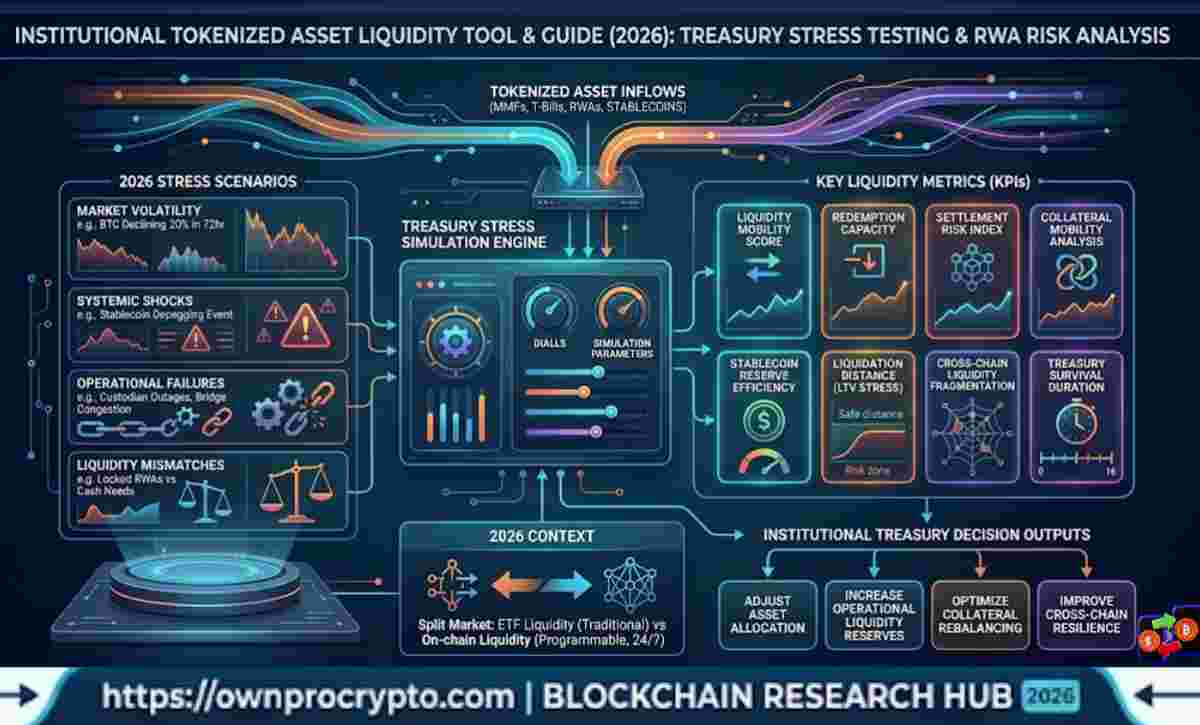
Infographic of Institutional Tokenized Asset Liquidity Tool & Guide (2026)
Institutional Tokenized Asset Liquidity Tool & Guide

Institutional crypto adoption in 2026 is no longer constrained by access. The real bottleneck is liquidity mobility. Hedge funds, treasury desks, family offices, and tokenized asset managers increasingly face a structural problem: capital exists onchain, but much of it cannot move efficiently during stress events, redemption cycles, or collateral shortages.

The rapid expansion of institutional RWA liquidity markets created a new challenge where tokenized assets provide yield but often reduce operational flexibility. Funds holding tokenized private credit, tokenized real estate, or locked staking allocations frequently struggle to meet liquidity demands without realizing losses or violating mandate constraints.

(Problem) Institutions increasingly hold yield-generating tokenized assets that cannot be mobilized quickly during operational stress.

(Solution) Modern treasury infrastructure now uses tokenized money market funds, onchain collateral mobility, and tokenized treasury funds to unlock liquidity without fully exiting digital asset exposure.

Why Institutional Tokenized Asset Liquidity Matters in 2026

The tokenized asset market expanded aggressively through 2025 and 2026. Institutional adoption accelerated after large financial firms launched tokenized treasury products and compliant onchain settlement systems.

Large institutions increasingly use:

  • tokenized treasury funds
  • tokenized money market funds
  • stablecoin reserve assets
  • tokenized private credit
  • onchain collateral infrastructure

The operational advantage is speed. Traditional finance still depends heavily on T+1 and T+2 settlement windows, while tokenized assets can settle continuously across global markets.

However, liquidity fragmentation became a major institutional concern. Many early tokenized allocations were built for yield generation rather than liquidity flexibility.

(Problem)
Funds often discover that tokenized exposure improves yield while reducing redemption flexibility.

(Solution)
Institutions are redesigning treasury architecture around liquid tokenized collateral and programmable settlement infrastructure.

The Institutional Liquidity Trap

The institutional liquidity trap occurs when firms hold significant digital asset exposure but cannot efficiently convert positions into operational liquidity during volatility or redemption pressure.

This problem became more visible as institutions expanded exposure into:

  • tokenized private credit
  • tokenized real estate
  • locked staking products
  • long-duration yield strategies
  • private secondary market allocations

Many of these products include:

  • multi-year lockups
  • redemption windows
  • settlement delays
  • compliance restrictions
  • transfer limitations

At the same time, institutional obligations continue operating in real time:

  • margin requirements
  • treasury operations
  • ETF settlement
  • client withdrawals
  • collateral posting

(Problem)
Yield-generating tokenized allocations frequently create liquidity mismatches during operational stress.

(Solution)
Institutions increasingly separate strategic yield exposure from operational liquidity reserves using tokenized treasury infrastructure.

How Tokenized Money Market Funds Solve Liquidity Constraints

Tokenized money market funds became one of the most important institutional crypto infrastructure developments in 2026.

Products such as:

  • BlackRock BUIDL
  • Franklin Templeton BENJI
  • JPMorgan tokenized treasury systems
  • institutional stablecoin reserve products

allow institutions to maintain:

  • dollar stability
  • treasury yield
  • onchain transferability
  • collateral utility

Unlike traditional treasury funds, tokenized treasury funds can move continuously across blockchain settlement rails.

This enables:

  • faster collateral deployment
  • intraday treasury management
  • real-time liquidity movement
  • programmable settlement workflows

(Problem)
Traditional treasury infrastructure cannot support 24/7 digital asset settlement requirements.

(Solution)
Tokenized money market funds provide institutional-grade liquidity while remaining compatible with onchain settlement systems.

Onchain Collateral Mobility Is Becoming Critical

Onchain collateral mobility is now one of the most important operational priorities for institutional treasury teams.

Modern institutions increasingly need collateral that can:

  • move across chains
  • support margin operations
  • integrate with custodians
  • remain yield-generating
  • settle instantly

After several bridge and settlement failures across earlier crypto infrastructure cycles, institutions shifted toward:

  • permissioned interoperability
  • regulated custody integrations
  • MPC-secured collateral systems
  • compliant cross-chain settlement rails

Collateral mobility now matters as much as asset performance.

(Problem)
Static custody models reduce operational flexibility during fast-moving market conditions.

(Solution)
Institutions increasingly prioritize interoperable collateral systems capable of real-time liquidity movement.

Infographic of Institutional Tokenized Asset Liquidity Explained How Funds Are Escaping the 2026 Liquidity Trap.
Institutional Tokenized Asset Liquidity

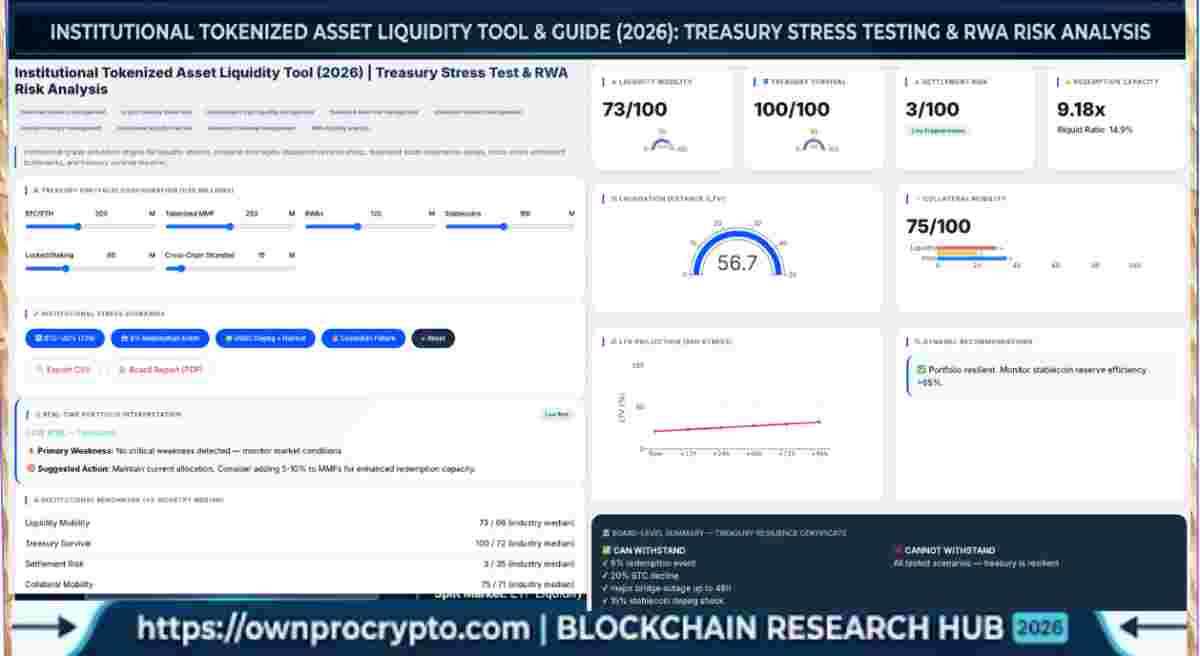
How This Tokenized Asset Liquidity Tool Works

This institutional tokenized asset liquidity tool analyzes how digital asset portfolios perform during liquidity stress, redemption events, and settlement disruptions. The simulator models treasury resilience across tokenized assets, stablecoin reserves, RWAs, and onchain collateral systems.

Step 1: Configure Institutional Treasury Exposure

Start by adjusting portfolio allocations across:

  • BTC and ETH exposure
  • tokenized money market funds (MMFs)
  • tokenized RWAs and private credit
  • stablecoin reserves
  • locked staking positions
  • cross-chain stranded liquidity

The tool calculates total institutional AUM based on the selected treasury structure.


Step 2: Run Institutional Stress Scenarios

Select a treasury stress scenario to simulate operational risk conditions.

Available simulations include:

  • BTC price decline (-20% stress)
  • institutional redemption events
  • stablecoin depeg scenarios
  • custodian or settlement outages
  • cross-chain liquidity disruptions

These simulations model how liquidity conditions change during market volatility and operational pressure.


Step 3: Analyze Liquidity Mobility Score

The liquidity mobility score estimates how efficiently institutional capital can move within 24 hours.

The score evaluates:

  • liquid reserve availability
  • tokenized collateral portability
  • stablecoin readiness
  • stranded cross-chain exposure
  • operational settlement flexibility

Higher scores indicate stronger treasury mobility during stress events.


Step 4: Review Treasury Survival Metrics

The treasury survival score measures whether liquid assets can withstand:

  • redemption pressure
  • collateral shocks
  • settlement delays
  • liquidity fragmentation

This helps institutions evaluate whether treasury reserves remain operational during adverse market conditions.


Step 5: Evaluate Settlement & Collateral Risk

The tool calculates:

  • settlement risk index
  • liquidation distance (LTV)
  • collateral mobility efficiency
  • illiquid capital ratio

These metrics help identify:

  • bottlenecks
  • locked capital
  • custodial dependency
  • cross-chain settlement risks

Institutions can use these insights to redesign treasury infrastructure around more flexible liquidity systems.


Step 6: Generate Treasury Recommendations

Based on portfolio conditions, the simulator generates institutional liquidity recommendations such as:

  • increasing tokenized MMF allocation
  • reducing stranded liquidity exposure
  • diversifying stablecoin reserves
  • improving collateral portability
  • optimizing treasury reserve structure

This allows treasury teams to model operational improvements before real market stress occurs.


Step 7: Export Institutional Treasury Reports

The platform supports:

  • CSV exports
  • PDF board reports
  • treasury stress summaries

Institutions can use these reports for:

  • treasury committee reviews
  • liquidity planning
  • operational risk analysis
  • redemption scenario modeling
  • digital asset governance frameworks
 

Institutional RWA Liquidity vs Traditional Crypto Liquidity

Institutional RWA liquidity differs significantly from speculative crypto market liquidity.

Traditional crypto liquidity depends heavily on:

  • exchange order books
  • perpetual futures
  • speculative trading volume
  • retail flows

Institutional RWA liquidity instead focuses on:

  • redemption reliability
  • treasury efficiency
  • collateral utility
  • settlement certainty
  • compliance-safe transfers

This shift is why institutional adoption increasingly favors tokenized treasury infrastructure rather than purely speculative digital assets.

(Problem)
Speculative crypto liquidity does not always provide operational liquidity for institutions.

(Solution)
Tokenized treasury systems create more stable and compliance-compatible liquidity infrastructure.

Infographic of Blockchain Digital Twins 2026 showing Tokenized, Examples & Use Case in Web3
Blockchain Digital Twins 2026

Institutional Liquidity Comparison: Legacy vs. 2026 Tokenized Infrastructure

Problem Objectives Analysis / Situation Implementation Challenges Results / Outcomes
The Liquidity Trap: Capital is on-chain but “trapped” during 8% redemption events or market stress. Achieve 24/7 liquidity mobility without exiting yield-generating RWA positions. 2026 Treasury desks manage tokenized MMFs, T-bills, and private credit across multiple settlement layers. Shifting from static cold storage to Tokenized Treasury Funds and Stablecoin Reserve Assets. Multi-year lockups, redemption windows, and liquidity mismatches in locked RWAs. Treasury Survival Duration increased; capital moves in minutes, not days (T+0).
Settlement Bottlenecks: Traditional T+1 and T+2 windows create operational gaps for digital assets. Eliminate settlement risk through programmable, real-time collateral movement. Traditional finance depends on banking hours; tokenized assets settle continuously on global rails. Using products like BlackRock BUIDL and Franklin Templeton BENJI for intraday management. Cross-chain liquidity fragmentation and bridge/settlement failures from earlier cycles. Near-instant settlement (Atomic Swaps) and improved Collateral Mobility Efficiency.
Static Custody Risks: Key-based security limits the speed of margin and collateral posting. Move collateral across chains and support 24/7 margin operations instantly. Institutions are moving toward MPC-secured collateral systems and regulated custody integrations. Deploying Institutional Liquidity Tools to track the Settlement Risk Index and LTV stress. Custodian dependency risk and oracle failures during high volatility scenarios. Interoperable systems capable of real-time liquidity movement and Zero-Key Security.

Why Crypto Liquidity Management Became a Board-Level Issue

Crypto liquidity management is no longer a trading problem. It became a governance and treasury management issue.

Institutional boards increasingly require:

  • liquidity stress testing
  • redemption scenario modeling
  • treasury contingency planning
  • stablecoin reserve allocation
  • collateral diversification frameworks

Liquidity failures can now create:

  • operational disruptions
  • client redemption pressure
  • compliance exposure
  • counterparty concerns
  • reputational risk

As a result, treasury teams increasingly build liquidity segmentation models that separate:

  • strategic capital
  • operational liquidity
  • collateral reserves
  • emergency settlement liquidity

(Problem)
Institutions historically optimized for yield before optimizing for liquidity survivability.

(Solution)
Modern treasury frameworks now prioritize operational liquidity resilience alongside performance.

Institutional Tokenized Asset Liquidity: Problem & Solution Matrix

Problem Objectives Analysis / Situation Implementation Challenges Results / Outcomes
Institutional Liquidity Trap: Capital exists onchain but cannot move efficiently during stress events or redemption cycles. Unlock liquidity without fully exiting digital asset exposure while maintaining yield. Institutions hold yield-generating tokenized assets (Private Credit, Real Estate) that cannot be mobilized quickly. Transitioning to tokenized money market funds, onchain collateral mobility, and tokenized treasury funds. Multi-year lockups, redemption windows, settlement delays, and compliance restrictions. Unlocked liquidity mobility and improved operational flexibility for treasury desks.
Traditional Settlement Gaps: Legacy infrastructure depends on T+1 and T+2 windows, failing 24/7 digital requirements. Support 24/7 digital asset settlement requirements and intraday treasury management. Products like BlackRock BUIDL and Franklin Templeton BENJI allow continuous movement across settlement rails. Deploying programmable settlement workflows and institutional stablecoin reserve products. Managing liquidity mismatches between locked RWAs and operational cash needs. Faster collateral deployment and real-time liquidity movement across global markets.
Static Custody & Fragmentation: Rigid custody models reduce operational flexibility and strand capital onchain. Ensure collateral can move across chains, support margin operations, and settle instantly. Institutions are shifting toward permissioned interoperability and regulated custody integrations. Utilizing MPC-secured collateral systems and compliant cross-chain settlement rails. Bridge and settlement failures across earlier crypto infrastructure cycles. Interoperable collateral systems capable of real-time liquidity movement.

Scenario Framework for Institutional Liquidity Planning

ScenarioTriggerInstitutional ActionExpected Outcome
Base CaseBTC range-bound, stable ratesIncrease tokenized treasury allocationImproved liquidity efficiency
Bull CaseETF inflows accelerateRotate liquidity reserves into growth assetsHigher risk-adjusted upside
Bear CaseRegulatory stress or market shockIncrease stablecoin and MMF exposureCapital preservation
Liquidity CrisisRedemption surgeActivate collateral mobility systemsFaster treasury stabilization

(Problem)
Many institutions still rely on static treasury models built for traditional settlement systems.

(Solution)
Scenario-based liquidity planning improves operational survivability during market stress.

Conclusion

The next institutional crypto cycle will not be defined only by performance. It will be defined by liquidity survivability.

Institutions increasingly recognize that operational flexibility matters more than static asset exposure. Tokenized treasury systems, onchain collateral mobility, and programmable settlement infrastructure are becoming foundational components of modern digital asset treasury architecture.

The institutions that survive future market stress will likely be those that remain liquid enough to act while others remain trapped inside illiquid allocations.

© 2026 OwnProCrypto.com · Data references: BlackRock BUIDL · JPMorgan Kinexys

FAQs: Smart Tokenized Asset Liquidity Tool

❓ What is a tokenized asset liquidity tool?
  • A tokenized asset liquidity tool measures how quickly tokenized assets, stablecoins, and digital collateral can be converted into operational liquidity during stress scenarios.
  • Problem: Institutions often miscalculate the “exit speed” of digital assets during market volatility.
  • Solution: Real-time monitoring allows treasurers to see exactly which assets are truly liquid under pressure.

❓ Why do institutions run treasury stress tests?
  • Institutions run treasury stress tests to evaluate whether portfolios can survive redemption events, collateral shocks, stablecoin depegs, or settlement disruptions.

❓ What is institutional liquidity risk in crypto?
  • Institutional liquidity risk refers to the possibility that digital assets cannot settle, move, or convert into usable liquidity fast enough during market stress.

❓ Why are tokenized MMFs important?
  • Tokenized Money Market Funds (MMFs) provide yield-bearing reserves with faster settlement and programmable collateral capabilities compared to traditional funds.
  • Problem: Idle cash in traditional MMFs suffers from T+2 settlement delays.
  • Solution: Tokenized MMFs enable T+0 liquidity, turning reserves into “instant” capital.

❓ What causes liquidity fragmentation?
  • Liquidity fragmentation occurs when capital becomes spread across multiple exchanges, custodians, chains, and settlement systems that cannot interoperate efficiently.

❓ What is collateral mobility?
  • Collateral mobility measures how efficiently assets can move between custodians, blockchains, and trading venues during operational stress.

❓ Why do institutions use tokenized Treasury bills?
  • Institutions use tokenized Treasury bills because they combine Treasury yield exposure with on-chain settlement speed and collateral flexibility.

❓ How do stablecoin reserves affect treasury risk?
  • Stablecoin reserve concentration can create liquidity stress if redemption pressure rises or reserve backing becomes uncertain.

❓ What is settlement risk in tokenized finance?
  • Settlement risk refers to failures or delays in transferring assets, collateral, or cash between counterparties and blockchain systems.

❓ Why is cross-chain liquidity monitoring important?
  • Cross-chain monitoring helps institutions identify stranded capital, bridge exposure, and settlement bottlenecks across blockchain ecosystems.