
Search by title, topic or phrase
Use our Crypto Search Engine 🔍 to find the topics and keywords you're looking for.
How institutions construct, allocate, manage, and optimize RWA portfolios
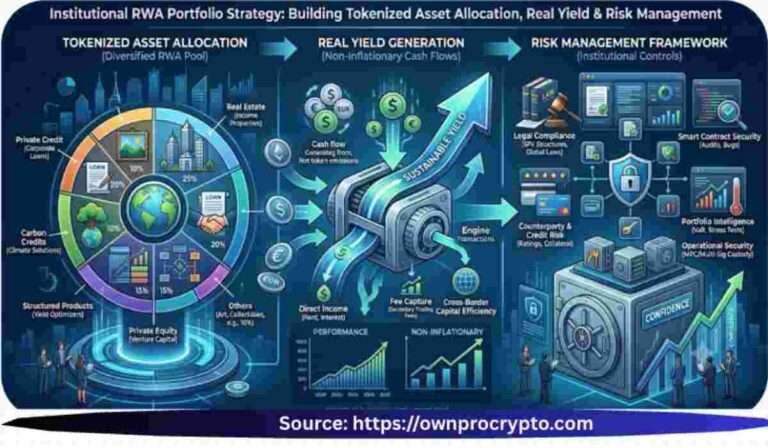
Table of Contents
Toggleproblem → shift → solution → framework → outcome The RWA Revaluation)
An Institutional RWA Portfolio Strategy is a structured framework used by asset managers, family offices, pension funds, sovereign wealth funds, and corporate treasuries to construct, allocate, manage, and optimize tokenized real-world asset portfolios. Modern Institutional RWA Portfolio Strategy models combine tokenized real estate, private credit, government bonds, infrastructure assets, commodities, and cash-equivalent instruments within a unified digital portfolio architecture. The primary objective is to improve capital efficiency, liquidity management, portfolio transparency, and long-term risk-adjusted returns while maintaining institutional governance and compliance standards.
The Strategy at a Glance:
Investor & Professional Note: In Web3, discipline is a feature, not a limitation. Verify Legal Wrappers, treat every on-chain signature as a legally binding execution. If you don’t understand the “Logic Layer” of what you are signing, you don’t truly own the outcome.
This guide is a core pillar of our Web3 Ecosystem Architecture. To understand how to move this capital securely, explore our Stablecoin Payments 2026 pillar or return to the Asset Security Fortress for custody frameworks.

For most of modern financial history, institutional portfolios have relied on a familiar combination of public equities, government bonds, private markets, and cash equivalents.
That framework is not disappearing.
However, a new asset infrastructure is emerging around it.
Real-world asset (RWA) tokenization is creating a bridge between traditional capital markets and digital financial systems. Instead of changing the underlying asset, tokenization changes how ownership, settlement, reporting, and distribution operate.
Government bonds remain government bonds.
Private credit remains private credit.
Commercial real estate remains commercial real estate.
What changes is the efficiency layer surrounding those assets.
As institutions search for yield, liquidity, operational efficiency, and global capital access, tokenized real-world assets are becoming an increasingly important component of modern portfolio strategy.
The discussion is no longer centered on whether tokenization works.
The discussion is increasingly focused on portfolio construction, allocation frameworks, risk management, and long-term capital deployment.
This guide examines how institutional investors approach RWA portfolio strategy in 2026, including asset allocation models, real-yield frameworks, portfolio engineering principles, and the risk controls required for sustainable participation.
An institutional RWA portfolio strategy is the process of allocating capital across tokenized real-world assets in order to generate income, preserve capital, improve liquidity, and enhance portfolio efficiency.
Unlike speculative digital asset strategies that focus primarily on price appreciation, institutional RWA portfolios focus on productive assets that generate measurable economic value.
Examples include:
The objective is not speculation.
The objective is predictable, risk-adjusted returns supported by real economic activity.
Many discussions focus on the technology layer.
Institutions focus on the portfolio layer.
Questions such as:
Ultimately matter more than blockchain architecture alone.
Tokenization is simply the mechanism.
Portfolio outcomes remain the priority.
Owning a tokenized asset is not the same as building an institutional portfolio.
Portfolio construction requires:
Institutional investors evaluate portfolios as systems rather than individual investments.
Retail investors often focus on opportunities.
Institutions focus on processes.
Before allocating capital, institutions typically evaluate:
The strongest RWA portfolios are designed around these principles.
The rapid growth of tokenized assets is being driven by economic incentives rather than technological curiosity.
The modern investment landscape has experienced prolonged periods of low yields, inflated asset valuations, and compressed risk premiums.
Institutional allocators increasingly seek investments supported by productive economic activity.
Examples include:
These income streams create what many investors refer to as real yield.
Traditional portfolios often depend heavily on public markets.
RWAs provide exposure to asset classes that historically remained inaccessible or difficult to access.
Benefits include:
Tokenized systems can improve capital efficiency by reducing settlement friction and operational delays.
Benefits may include:
Certain RWA categories may exhibit different behavior than public equities and digital assets.
This can improve portfolio resilience during periods of market stress.
Corporate treasuries, family offices, and institutional funds increasingly evaluate tokenized yield-bearing assets as alternatives to idle cash holdings.
The focus is not replacing traditional finance.
The focus is improving capital utilization.
Institutional portfolio construction begins with understanding the available asset universe.
Tokenized treasury products represent one of the largest and fastest-growing segments of the RWA market.
Characteristics:
Institutional Role:
Core defensive allocation.
Private credit provides financing to businesses outside traditional public debt markets.
Characteristics:
Institutional Role:
Yield enhancement allocation.
Commercial and residential property remain foundational institutional asset classes.
Characteristics:
Institutional Role:
Income generation and diversification.
Infrastructure investments include:
Characteristics:
Institutional Role:
Capital preservation and yield generation.
Tokenized commodity exposure may include:
Institutional Role:
Inflation protection and diversification.
Rather than purchasing individual assets, investors can gain diversified exposure through tokenized funds.
Institutional Role:
Portfolio simplification and professional management.
No single allocation framework fits every institution.
Investment objectives determine portfolio construction.
| Allocation | Asset Class |
|---|---|
| 70% | Tokenized Treasuries |
| 20% | Real Estate |
| 10% | Alternatives |
Primary Objective:
Capital preservation with moderate income generation.
| Allocation | Asset Class |
| 40% | Treasuries |
| 30% | Private Credit |
| 20% | Real Estate |
| 10% | Alternatives |
Primary Objective:
Balanced income and growth.
| Allocation | Asset Class |
| 20% | Treasuries |
| 50% | Private Credit |
| 20% | Real Estate |
| 10% | Alternatives |
Primary Objective:
Maximizing real yield while accepting greater risk.
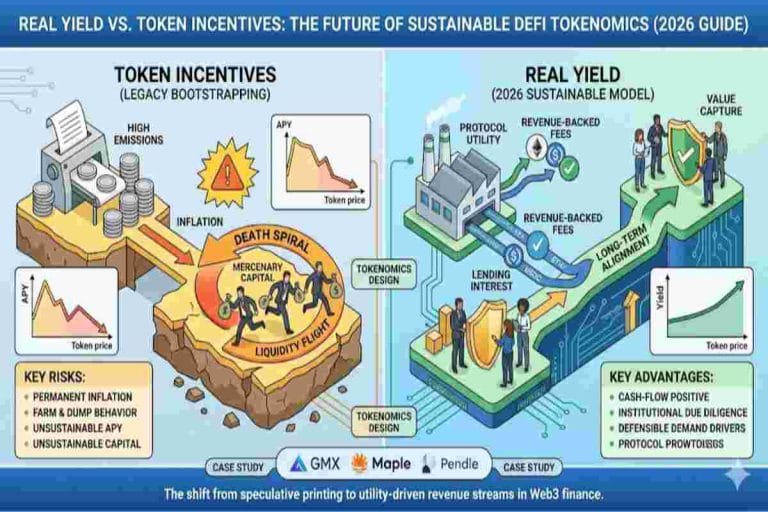
One of the most important concepts in institutional RWA investing is real yield.
Real yield refers to income generated by productive economic activity rather than token incentives or speculative appreciation.
Sources include:
Institutions generally prefer income streams that are:
These characteristics improve long-term portfolio stability.
Productive assets generate recurring value regardless of market sentiment.
This distinction separates real-yield assets from purely speculative investments.
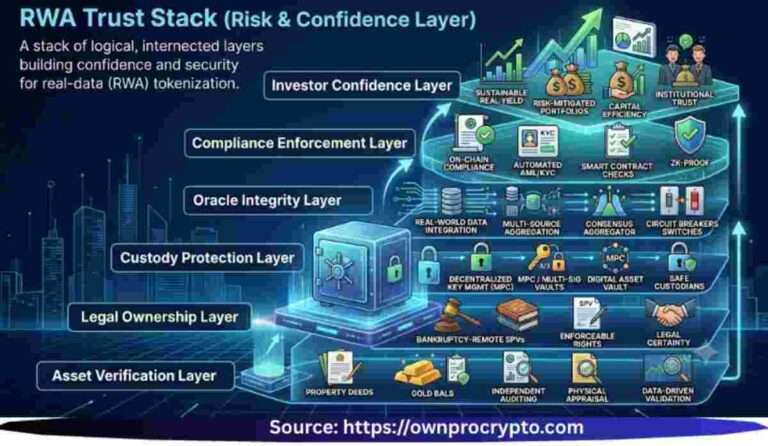
Every institutional allocation decision begins with risk management.
Questions to evaluate:
Questions to evaluate:
Questions to evaluate:
Questions to evaluate:
Questions to evaluate:
Questions to evaluate:
No single asset class should dominate portfolio exposure.
Diversification remains one of the most effective risk-management tools.
Before allocating capital, institutions typically conduct structured due diligence.
Evaluate:
Evaluate:
Evaluate:
Evaluate:
Evaluate:

Family offices often approach RWA portfolios differently than large institutions.
Protecting wealth remains a primary objective.
Many family offices prioritize recurring income over aggressive growth.
Long-term ownership structures often align naturally with productive real-world assets.
RWAs can provide diversification beyond traditional public markets.
Corporate treasuries increasingly evaluate tokenized assets as part of liquidity management frameworks.
Excess cash may create opportunity costs when left unproductive.
Tokenized yield-bearing assets provide potential alternatives.
Goals include:
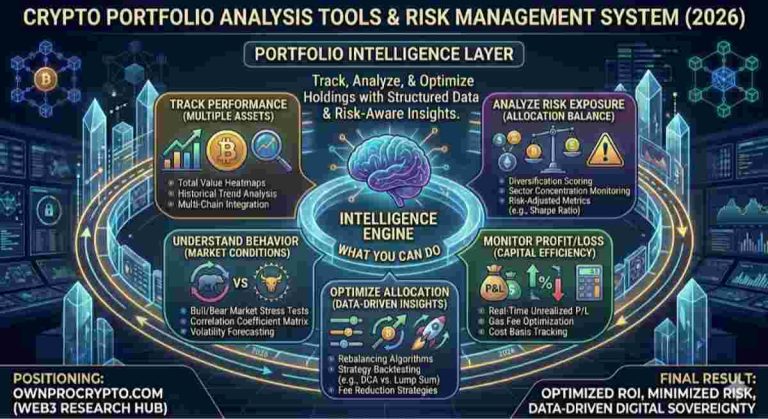
Portfolio construction is not a one-time event.
Market conditions change continuously.
Allocations should adapt when risk profiles shift.
Risk-adjusted returns matter more than headline yields.
Investors should evaluate:
Liquidity requirements should remain aligned with investor objectives.
Institutional investors rely on measurable performance indicators.
Income generated by portfolio assets.
Measures return relative to risk exposure.
Measures peak-to-trough portfolio declines.
Measures ease of entering and exiting positions.
Measures sensitivity to interest-rate changes.
Measures exposure across asset categories.
The Family Office Manager (The “Diversifier”)
The Emerging Market Entrepreneur (The “Unbanked Architect”)
By 2026, BlackRock’s BUIDL Fund has evolved beyond Ethereum into a multi-chain deployment, positioning itself as a foundational layer in emerging on-chain institutional yield rails and serving as a primary collateral asset across institutional DeFi markets.
A modern Institutional RWA Portfolio Strategy typically combines four core objectives:
Capital Preservation
Income Generation
Diversification
Liquidity Management
The most successful portfolios are not built around a single asset class.
They are built around balancing income, risk, liquidity, and long-term resilience.
Several structural trends are expected to influence RWA markets over the coming years.
Artificial intelligence may assist with:
Portfolio administration is becoming increasingly automated.
Digital settlement systems may improve global capital mobility.
A broader range of traditional financial products is expected to become digitally represented.
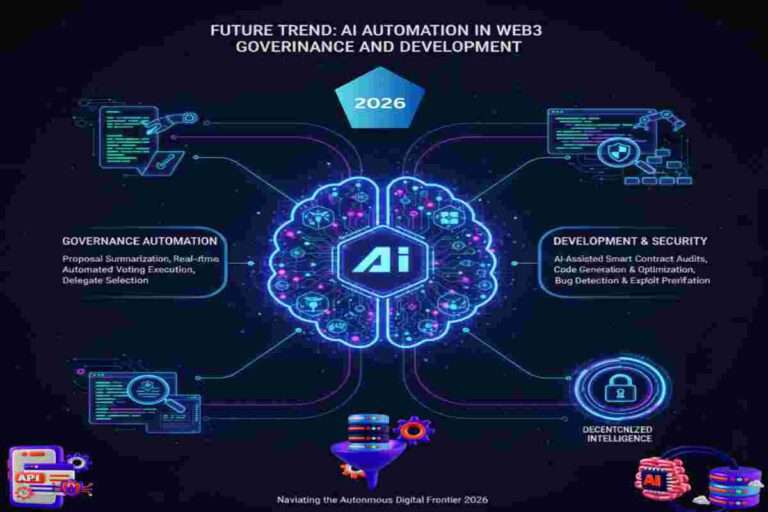
Artificial intelligence enhances portfolio optimization, risk monitoring, and compliance automation, creating more adaptive tokenized investment strategies.
The convergence of AI and Automation in Institutional RWA Portfolio Strategy has birthed the “Self-Optimizing Treasury.” In 2026, AI agents monitor global real yield fluctuations in real-time, executing rebalancing strategies that ensure capital efficiency is always peaked. This automation removes the “Human Error” element, creating a resilient, 24/7 management layer that never sleeps and never misses a compliance update.
Rooted in Case Study Failure: A fund in 2025 was hit with a regulatory fine because a manual compliance officer missed a change in “Travel Rule” requirements for a specific jurisdiction. Portfolios utilizing AI and Automation in Institutional RWA Portfolio Strategy updated their logic instantly, blocking non-compliant trades before they could even be signed
In advanced Web3 architectures, AI-automation functions as an execution layer rather than a decision authority. Human actors define strategy, governance rules, and risk parameters, while automated agents enforce those policies consistently across time, scale, and networks. In practice, AI-driven automation monitors on-chain activity, validates governance conditions, flags security anomalies, and executes pre-approved workflows such as transaction limits, treasury operations, or compliance checks. This design strengthens operational resilience, reduces human error, and ensures continuity without compromising self-custody or sovereign control. By separating decision-making from execution, Web3 systems achieve scalable automation while preserving decentralization, accountability, and long-term digital sovereignty.
Institutional RWA Portfolio Strategy table helps readers mentally place AI correctly , not as magic, but as infrastructure.
| Layer | Human Role | AI-Automation Role | Sovereignty Impact |
|---|---|---|---|
| Strategy | Define goals, risk limits, governance rules | None | Fully human |
| Policy | Encode rules into smart contracts & workflows | Validate rule consistency | Human-controlled |
| Execution | Approve systems & escalation paths | Execute tasks automatically | Delegated, reversible |
| Monitoring | Decide what matters | Watch thresholds & anomalies | Prevents silent failure |
| Recovery | Authorize intervention | Trigger alerts & pauses | Human override preserved |
Institutional RWA portfolio strategy is rapidly evolving from a niche concept into a practical framework for modern capital allocation.
The most important shift is not technological. It is financial.
Investors are increasingly prioritizing productive assets that generate sustainable cash flow, offer greater operational efficiency, and integrate with emerging digital ownership systems.
Tokenized treasuries, private credit, real estate, infrastructure, and alternative assets are creating new opportunities for institutions seeking real yield and improved capital efficiency.
As digital ownership infrastructure matures, the institutions that understand allocation, risk management, liquidity planning, and portfolio construction will be better positioned to navigate the next generation of capital markets.
An institutional RWA portfolio is a professionally managed investment portfolio composed of tokenized real-world assets such as government bonds, private credit, real estate, infrastructure, and income-generating funds.
There is no universal allocation model. Conservative investors may allocate 5–15%, while dedicated alternative asset strategies may allocate significantly more depending on risk tolerance, liquidity requirements, and investment objectives.
The best model depends on investor goals. Capital-preservation strategies typically emphasize tokenized treasuries, while income-focused portfolios may allocate more heavily toward private credit and real estate.
Portfolios are typically rebalanced based on asset performance, changing risk profiles, market conditions, liquidity requirements, and yield opportunities.
Certain RWA categories may exhibit lower volatility than speculative digital assets because they are supported by underlying cash flows and productive economic activity.
Real yield is generated by productive economic activities such as bond coupons, rental income, infrastructure revenues, loan repayments, and private credit interest.
Yield refers to investment income in general. Real yield specifically refers to income derived from actual economic activity rather than token emissions, inflationary incentives, or speculative appreciation.
Tokenized bonds often serve as income-generating and defensive portfolio components, providing predictable cash flows and potential liquidity improvements.
Private credit is frequently used to enhance portfolio yield while providing exposure to lending opportunities outside traditional public debt markets.
Income-focused RWA portfolios may support retirement planning objectives because many underlying assets generate recurring cash flows.
Tokenized funds typically represent ownership interests in professionally managed investment vehicles where fund shares are recorded and transferred through blockchain-based systems.
Treasury-backed tokens often function as low-risk portfolio anchors that provide liquidity, stability, and yield generation.
Tokenized real estate can provide rental income, inflation sensitivity, and diversification benefits within a broader allocation framework.
Infrastructure investments often generate long-term, predictable cash flows while providing defensive characteristics during economic uncertainty.
Commodities may serve as inflation hedges and diversification tools within institutional asset allocation strategies.
Common risks include credit risk, liquidity risk, regulatory risk, operational risk, custody risk, valuation risk, and counterparty risk.
The answer varies by asset type, but liquidity risk and legal enforceability are often among the most important considerations.
Duration risk refers to the sensitivity of fixed-income assets to changes in interest rates, which can affect market valuations.
Institutions typically utilize regulated custodians, segregated asset structures, multi-layer security controls, and ongoing audits.
Evaluation generally includes asset quality analysis, legal review, cash-flow assessment, operational due diligence, and risk-adjusted return modeling.
Liquidity varies significantly by asset type, market structure, trading venue, and investor demand.
Liquidity influences an investor’s ability to enter, exit, and rebalance positions efficiently while managing risk.
Improved capital efficiency can reduce settlement delays, increase collateral mobility, and improve overall portfolio flexibility.
Some institutions use stablecoins for settlement, treasury operations, liquidity management, and capital deployment within digital asset ecosystems.
Digital ownership systems may reduce settlement friction by automating transfers, reporting, and transaction processing.
Institutions typically access tokenized assets through regulated issuers, investment platforms, asset managers, and specialized financial products.
Family offices often use RWAs to diversify holdings, generate income, improve liquidity, and gain exposure to alternative asset classes.
Pension funds generally focus on long-term cash flows, legal certainty, risk management, liquidity requirements, and regulatory compliance.
No. Most institutions view RWAs as complementary components that enhance existing portfolio strategies rather than replacing traditional investments entirely.
Regulatory clarity is often a key driver of institutional participation because it reduces uncertainty and strengthens investor protections.
The market is expected to expand through increased institutional participation, broader asset tokenization, improved infrastructure, and greater integration with traditional financial systems.
Artificial intelligence may assist with portfolio monitoring, risk analysis, asset screening, and allocation optimization, although human oversight remains essential.
Many industry participants believe tokenized assets will become a growing segment of institutional portfolios as infrastructure and regulations mature.
Key trends include tokenized treasuries, private credit expansion, AI-assisted portfolio management, programmable compliance, and cross-border digital capital markets.
New investors should begin by understanding asset quality, risk management, yield generation, portfolio construction principles, and the legal structures supporting tokenized assets.
This article is part of our RWA & Tokenized Real Estate 2026 Research Library, a connected group of resources designed to help investors and institutions understand real-world asset tokenization, property-backed income, legal structures, portfolio allocation, liquidity, risk and on-chain financial infrastructure in 2026.