infographic of site logo for contact us

OwnProCrypto.com

Use our Crypto Search Engine 🔍 to find the topics and keywords you're looking for.

Institutional RWA Market Report · 2026

Institutional RWA Market Report 2026: Tokenized Assets, Growth & Adoption

The institutional real-world asset (RWA) market has moved beyond early experimentation into a measurable segment of digital financial infrastructure. In 2026, tokenized Treasuries, funds, commodities, private credit and equities are attracting institutional attention, but growth remains concentrated in selected asset classes and products. Legal structure, liquidity, transfer restrictions, custody and settlement continue to determine whether tokenized assets become genuinely usable financial instruments.

This report examines the size and composition of the tokenized RWA market, institutional adoption, major asset categories, market infrastructure, liquidity and activity, adoption drivers, barriers, regulation, risk and the outlook toward 2030. Market figures should always be read together with their measurement date, asset scope and methodology.


Table of Contents

What Is the RWA Market in 2026?

The RWA market refers to financial and economic interests connected to real-world assets that are represented, transferred or managed through blockchain-based infrastructure. The token may represent direct ownership, a beneficial interest, a debt claim, a fund share, collateral exposure or another contractual right connected to an off-chain asset.

There is no single universally accepted figure for the size of the tokenized RWA market. Different research providers count different asset structures, chains, products and representations. For example, CoinGecko reported approximately $19.3 billion in tokenized RWA market capitalization at the end of Q1 2026 under its defined scope, while broader datasets can produce materially higher totals.

The key market signal is not one headline number. Market analysis should combine represented asset value with institutional participation, product diversity, holder activity, transferability, liquidity and integration with existing financial infrastructure.

RWA Market 2026: First Answer

Market Question 2026 Observation
Is tokenized RWA value growing? Yes. Multiple 2026 datasets report substantial year-over-year expansion.
Which category remains central? Tokenized government securities and related cash-equivalent products remain a major institutional segment.
Is growth evenly distributed? No. Market value remains concentrated across a relatively small number of products and asset categories.
Does tokenization automatically create liquidity? No. Secondary-market depth, transfer rules, investor eligibility and redemption determine practical liquidity.
Is institutional adoption increasing? Institutional participation is expanding across funds, securities, commodities, private credit and settlement infrastructure.

Why RWA Market Figures Differ

  • Some datasets measure distributed tokenized assets.
  • Some measure active RWA market capitalization.
  • Some include private-credit structures that are difficult to observe directly.
  • Some include products represented on permissioned infrastructure.
  • Some datasets exclude assets that cannot move freely between wallets.
  • Data snapshots may be taken on different dates.

Three Useful Market Measurements

Measurement What It Tells You Limitation
Market capitalization Estimated value represented by tracked tokenized assets. Does not prove active trading.
Active value Value meeting the dataset’s activity criteria. Methodology varies by provider.
Trading volume Observed market activity. Can be concentrated or episodic.
Infographic of Institutional RWA Market Report 2026: Tokenized Assets Growth & Adoption
Institutional RWA Market Report 2026

How Large Is the Tokenized RWA Market?

2026 data confirms that tokenization has reached multi-billion-dollar scale, but the exact reported market size depends heavily on the dataset’s definition. Market capitalization, active value and observed trading activity should not be treated as interchangeable measures.

$19.32 billion CoinGecko’s reported tokenized RWA market capitalization as of March 31, 2026, within its defined reporting scope.

CoinGecko’s Q1 2026 report recorded approximately $19.32 billion in tokenized RWA market capitalization as of March 31, 2026, up 256.7% from the beginning of 2025 within its reporting scope. Tokenized Treasuries represented the largest component in that dataset.

Other datasets produce higher totals because they use broader definitions. DeFiLlama’s Q1 research, for example, reported approximately $25.2 billion in active RWA market capitalization as of March 2026 and showed growth across funds, commodities, private credit and equities.

Why One Number Should Not Represent the Entire Market

Differences between market estimates are not necessarily evidence that one dataset is wrong. They can reflect different measurement boundaries, asset definitions, chains, activity criteria and snapshot dates.

Market Measurement Framework

Measurement Best Used For What It Cannot Prove
Market capitalization Estimating the represented value of tracked tokenized assets. It does not prove active trading or exit liquidity.
Active value Assessing assets meeting a provider’s activity criteria. Activity definitions differ between providers.
Trading volume Measuring observed market activity. Volume can be concentrated or episodic.
Holder count Assessing distribution of ownership. More holders do not automatically mean deeper liquidity.

Methodology Rule

Every RWA market figure should be accompanied by its definition, measurement date, asset scope and methodology. This is particularly important when comparing public-market products with private-credit, real-estate or permissioned structures.

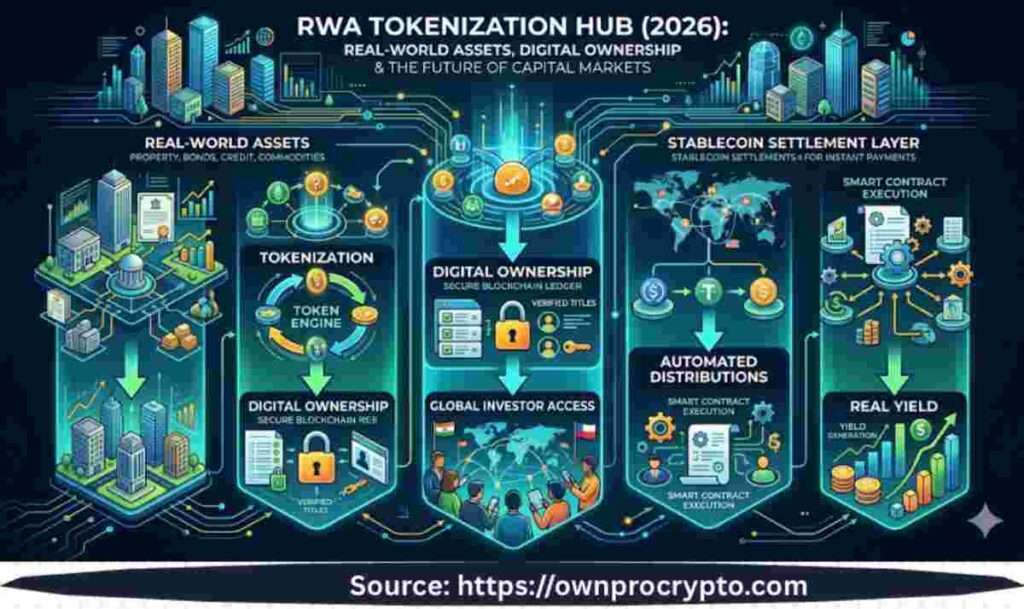
Infographic of rwa tokenization hub Real-World Assets, Digital Ownership & the Future of Capital Markets
Major Tokenized RWA Asset Classes

Major Tokenized RWA Asset Classes

The RWA market is increasingly diversified, although diversification remains uneven. Government securities, commodities, funds, private credit, equities and real estate are among the most visible categories, but each has a different legal, liquidity, custody and valuation profile.

Government SecuritiesYield, liquidity and relatively standardized instruments make Treasuries a major institutional use case.
Money-Market FundsTokenized fund structures can connect established cash-management products with digital settlement infrastructure.
CommoditiesGold and other commodity exposure can be represented digitally, subject to custody, reserve and redemption controls.
Private CreditTokenization can represent lending exposure, but underwriting, servicing and secondary liquidity remain central.
Equities & FundsDigital distribution and programmable infrastructure are potential benefits, subject to securities regulation and investor rights.
Real Estate & Private AssetsFractionalization and digital records are possible, but property law, valuation and local regulation remain important.

Asset Category Comparison

Asset Category Typical Institutional Rationale Key Constraint
Government securities Yield, liquidity and relatively standardized instruments. Eligibility, custody and transfer restrictions.
Money-market funds On-chain representation of cash-management products. Investor eligibility and fund administration.
Commodities Digital access to gold and other commodity exposure. Physical backing and redemption arrangements.
Private credit Programmable representation of private lending exposure. Credit underwriting and limited secondary liquidity.
Equities and ETFs Digital distribution and programmable market infrastructure. Jurisdiction, investor rights and regulatory structure.
Real estate Fractionalization and digital recordkeeping. Property law, valuation and local regulation.

Why Asset Structure Matters

A tokenized government security, a tokenized fund interest, a commodity-backed token and a real-estate participation token should not be treated as economically identical simply because each uses blockchain infrastructure. The underlying claim, legal wrapper, custody model, redemption mechanism and investor rights determine what the token actually represents.

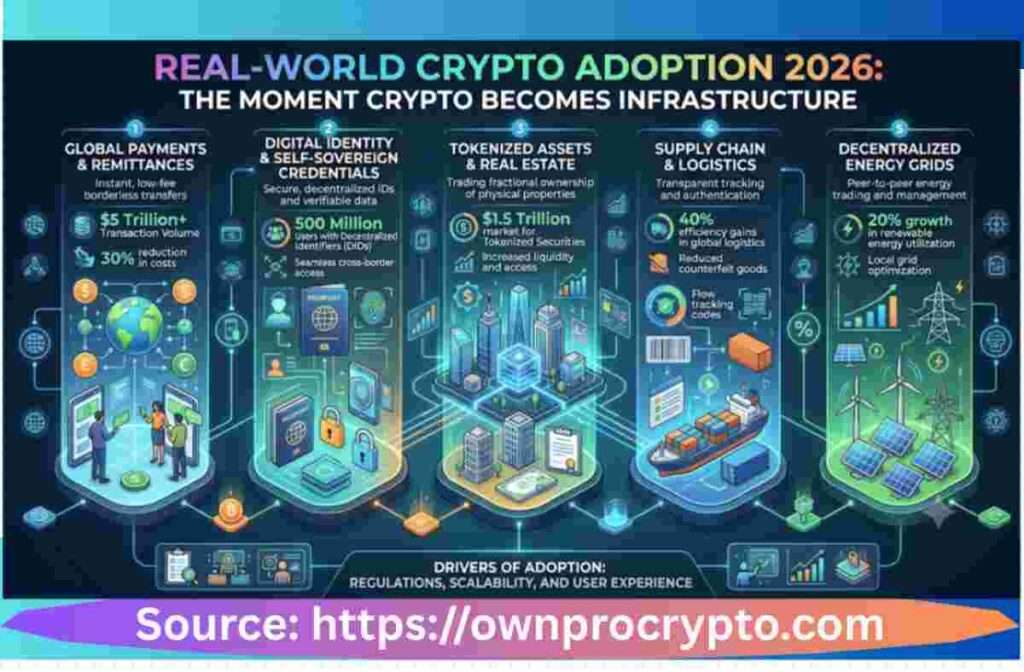
Infographic Image of Real-World Crypto Adoption 2026
Institutional Adoption in 2026

Institutional Adoption in 2026

Institutional adoption is increasingly focused on financial instruments that fit existing capital-market workflows. Asset managers, banks, custodians, exchanges, fintech companies and investment firms are exploring tokenization for settlement efficiency, digital distribution, operational automation, collateral workflows and selected financial products.

What Institutions Are Actually Looking For

  • Reliable legal rights and documentation
  • Regulated issuance and transfer mechanisms
  • Qualified custody and operational controls
  • Accurate valuation and asset data
  • Predictable settlement
  • Controlled investor access
  • Auditability and reporting
  • Redemption and liquidity mechanisms
Underlying Asset
Legal Structure
Asset Verification
Token Issuance
Compliance Controls
Custody & Settlement
Secondary Market
Redemption
Institutional principle: the market is not simply about putting assets on-chain. It is about connecting blockchain representations with existing legal, financial and operational systems.

Institutional Adoption by Industry

Industry Potential RWA Use Key Requirement
Banking & capital markets Issuance, settlement, collateral and selected financial instruments. Regulatory permissions and integration with existing infrastructure.
Asset management Tokenized funds, private-market interests and digital distribution. Investor eligibility, custody and fund administration.
Private markets Digital ownership records and coordinated investor workflows. Legal rights, transfer controls and realistic liquidity.
Real estate Defined ownership or economic interests represented digitally. Property law, securities rules, servicing and valuation.
Treasury & fixed income Tokenized government securities and cash-management products. Custody, settlement and legal recognition.
Corporate treasury Liquidity management, collateral and programmable workflows. Clear operational benefit and reliable digital settlement.

Institutional Adoption Framework

Adoption Layer Institutional Question Key Requirement
Asset What economic or ownership interest is represented? Clear legal definition.
Issuance How is the digital asset created and distributed? Controlled issuance process.
Identity Who can hold or transfer the asset? Identity and eligibility controls.
Compliance Which regulatory obligations apply? Jurisdiction-aware controls.
Custody How are institutional holdings protected? Qualified custody and key management.
Settlement How are transactions completed? Reliable settlement infrastructure.
Reporting How are transactions and holdings documented? Audit-ready records.

Experimentation vs Scaled Adoption

A pilot demonstrates technical feasibility. Sustained institutional adoption requires repeatable issuance, legal certainty, operational integration, reliable custody, sufficient demand and a lifecycle that can function beyond a single demonstration.

This Image explaining about RWA Tokenization: Real Assets, Real Yield in 2026
Tokenized Asset Categories

Leading Tokenized Asset Categories

Different asset classes are developing at different speeds because the economic and legal properties of the underlying assets are different. Government securities have comparatively standardized characteristics, while private credit and real estate depend more heavily on off-chain documentation, servicing, valuation and legal enforcement.

Tokenized Treasuries & Money-Market Products

Tokenized government securities and money-market products remain among the more mature institutional RWA categories. CoinGecko’s Q1 2026 data showed tokenized Treasuries reaching approximately $13.0 billion within its dataset and representing roughly two-thirds of tokenized RWA market capitalization.

Treasuries became an early institutional use case because the underlying instruments have established financial markets, relatively transparent valuation, familiar risk characteristics and existing institutional demand.

What Tokenization Does Not Change

Tokenization does not eliminate the underlying interest-rate, issuer, custody, legal or redemption risks of the financial product. The blockchain representation adds infrastructure; it does not replace the underlying economic structure.

Tokenized Commodities

Tokenized commodities have become another significant RWA segment, with gold-backed products accounting for much of the category’s reported growth. CoinGecko reported tokenized commodities at approximately $5.55 billion at the end of Q1 2026 within its dataset.

Commodity tokens connect blockchain settlement and digital ownership records with assets whose value exists outside the blockchain. Their credibility therefore depends heavily on custody, reserves, redemption and verification.

Commodity Verification Chain

Physical Commodity
Custodian / Vault
Reserve Evidence
Issuer
Blockchain Token
Redemption

Private Credit & Debt

Private credit is an important RWA category because tokenization can connect private lending structures with programmable settlement and digital ownership records. However, private credit is harder to measure than publicly traded assets because underlying loans are private and platform structures differ.

  • Credit underwriting remains central.
  • Loan documentation remains legally important.
  • Valuation may be less frequent.
  • Secondary markets can be limited.
  • Default and servicing risk remain off-chain economic realities.

Tokenization can improve the representation and movement of claims, but it does not transform private credit into risk-free or instantly liquid capital.

Tokenized Equities, Funds & ETFs

Tokenized equities and fund products expanded during 2025–2026, but their legal structure varies considerably. Some products represent direct securities, while others provide contractual or synthetic exposure.

Why Structure Matters

Question Why It Matters
What does the token represent? Determines the holder’s economic and legal rights.
Who owns the underlying asset? Determines custody and insolvency exposure.
Can the token be transferred? Determines practical secondary-market utility.
Who can hold it? Investor eligibility can restrict distribution.
How does redemption work? Determines how digital exposure connects to the underlying asset.

Real Estate & Other Private Assets

Real estate, private equity and other physical or privately held assets remain attractive tokenization candidates because they can benefit from digital recordkeeping and fractional structures. They also carry strong dependencies on local law, asset servicing, valuation and off-chain administration.

A blockchain token cannot independently transfer legal title to real property unless the relevant legal and administrative systems recognize that structure. Property tokenization should therefore be analyzed as a combined legal, financial and technical system.

Category Comparison

Asset Category Primary Institutional Use Key Advantage Major Constraint
Government securities Treasury and liquidity management Established financial instrument Regulatory and custody requirements
Funds Digital distribution and administration Programmable ownership records Investor eligibility and transfer controls
Private credit Digital representation of credit interests Potential workflow automation Credit, servicing and liquidity risk
Real estate Digital representation of property interests Potentially granular ownership structures Property law and limited liquidity
Commodities Digital ownership or claims Programmable transfer records Custody and redemption verification
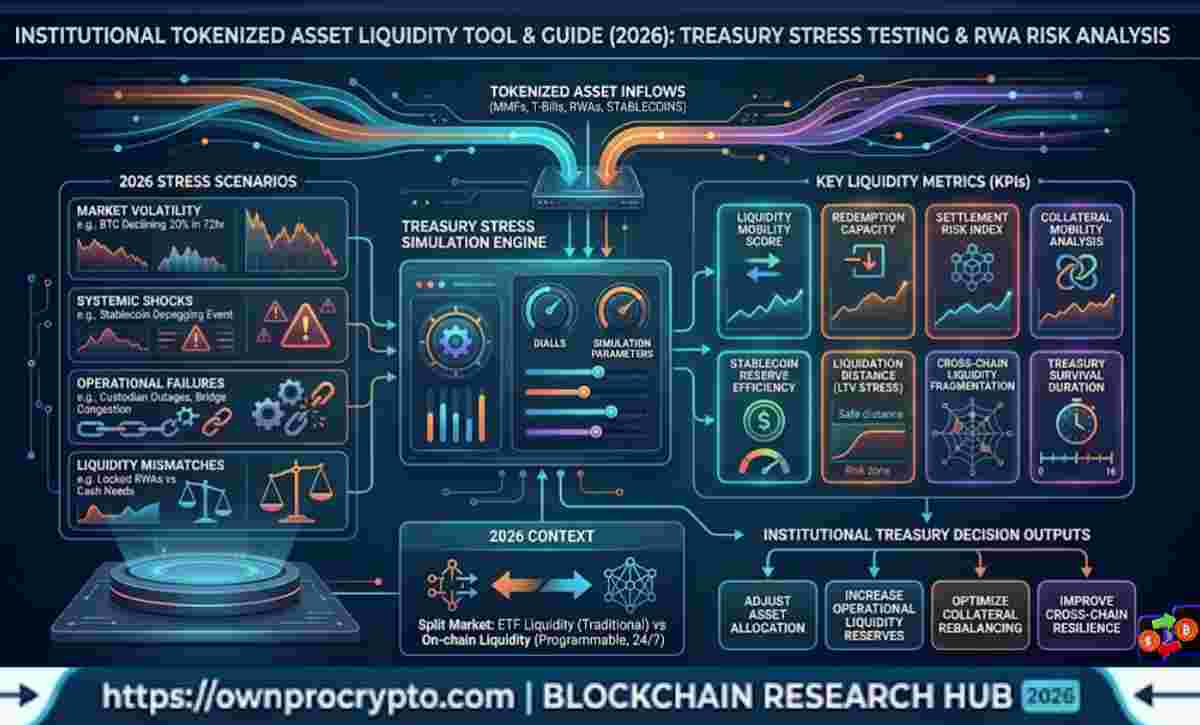
Infographic of Institutional Tokenized Asset Liquidity Tool & Guide (2026)
RWA Market Structure, Activity & Liquidity

RWA Market Structure, Activity & Liquidity

The institutional RWA ecosystem is better understood as a connected market than as a single product category. Issuers, investors, infrastructure providers, custodians, compliance systems, settlement networks and redemption mechanisms all contribute to the final market structure.

Issuers

  • Funds
  • Banks
  • Fintechs
  • Asset originators

Investors

  • Institutions
  • Funds
  • Family offices
  • Eligible private investors

Infrastructure

  • Custody
  • Compliance
  • Settlement
  • Market infrastructure

Institutional RWA Infrastructure Layers

  1. Asset origination
  2. Legal structuring
  3. Verification & data
  4. Token issuance
  5. Identity & compliance
  6. Custody
  7. Settlement
  8. Distribution
  9. Secondary liquidity
  10. Servicing & redemption

Tokenized Value vs Actual Market Activity

One of the most important findings in 2026 RWA research is that headline asset value should not automatically be interpreted as active market liquidity. A token can have substantial represented value while experiencing limited secondary transfers.

Important distinction: technical transferability is not the same as practical liquidity. Buyers, sellers, investor eligibility, pricing, market venues, redemption and market depth still determine whether an asset can realistically be exited.

Four Different Market Questions

Metric Question What It Shows
Value How much asset value is represented? Scale of the tokenized asset base.
Holders How broadly is ownership distributed? Distribution of ownership.
Transfers How frequently does the asset actually move? Observed transaction activity.
Liquidity Can holders realistically enter or exit positions? Practical market usability.

Concentration Matters

A 2026 tokenization analysis based on RWA.xyz data reported significant concentration of value among a relatively small number of assets and highlighted limited weekly activity across a substantial portion of tokenized asset value. This reinforces the need to distinguish market size from actual secondary-market activity.

Liquidity Test

When assessing a tokenized asset, ask four separate questions: who can hold it, who can transfer it, where can it trade, and how can it be redeemed? A positive answer to only the technical transfer question does not establish a functioning liquid market.

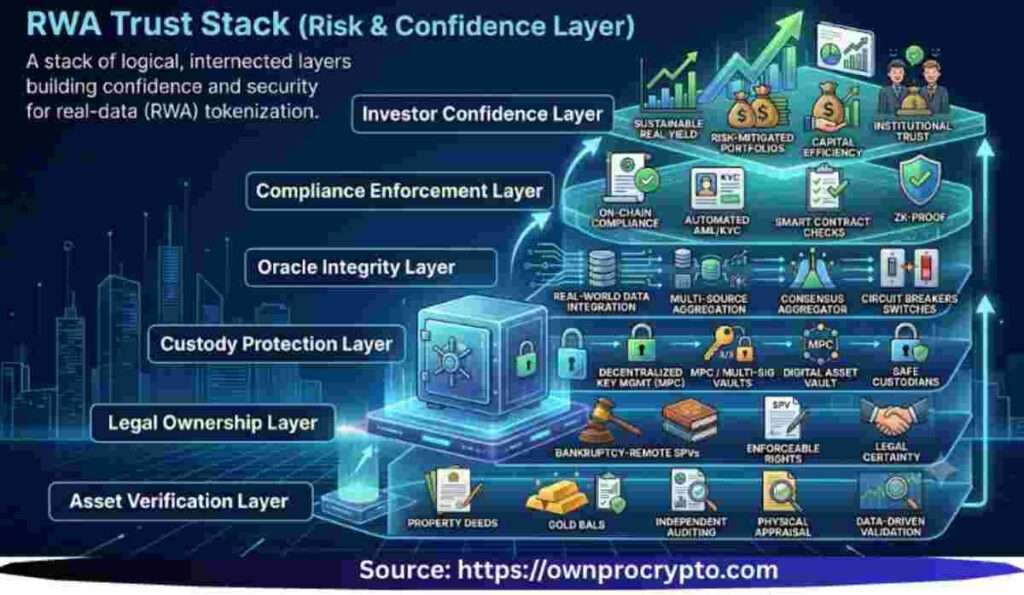
Infographic of RWA Trust Stack- Risk & Confidence Layer (2026)
Institutional RWA Infrastructure


Institutional RWA Infrastructure & Adoption Drivers

Institutional RWA adoption depends on infrastructure that connects blockchain networks with conventional financial operations. The market opportunity is therefore broader than token issuance: custody, identity, compliance, valuation, settlement, accounting, reporting, servicing and redemption all have to operate together.

Core Institutional Infrastructure

Institutional CustodyControls for safeguarding digital assets, private keys, permissions and institutional holdings.
Identity & EligibilitySystems that determine who can access, hold or transfer restricted tokenized assets.
Compliance ControlsTransfer restrictions, jurisdiction controls, investor requirements and transaction monitoring.
Asset & Market DataReliable information for asset verification, pricing, valuation and ongoing monitoring.
SettlementInfrastructure connecting digital asset transfers with payments and institutional settlement processes.
Accounting & ReconciliationRecords that connect blockchain activity with institutional books, reporting and audit processes.
Secondary MarketsTrading venues, eligible counterparties and market infrastructure for transferable assets.
Redemption & ServicingProcesses that connect the tokenized representation back to the underlying economic asset.

What Is Driving RWA Adoption?

1. Settlement Efficiency

Digital settlement can potentially reduce reconciliation steps and shorten certain transaction workflows. For institutional markets, the value is less about simply making transactions faster and more about coordinating issuance, transfer, compliance, custody and settlement.

2. Programmable Asset Operations

Tokenized assets can embed selected operational rules into digital workflows. Depending on the asset and legal structure, these may support transfer restrictions, eligibility checks, distribution logic, reporting events and administrative processes.

3. Improved Market Transparency

Shared transaction records can provide authorized participants with a more consistent view of asset movements and ownership events. The benefit depends on data quality, system design and the permissions applied to participants.

4. Digital Capital-Market Access

Tokenization can connect traditionally fragmented asset processes with digital-market infrastructure. This is particularly relevant where institutions need programmable settlement, automated servicing or integration with blockchain-based financial applications.

5. Fractional Ownership Structures

Some tokenization models can divide economic interests into smaller digital units. Whether fractionalization creates meaningful market access depends on securities law, transfer restrictions, investor eligibility, liquidity, custody arrangements and the legal rights attached to each token.

6. Institutional Operational Automation

Financial institutions are evaluating digital infrastructure not only for trading but also for issuance, reconciliation, reporting, collateral management and post-trade operations.

7. Integration With Existing Financial Infrastructure

Adoption is more practical when tokenized assets can connect with existing custody systems, compliance processes, payment rails, accounting systems and reporting infrastructure. Interoperability is therefore an adoption requirement rather than an optional feature.

Traditional Finance vs Tokenized Workflows

Area Traditional Workflow Tokenized Workflow
Ownership records Multiple institutional systems. Blockchain-based digital records with defined permissions.
Settlement May involve multiple intermediaries. Can be coordinated through digital settlement infrastructure.
Compliance Separate operational controls. Can incorporate programmable transfer controls.
Reporting Reconciliation across systems. Potentially more coordinated digital records.
Automation Dependent on existing financial software. Can incorporate smart-contract logic.

Related OwnProCrypto Research

For the technical architecture and lifecycle of institutional RWA tokenization, see the RWA Tokenization Guide 2026.

Infographic of Crypto Risk Fingerprint Tool — Market, Liquidity, Tokenomics, Protocol & Concentration Risk 2026
RWA Adoption Barriers, Regulation & Risk

RWA Adoption Barriers, Regulation & Institutional Risk

Tokenization can introduce new financial infrastructure, but it does not remove the legal, market or operational constraints attached to the underlying asset. Institutional deployment therefore depends on evaluating the token, the underlying asset and the surrounding legal and operational system together.

What Is Slowing RWA Adoption?

1. Regulatory Fragmentation

Tokenized assets can cross technological and jurisdictional boundaries while remaining subject to local financial laws. Different definitions, licensing requirements, investor rules and reporting obligations can complicate institutional deployment.

2. Legal Recognition

A token is not automatically equivalent to ownership of the underlying asset. Institutions must establish precisely what legal right the digital representation conveys and how that right is enforced.

3. Liquidity Limitations

Tokenization can make an asset easier to transfer digitally, but it does not guarantee a liquid secondary market. Market makers, eligible participants, venues and demand remain important.

4. Interoperability

Institutions may operate across multiple custody systems, blockchains, financial platforms and compliance environments. Limited interoperability can reduce the operational benefits of tokenization.

5. Valuation & Data Quality

The tokenization layer does not eliminate valuation problems. Private assets, property, credit instruments and other non-public markets can still require external data, independent valuation and ongoing monitoring.

6. Custody & Operational Security

Institutional adoption requires controls around private keys, permissions, transaction authorization, recovery, segregation of duties and operational continuity.

Market-development constraint: a tokenized asset can be technically transferable while remaining legally restricted, operationally complex or economically illiquid.

Top Market Challenges

Challenge Potential Market Effect Institutional Response
Regulatory uncertainty Slower deployment. Jurisdiction-specific legal review.
Low secondary liquidity Limited market efficiency. Liquidity and venue assessment.
Interoperability gaps Higher operational complexity. Standards and integration planning.
Custody risk Operational and asset-security exposure. Institutional custody controls.
Data quality Incorrect valuation or reporting. Independent data validation.

Institutional RWA Risk Framework

  • Underlying asset risk
  • Credit and counterparty risk
  • Market and interest-rate risk
  • Liquidity and redemption risk
  • Legal and enforceability risk
  • Regulatory and jurisdiction risk
  • Custody and key-management risk
  • Smart-contract and technology risk
  • Oracle and external-data risk
  • Operational and business-continuity risk
  • Interoperability and integration risk
  • Reporting and reconciliation risk

Regulation & Legal Structure

RWA regulation differs substantially by jurisdiction and by the legal nature of the underlying asset. A token may be treated differently depending on whether it represents a security, fund interest, debt claim, commodity exposure, property interest or another contractual right.

Legal principle: blockchain representation does not independently determine ownership. The enforceable legal relationship between the holder, issuer, custodian and underlying asset must be established separately.

Questions Institutions Should Establish

  • What exact legal right does the token represent?
  • Who legally owns the underlying asset?
  • What happens if the issuer becomes insolvent?
  • Who controls custody of the underlying asset?
  • Which investors are eligible to hold or transfer the token?
  • Which jurisdiction governs the contractual relationship?
  • How does redemption work?
  • Which regulator or regulatory framework applies?
Institutional evaluation principle: the strongest analysis treats technology, legal rights, custody, regulation, liquidity and the underlying asset as one connected system.
Blockchain-as-a-Service (BaaS)- Platforms, Providers, Market Size, Trends & 2033 ForecastBlockchain-as-a-Service (BaaS)- Platforms, Providers, Market Size, Trends & 2033 Forecast
Blockchain-as-a-Service (BaaS)

RWA Market Outlook Through 2030

The next stage of RWA development is likely to focus less on proving that assets can be tokenized and more on determining whether tokenized infrastructure can operate reliably at institutional scale. The relevant question is increasingly whether the technology improves a real financial workflow.

2026 Production PilotsInstitutional pilots and selected live deployments establish practical operating models.
2027–2028 Infrastructure IntegrationCustody, settlement, compliance and asset coverage become increasingly integrated.
2029 Multi-Asset ConnectivityInteroperability and standardized institutional workflows become more important.
2030 Institutional ScaleMarket maturity can be assessed through repeat usage, liquidity and operational standardization.

From Experiments to Financial Infrastructure

A mature tokenization market requires more than successful pilots. Legal clarity, operational reliability, institutional custody, standardized reporting, sustained demand and functioning liquidity mechanisms all matter.

Greater Integration With Existing Markets

Tokenization is more likely to expand through integration with existing financial infrastructure than through an immediate replacement of conventional markets. Custody, settlement, compliance, payments and reporting systems will remain important components of the institutional environment.

More Selective Asset Tokenization

Not every asset benefits equally from tokenization. Institutions are likely to focus on assets and workflows where digital representation provides measurable improvements in settlement, administration, transparency, distribution or programmability.

Increasing Importance of Legal & Compliance Infrastructure

As institutional participation grows, the legal wrapper around tokenized assets becomes increasingly important. Technology can record and automate transactions, but enforceable ownership, investor rights, regulatory permissions and contractual obligations remain fundamental.

RWA Market Development Roadmap

Period Market Development Focus Key Indicator
2026 Institutional pilots and production deployments. Quality of live implementations.
2027–2028 Infrastructure integration and broader asset coverage. Repeat institutional usage.
2029–2030 Greater interoperability and market integration. Scale, liquidity and operational standardization.
2030 Outlook: structural scenario, not a guaranteed forecast

Actual RWA development will depend on regulation, institutional demand, market liquidity, technology standards, custody infrastructure and the legal treatment of tokenized assets in individual jurisdictions.

How the Industry Is Responding

Standardization

Market participants are developing common approaches for token standards, identity, compliance, custody, settlement and reporting. Standardization can reduce integration costs and make institutional deployment easier across platforms.

Regulated Infrastructure

Financial institutions increasingly require infrastructure that connects blockchain systems with regulated custody, compliance, payment and reporting environments.

Institutional Interoperability

Interoperability becomes more important as tokenized assets move beyond isolated pilots. Institutions need systems capable of coordinating assets, identities, permissions and settlement across different technological environments.

Transparency Around Asset Backing

Tokenized products require credible information about the relationship between the digital representation and the underlying asset. Independent verification, reporting, custody evidence and clear legal documentation can support institutional due diligence.

RWA Market FAQs & Research Resources

RWA Market Basics

What is the RWA market?

The RWA market refers to financial and economic interests connected to real-world assets that are represented or managed through digital-token infrastructure. The legal and economic structure can differ significantly between asset categories.

What assets can be tokenized?

Potential categories include government securities, funds, private credit, real estate interests, commodities and other financial or contractual assets.

Institutional Adoption

Why are institutions interested in tokenized assets?

Institutions may evaluate tokenization for settlement efficiency, programmable workflows, digital distribution, improved data coordination and automation of selected financial processes.

What is preventing faster institutional adoption?

Regulatory fragmentation, legal uncertainty, liquidity limitations, interoperability, custody requirements, data quality and integration costs can all affect deployment decisions.

Market Growth

Is the RWA market growing?

Tokenization activity has expanded across several financial-asset categories, but market estimates differ depending on which assets, jurisdictions and measurement methods are included. Reported tokenized value should therefore be compared using consistent definitions and dates.

Will tokenized assets replace traditional assets?

Tokenization is more likely to complement existing financial infrastructure in the near term. Whether a tokenized structure becomes preferable depends on its legal design, operating costs, liquidity, investor access and institutional requirements.

Risk & Infrastructure

Does tokenization eliminate investment risk?

No. Tokenization changes how an asset can be represented, transferred and administered. It does not remove market, credit, liquidity, legal, counterparty, custody or operational risks associated with the underlying asset.

Why is interoperability important for RWAs?

Institutional portfolios can involve multiple blockchains, custodians, financial platforms, identity systems and compliance environments. Interoperability can reduce fragmentation between these systems.

OwnProCrypto Resources Library

Continue your research through the OwnProCrypto Resources Library, a connected collection of guides and market research covering real-world asset tokenization, institutional portfolios, tokenized securities, infrastructure, adoption and the evolving digital-asset ecosystem. Each resource explores a different layer of the RWA market, allowing readers to move from market data and institutional adoption into tokenization architecture, portfolio strategy, platform selection and broader blockchain adoption.

RWA Tokenization Guide 2026

Explore the legal structures, asset verification, custody, token design, compliance, servicing and secondary-market considerations behind institutional RWA tokenization. Read the RWA Tokenization Guide 2026 →

Best Tokenization Platforms 2026

Compare tokenization infrastructure across enterprise issuance, compliance, custody, token standards, asset management and secondary-market capabilities. Compare Tokenization Platforms →

Real-World Crypto Adoption 2026

Explore how blockchain infrastructure is moving into practical financial and real-world applications, including tokenized assets and institutional use cases. Explore Real-World Crypto Adoption →

Web3 Trends 2026

Review the broader trends shaping tokenization, institutional blockchain adoption, digital financial infrastructure and emerging Web3 markets. Explore Web3 Trends 2026 →

For broader institutional research on tokenization, digital financial infrastructure and the evolution of financial markets, readers can consult the Bank for International Settlements (BIS), which publishes research and analysis on digital assets, tokenized finance and emerging financial-market infrastructure.

Final Institutional RWA Framework

The institutional RWA market is moving from a discussion about whether real-world assets can be tokenized toward a more practical question: whether tokenized infrastructure can deliver measurable operational value at institutional scale.

Settlement efficiency, programmable workflows, digital distribution and coordinated data are among the main potential benefits, while legal certainty, liquidity, custody, regulation and interoperability remain decisive constraints.

The 8-Layer Institutional RWA Framework

  1. Underlying Asset Identify exactly what economic asset or claim is being represented.
  2. Legal Structure Establish the legal rights, ownership relationship and enforceability of the token.
  3. Asset Verification Establish how the underlying asset, reserves, valuation or contractual claim is verified.
  4. Tokenization Define how the digital representation is issued, transferred and technically controlled.
  5. Identity & Compliance Determine who can hold, transfer and interact with the asset under applicable rules.
  6. Custody & Settlement Establish how digital assets, underlying assets and transaction settlement are controlled.
  7. Liquidity & Distribution Evaluate eligible markets, counterparties, transferability, secondary activity and redemption.
  8. Reporting & Lifecycle Maintain valuation, accounting, servicing, audit, reconciliation and ongoing redemption processes.

Key Takeaways for Institutions

  • Tokenization does not automatically create liquidity or legal ownership.
  • Institutional adoption depends on legal, regulatory, custody and operational infrastructure.
  • Settlement efficiency and workflow automation are important potential benefits.
  • Different RWA categories have materially different risk and operational profiles.
  • Interoperability becomes increasingly important as institutional deployments expand.
  • Market maturity should be assessed using sustained adoption rather than announcements alone.
Final Takeaway

The strongest RWA opportunities are unlikely to be determined by tokenization alone. Institutions need to evaluate the underlying asset, legal rights, market structure, technology, compliance requirements, custody model, liquidity and settlement process together.

In that framework, tokenization is not the destination. It is one layer of a broader financial infrastructure system.

Important Disclaimer

Research and educational information only. This report is provided for informational and educational purposes and should not be treated as financial, investment, legal, tax, accounting or regulatory advice.

Tokenized real-world assets can involve securities, commodities, private credit, funds, real estate interests and other regulated or contractually defined financial exposures. The legal treatment, investor eligibility, transferability, custody requirements and regulatory obligations can vary materially between jurisdictions and products.

Market-size figures and activity measurements are presented according to the methodology and measurement date of the cited research source. Different providers may use different definitions of tokenized RWA, active value, market capitalization and trading activity. Figures should therefore not be compared without checking their underlying methodology.

Forward-looking statements and market-development scenarios through 2030 are not guarantees of future outcomes. Actual market development may differ because of regulation, institutional demand, liquidity, technology standards, custody infrastructure, legal treatment, macroeconomic conditions and other factors.

Sources & Methodology Note

This report distinguishes observed market activity from forward-looking expectations. Market-size figures should only be compared when their definitions, measurement dates, asset categories and methodologies are materially consistent.

Readers should verify material claims against primary documentation, regulatory disclosures and current market data before making financial, legal or business decisions.

Looking for another topic? Search the OwnProCrypto research archive.
Comments
💬 What’s Your Take? Leave a Comment Below 0
← RWA Protocol Comparison (2026): Ondo vs Centrifuge vs Maple Finance Explained
RWA Tokenization Trust 2026: Legal, Data & Technical Trust Framework – (L × D × T Explained) →
🛠 Explore Tools ▼
📚 Explore Crypto Research Select a research category