
Search by title, topic or phrase
Use our Crypto Search Engine 🔍 to find the topics and keywords you're looking for.

Table of Contents
ToggleAn RWA Protocols Comparison reveals how these platforms are becoming the backbone of blockchain-based finance by connecting traditional assets such as US Treasuries, private credit, real estate, and other Real World Assets (RWAs) with decentralized networks. Through a comprehensive RWA Protocols Comparison, it becomes clear that instead of simply tokenizing assets, these protocols provide the core infrastructure for issuing, managing, financing, and trading tokenized assets on-chain.
As institutional adoption accelerates, protocols such as Ondo Finance, Centrifuge, and Maple Finance are leading the development of digital capital markets. Each protocol focuses on different areas of the RWA ecosystem, including tokenized Treasury products, private credit, institutional lending, and blockchain-based yield generation.
This guide compares the leading RWA Protocols, explains how they work, highlights their strengths and limitations, and helps investors understand which protocol is best suited for different investment strategies and Real World Asset opportunities.
RWA Protocols (Real World Asset Protocols) are blockchain-based platforms that enable traditional financial assets to interact with decentralized networks. They provide the infrastructure required to tokenize, manage, finance, and transfer assets such as government bonds, private credit, real estate, invoices, commodities, and other off-chain assets.
Unlike tokenization platforms that primarily create digital representations of assets, RWA protocols often provide complete financial ecosystems. These ecosystems may include lending markets, liquidity solutions, collateral management, governance systems, compliance tools, and integration with decentralized finance (DeFi).
The rapid growth of tokenized assets has positioned RWA protocols as one of the most important sectors within blockchain finance, helping bridge traditional capital markets with programmable digital infrastructure.
| Feature | Traditional Finance | RWA Protocols |
|---|---|---|
| Asset Ownership | Traditional financial records | Blockchain-based digital ownership |
| Settlement | Business hours and intermediaries | Programmable blockchain settlement |
| Transparency | Institution-controlled reporting | On-chain transaction visibility |
| Accessibility | Institution dependent | Global blockchain infrastructure |
| Automation | Manual operational processes | Smart contract automation |
| Composability | Limited integration | DeFi ecosystem compatibility |
| Term | Description |
|---|---|
| RWA | Real World Assets represented on blockchain networks. |
| Tokenization | Converting ownership or financial rights into digital blockchain tokens. |
| Protocol | A decentralized blockchain system that provides financial infrastructure. |
| Smart Contract | Blockchain software that automates transactions and financial rules. |
| On-Chain Finance | Financial activities executed using blockchain infrastructure. |
| DeFi | Decentralized Finance applications operating without traditional intermediaries. |
Traditional Asset
      ↓
Asset Verification
      ↓
Tokenization
      ↓
RWA Protocol
      ↓
Blockchain Investors
Although every RWA Protocol uses its own architecture, most follow a similar lifecycle for bringing traditional assets on-chain. The process starts with identifying a real-world asset, verifying ownership, creating blockchain representations, and allowing investors to interact with those assets through decentralized infrastructure.
The goal is not simply tokenization, but building an ecosystem where assets can be traded, financed, used as collateral, or integrated into decentralized finance (DeFi).
| Step | Process | Purpose |
|---|---|---|
| 1 | Asset Selection | Identify eligible real-world assets such as Treasuries, private credit, or real estate. |
| 2 | Legal Structuring | Create ownership and compliance framework. |
| 3 | Asset Tokenization | Issue blockchain tokens representing the asset. |
| 4 | Protocol Integration | Connect tokens with lending, liquidity, or trading markets. |
| 5 | Investor Participation | Users purchase, lend, borrow, or hold tokenized assets. |
| 6 | Yield & Asset Management | Income, repayments, and governance are managed on-chain. |
| Traditional Process | Blockchain Process |
|---|---|
| Asset Issuer | Token Issuer |
| Legal Ownership | Digital Ownership Record |
| Bank Settlement | Blockchain Settlement |
| Manual Administration | Smart Contract Automation |
| Traditional Investors | Global Digital Investors |
Real-World Asset
↓
Legal Verification
↓
Blockchain Token
↓
RWA Protocol
↓
Lending • Trading • Yield • DeFi

The Real World Asset ecosystem includes multiple protocols specializing in different asset classes. Some focus on tokenized US Treasuries, while others concentrate on private credit, institutional lending, or broader asset tokenization infrastructure.
| Protocol | Primary Focus | Main Asset Types | Best For |
|---|---|---|---|
| Ondo Finance | Tokenized Treasuries | US Treasuries & Fixed Income | Institutional yield exposure |
| Centrifuge | Private Credit | Invoices, Credit, Real Assets | Business financing |
| Maple Finance | Institutional Lending | Private Credit & Loans | Professional borrowers |
| MakerDAO | Collateralized Lending | Multi-Asset RWAs | Stablecoin ecosystem |
| Plume | RWA Infrastructure | Multiple Asset Classes | Asset tokenization ecosystem |
| OpenEden | Treasury Products | US Treasury Bills | Digital yield products |
| Backed | Tokenized Securities | Stocks & ETFs | Regulated digital assets |
| Ethena | Yield Infrastructure | Digital Dollar Strategies | Blockchain-native yield |
| Protocol | Yield | Institutional Focus | DeFi Integration | RWA Diversity |
|---|---|---|---|---|
| Ondo | ★★★★★ | ★★★★★ | ★★★★☆ | ★★★☆☆ |
| Centrifuge | ★★★★☆ | ★★★★☆ | ★★★★★ | ★★★★★ |
| Maple | ★★★★☆ | ★★★★★ | ★★★★☆ | ★★★☆☆ |
| MakerDAO | ★★★★☆ | ★★★★☆ | ★★★★★ | ★★★★☆ |
| Plume | ★★★☆☆ | ★★★★☆ | ★★★★★ | ★★★★★ |
| If Your Goal Is… | Recommended Protocol |
|---|---|
| Government-backed yield | Ondo Finance |
| Private credit investing | Centrifuge |
| Institutional lending | Maple Finance |
| Broad RWA exposure | MakerDAO |
| Building tokenized assets | Plume |
Ondo Finance, Centrifuge, and Maple Finance are among the most recognized RWA protocols, but each serves a different role within blockchain finance. Rather than competing directly, they specialize in different asset classes and investor needs.
| Feature | Ondo Finance | Centrifuge | Maple Finance |
|---|---|---|---|
| Primary Focus | Tokenized US Treasuries | Private Credit | Institutional Lending |
| Main Users | Investors | Businesses & Investors | Institutions |
| Core Asset | Government Securities | Business Assets | Private Loans |
| Yield Source | Treasury Returns | Credit Markets | Institutional Lending |
| DeFi Compatibility | High | High | Medium |
| Risk Profile | Lower Relative Risk | Moderate | Moderate |
| Protocol | Major Strength | Best Investor Type |
|---|---|---|
| Ondo | Government-backed digital yield products | Conservative income investors |
| Centrifuge | Private credit tokenization | Alternative asset investors |
| Maple | Institutional credit infrastructure | Professional market participants |
Need Treasury Yield?
        │
      YES ─────────► Ondo Finance
        │
       NO
        │
Need Private Credit?
        │
      YES ─────────► Centrifuge
        │
       NO
        │
Institutional Lending?
        │
      YES ─────────► Maple Finance
Ondo Finance is best suited for investors seeking exposure to tokenized US Treasuries and blockchain-based fixed-income products.
Centrifuge specializes in bringing private credit and business financing on-chain, making it attractive for investors interested in diversified Real World Assets.
Maple Finance focuses on institutional lending and professional credit markets, providing infrastructure for large-scale blockchain finance.
RWA Protocols are changing how traditional financial assets interact with blockchain networks. By combining tokenization, smart contracts, and decentralized infrastructure, these protocols make Real World Assets more accessible, transparent, and programmable for both institutional and retail participants.
Beyond digitizing ownership, RWA protocols create new opportunities for liquidity, lending, collateralization, and cross-border investment while reducing operational complexity.
| Benefit | How It Helps Investors |
|---|---|
| Fractional Ownership | Allows investors to own portions of high-value assets. |
| Improved Liquidity | Creates additional trading opportunities for traditionally illiquid assets. |
| Global Accessibility | Eligible investors can access digital assets through blockchain networks. |
| Programmable Finance | Smart contracts automate financial operations and settlements. |
| Greater Transparency | Blockchain records improve transaction visibility and auditability. |
| Institutional Integration | Connects traditional finance with decentralized financial infrastructure. |
| Category | Traditional Markets | RWA Protocols |
|---|---|---|
| Ownership | Centralized records | Blockchain-based records |
| Settlement | Business-day processing | Near real-time blockchain settlement |
| Transparency | Limited public visibility | On-chain transaction history |
| Automation | Manual workflows | Smart contract execution |
| Accessibility | Jurisdiction dependent | Digital-first infrastructure |
| Capital Efficiency | Often fragmented | Programmable asset utilization |
| Institutional Need | Protocol Advantage |
|---|---|
| Operational Efficiency | Automated workflows reduce manual administration. |
| Digital Asset Expansion | Supports tokenized investment products. |
| Settlement Modernization | Blockchain streamlines transaction processing. |
| Liquidity Management | Improves access to tokenized capital markets. |
| Compliance Automation | Smart contracts assist with programmable rules. |
Real-World Assets
        ↓
Tokenization
        ↓
RWA Protocol
        ↓
Liquidity • Yield • Lending • Trading 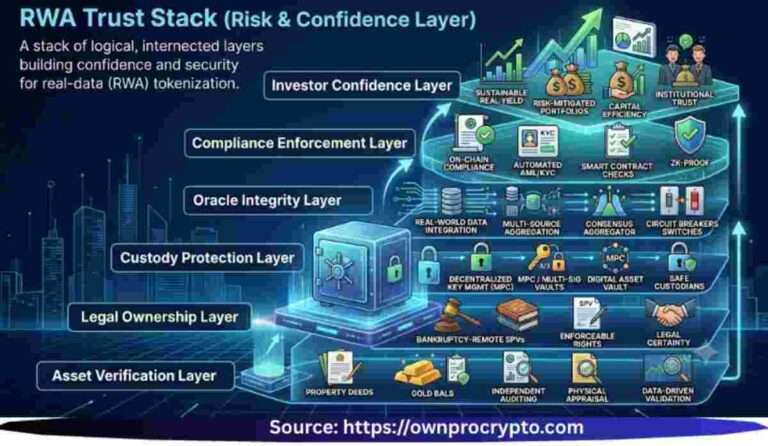
Although RWA Protocols introduce significant innovation, they also create new legal, technical, and operational challenges. Investors should understand both blockchain-specific risks and traditional financial risks before participating in tokenized asset ecosystems.
The level of risk varies depending on the protocol, underlying assets, governance structure, regulatory environment, and smart contract implementation.
| Risk | Potential Impact | Possible Mitigation |
|---|---|---|
| Regulatory Changes | Compliance requirements may evolve. | Choose regulated or compliant protocols. |
| Smart Contract Risk | Software vulnerabilities could affect protocol operations. | Review security audits and development history. |
| Liquidity Risk | Limited secondary market activity. | Evaluate trading volume and ecosystem maturity. |
| Custody Risk | Underlying assets require secure management. | Verify custodians and legal structure. |
| Counterparty Risk | Dependence on issuers or borrowers. | Review protocol disclosures and asset backing. |
| Technology Risk | Network outages or blockchain failures. | Diversify exposure and monitor infrastructure. |
| Risk Category | Ondo | Centrifuge | Maple |
|---|---|---|---|
| Smart Contracts | Medium | Medium | Medium |
| Credit Exposure | Lower | Higher | Higher |
| Liquidity | Medium | Medium | Medium |
| Regulatory Complexity | Medium | Medium | Medium |
| Underlying Asset Risk | Lower Relative Risk | Moderate | Moderate |
| Challenge | Industry Impact |
|---|---|
| Global Regulations | Different countries apply different compliance rules. |
| Legal Ownership | Clear legal rights must support digital tokens. |
| Cross-Chain Compatibility | Protocols need better interoperability. |
| Institutional Adoption | Large financial firms require proven infrastructure. |
| Investor Education | Users must understand both blockchain and traditional assets. |
| Scalability | Infrastructure must support growing transaction volumes. |
Choose Protocol
        │
        ▼
Review Regulation
        │
        ▼
Analyze Assets
        │
        ▼
Evaluate Risks
        │
        ▼
Invest Responsibly
| Checklist | Why It Matters |
|---|---|
| Research the protocol | Understand its purpose and ecosystem. |
| Review asset backing | Know what supports the tokenized assets. |
| Understand governance | Learn how protocol decisions are made. |
| Read documentation | Understand legal and technical structure. |
| Diversify investments | Reduce concentration risk. |
| Monitor updates | Stay informed about protocol developments. |
Not all RWA Protocols serve the same purpose. Some focus on tokenized US Treasuries, while others specialize in private credit, institutional lending, tokenized securities, or multi-asset infrastructure. Selecting the right protocol depends on your investment objectives, risk tolerance, preferred asset class, and level of blockchain experience.
Instead of looking for a single “best” protocol, investors should evaluate which ecosystem aligns with their financial goals and how each protocol manages security, liquidity, governance, and compliance.
| If You Want… | Recommended Protocol | Why |
|---|---|---|
| Government-backed yield | Ondo Finance | Focuses on tokenized Treasury products. |
| Private credit exposure | Centrifuge | Specializes in real-world credit markets. |
| Institutional lending | Maple Finance | Designed for professional lending infrastructure. |
| Diversified RWA ecosystem | MakerDAO | Supports multiple real-world collateral types. |
| Building tokenized assets | Plume | Infrastructure for RWA developers and issuers. |
| Tokenized securities | Backed | Focuses on regulated financial assets. |
| Evaluation Factor | Questions to Ask |
|---|---|
| Asset Type | What real-world assets does the protocol support? |
| Yield Model | How is investor income generated? |
| Risk Profile | What are the primary investment risks? |
| Governance | How are protocol decisions made? |
| Liquidity | Can assets be easily traded or redeemed? |
| Compliance | Does the protocol follow applicable regulations? |
| Security | Has the protocol undergone security audits? |
| Ecosystem Growth | Is adoption increasing among users and institutions? |
Need Stable Yield?
        │
      YES ─────────► Ondo Finance
        │
       NO
        │
Need Credit Markets?
        │
      YES ─────────► Centrifuge
        │
       NO
        │
Need Institutional Lending?
        │
      YES ─────────► Maple Finance
        │
       NO
        │
Need Broad RWA Exposure?
        │
      YES ─────────► MakerDAO / Plume
| Investor Type | Suggested Starting Point |
|---|---|
| Beginner | Learn how tokenization and RWAs work before selecting a protocol. |
| Income-Focused Investor | Explore Treasury-based RWA ecosystems. |
| Alternative Asset Investor | Research private credit and lending protocols. |
| Institutional User | Evaluate governance, compliance, and custody structure. |
| Developer | Choose protocols with strong infrastructure and APIs. |

The future of RWA Protocols extends beyond simple asset tokenization. These platforms are gradually becoming digital financial infrastructure capable of connecting banks, investment funds, enterprises, and blockchain ecosystems through programmable assets.
As institutional participation increases, RWA protocols are expected to support broader asset classes, improved interoperability, stronger compliance frameworks, and more efficient capital markets.
| Trend | Potential Impact |
|---|---|
| Institutional Adoption | Greater participation from banks and asset managers. |
| Tokenized Treasuries | Continued growth of blockchain-based fixed-income products. |
| Private Credit Expansion | More lending markets moving on-chain. |
| Cross-Chain Infrastructure | Improved interoperability between blockchain ecosystems. |
| Programmable Finance | Automation through smart contracts and digital workflows. |
| Global Regulatory Clarity | Higher confidence for institutional investors. |
| Stage | Market Evolution |
|---|---|
| Asset Tokenization | Creating blockchain representations of traditional assets. |
| Protocol Development | Building financial infrastructure around tokenized assets. |
| Institutional Adoption | Professional investors enter blockchain markets. |
| Digital Capital Markets | Traditional finance and blockchain become increasingly connected. |
| Programmable Economy | Smart contracts automate financial services. |
Traditional Finance
         ↓
Asset Tokenization
        ↓
RWA Protocols│
         ↓
Digital Capital Markets
         ↓
Programmable Global Finance
Real World Asset protocols are helping transform blockchain from a cryptocurrency-focused ecosystem into broader financial infrastructure capable of supporting government securities, private credit, real estate, commodities, investment funds, and institutional financial products.
Rather than replacing traditional finance, RWA protocols are creating a digital bridge that enables established financial assets to participate in modern blockchain ecosystems.
RWA Protocols are becoming one of the fastest-growing segments of blockchain finance by connecting traditional assets with decentralized infrastructure. While every protocol has a different specialization, together they are expanding how investors access government bonds, private credit, institutional lending, and tokenized securities.
Ondo Finance stands out for tokenized Treasury products, Centrifuge leads in private credit, and Maple Finance focuses on institutional lending. Other protocols continue to strengthen the broader Real World Asset ecosystem by supporting additional asset classes and financial services.
The best protocol depends on your investment goals, preferred asset exposure, and risk profile. Understanding each protocol’s strengths, governance, and ecosystem is essential before investing in any blockchain-based financial product.
| Related Article | Internal Linking Purpose |
|---|---|
| Real World Assets (RWA) Explained | Main educational pillar for the entire cluster. |
| Real Estate Tokenization Guide | Property-focused RWA investments. |
| Tokenized US Treasuries Explained | Government-backed yield and fixed-income assets. |
| Tokenized Impact Bonds | ESG and sustainable finance tokenization. |
| Best Tokenization Platforms | Enterprise infrastructure and software comparison. |
| Security Token Offering (STO) Guide | Regulated digital securities and compliance. |
| Asset Tokenization Guide | Foundational explanation of blockchain tokenization. |
│
├── What Are Real World Assets (Pillar)
├── Asset Tokenization Guide
├── Real Estate Tokenization
├── Tokenized US Treasuries
├── Tokenized Impact Bonds
├── RWA Protocol Comparison
├── Best Tokenization Platforms
├── Security Token Offering (STO)
├── Tokenized Bonds
├── Tokenized Commodities
├── Tokenized Funds
├── Tokenized Private Credit
└── RWA Market Size & Trends