
Table of Contents
ToggleThis Institutional Tokenized Asset Liquidity Tool is designed to simulate liquidity stress, collateral mobility, and redemption risk across institutional crypto portfolios built on tokenized assets, RWAs, and onchain treasury systems.
Institutions today allocate capital into tokenized Treasuries, stablecoin reserves, tokenized money market funds, and real-world assets. However, despite growing adoption, the underlying institutional crypto infrastructure remains fragmented across custody, settlement, compliance, and cross-chain execution layers.
This creates a structural gap between capital allocation and operational liquidity — where assets may be digitally accessible but not always instantly movable at scale.
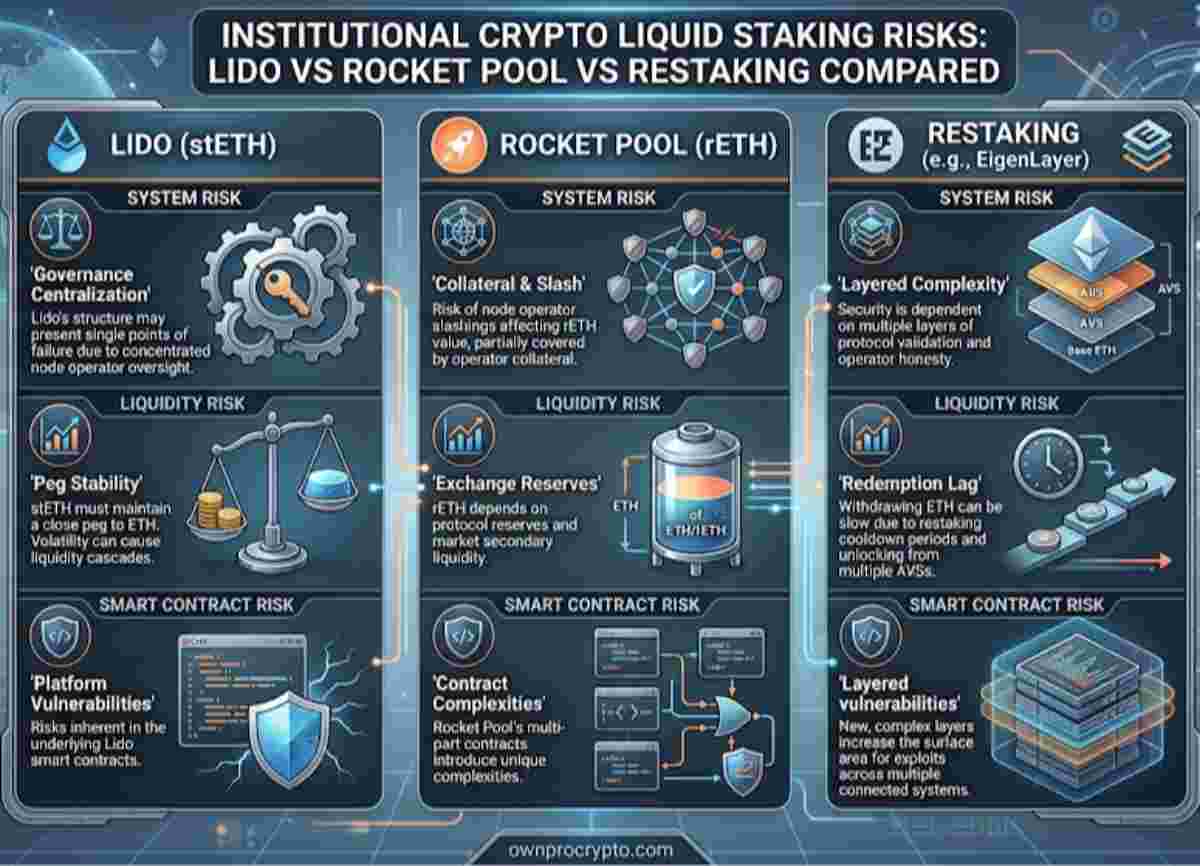
Institutional crypto infrastructure directly determines liquidity efficiency. Even when markets are deep, liquidity can fail at the operational level due to fragmented custody systems, settlement delays, and cross-chain constraints.
This is why institutional liquidity risk is increasingly an infrastructure problem rather than purely a market structure issue.
Problem: Liquidity breakdowns in institutional crypto markets are caused by fragmented infrastructure rather than insufficient demand.
Solution: Unified infrastructure layers are required across custody, compliance, settlement, and collateral mobility systems.
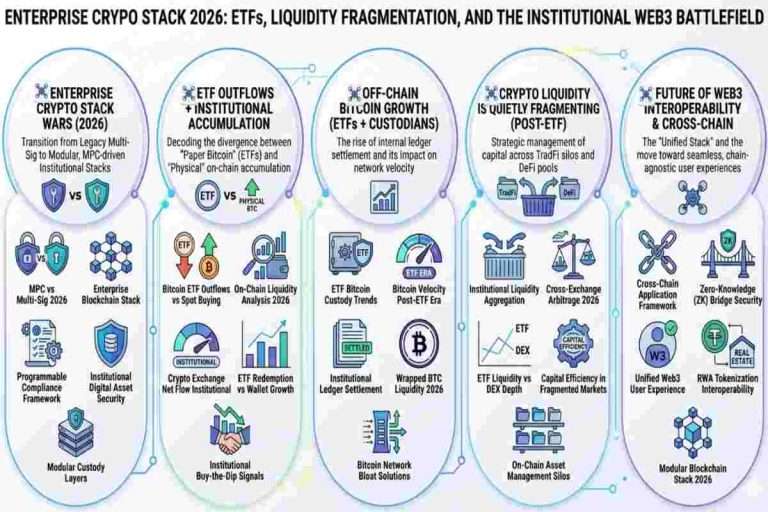
This simulator models real-world institutional stress conditions across the digital asset stack, including:
These variables reflect how institutional crypto infrastructure behaves under real operational constraints in 2026 markets.

Institutional crypto infrastructure consistently breaks across seven key dimensions:
Together, these failures prevent full-scale adoption of RWAs and institutional DeFi systems.
Problem: Institutional crypto systems fail across multiple infrastructure layers simultaneously.
Solution: A unified institutional crypto operating system is required.
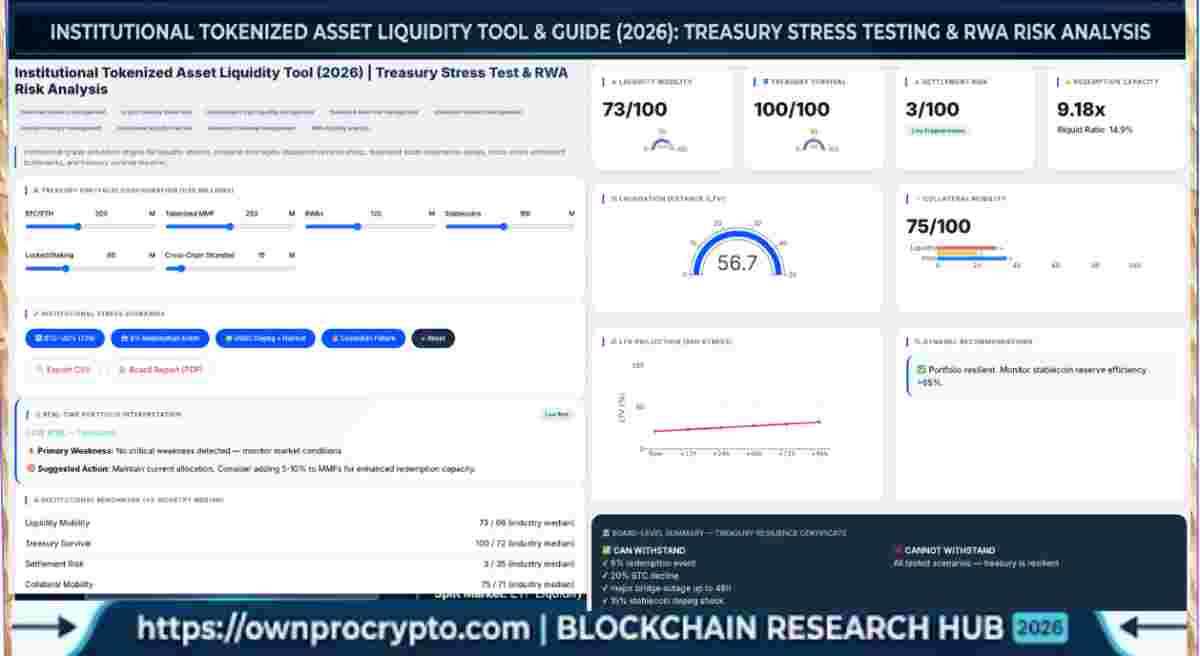
Step 1: Configure Institutional Treasury Exposure Input your allocations across BTC/ETH, tokenized MMFs, tokenized RWAs, and stablecoin reserves. The tool calculates total institutional AUM and identifies cross-chain stranded liquidity within your current treasury structure.
Step 2: Run Institutional Stress Scenarios Select a simulation to model operational risk, such as a BTC price decline (-20%), stablecoin depeg, or custodian outages. These scenarios test how your liquidity holds up under intense market volatility.
Step 3: Analyze Liquidity Mobility Score The tool generates a liquidity mobility score to estimate how efficiently capital moves within 24 hours. It evaluates tokenized collateral portability and operational settlement flexibility to ensure capital isn’t “trapped” during a crisis.
Step 4: Review Treasury Survival Metrics Measure your treasury survival score against redemption pressure and liquidity fragmentation. This determines if your reserves can remain operational during collateral shocks and unexpected settlement delays.
Step 5: Evaluate Settlement & Collateral Risk Analyze your settlement risk index and liquidation distance (LTV). This identifies custodial dependency and cross-chain settlement risks, allowing you to redesign infrastructure around flexible liquidity systems.
Step 6: Generate Treasury Recommendations The simulator suggests improvements, such as increasing tokenized MMF allocation or optimizing treasury reserve structure. This allows teams to model improvements to collateral portability before real stress occurs.
Step 7: Export Institutional Treasury Reports Generate PDF board reports or treasury stress summaries. These are designed for digital asset governance frameworks, liquidity planning, and institutional treasury committee reviews.
Institutional treasury teams, RWA allocators, and digital asset managers use stress simulation frameworks like this to evaluate:
This reflects the shift from static portfolio valuation to infrastructure-aware treasury management.
This tool is designed for:
Its purpose is to evaluate operational liquidity resilience, not just market exposure.
Institutional crypto markets are no longer constrained by asset availability or investment demand — they are constrained by infrastructure design limitations.
As tokenized assets and RWAs scale, institutional success will depend on how effectively systems unify:
Until this convergence happens, institutional crypto infrastructure will remain structurally incomplete.
Institutions can reduce custody and compliance fragmentation by implementing unified digital asset infrastructure that standardizes policy enforcement across multiple custodians, chains, and execution environments.
Problem: Custody and compliance systems operate in silos across different blockchain networks and service providers.
Solution: A unified infrastructure layer is required to enforce real-time compliance and custody rules across all asset movements.
Liquidity resilience improves when institutions deploy automated secondary market mechanisms and diversified redemption pathways beyond issuer-dependent settlement.
Problem: Tokenized treasury liquidity depends heavily on issuer redemptions, creating bottlenecks during stress events.
Solution: Secondary liquidity systems and automated market-making layers improve continuous capital availability.
Cross-chain collateral restrictions reduce capital efficiency by delaying settlement, increasing operational risk, and preventing real-time portfolio rebalancing across protocols.
Problem: Bridging and settlement delays trap collateral across isolated blockchain networks.
Solution: Interoperable cross-chain infrastructure enables faster collateral mobility and improved capital utilization.
Legal uncertainty arises because tokenized assets often separate onchain representation from underlying legal ownership frameworks across jurisdictions.
Problem: Ownership rights of tokenized assets are not consistently enforceable across global legal systems.
Solution: Standardized legal wrappers and jurisdiction-aligned frameworks are required for enforceability.
Institutions can close reporting gaps by integrating blockchain data directly into enterprise accounting systems through automated reconciliation and real-time ledger synchronization.
Problem: Digital asset data is not natively compatible with GAAP/IFRS reporting systems.
Solution: Real-time accounting integration with onchain data pipelines enables audit-ready financial reporting.
Without standardized risk ratings, investment committees lack consistent frameworks to evaluate smart contract, counterparty, and protocol-level risk.
Problem: Institutional investors cannot benchmark digital asset risk using trusted standardized metrics.
Solution: A formalized risk rating system is required to support institutional allocation decisions.
Fragmented prime brokerage systems reduce capital efficiency by separating custody, trading, lending, and margining across disconnected platforms.
Problem: Capital must be distributed across multiple venues, increasing counterparty and execution risk.
Solution: Integrated prime brokerage infrastructure enables unified margining and execution across asset classes.
The liquidity mobility score measures how efficiently institutional capital can be moved during stress events, including redemption pressure and market volatility.
Problem: Traditional balance sheets do not account for operational friction in asset movement.
Solution: This metric provides a real-time view of true capital mobility under stress conditions.
Tokenized treasury funds provide yield-bearing, highly liquid instruments that improve settlement speed and collateral flexibility compared to traditional treasury systems.
Problem: Traditional settlement cycles (T+1/T+2) create liquidity gaps during volatile market conditions.
Solution: Tokenized treasuries enable near-instant settlement and faster portfolio rebalancing.
Collateral mobility refers to the speed and efficiency with which assets can move across custodians, protocols, and blockchain networks.
Problem: Static collateral reduces capital efficiency and increases liquidation risk.
Solution: Higher collateral mobility improves liquidity efficiency and reduces systemic exposure.
Cross-chain fragmentation limits the ability to deploy capital where it is most needed during stress events, reducing overall treasury efficiency.
Problem: Assets locked in isolated chains cannot be reallocated during market stress.
Solution: Cross-chain interoperability solutions enable dynamic capital reallocation across networks.
Welcome to OwnProCrypto (Own & Pro Crypto) — a next-generation Bitcoin and blockchain education platform where the science of finance meets the power of AI-driven automation.
Our mission is simple: to equip you with the knowledge, frameworks, and tools needed to make smarter financial and business decisions in the Web3 economy.
Beyond analysis, OwnProCrypto focuses on transparency, verifiable data, and practical frameworks that investors and builders can actually use. Our goal is not hype — but clear thinking, disciplined analysis, and long-term value creation in the decentralized economy.
Our Background
Crypto Tools & Analysis:
Crypto Fundamental Analysis Tools | Protocol Evaluation System | DeFi Risk Analysis Tools | Crypto Portfolio Dashboard | Token Risk vs Reward Tool
Guides:
Crypto Fundamental Analysis | Blockchain Project Evaluation | Tokenomics Analysis | DeFi Protocol Analysis
© 2026 OwnProCrypto — Built for smarter crypto decisions