
Search by title, topic or phrase
Use our Crypto Search Engine 🔍 to find the topics and keywords you're looking for.
First Answer: MPC, multi-signature and HSM custody are different approaches to controlling and protecting the cryptographic keys used to authorize digital asset transactions. MPC (multi-party computation) distributes key-generation and signing operations across multiple parties or computing components, while multi-signature custody requires multiple independent keys or signatures to authorize a transaction. HSM (hardware security module) custody protects cryptographic keys and signing operations inside specialized tamper-resistant hardware. For institutional custody, the choice involves more than security technology alone: organizations should evaluate key control, transaction authorization, governance, recovery, operational complexity, policy enforcement, infrastructure dependencies and regulatory requirements.
Table of Contents
ToggleAs digital assets continue expanding into institutional portfolios, the debate around MPC vs Multi-Sig vs HSM Custody has evolved from a technical discussion into a core infrastructure decision. Institutions are no longer evaluating custody as simple wallet storage — they are evaluating how security architecture distributes trust, operational control, governance, and recovery resilience across entire financial systems.
In 2026, institutional custody frameworks are primarily built around three dominant models: MPC crypto custody, HSM crypto custody, and multi-sig wallet security. Each represents a fundamentally different approach to key management, transaction authorization, compliance enforcement, and disaster recovery planning.
Understanding the MPC vs multi-sig vs HSM comparison is now essential for institutions designing secure digital asset infrastructure at scale. Rather than competing solutions, these technologies increasingly operate together within layered custody systems that prioritize security, governance, compliance, and operational continuity.
In modern institutional crypto custody architecture, MPC, multi-sig, and HSM are complementary not competing models.
The debate of MPC vs multi-sig is incomplete without considering HSM-backed infrastructure.
Institutional crypto asset security in 2026 is defined by layered custody design.
Problem: Institutions risk permanent digital asset loss when crypto inheritance and custody planning are not formally documented.
Solution: Layered institutional custody frameworks establish secure governance, recovery, and operational continuity for digital assets.

Institutional-grade custody is no longer defined by wallet storage alone. Modern institutions require custody systems capable of maintaining operational integrity during market volatility, cyberattacks, insider threats, regulatory audits, and infrastructure failures.
Today’s institutions prioritize:
As institutional capital scales into digital assets, custody architecture becomes a foundational layer of enterprise risk management rather than a standalone security tool.
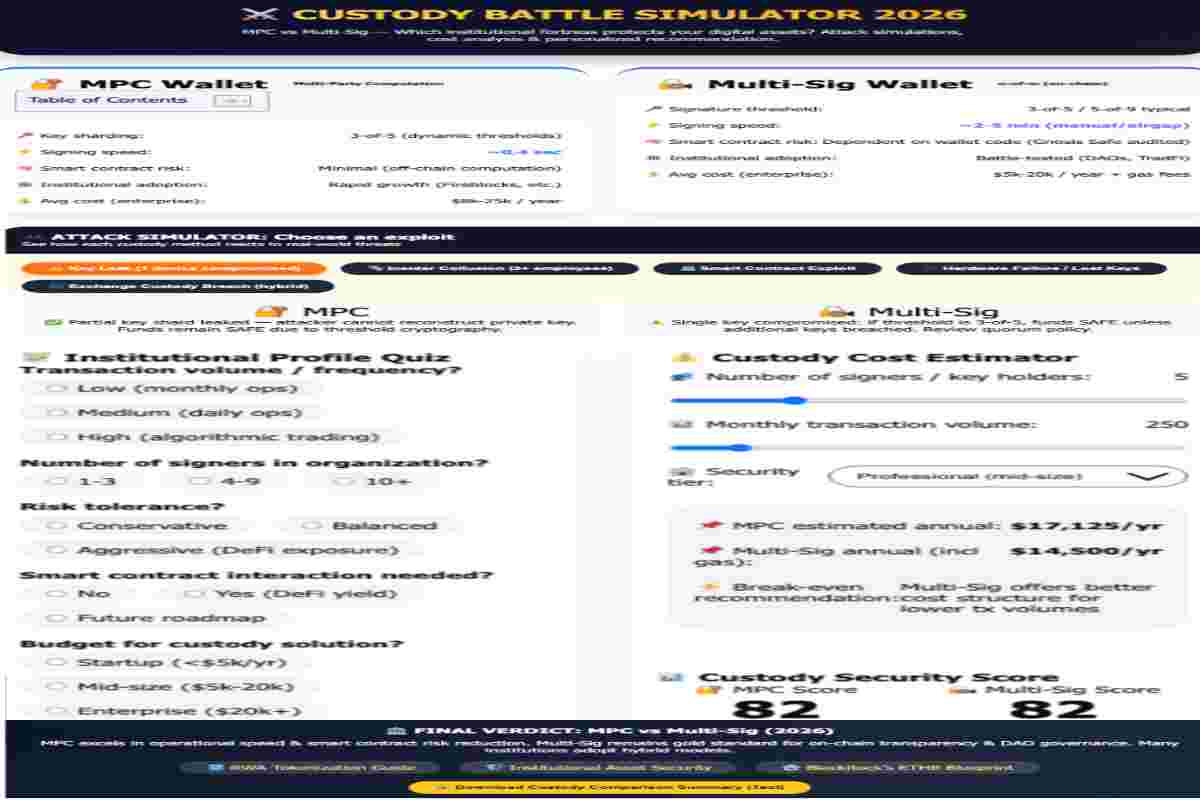
Institutional-grade custody isn’t defined by a single storage model. It’s measured by how well a system performs under stress—during market volatility, operational failures, and adversarial conditions. In modern institutional crypto asset security, resilience matters more than architecture alone.
Rather than asking whether MPC, multi-signature, or HSM is “best,” institutions evaluate how these models are implemented, governed, and tested in real-world scenarios.
Key evaluation criteria include:
The takeaway is simple: institutional custody is not about choosing a single technology—it’s about building a system that maintains integrity, control, and availability under all conditions.
Problem: Traditional wallet storage models cannot handle institutional-scale governance, compliance, and operational risk requirements.
Solution: Modern custody systems integrate distributed key management, policy enforcement, audit infrastructure, and disaster recovery planning.
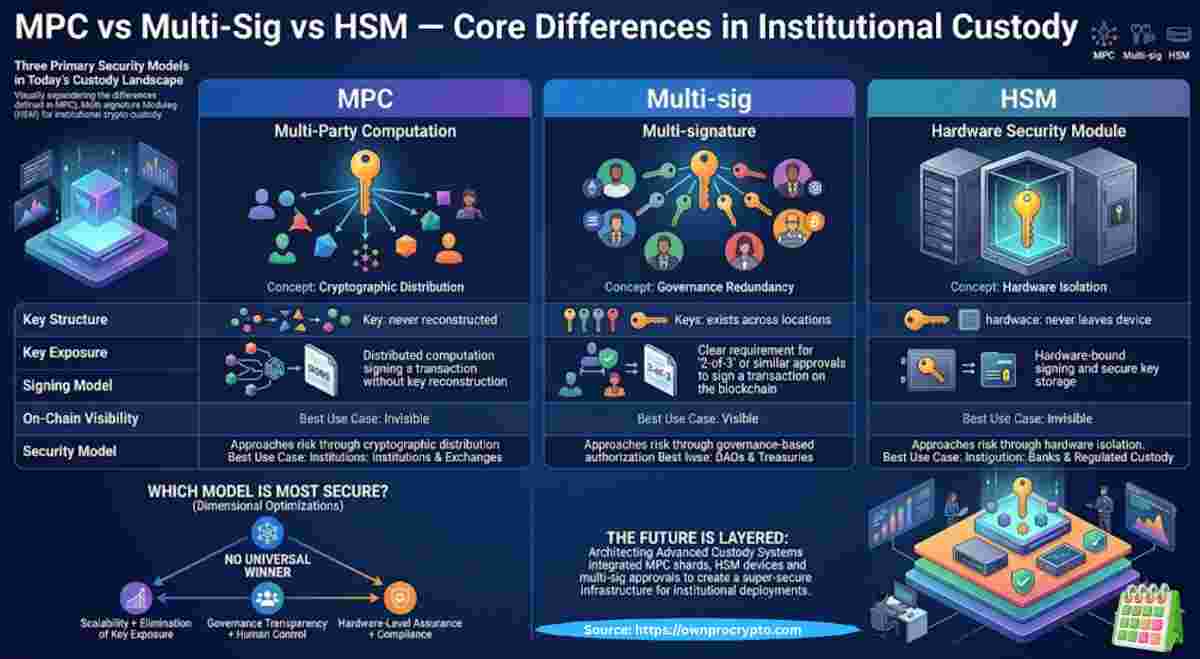
Today’s custody landscape is dominated by three security models:
Each model approaches custody risk differently through cryptographic distribution, hardware isolation, or governance-based authorization.
| Feature | MPC | Multi-Sig | HSM |
|---|---|---|---|
| Key Structure | Split cryptographic shares | Multiple full keys | Stored in secure hardware |
| Key Exposure | Never reconstructed | Exists across multiple locations | Never leaves device |
| Signing Model | Distributed computation | Multi-approval signing | Hardware-bound signing |
| On-Chain Visibility | Invisible | Visible | Invisible |
| Security Model | Cryptographic distribution | Governance redundancy | Hardware isolation |
| Best Use Case | Institutions & exchanges | DAOs & treasuries | Banks & regulated custody |
The future of institutional custody is not defined by choosing a single model — but by architecting layered systems that combine the strengths of all three approaches.
There is no universal winner.
Each model optimizes for a different dimension:
In real institutional deployments, these are rarely used in isolation.
Problem: Institutions struggle to determine which custody architecture best balances security, governance, and scalability.
Solution: Understanding the MPC vs multi-sig vs HSM comparison helps organizations design layered custody systems optimized for operational resilience.

Each custody architecture introduces different operational strengths and risks.
MPC crypto custody reduces single points of failure by distributing signing operations across multiple parties and devices. This significantly minimizes key exposure risk while enabling scalable workflows across institutional teams and jurisdictions.
Multi-sig wallet security relies on governance redundancy through multiple approval signatures. While transparent and battle-tested, operational complexity can increase as signer coordination grows across organizations and time zones.
HSM crypto custody provides hardware-isolated protection for cryptographic keys and remains widely trusted by banks and regulated financial institutions. However, hardware dependency introduces infrastructure management and physical security considerations.
Modern institutional deployments rarely rely on one model alone. Instead, operational resilience is achieved through layered security architecture combining MPC orchestration, HSM isolation, and governance-driven approval systems.
Problem: Different custody architectures introduce unique operational risks, including signer coordination failures, hardware dependency, and key exposure vulnerabilities.
Solution: Layered custody deployments reduce operational risk by combining distributed signing, governance redundancy, and hardware-isolated protection.
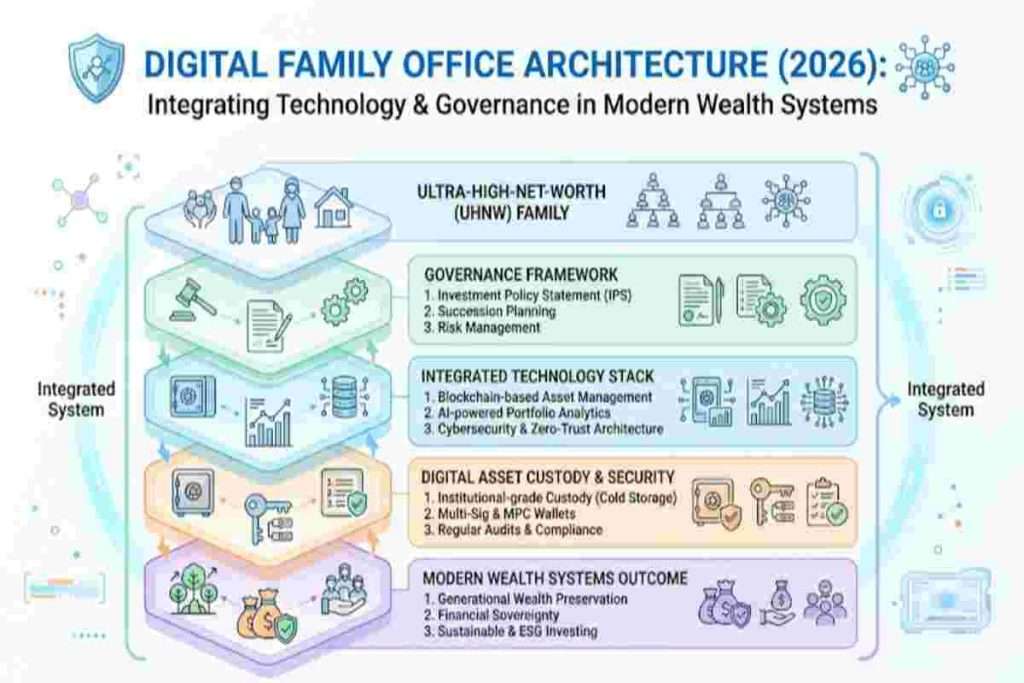
Institutional custody infrastructure in 2026 depends heavily on governance automation and policy orchestration.
Modern systems implement:
Rather than relying solely on cryptographic protection, institutions increasingly secure digital assets through layered governance enforcement capable of managing operational risk at scale.
This shift reflects a broader evolution where institutional custody becomes part security infrastructure, part compliance framework, and part operational intelligence system.
Problem: Cryptographic security alone cannot prevent insider threats, unauthorized transactions, or compliance failures.
Solution: Governance automation and policy-driven authorization systems strengthen institutional operational control and compliance enforcement.
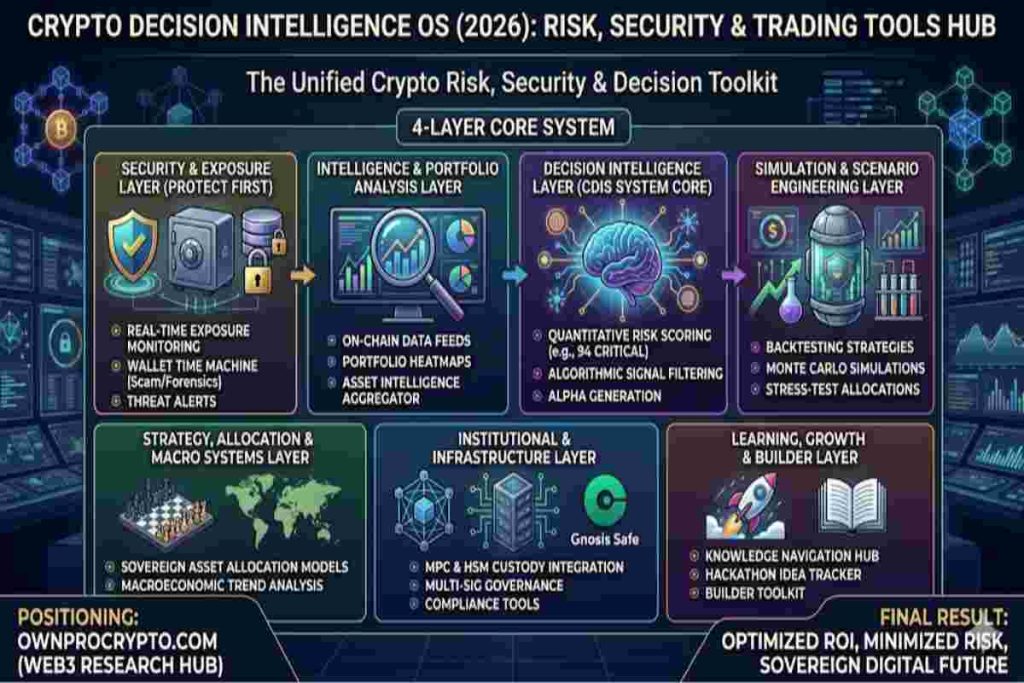
Disaster recovery is now one of the most important components of institutional custody design.
Institutions must prepare for:
MPC systems improve resilience by distributing signing authority across independent nodes and operators, reducing catastrophic single-device failures.
HSM deployments often implement geographically separated hardware clusters with backup recovery environments for continuity assurance.
Multi-signature systems provide additional governance protection by distributing transaction authorization across multiple parties, helping reduce unilateral compromise risk.
The most resilient institutional systems combine all three approaches within coordinated recovery orchestration frameworks.
Problem: Key loss, infrastructure outages, and custodian failures can permanently disrupt institutional asset access.
Solution: Coordinated disaster recovery frameworks improve resilience through distributed signing, hardware redundancy, and governance-based recovery workflows.
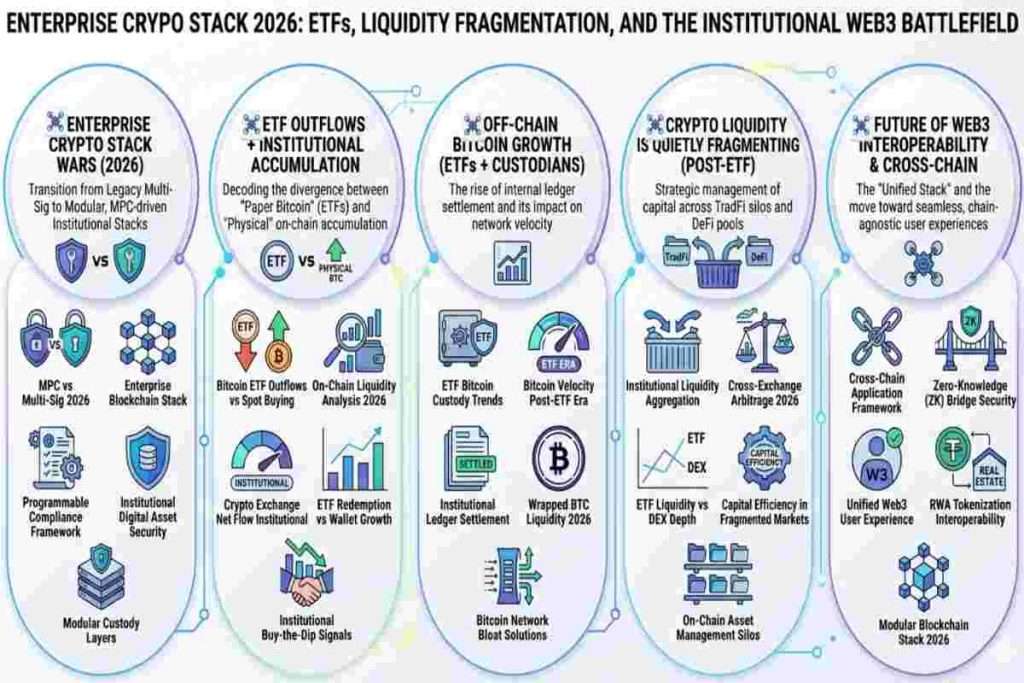
As spot Bitcoin ETFs, tokenized assets, and institutional digital asset products continue expanding globally, custody requirements are becoming significantly stricter.
Institutions now require:
Custody providers serving ETFs and regulated institutions must demonstrate not only strong cryptographic security but also enterprise-grade operational maturity and compliance infrastructure.
Problem: Regulated institutions face increasing compliance pressure around digital asset custody transparency and operational maturity.
Solution: Enterprise-grade custody infrastructure supports auditability, regulatory reporting, insurance readiness, and institutional governance controls.
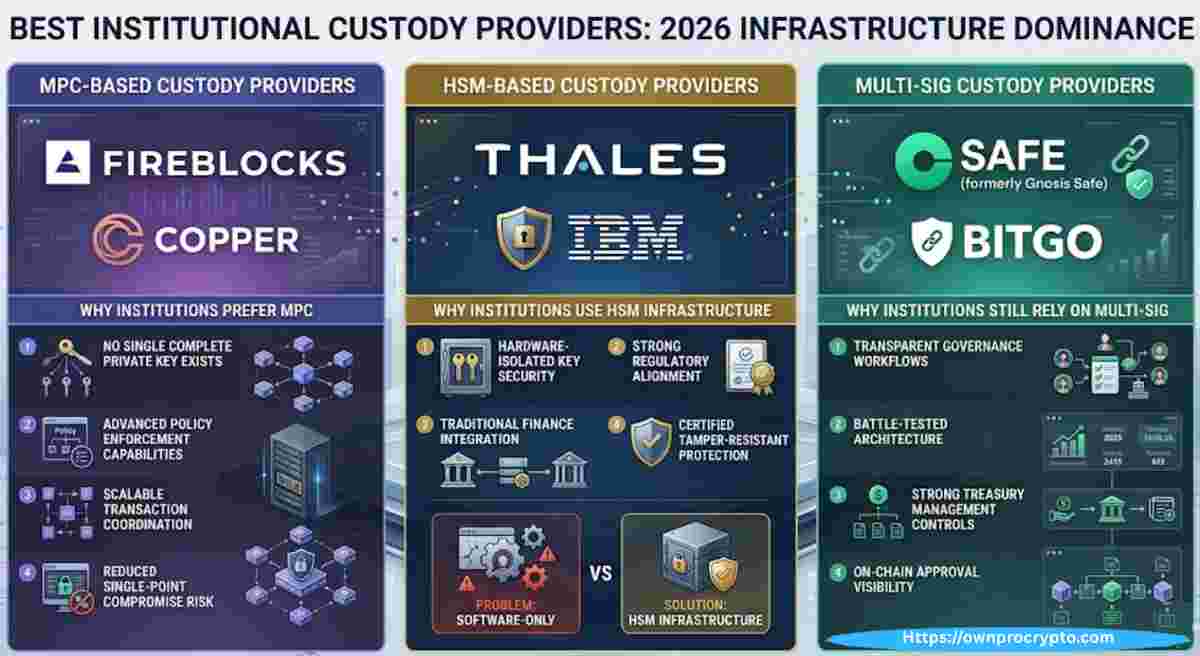
Several providers currently dominate institutional custody infrastructure in 2026.
Why institutions prefer MPC:
Why institutions use HSM infrastructure:
Problem: Software-only custody systems may not satisfy strict banking-grade security and regulatory expectations.
Solution: HSM infrastructure protects cryptographic keys within certified tamper-resistant hardware environments.
Why institutions still rely on multi-sig:
Problem: Institutions require transparent governance controls for treasury and transaction authorization.
Solution: Multi-signature custody distributes approval authority across multiple trusted participants and workflows.
Despite the rapid growth of MPC infrastructure, multi-signature custody remains highly relevant for many organizations.
Multi-sig architecture continues to perform exceptionally well for:
For many organizations, the transparency and predictability of multi-signature approval systems still outweigh the complexity advantages offered by more advanced MPC deployments.
Problem: Advanced MPC deployments may introduce unnecessary complexity for some organizations and treasury structures.
Solution: Multi-signature custody remains effective for transparent governance, operational simplicity, and smaller institutional teams.
The future of institutional crypto custody will be defined by orchestration rather than isolated wallet technologies.
Leading institutions are now deploying hybrid custody systems that combine:
This layered approach creates defense-in-depth architecture capable of adapting to evolving regulatory, operational, and cybersecurity challenges.
In 2026, the most secure institutional custody systems are no longer defined by individual technologies alone — but by how effectively those technologies work together within a unified operational framework.
Problem: Isolated custody technologies cannot fully address evolving cybersecurity, regulatory, and operational risks.
Solution: Hybrid custody orchestration combines MPC, HSM, governance automation, and compliance intelligence into unified institutional security frameworks.
Institutional crypto custody in 2026 is evolving beyond single-wallet security models into fully integrated digital asset infrastructure designed for operational resilience, governance enforcement, treasury coordination, and enterprise-scale risk management. The growing shift from traditional wallet security toward layered custody architecture reflects how institutional participation in digital assets has matured across ETFs, tokenized assets, treasury operations, and cross-border settlement systems.
As the MPC vs multi-sig infrastructure debate continues, institutions are increasingly adopting hybrid security frameworks that combine MPC distributed signing, HSM-backed hardware isolation, and multi-signature governance controls within a unified crypto custody infrastructure stack. This approach reduces single points of failure while improving transaction governance, operational scalability, disaster recovery planning, and institutional wallet security.
Modern institutions no longer evaluate custody purely through key storage. Instead, they prioritize programmable policy engines, operational workflow automation, governance orchestration, and flexible security architecture capable of adapting to evolving financial and regulatory environments. Organizations that successfully integrate MPC crypto custody, HSM security controls, and multi-sig authorization layers will be better positioned to strengthen institutional crypto treasury security while supporting long-term digital asset operations at scale.
For a deep-dive analysis of how these cryptographic primitives operate at scale, review the industry benchmark on MPC vs. Multi-Sig Key Management Architecture provided by Fireblocks.
Problem: Institutions relying on single-layer custody architecture face growing operational and compliance vulnerabilities.
Solution: Unified layered custody systems create scalable institutional infrastructure capable of supporting long-term digital asset security and operational continuity.