
Table of Contents
ToggleIn 2024, investors were still asking a simple question:
Bitcoin vs Gold — which is better?
In 2026, that question is obsolete.
We’ve entered the era of global asset decoupling, where assets no longer move together — they perform distinct roles in a fragmented, volatile, and increasingly uncertain financial system.
Driven by:
capital is no longer chasing “the next Bitcoin.”
Instead, it is repositioning into what institutions now call:
Safe-haven architecture
At the center of this shift lies a staggering reality:
Over $700 trillion in global assets are being re-evaluated.
And for the first time, investors are thinking in layers — not assets.
Most investors make decisions without understanding scale.
They compare Bitcoin to Gold…
without realizing they operate in entirely different universes.
Think of global assets as a cosmic system:
| Asset Class | Estimated Size | Role in System |
|---|---|---|
| Real Estate | $600T+ | Infrastructure Layer |
| Bonds | $130T+ | Yield Layer |
| Gold | $15T+ | Shock Absorber |
| Bitcoin | ~$1–2T | Liquidity Layer |
| Silver | ~$1T | Industrial Hedge |
This explains a critical truth:
Bitcoin doesn’t need to replace Real Estate to be important.
Its role is completely different.

As uncertainty rises, capital moves toward assets that cannot fail structurally.
Gold and real estate share one powerful advantage:
They are immune to digital attack vectors.
Unlike crypto assets, they:
This makes them the ultimate “bunkers” in a world increasingly concerned about:
Large players are not speculating — they are reallocating.
This is not hype.
This is defensive positioning at scale.

One of the most underestimated forces in 2026 is the quantum threat.
Quantum computers, using concepts like Shor’s Algorithm, could potentially:
This creates a dangerous scenario known as:
“Harvest now, decrypt later”
Even the perception of this threat has triggered:
This is a key driver behind asset decoupling trends.
Despite concerns, Bitcoin is not disappearing.
It is evolving.
Bitcoin offers something no physical asset can:
You cannot move real estate across borders in minutes.
But you can move Bitcoin.
| Feature | Gold | Bitcoin |
|---|---|---|
| Primary Role | Store of Value | Liquidity Layer |
| Speed | Slow | Instant |
| Quantum Risk | None | Potential |
| Volatility | Low | High |
| Portability | Low | High |
The debate is no longer:
“Gold vs Bitcoin”
It is now:
Gold and Bitcoin — for different purposes
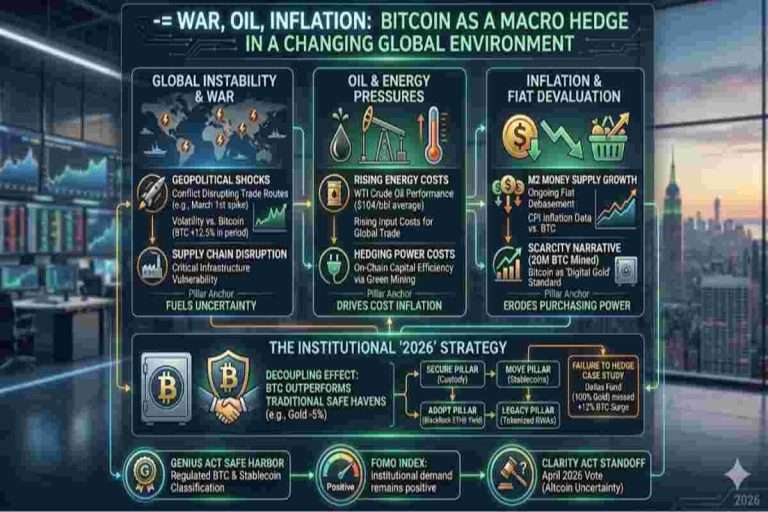
Bitcoin’s position in the 2026 financial system becomes clearer when viewed through real-world macro events rather than theory alone. During periods of war, inflation spikes, and energy-driven economic shocks, Bitcoin has shown characteristics of both a speculative asset and a global liquidity tool. This evolving behavior is explored in detail here: –> https://ownprocrypto.com/bitcoin-as-a-macro-hedge/
This deeper analysis helps explain why Bitcoin is no longer just compared under the “bitcoin vs gold 2026” narrative, but instead plays a distinct role within global asset decoupling 2026 — acting as a high-speed liquidity layer rather than a traditional safe-haven asset.
This is the defining trend of 2026.
Global asset decoupling refers to:
Assets responding differently to the same macro conditions.
Examples:
In the past:
In 2026:
This is a shift from:
speculation → structure
The modern investor no longer builds a portfolio.
They build a system.
| Layer | Asset Class | Purpose |
|---|---|---|
| Infrastructure Layer | Real Estate | Stability & capital preservation |
| Protection Layer | Gold | Crisis hedge |
| Velocity Layer | Bitcoin | Liquidity & mobility |
It aligns with reality:
Understanding asset roles is one thing — applying them is another.
Most investors know they should diversify, but very few know how to structure their portfolio across the new asset layers.
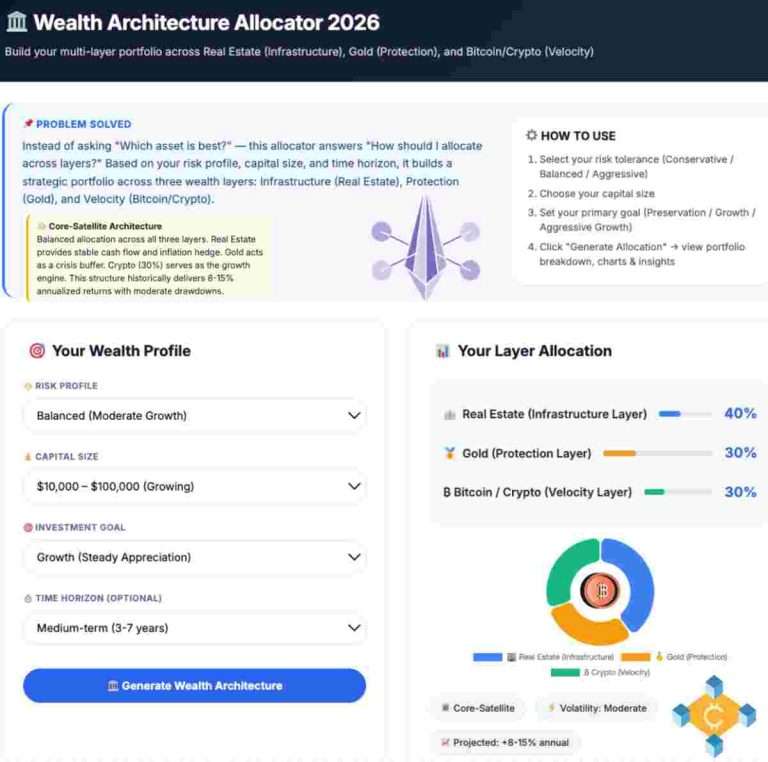
To simplify this, use the Wealth Architecture Allocator (2026) below.
It helps you design a portfolio based on the three-layer model: infrastructure, protection, and velocity.
The allocator builds your portfolio using three key inputs:
Based on this, it assigns allocation across:
| Profile | Real Estate | Gold | Crypto |
|---|---|---|---|
| Conservative | 60% | 30% | 10% |
| Balanced | 40% | 30% | 30% |
| Aggressive | 30% | 10% | 60% |
Most portfolios fail not because of bad assets…
But because of bad structure.
This model ensures you are:
Use the allocator to map your strategy before deploying capital.
Because in 2026:
Wealth is no longer about picking assets :
it’s about designing systems.
In 2025, a wave of fear hit crypto markets:
Investors who were:
faced:
Investors with:
maintained stability.
Don’t chase returns.
Build resilience.
The future of investing is no longer about picking winners.
It’s about understanding roles.
Together, they form a resilient financial system.
The decoupling of global trade and activity apparent since the second half of 2018 largely reflects a weakening of global investment, although consumption also softened at the turn of the year.
Global Strategy Reference: For an authoritative deep dive into the Global Asset Decoupling 2026 and its impact on the global financial stack, explore the Global Asset Decoupling 2026.
The question is no longer:
“What is the best asset?”
It is:
“What role does each asset play in your wealth?”
It’s the shift where different asset classes respond uniquely to macro conditions instead of moving together.
Not in the traditional sense. It acts more as a liquidity and mobility layer than a pure safe haven.
It introduces long-term risks to cryptographic security, prompting innovation in quantum-resistant systems.
Because it offers stability, liquidity, and zero digital risk during uncertain times.
Welcome to OwnProCrypto (Own & Pro Crypto) — a next-generation Bitcoin and blockchain education platform where the science of finance meets the power of AI-driven automation.
Our mission is simple: to equip you with the knowledge, frameworks, and tools needed to make smarter financial and business decisions in the Web3 economy.
Beyond analysis, OwnProCrypto focuses on transparency, verifiable data, and practical frameworks that investors and builders can actually use. Our goal is not hype — but clear thinking, disciplined analysis, and long-term value creation in the decentralized economy.
Our Background: Salim (Sam) is the founder and lead researcher behind OwnProCrypto, a Web3 intelligence platform focused on crypto security, digital ownership, stablecoin systems, interoperability, and institutional blockchain infrastructure.
Crypto Tools & Analysis:
Crypto Fundamental Analysis Tool | Protocol Evaluation System | DeFi Risk Analysis Tools | Crypto Portfolio Dashboard | Token Risk vs Reward Tool
Guides:
Crypto Fundamental Analysis | Blockchain Project Evaluation | Tokenomics Analysis | DeFi Protocol Analysis | Capital Efficiency
© 2026 OwnProCrypto — Built for smarter crypto decisions