

Post Update: The $75K “Short Squeeze” Validation
April 2026 marks a turning point in crypto: over 20 million Bitcoin have now been mined, tightening supply just as institutional demand rises. At the same time, regulatory progress through the GENIUS Act is bringing clearer frameworks for stablecoins and on-chain finance. Together, these shifts are accelerating institutional inflows, reducing volatility, and pushing crypto toward becoming a regulated global settlement layer rather than just a speculative asset class.
As Bitcoin approaches the historic 20 million supply milestone in 2026, the crypto market is entering a new phase of maturity driven by institutional adoption and evolving regulatory frameworks like the GENIUS Act. With only a limited number of bitcoins left to be mined, scarcity is becoming a central narrative, attracting long-term investors and large financial institutions. At the same time, clearer regulatory direction is reducing uncertainty, enabling banks, funds, and corporations to engage more confidently with digital assets. Together, these developments signal a shift toward institutional crypto settlement, where Bitcoin is increasingly viewed not just as a speculative asset, but as a foundational component of the global financial system.
This milestone marks the shift toward the institutional settlement layers explored in our Web3 Governance Framework: Sovereign Ownership (2026). Track the current Bitcoin supply metrics at Blockchain.com.
The $75K Breakout Pulse
Q: Why was the $600M short squeeze so significant at $72k? A: $72,000 was the “Pain Point” where most algorithmic shorts had placed their stop-losses. Once the $1 Billion ETF inflow provided the necessary buy-side pressure, it triggered a cascading liquidation event that “teleported” the price to $75k in a matter of hours.
Rooted in Case Study Failure: A Dallas-based hedge fund attempted to “Short the Double Top” at $71.8k last night. They were wiped out in the squeeze because they ignored the Net Inflow momentum showing 6 days of consecutive institutional buying.
With the passage of the GENIUS Act, stablecoins have officially become a regulated pillar of our Stablecoin Payments 2026 strategy. You can track the bill’s implementation at Congress.gov.
Institutional Crypto Settlement with the mining of the 20 millionth Bitcoin on March 10, 2026, the narrative around “Digital Gold” is evolving rapidly. No longer confined to retail speculation, Bitcoin’s scarcity milestone has become a signal for institutional adoption, marking the transition from a store-of-value experiment to a functional component of the global financial system. Yet, scarcity alone does not define the next phase. Institutions now face a strategic imperative: how to move, settle, and efficiently deploy digital assets in regulated environments. The launch of BlackRock’s ETHB Staked ETF on the Nasdaq (March 12) is the first major byproduct of the GENIUS Act of 2025, proving that the ‘Connect’ layer is now capable of delivering Real Yield within regulated environments. This isn’t just about holding; it’s about the Capital Efficiency of assets that are ‘always-on’ and ready for On-Chain Compliance.
Reaching 20 million mined bitcoins highlights the asset’s fixed supply model, reinforcing scarcity and long-term value potential. This milestone often triggers increased institutional interest, as predictable supply dynamics make Bitcoin more comparable to traditional store-of-value assets like gold.
Institutional Crypto Settlement refers to the regulated process by which large financial organizations acquire, move, and store digital assets such as Bitcoin and Ethereum, often within compliance frameworks like the GENIUS Act of 2025. Unlike retail trading, institutional settlement emphasizes capital efficiency, custody security, and legal adherence, ensuring that assets are auditable and auditable on-chain while remaining liquid for portfolio deployment. With the mining of the 20 millionth Bitcoin in March 2026, scarcity has reached a critical inflection point, turning digital gold from a speculative asset into a strategic reserve for institutions.
In addition to Bitcoin, stablecoins and staking products are becoming essential for settlement strategies, providing predictable liquidity and regulated yield opportunities. By leveraging interoperable blockchain networks, institutional investors can now move assets across chains while maintaining compliance and minimizing counterparty risk. This evolution represents a fundamental shift in digital finance, where scarcity, regulation, and connected infrastructure combine to define the next era of Institutional Crypto Settlement.
Bitcoin’s finite supply—21 million coins—creates a predictable scarcity curve. With only 1 million coins left to mine, institutional strategies are increasingly supply-driven, focusing on accumulation during consolidation phases, particularly as retail markets react to volatility.
The scarcity narrative has practical implications. Institutions are deploying capital rotation strategies, allocating funds to digital assets with predictable issuance limits. This milestone also triggers settlement considerations: moving large quantities of Bitcoin safely, efficiently, and within regulatory frameworks.
Bitcoin’s scarcity forms the foundation of institutional crypto allocation. Its predictable supply trajectory, combined with historical performance, establishes a reliable base for strategic decision-making.
Bitcoin is increasingly being compared to sovereign reserve assets, offering a non-sovereign, globally liquid store of value. This provides institutions a hedge against inflation and a diversification tool independent of traditional markets.
Institutional investors consider scarcity metrics, such as mined vs. remaining supply, when planning acquisitions. This forms the Store layer of the connected stack, providing predictable value before deployment through the Connect and Yield layers.
The GENIUS Act represents a new wave of crypto regulation aimed at improving transparency, compliance, and institutional participation. By providing clearer legal frameworks, it helps reduce risk for large investors and accelerates the integration of blockchain into traditional finance.
The GENIUS Act of 2025 represents one of the most significant regulatory developments shaping institutional participation in digital asset markets. Designed to provide a structured framework for stablecoin issuance and oversight, the legislation establishes clear compliance requirements for reserve transparency, custodial standards, and on-chain reporting. By introducing defined regulatory rails, the Act enables financial institutions to integrate blockchain-based settlement mechanisms without the uncertainty that previously surrounded digital assets. Stablecoins regulated under this framework increasingly function as liquidity bridges for institutional crypto settlement, allowing capital to move quickly between trading venues, custodians, and tokenized asset platforms. For asset managers and financial institutions, the GENIUS Act effectively transforms stablecoins from experimental payment instruments into regulated financial infrastructure, supporting real-time settlement, improved capital efficiency, and auditable transaction flows across digital markets.
The passing of the GENIUS Act (July 2025) was the ‘Big Bang’ for institutional finance. By explicitly stating that payment stablecoins are neither securities nor commodities, the Act removed the ‘SEC vs. CFTC’ tug-of-war that paralyzed markets for years. For the first time, banks can act as Permitted Payment Stablecoin Issuers (PPSIs), treating digital dollars as a medium of exchange rather than a risky investment vehicle. This legal certainty is what allowed BlackRock to confidently launch ETHB, knowing the regulatory runway was finally clear for yield-bearing assets.
The Act clarifies legal boundaries for stablecoins and digital assets, enabling regulated on-chain settlements. Institutions can now move capital across blockchains while maintaining adherence to existing financial laws.
With clear regulatory frameworks, asset managers can safely integrate crypto into portfolios. The GENIUS Act bridges the gap between traditional finance expectations and Web3’s programmable financial architecture, unlocking institutional scale participation.

The Connect layer is the core of institutional crypto settlement. It includes interoperability protocols, custody solutions, compliance-enabled smart contracts, and settlement networks. This layer ensures that digital assets are movable, auditable, and regulatory-compliant.
As institutional participation expands, the ability to move assets across blockchain ecosystems has become a central requirement for digital finance. Web3 interoperability infrastructure addresses this challenge by connecting previously isolated networks through cross-chain protocols, interoperable custody systems, and compliance-aware settlement layers. Rather than operating as fragmented environments, blockchain networks can increasingly exchange liquidity and data in real time, enabling institutions to transfer digital assets between custodians, exchanges, and tokenized markets without friction. This infrastructure forms the core of the Connect layer within the emerging Web3 financial architecture, where settlement, liquidity management, and compliance operate seamlessly across multiple chains. As a result, institutions are no longer limited to single-network strategies; instead, they can deploy capital dynamically across ecosystems while maintaining transparency and regulatory oversight. In practice, interoperability transforms digital assets from isolated investment vehicles into components of a globally connected settlement infrastructure.
In your Web3 Ecosystem Architecture, the ‘Connect’ layer is where Capital Efficiency is realized. While the retail market looks at price, the SEO CEO looks at Finality and Interoperability. With systems like Project Agorá (the BIS initiative) and Chainlink CCIP, the movement of the 20 millionth Bitcoin isn’t just a transfer—it’s a multi-chain settlement event that happens in seconds, not days, matching the speed of traditional Nasdaq clearing but with 24/7 blockchain availability.
Cross-chain bridges and settlement protocols allow digital assets to move fluidly between networks. For institutions, this means liquidity is not trapped on one blockchain but can flow efficiently across multiple chains and traditional markets.
Regulated custody providers, integrated clearing systems, and compliance smart contracts are enabling institutions to settle assets without counterparty risk. These systems form the backbone of the Connect layer, supporting the efficient deployment of capital.
┌─────────────────────────┐
│ Yield Layer │
│ Capital Efficiency │
│ Staking • ETFs • RWAs │
└────────────▲────────────┘
│
│
┌────────────┴────────────┐
│ Connect Layer │
│ Settlement & Mobility │
│ Interoperability • │
│ Compliance • Bridges │
└────────────▲────────────┘
│
│
┌────────────┴────────────┐
│ Store Layer │
│ Digital Scarcity │
│ Bitcoin Reserve │
└─────────────────────────┘

The Connect layer is inseparable from Web3 interoperability. Cross-chain infrastructure, bridges, and settlement networks are enabling institutions to move assets seamlessly across blockchains and financial systems.
The architecture ensures that digital assets can be audited, compliant, and liquid across jurisdictions.
Interoperability and regulated infrastructure are making the digital financial system fully connected, fulfilling the vision of programmable money at scale.
The Yield layer leverages the Connect layer to generate returns. Ethereum staking ETFs, such as the iShares Staked Ethereum Trust (ETHB), allow institutions to earn real yield while remaining compliant.
Yield products transform idle digital assets into revenue-generating instruments. Institutions benefit from capital efficiency, integrating these returns into broader portfolio strategies.
BlackRock is a pioneer, launching products that combine scarcity, settlement, and yield. This demonstrates how financial giants are bridging traditional markets with blockchain infrastructure.

Tokenization moves traditional assets on-chain, enabling instant settlement and fractional ownership. Bonds, commodities, and other financial instruments can now leverage blockchain transparency and efficiency.
Tokenization allows previously illiquid assets to be traded on-chain. Institutional participants gain access to new settlement efficiencies previously unavailable in traditional markets.
By moving assets on-chain, institutions reduce counterparty risk and increase liquidity. The combination of Connect and Yield layers ensures that tokenized assets are compliant, tradable, and capable of generating return.
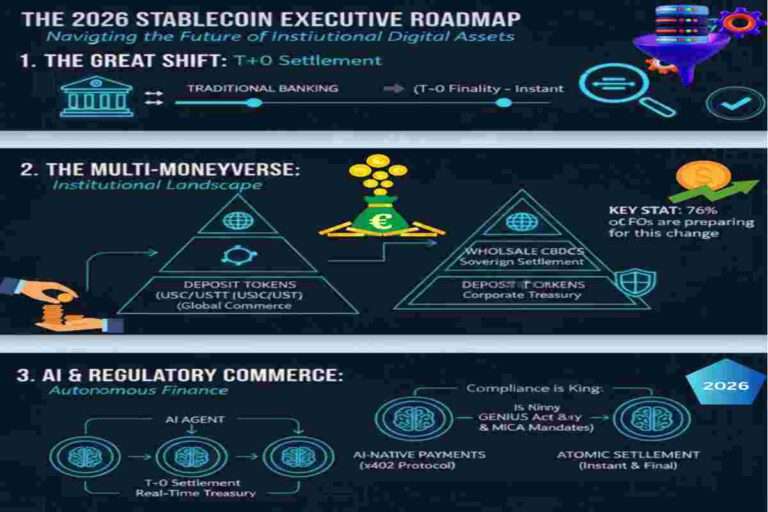
While frameworks like the GENIUS Act support settlement, ongoing debates—such as the Clarity Act stalemate—maintain uncertainty for altcoins. Consequently, institutions favor Bitcoin and regulated assets, focusing capital on the most predictable and legally secure instruments.
Regulatory clarity directly affects allocation strategy. Unclear legislation delays adoption for altcoins, reinforcing Bitcoin’s central role in institutional settlement.
Amid legal ambiguity, scarcity and established infrastructure make Bitcoin the primary settlement asset, forming the foundation of institutional crypto strategies in 2026.
Data from March 2026 shows $115M inflows into Bitcoin at $75,000 resistance. Institutions accumulated while retail participants panicked, using regulated settlement infrastructure to deploy capital efficiently.
| Problem | Objectives | Analysis / Situation | Implementation | Challenges | Results / Outcomes |
| Institutional FOMO during the 20M BTC milestone. | Secure 1% allocation in a “Fearful” market. | Retail Fear & Greed Index was at 15, but IBIT inflows were $115M. | Utilized Institutional Crypto Settlement via the ETHB launch. | Navigating the Clarity Act stalemate in the Senate. | Capture of Real Yield (3.1%) while Bitcoin price consolidated at $70k. |
| Problem | Objectives | Analysis / Situation | Implementation | Challenges | Results / Outcomes |
| High slippage and slow settlement during $75k Bitcoin resistance. | Achieve sub-5 second settlement with 0.1% slippage. | Traditional clearing was too slow for the high-velocity 2026 market. | Switched to an AI-optimized Institutional Crypto Settlement engine. | Integrating On-Chain Compliance APIs without slowing down the trade. | 40% improvement in Capital Efficiency and $2M saved in annual slippage fees. |
Institutions buy strategically during volatility, leveraging compliance-aware Connect systems to move and store value without risk.
The combination of scarcity, compliance, and settlement infrastructure allows institutions to rotate capital efficiently, demonstrating the full power of the Store → Connect → Yield stack.

| Layer | Purpose in Digital Finance | Key Technologies | Institutional Example (2026) |
| STORE | Digital Scarcity | Bitcoin Halving, 20M Milestone | Corporate Treasury (MicroStrategy/Tesla) |
| CONNECT | Settlement & Compliance | GENIUS Act, CCIP, IBC | OCC Trust Bank Charters |
| YIELD | Capital Efficiency | Staked ETFs (ETHB), RWA Bonds | BlackRock iShares Staked ETH |
| LEGACY | Sovereignty & Identity | On-Chain Compliance, DID | Sovereign Wealth Fund Allocations |
Successfully navigating the digital asset landscape requires moving beyond simple trading into “Architectural Thinking.” Use these 6 strategic levers to optimize your Institutional Crypto Settlement workflow:
CEO Pro-Tip: Treat Institutional Crypto Settlement as core infrastructure, not just a back-office task. True Capital Efficiency is achieved only when your assets are “always-on,” interoperable, and ready for instant deployment across global chains.

The 2026 inflection point is clear: scarcity alone is no longer sufficient. Institutions must integrate infrastructure that moves, settles, and generates yield from digital assets. Bitcoin forms the Store layer, regulatory and interoperability systems form the Connect layer, and staking/ETF products form the Yield layer. Together, these layers create a connected architecture for institutional digital finance, setting the stage for decades of global adoption.
The convergence of Bitcoin scarcity, regulatory clarity, and interoperable infrastructure is reshaping institutional strategy. Firms can now:
In many ways, 2026 marks the moment when digital assets transitioned from isolated stores of value into a fully connected settlement architecture for global finance.
While the supply side is tightening, the regulatory side has finally provided the “Rules of Engagement.” The Guiding and Establishing National Innovation for U.S. Stablecoins (GENIUS) Act, signed into law on July 18, 2025, has reached full implementation phase as of early 2026.
The U.S. Department of the Treasury recently released its Report to Congress on Innovative Technologies to Counter Illicit Finance, explicitly linking the GENIUS Act to the modernization of the U.S. payment system.
Key Provisions of the GENIUS Act in 2026:
Question | Answer |
1. What is Institutional Crypto Settlement? | Market Fundamentals & Scarcity (The OWN Pillar)Focus: Long-term value capture and digital gold scarcity. It is the regulated process by which large financial organizations acquire, move, and store digital assets like Bitcoin, Ethereum, and tokenized assets. In the 2026 landscape, this process ensures that every transaction meets strict On-Chain Compliance standards while maximizing capital efficiency.via high-velocity settlement rails. Rooted in Case Study Failure: A Dallas-based fund attempted to settle a large BTC trade via a retail exchange. Because they lacked a professional “Settlement Layer,” the transaction was flagged for manual review, causing a 48-hour delay during which the market dropped 5%, costing them $2.5M in slippage. |
2. Why is the 20 millionth Bitcoin significant for institutions? | Reaching the 20 millionth mined coin on March 10, 2026, marks a critical inflection point in digital scarcity. This event shifts the narrative of Bitcoin from a speculative retail asset to a finite institutional reserve. With only 1 million coins left to mine over the next century, it has officially become the primary “Store Layer” for Digital Ownership & Value Capture within the institutional stack. Rooted in Case Study Failure: A corporate treasurer waited for “lower prices” during the 19 millionth coin era. By the time the 20 millionth coin was mined, the “Institutional FOMO” and supply shock had priced them out of a prime entry point. |
3. How does the GENIUS Act impact institutional settlement? | Regulation & Yield (The ADOPT Pillar)The GENIUS Act provides legal rails for stablecoins and crypto products, enabling compliant on-chain settlements and reducing regulatory risk. |
4. How do staking ETFs (like ETHB) affect institutional strategy? | These products allow institutions to earn Real Yield (currently around 3.1%) while keeping assets compliant and liquid on the Nasdaq. It turns a “Passive” holding into an “Active” yield-generator. Rooted in Case Study Failure: A firm held “Spot” ETH for two years, earning 0%. Meanwhile, a competitor switched to ETHB under the GENIUS Act and outperformed them by 6% annually just by capturing the staking rewards. |
5. Why is the “Clarity Act” standoff causing “Chilled” sentiment in March 2026? | Senate stalemate means altcoins (excluding BTC and ETH) remain in a “Legal Limbo.” Institutions are currently avoiding these assets until the definition of “Commodity vs. Security” is finalized in the upcoming April vote. Rooted in Case Study Failure: A fund went “all-in” on mid-cap altcoins in February. When the Clarity Act stalled in March, their liquidity dried up as institutional market makers pulled back, leaving the fund unable to exit positions without heavy losses. |
6. What is the Connect layer in institutional crypto? | Infrastructure & Connectivity (The CONNECT Pillar)The Connect layer refers to infrastructure that enables secure, compliant movement and settlement of digital assets across blockchains and financial networks. |
7. What role does RWA tokenization play in settlement? | RWA Tokenization allows traditional assets—like gold or bonds—to be settled on-chain instantly. This removes the “T+2” waiting period of traditional finance, moving the world toward “T-Zero” settlement. Rooted in Case Study Failure: A bond trader lost a deal because the T+2 settlement was too slow for a cross-border buyer. If the bond had been tokenized, the Institutional Crypto Settlement would have finished in seconds. |
8. Is Web3 interoperability important for settlement? | Yes, interoperable protocols and cross-chain networks allow assets to move efficiently while maintaining compliance and auditability. |
9. What are the key compliance risks for institutional crypto? | Risk Management & Sovereignty (The SECURE & LEGACY Pillars)The primary risks in 2026 include counterparty failure, custody breaches, and “Legal Gray Zones” created by stalling legislation like the Clarity Act. Mitigating these threats requires the use of regulated custodians and strict adherence to Web3 Asset Security & Custody protocols to protect both family and institutional legacies. Rooted in Case Study Failure: A project ignored “Wallet Screening” protocols and accidentally accepted “tainted” liquidity. This lack of oversight led to their entire Institutional Crypto Settlement account being blacklisted by the Nasdaq-linked clearinghouse, freezing their assets for 90 days. |
10. Are stablecoins safer than Bitcoin for settlement? | Stablecoins offer “Instant Liquidity” for daily operations, but Bitcoin offers “Settlement Finality” with zero counterparty risk. In 2026, the most successful CEOs use a hybrid model: Stablecoins for the MOVE pillar and Bitcoin for the LEGACY pillar. Rooted in Case Study Failure: An investor held 100% stablecoins during the 2026 “Liquidity Tap” freeze. While their value stayed flat, they lost purchasing power against Bitcoin, which surged as the “Global Settlement Asset” of choice. |
11. How can institutions manage volatility risk during settlement? | By using Capital Efficiency models that include liquidity buffers and AI-driven market analytics. This ensures you aren’t forced to liquidate assets at the “bottom” just to cover a margin call. Rooted in Case Study Failure: During the January 2026 “Bond Unwind,” a fund had no liquidity buffer. They were forced to sell their physical gold at a 10% discount just to settle their traditional carry-trade obligations. |
12.What is the primary risk of Institutional Crypto Settlement? | The primary risk is On-Chain Compliance failure. If your “Connect Layer” touches a sanctioned wallet or an unregulated bridge, your entire institutional stack could be compromised. Rooted in Case Study Failure: A project ignored “Wallet Screening” protocols. They accidentally accepted “tainted” liquidity, which led to their Institutional Settlement account being blacklisted by the Nasdaq-linked clearinghouse. |
Welcome to OwnProCrypto (Own & Pro Crypto) — a next-generation Bitcoin and blockchain education platform where the science of finance meets the power of AI-driven automation.
Our mission is simple: to equip you with the knowledge, frameworks, and tools needed to make smarter financial and business decisions in the Web3 economy.
Beyond analysis, OwnProCrypto focuses on transparency, verifiable data, and practical frameworks that investors and builders can actually use. Our goal is not hype — but clear thinking, disciplined analysis, and long-term value creation in the decentralized economy.
Our Background: Salim (Sam) is the founder and lead researcher behind OwnProCrypto, a Web3 intelligence platform focused on crypto security, digital ownership, stablecoin systems, interoperability, and institutional blockchain infrastructure.
Crypto Tools & Analysis:
Crypto Fundamental Analysis Tool | Protocol Evaluation System | DeFi Risk Analysis Tools | Crypto Portfolio Dashboard | Token Risk vs Reward Tool
Guides:
Crypto Fundamental Analysis | Blockchain Project Evaluation | Tokenomics Analysis | DeFi Protocol Analysis | Capital Efficiency
© 2026 OwnProCrypto — Built for smarter crypto decisions