
Table of Contents
Toggle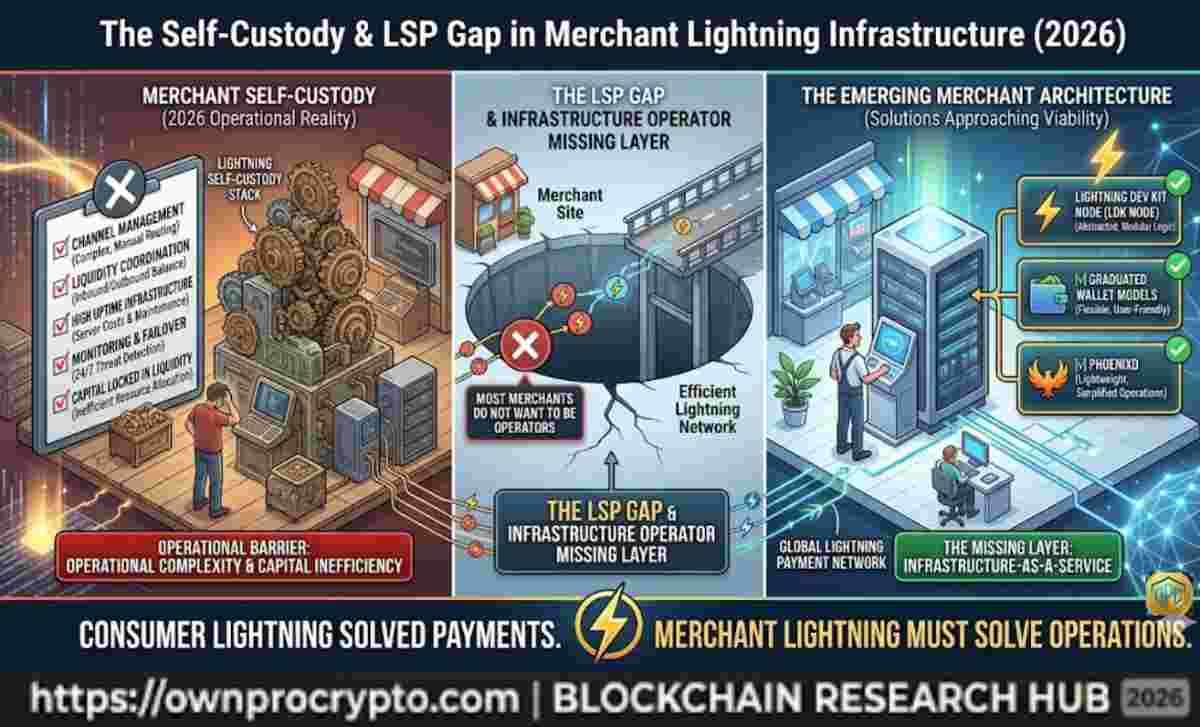
Consumer Lightning adoption has matured rapidly.
Today, users can send sats globally in seconds with near-zero fees through wallets like Phoenix Wallet, Breez, and Mutiny Wallet. Since 2021, Lightning UX has improved dramatically: routing reliability is stronger, mobile onboarding is smoother, and payment flows feel increasingly invisible to the end user.
On the consumer side, Lightning is no longer experimental.
Merchant adoption, however, is a different story.
Most businesses accepting Lightning payments still depend on custodial infrastructure providers such as Strike, Voltage, or OpenNode to abstract away operational complexity.
That creates a fundamental paradox:
Lightning succeeded technically before it succeeded operationally.
The challenge is not Bitcoin itself.
It is not routing reliability.
It is not payment speed.
The real bottleneck is operational complexity combined with capital inefficiency.
Today, self-custodial merchant Lightning infrastructure still demands:
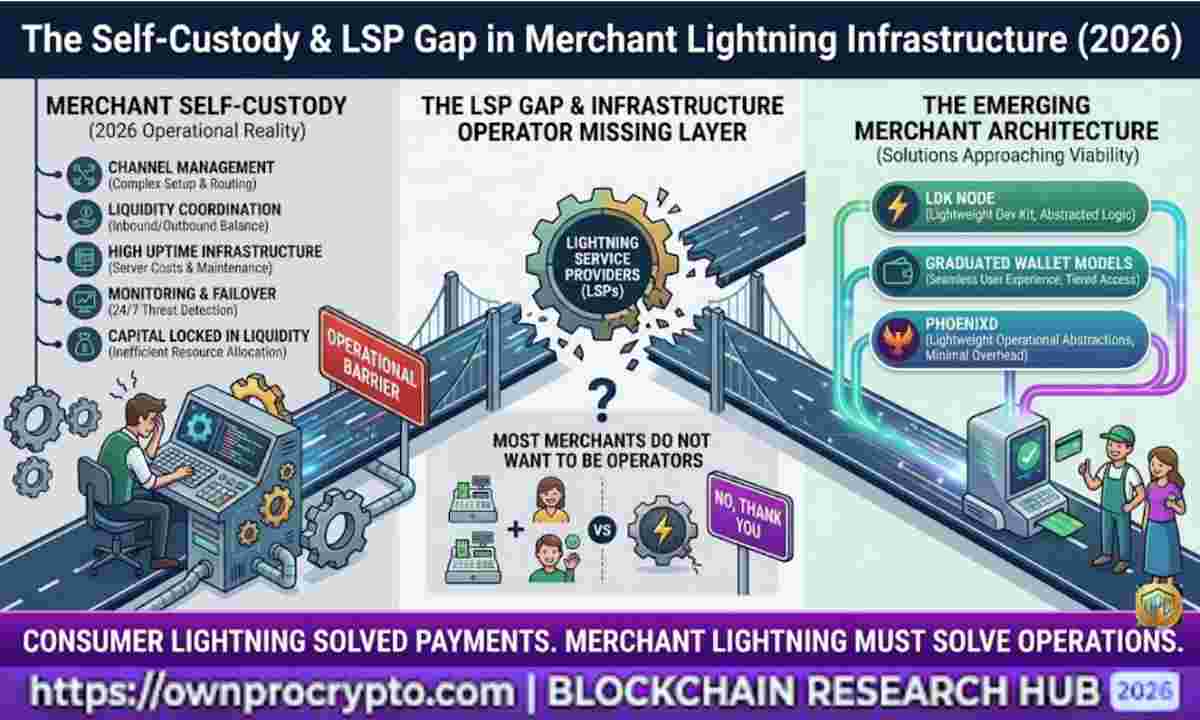
Most merchants do not want to become Lightning infrastructure operators simply to accept Bitcoin payments.
That missing operational layer is the core gap in Merchant Lightning Infrastructure.
Recent developments—including Lightning Dev Kit Node, graduated wallet architectures, and lightweight operational abstractions like Phoenixd—suggest the ecosystem may finally be approaching a viable merchant model that balances self-custody with operational simplicity.
The thesis is straightforward:
Consumer Lightning solved payments. Merchant Lightning Infrastructure must solve operations.
If a merchant wants to accept Lightning today, there are realistically only three options:
| Option | Trade-Off |
|---|---|
| Use custodial infrastructure | Lose sovereignty |
| Run your own node | Accept operational overhead |
| Ignore Lightning entirely | Lose censorship-resistant payments |
Most businesses choose custody because the alternative is operationally expensive.
The merchant problem is fundamentally different from the consumer problem.
Consumers optimize for convenience.
Merchants optimize for reliability.
Lightning nodes introduce operational responsibilities most merchants are not prepared to manage internally.
Running a merchant node is not “set and forget.”
Channels require:
If inbound liquidity is exhausted, payments fail.
If outbound liquidity disappears, refunds and treasury movements become difficult.
For merchants processing hundreds of payments per day, Lightning infrastructure effectively becomes a DevOps function.
| Requirement | Why It Matters |
|---|---|
| Channel balancing | Prevent failed inbound payments |
| Liquidity monitoring | Maintain routing reliability |
| Node uptime | Avoid settlement interruptions |
| Force-close handling | Reduce on-chain fee exposure |
| Backup coordination | Protect against data loss |
This is the operational gap custodial LSPs currently solve.
Lightning’s largest structural inefficiency remains inbound liquidity.
To receive 500,000 sats, someone else must commit 500,000 sats to the opposite side of the channel.
That capital remains locked.
For LSPs serving large merchant networks, the liquidity burden scales aggressively.
| Scenario | Capital Required |
|---|---|
| 1 merchant @ 500k sats | 500k sats |
| 10 merchants | 5M sats |
| 100 merchants | 50M sats |
This creates several consequences:
The result is a Lightning network that trends toward managed infrastructure rather than sovereign participation.
Lightning’s long-term decentralization depends on reducing liquidity requirements.
Without better capital efficiency:
This is why graduated wallets matter.
Instead of an LSP providing 100% of channel liquidity, the merchant contributes a portion of the balance.
| Metric | Traditional Model | Graduated Model |
|---|---|---|
| Channel size | 500k sats | 500k sats |
| Merchant contribution | 0 sats | 100k sats |
| LSP contribution | 500k sats | 400k sats |
| Capital reduction | — | 20% per channel |
When scaled across thousands of merchants, the savings become substantial.
| Merchant Base | Traditional Liquidity | Graduated Liquidity |
|---|---|---|
| 100 merchants | 50M sats | 40M sats |
| 1,000 merchants | 500M sats | 400M sats |
If only a subset of merchants qualify for channels based on balance thresholds, liquidity requirements decline even further.
This is the first credible path toward reducing Lightning centralization pressure.
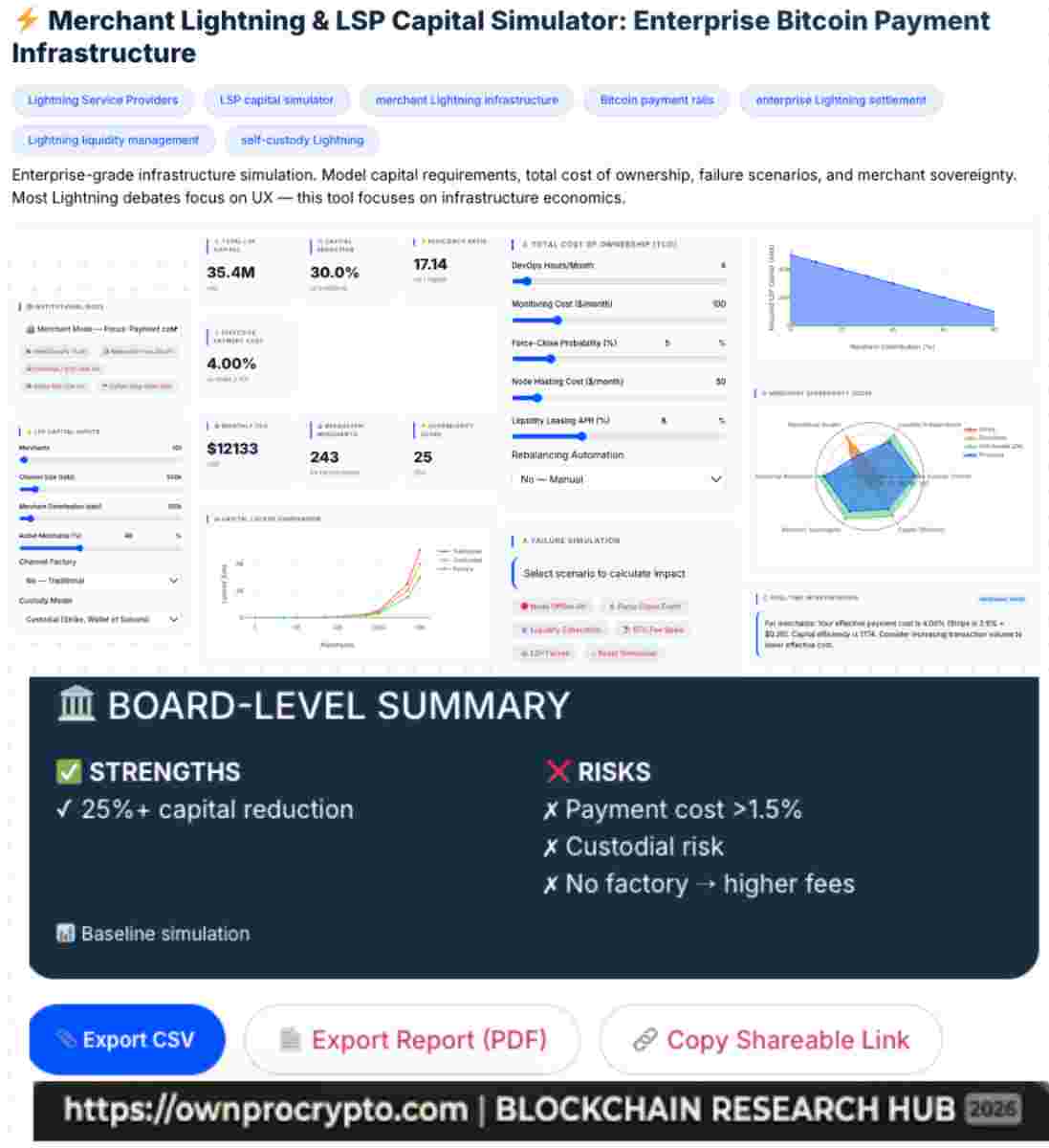
The core engine maps out enterprise infrastructure economics by calculating the financial and operational trade-offs of node management. Rather than evaluating basic transaction speeds, the backend processes structural variables—such as channel sizes, rebalancing automation, and hosting overhead—to output an institutional Total Cost of Ownership (TCO).
The simulation architecture operates across three distinct calculation layers:
Capital Allocation Modeling: Evaluates channel capacity inputs against required inbound liquidity thresholds to determine capital efficiency ratios and calculate real-world capital reduction percentages.
Failure Scenario Stress-Testing: Simulates the financial impact of node-offline events, force-closure probabilities, and channel exhaustion to stress-test your system’s operational resilience.
Governance Balancing: Compares custodial, hybrid, and absolute self-custody models, generating a board-level summary that contrasts cost reductions directly against counterparty risks and network fee metrics.
The simulator evaluates how much capital a Lightning Service Provider (LSP) must lock to support merchant payment channels.
Example:
| Merchant Count | Avg Channel Size | Traditional Capital Lockup | Graduated Wallet Model |
|---|---|---|---|
| 100 | 500k sats | 50M sats | 40M sats |
| 1,000 | 500k sats | 500M sats | 375M sats |
| 10,000 | 500k sats | 5B sats | 3.75B sats |
| Infrastructure Variable | Purpose |
|---|---|
| Merchant Count | Measures scaling pressure |
| Channel Size | Estimates inbound liquidity demand |
| Merchant Contribution | Reduces LSP capital dependency |
| Routing Fees (ppm) | Models operational profitability |
| Channel Factory Toggle | Simulates batched channel economics |
| Custody Model | Compares custodial vs self-custodial infrastructure |
The simulator models Lightning infrastructure across four operational layers:
| Layer | Infrastructure Role |
|---|---|
| Merchant POS | Checkout and payment processing |
| LDK Node / Phoenixd | Self-custodial node operations |
| LSP Liquidity Layer | Provides inbound routing capacity |
| Bitcoin Settlement Layer | Final settlement and channel batching |
Traditional Lightning deployments require a near 1:1 capital lockup.
extTraditionalCapital=extMerchantsimesextChannelSizeext{Traditional Capital} = ext{Merchants} imes ext{Channel Size}extTraditionalCapital=extMerchantsimesextChannelSize
Graduated wallet infrastructure reduces required liquidity by allowing merchants to contribute part of the channel balance.
extRequiredLSPCapital=extChannelSize−extMerchantContributionext{Required LSP Capital} = ext{Channel Size} – ext{Merchant Contribution}extRequiredLSPCapital=extChannelSize−extMerchantContribution
This allows operators to visualize how channel factories and self-custodial infrastructure improve Lightning Network scalability.
| Model | Capital Efficiency | Custody Risk | Ops Complexity | Decentralization |
|---|---|---|---|---|
| Custodial LSP | Low | High | Low | Weak |
| Self-Custodial Node | Medium | Low | High | Strong |
| LDK + Phoenixd Stack | High | Low | Medium | Strong |
| Channel Factory Model | Very High | Low | Medium | Very Strong |
Merchant Lightning is improving because three separate infrastructure layers are maturing simultaneously.
The biggest breakthrough is abstraction.
LDK Node dramatically reduces the complexity of integrating Lightning into applications.
Instead of directly managing:
Developers interact with a smaller API surface.
| Before | After LDK Node |
|---|---|
| Full Lightning daemon management | Embedded Lightning stack |
| Complex backend infrastructure | Mobile-first integrations |
| Manual wallet coordination | Integrated BDK wallet |
| Weeks of integration | Days of integration |
This matters because merchant teams do not want Lightning specialists.
They want payment infrastructure that behaves like modern APIs.
Two developments are especially important:
User balances offset liquidity requirements.
Benefits include:
Channel factories batch multiple channel opens into a single on-chain transaction.
| Model | On-Chain Transactions |
|---|---|
| 10 independent channels | 10 transactions |
| Channel factory | 1 transaction |
Benefits:
Without channel factories, merchant onboarding remains too expensive during high-fee environments.
Even with simpler software, nodes still require management.
This is where tools like Phoenixd and Lightstack matter.
These systems abstract:
| Layer | Before 2023 | After LDK Node + Phoenixd |
|---|---|---|
| Setup | Manual Lightning deployment | 1-day integration |
| Channel management | CLI scripts | Automated APIs |
| Monitoring | Custom Grafana stacks | Embedded tooling |
| Liquidity management | Manual balancing | LSP-assisted automation |
| Recovery | Manual intervention | Automated backups |
The key transition is psychological as much as technical:
Merchants no longer need to “run Lightning.”
They need software that quietly runs Lightning underneath.
[ Merchant App / POS ]
            │
            ▼
[ LDK Node / Phoenixd ]
  Keys • Channels • Routing
            │
            ▼
[ LSP Liquidity Layer ]
Inbound Liquidity Only
            │
            ▼
[ Bitcoin Base Layer ]
Channel Factories • Settlement
Architecture Insight
The critical shift is that the LSP becomes a liquidity provider—not a custodian.
That distinction changes the trust model entirely.
Split represents one of the clearest examples of this new merchant-first thesis.
Its core idea is not “better Lightning UX.”
Its thesis is:
Merchants should run their own payment infrastructure without operating full Lightning infrastructure teams.
That distinction matters.
Most existing merchant solutions optimize for:
Split is targeting sovereignty.
| Traditional Merchant LSPs | Split Thesis |
|---|---|
| Custodial convenience | Self-custodial control |
| Managed liquidity | Merchant-operated nodes |
| Infrastructure outsourcing | Infrastructure abstraction |
| Centralized dependency | Sovereign payments |
The project remains early-stage.
But the roadmap direction is strategically important because it aligns with Lightning’s original decentralization goals rather than replacing them with API-based custody.
Lightning merchant infrastructure is improving, but several missing components still prevent mass adoption.
Every Lightning provider currently exposes different infrastructure interfaces.
Merchants need:
Without standardization, Lightning onboarding remains fragmented.
Channel factories are still not widely deployed at merchant scale.
This matters because on-chain costs remain the largest onboarding friction during fee spikes.
| Problem | Factory Solution |
|---|---|
| Expensive channel opens | Batched opens |
| Slow merchant onboarding | Shared settlement |
| High fee environments | Lower per-user cost |
Merchant scalability depends heavily on this layer.
The ecosystem tracks:
But it rarely tracks:
How many merchants actually control their own infrastructure?
That may become the most important Lightning metric of the decade.
Merchants care about total operational cost—not ideology.
| Payment Rail | Typical Cost Structure |
|---|---|
| Stripe | 2.9% + fixed fee |
| Custodial Lightning | Lower fees but custodial dependency |
| Self-custodial Lightning | Minimal fees + operational overhead |
If operational complexity continues falling, self-custodial Lightning becomes economically compelling.
Traditional Merchant LSP Model
--------------------------------
100 Merchants
        │
        ▼
50M sats locked by LSP

Graduated Wallet Model
--------------------------------
Merchant balances offset liquidity
        │
        ▼
LSP provides only remaining capacity
        │
        ▼
~80% lower effective capital burden
Key Insight
Capital efficiency is not merely a scaling optimization.
It is the mechanism that determines whether Lightning remains decentralized.
Consumer Lightning proved Bitcoin payments work.
Merchant Lightning must prove sovereignty can scale operationally.
That requires:
The important shift is already happening.
| Problem | Emerging Solution |
|---|---|
| Dev complexity | LDK Node |
| Liquidity inefficiency | Graduated wallets |
| On-chain cost | Channel factories |
| Operational burden | Phoenixd / Lightstack |
| Custodial dependency | Merchant-operated nodes |
The infrastructure is finally converging.
When merchants can run Lightning infrastructure the same way they run websites—cheap, abstracted, and reliable—the network changes fundamentally.
Lightning stops being:
It becomes a censorship-resistant merchant payments network that businesses can actually own.
That is the real unlock.
And the ecosystem still has work to do before it arrives.
As institutional Bitcoin payment infrastructure matures, regulatory clarity around digital assets, reporting standards, and custody models is becoming increasingly important for merchant adoption. The U.S. Treasury and IRS have already expanded digital asset reporting frameworks for payment processors and financial intermediaries, signaling that Bitcoin-native payment rails are moving closer to mainstream financial infrastructure.
Merchant Lightning infrastructure refers to the tools, APIs, routing systems, wallets, nodes, and payment orchestration layers that enable businesses to accept Bitcoin payments over the Lightning Network. In 2026, this infrastructure increasingly includes Lightning Service Providers (LSPs), liquidity management systems, compliance tooling, and self-custody payment stacks designed for institutional-scale operations.
LSPs simplify Lightning adoption by handling channel management, inbound liquidity, routing reliability, and uptime requirements. Most merchants do not want to operate complex Lightning node infrastructure internally, so LSPs act as operational intermediaries that make Bitcoin payment infrastructure usable at scale.
The self-custody gap refers to the tradeoff between usability and control. Many merchant Lightning solutions improve UX through custodial infrastructure, but this reduces sovereignty over funds and settlement. Self-custodial Lightning systems remain operationally complex because they require liquidity management, channel monitoring, routing optimization, and node maintenance.
Yes. In 2026, institutional Lightning Network usage expanded beyond micropayments into high-value settlement flows. Several public tests demonstrated seven-figure Lightning transfers between regulated entities, showing growing confidence in Lightning as enterprise payment infrastructure.
Institutional demand is increasing because Lightning enables near-instant Bitcoin settlement with lower fees than on-chain transactions. Exchanges, custodians, fintech platforms, and payment processors increasingly view Lightning as a scalable settlement rail for treasury operations, merchant payments, and cross-platform liquidity movement.
The largest barriers include liquidity complexity, failed payment routing, operational overhead, poor recovery UX, and dependence on centralized infrastructure providers. Many businesses still prefer custodial solutions because self-custodial Lightning operations require significant technical expertise.
Self-custody allows merchants to control their own Bitcoin settlement without relying on exchanges, processors, or custodial intermediaries. This reduces counterparty risk and aligns with Bitcoin’s trust-minimized philosophy, especially for businesses operating globally or across unstable banking environments.
Not entirely. Most enterprise Lightning deployments currently operate alongside traditional payment rails rather than replacing them completely. Hybrid models combining fiat settlement, custodial services, and self-custody infrastructure are becoming the dominant institutional approach in 2026.
Liquidity management is central to Lightning performance because payments require properly balanced channels and sufficient routing capacity. Institutional Lightning operators increasingly use automated tooling, LSP integrations, and marketplace-based liquidity systems to maintain reliable merchant payment flows.
The next phase of merchant Lightning infrastructure will likely focus on abstracting node complexity while preserving self-custody. Emerging trends include decentralized LSP discovery, programmable Bitcoin payment APIs, enterprise compliance tooling, stablecoin settlement on Lightning rails, and automated liquidity orchestration.
Welcome to OwnProCrypto (Own & Pro Crypto) — a next-generation Bitcoin and blockchain education platform where the science of finance meets the power of AI-driven automation.
Our mission is simple: to equip you with the knowledge, frameworks, and tools needed to make smarter financial and business decisions in the Web3 economy.
Beyond analysis, OwnProCrypto focuses on transparency, verifiable data, and practical frameworks that investors and builders can actually use. Our goal is not hype — but clear thinking, disciplined analysis, and long-term value creation in the decentralized economy.
Our Background
Crypto Tools & Analysis:
Crypto Fundamental Analysis Tools | Protocol Evaluation System | DeFi Risk Analysis Tools | Crypto Portfolio Dashboard | Token Risk vs Reward Tool
Guides:
Crypto Fundamental Analysis | Blockchain Project Evaluation | Tokenomics Analysis | DeFi Protocol Analysis
© 2026 OwnProCrypto — Built for smarter crypto decisions