
Search by title, topic or phrase
Use our Crypto Search Engine 🔍 to find the topics and keywords you're looking for.
Crypto Security Standards define the principles, controls, and operating practices used to protect digital assets from unauthorized access, private-key compromise, fraudulent transactions, operational failures, and loss of recovery authority.
In 2026, securing cryptocurrency requires far more than choosing a hardware wallet or storing a seed phrase. Effective security is a connected architecture that combines key protection, custody, authorization, transaction controls, monitoring, incident response, recovery, and governance.
Table of Contents
ToggleA hardware wallet, multisignature setup, monitoring platform, or backup protocol provides an important layer of protection, but no individual control should be expected to secure an entire digital-asset operation by itself.
Secure private keys, signing devices, credentials, recovery material, and mechanisms that control asset ownership.
Establish clear operational rules governing who can access, approve, sign, or transfer digital assets.
Separate wallets, permissions, and environments so a single failure does not expose the entire portfolio.
Monitor on-chain activity to identify unusual transfers, permission updates, and compromise indicators.
Maintain defined procedures for verifying threats, containing risk, investigating events, and safeguarding assets.
Maintain tested paths to restore control after device loss, key compromise, signer unavailability, or disruption.
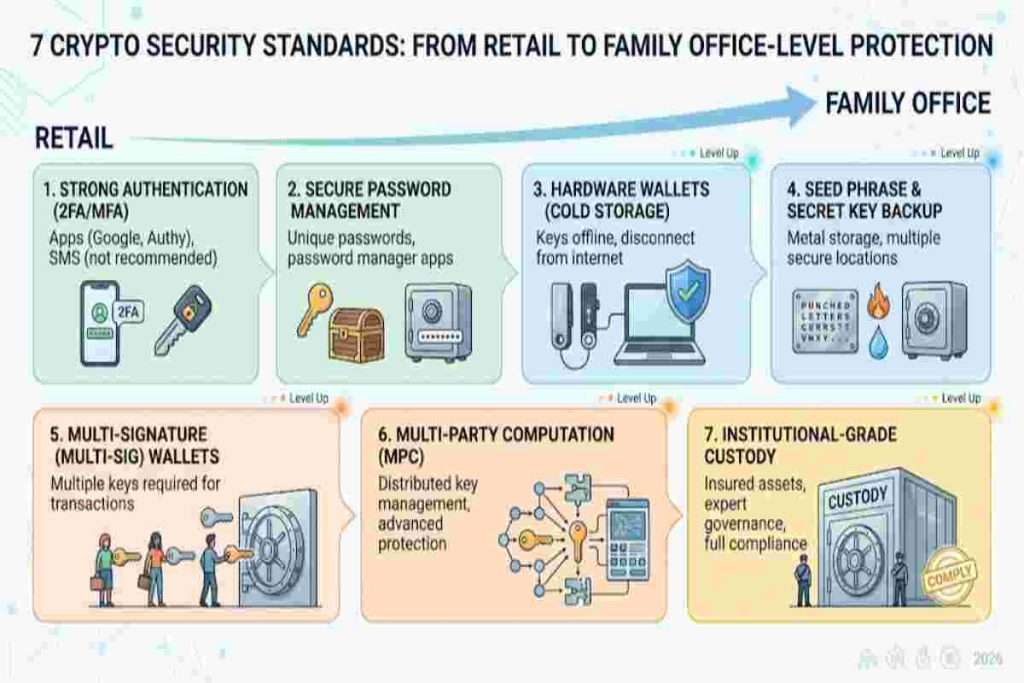
Different cybersecurity frameworks address different layers of the digital-asset security stack. Relying on a single standard to cover key management, cloud resilience, and smart contract execution creates dangerous blind spots. Modern Web3 security requires combining complementary frameworks.
| Framework | Primary Focus Layer | Key Target Audience | Audit Frequency |
|---|---|---|---|
| CCSS | Cryptographic Keys & Wallets | Custodians, Exchanges, Wallet Devs | Annual Third-Party Audit |
| NIST CSF 2.0 | Enterprise Operational Risk | CISOs, Enterprise IT Teams | Continuous Monitoring |
| ISO 27001 | Corporate ISMS Controls | Compliance Officers, Cloud Ops | 3-Year Certification Cycle |
| OWASP SC Top 10 | Smart Contract Source Code | Solidity Developers, Auditors | Per-Deployment & Build |
Establish baseline corporate access controls, endpoint encryption, and operational risk policies before touching on-chain infrastructure.
Deploy hardware security modules (HSMs), multi-party computation (MPC) setups, and strict transaction signing workflows for key storage.
Perform automated static analysis and manual audits on all smart contracts to patch reentrancy, oracle, and logic flaws prior to mainnet launch.

Core security controls establish the physical, cryptographic, and procedural barriers that prevent unauthorized movement of assets. A robust architecture separates key generation, signing authority, and storage environments so that no single compromised credential can lead to a full vault breach.
Tamper-resistant physical hardware designed to generate, store, and manage cryptographic keys in an isolated environment.
Splits private keys into multiple mathematical secret shares held by separate parties without ever combining them in one location.
Smart contract or protocol-level governance requiring $M$-of-$N$ distinct signatures to approve an on-chain transaction.
Offline storage environments with zero direct network interfaces, communicating strictly via QR codes or physical media.
| Tier Type | Primary Technology | Operational Speed | Risk Exposure | Target Allocations |
|---|---|---|---|---|
| Hot Storage | API-Connected Wallet / Cloud KMS | Immediate (Automated) | High (Network Exposed) | < 5% Operational Liquidity |
| Warm Storage | MPC Nodes / Programmable Multisig | Minutes to Hours | Medium (Policy Restricted) | 10% – 20% Treasury / Staking |
| Cold Storage | Air-Gapped HSM / Offline Multisig | 24 to 48 Hours | Near-Zero Network Risk | 75% – 85% Long-Term Assets |
The transaction request is generated and automatically evaluated against withdrawal limits, address whitelists, and velocity constraints.
Required keyholders receive verification requests through independent channels (hardware tokens, mobile push) to authorize payload details.
Once threshold approvals are collected via MPC or Multisig smart contract, the signature is assembled and broadcasted safely to the network.

Even the most secure cryptographic custody setup can fail if operational security (OpSec) is lax or monitoring systems miss early compromise signals. Continuous real-time telemetry combined with an automated incident response plan ensures organizations contain threats before funds leave the ecosystem.
Restricting system privileges to the absolute minimum necessary for daily operations.
Continuous monitoring of vault addresses and smart contract interactions.
Pre-execution validation of state changes before signing on-chain transactions.
Telemetry flags anomalous key activity, contract exploit alerts trigger, or an authorized signer reports device loss. Automated triaging classifies threat severity.
Trigger automated pause functions on smart contracts, revoke compromised allowance approvals, rotate session keys, and isolate compromised signing devices.
Execute emergency multisig sweep protocols to move uncompromised funds from warm/hot vaults directly to air-gapped cold storage.
Conduct root-cause analysis, reconstruct vector timelines via on-chain forensics, patch vulnerabilities, and update operational playbooks.
| Severity Level | Trigger Event | Automated Response | Target Resolution Time |
|---|---|---|---|
| P1 – Critical | Private key compromise / Smart contract active exploit | Pause contract execution & initiate emergency asset sweep | < 15 Minutes |
| P2 – High | Single signer device loss / Phishing attempt detected | Revoke key session & isolate affected IAM accounts | < 2 Hours |
| P3 – Medium | Anomalous gas spikes / Unrecognized contract allowance | Flag transaction for manual out-of-band approval | < 24 Hours |

Institutional digital-asset security requires more than a secure wallet hardware model or strong private key backups. A complete security framework defines how custody, authorization, transaction controls, monitoring, governance, and recovery operate together as a connected, resilient system.
Design security as a system of independent, reinforcing controls. The primary objective is not simply to prevent every possible breach, but to ensure that the failure of any single device, credential, person, or process does not result in a portfolio-wide loss event.
An institutional architecture operates as a series of connected layers. Each layer mitigates specific threat vectors while creating multiple opportunities to prevent, detect, contain, and recover from unauthorized activity.
To prevent single-point operator failures, responsibility for initiating, approving, verifying, and executing high-value transactions should be distributed across distinct operational roles:
Design every control assuming an individual credential, device, or key share will eventually be targeted or lost.
Grant operators and systems only the minimum access level necessary for their immediate function (Principle of Least Privilege).
Validate raw transaction data, smart contract calls, and recipient addresses independently of the requester’s identity.
Isolate treasury holdings, operational hot wallets, and staking environments so that one incident cannot expose the full balance.
Treat unexpected state changes, contract approvals, or login anomalies as immediate security signals requiring review.
Establish key succession plans, disaster recovery scenarios, and emergency response playbooks before incidents occur.
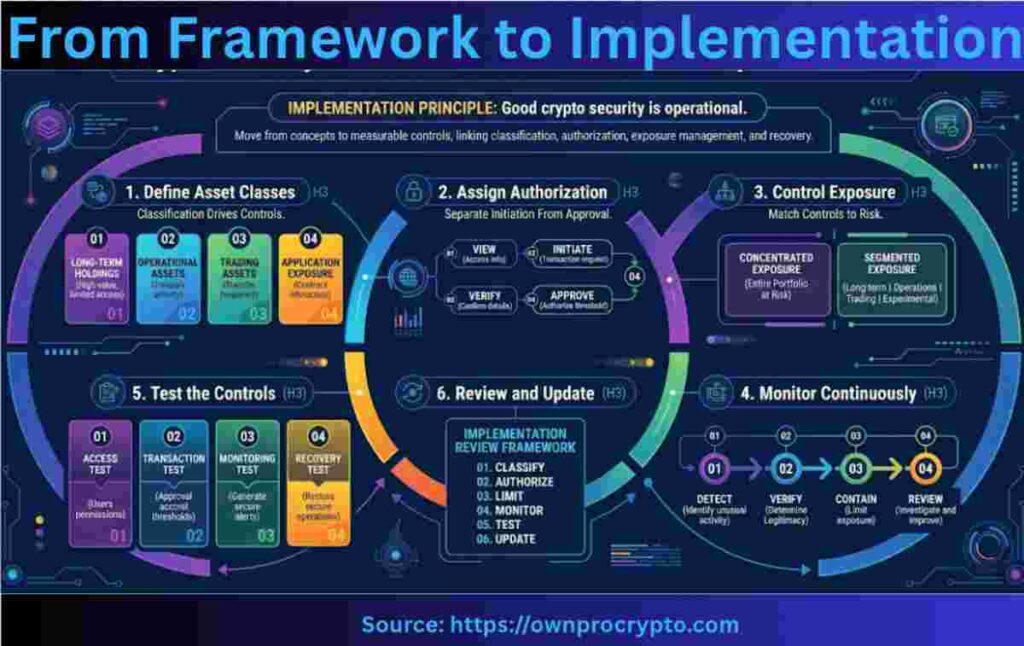
A security framework only becomes meaningful when its principles are translated into specific controls, responsibilities, and operating procedures. Crypto Security Standards should therefore provide a practical method for determining what is protected, who can access it, how transactions are authorized, what activity is monitored, and how the digital-asset environment can recover from failure.
Implementation should be based on the actual risk profile of the portfolio rather than applying identical controls to every wallet, asset, person, or transaction. Higher-value and higher-risk assets generally require stronger authorization, greater separation, additional verification, and more resilient recovery arrangements.
Move from security concepts to measurable controls. Every important asset should have an identified owner, an appropriate custody model, defined authorization requirements, monitoring coverage, and a tested recovery path.
The first implementation step is to identify and classify the digital assets being protected. Classification should consider value, liquidity, purpose, network, ownership, operational frequency, and potential impact if the asset becomes unavailable or compromised.
Asset classification should not become a documentation exercise with no operational consequence. The classification should directly influence custody architecture, transaction limits, access permissions, monitoring requirements, and recovery arrangements.
Every material digital-asset operation should have clearly defined authorization rules. These rules should identify who can access assets, who can initiate transactions, who can approve them, and when additional authorization is required.
Where the value and complexity of the portfolio justify it, the person requesting or preparing a transaction should not be the only person responsible for approving it. Separating these responsibilities reduces the chance that a compromised account, manipulated instruction, or operational mistake can immediately result in an irreversible transfer.
Security controls should limit how much of the portfolio can be affected by a single failure. This can be achieved through asset segregation, custody segmentation, transaction limits, approved destinations, multisignature authorization, time delays, restricted access, and separate operational environments.
One compromised environment may expose a large proportion of the portfolio.
A single incident is more likely to remain contained within a defined security boundary.
Routine transactions can use streamlined controls when the potential loss is limited. Larger, unusual, or higher-risk transactions should trigger stronger verification and authorization requirements. This creates a proportional security model without making every ordinary operation unnecessarily difficult.
Implementation is incomplete without ongoing monitoring. Security operations should be capable of identifying unusual transfers, unexpected account changes, suspicious token approvals, unfamiliar contract activity, abnormal access patterns, and other events that could indicate compromise or unauthorized activity.
A control that appears effective on paper but cannot be used during an emergency does not provide reliable security. Implementation should therefore include practical testing of access controls, transaction approvals, monitoring alerts, backups, recovery procedures, and escalation processes.
A crypto security standard should be treated as an operating process rather than a one-time configuration. Access permissions, custody arrangements, transaction limits, recovery procedures, monitoring rules, and authorized participants should be reviewed as circumstances change.
The final objective of implementation is not simply to produce a security document. It is to establish a repeatable operating standard that connects asset classification, authorization, exposure management, monitoring, testing, and review.
Good crypto security is operational. The standard should clearly define what is protected, who can act, how exposure is limited, how activity is detected, and whether the organization can recover when something goes wrong.
Crypto security is best understood as a system of controls rather than a single product, wallet hardware, or static compliance certificate. A resilient digital asset security program combines domain-specific blockchain requirements with standard cybersecurity governance and application-level defensive practices.
The primary objective is not to follow every framework indiscriminately, but to establish a cohesive security architecture in which critical assets are protected, operational responsibilities are explicitly defined, failure modes are anticipated, and controls can be continuously verified.
Use standards to define security requirements. Use controls to implement them. Use continuous testing and monitoring to verify that they actually work. That is what transforms scattered security efforts into a resilient pillar architecture.
Ensuring long-term asset protection requires combining periodic governance audits with strict operational hygiene. Use this implementation checklist alongside our expert group-wise FAQs to validate your organization’s security posture.
Q: What are crypto security standards?
A: Crypto security standards are structured requirements, frameworks, and control practices used to improve the security of cryptocurrency and digital-asset systems. They address key management, access control, custody, governance, recovery, operations, and application security across the entire life cycle of an asset.
Rooted in Case Study Failure: Ad-hoc security measures without formalized standards frequently leave glaring operational blind spots, resulting in unauthorized internal key access or unmonitored infrastructure access.
Q: What is the CryptoCurrency Security Standard (CCSS)?
A: The CryptoCurrency Security Standard (CCSS) is a cryptocurrency-specific security framework designed for systems that store, manage, or interact with digital assets. It establishes explicit audit tiers covering key and seed generation, key storage, usage, compromise protocols, and operational proof-of-reserve requirements.
Rooted in Case Study Failure: Platforms storing live production private keys in hot-wallet server memory without adhering to CCSS Level 2 or 3 key separation guidelines have suffered devastating total-reserve drains.
Q: Is NIST CSF a crypto security standard?
A: No. The NIST Cybersecurity Framework (NIST CSF 2.0) is a general cybersecurity risk-management framework. While its core functions—Govern, Identify, Protect, Detect, Respond, and Recover—apply effectively to organizations operating digital-asset infrastructure, it was not created specifically for cryptocurrency protocols or private-key management.
Rooted in Case Study Failure: Relying solely on traditional NIST perimeter controls while neglecting blockchain-native smart contract permissions frequently allows attackers to bypass corporate firewalls using valid dApp payload signatures.
Q: Is ISO 27001 a crypto security standard?
A: No. ISO/IEC 27001 is an Information Security Management System (ISMS) standard. It complements cryptocurrency-specific security controls by providing a broader organizational approach to information security governance, vendor management, physical security, and overall risk mitigation.
Rooted in Case Study Failure: Crypto institutions with strong cryptographic key security but lacking ISO 27001 physical and vendor controls have suffered breaches via compromised employee laptops and rogue insider access.
Q: Is MPC more secure than Multi-Sig?
A: Neither architecture is automatically more secure in every situation. Security depends on the implementation, threat model, governance process, recovery design, chain environment, and operational controls. Multi-Sig offers explicit on-chain transparency, whereas Multi-Party Computation (MPC) keeps signing logic off-chain and reduces gas costs. MPC and Multi-Sig should be evaluated based on the organization’s specific technical and policy requirements.
Rooted in Case Study Failure: Deploying an overly complex MPC setup without out-of-band quorum policies allowed malicious signers to collude off-chain, proving that architectural selection cannot replace rigorous operational governance.
Q: Why are hardware security modules (HSMs) preferred for institutional cold storage?
A: HSMs offer tamper-resistant physical protection with FIPS 140-3 compliance that automatically zeroizes (erases) private keys if physical tampering, electromagnetic probing, or extreme temperature variations are detected.
Rooted in Case Study Failure: Storing unencrypted private keys on standard cloud instances led to the total drain of multiple centralized exchanges during routine server updates.
Q: What is the OWASP Smart Contract Top 10?
A: The OWASP Smart Contract Top 10 is a security awareness and assessment reference focused on major smart-contract vulnerabilities. It covers critical risk categories such as access control flaws, business logic errors, oracle manipulation, reentrancy attacks, and upgradeability risks.
Rooted in Case Study Failure: Protocols failing to check oracle freshness and liquidity depth against OWASP guidelines suffered multi-million-dollar flash-loan price manipulation exploits.
Q: How do transaction dry-run simulations prevent drainer attacks?
A: Dry-run engines simulate state changes on a fork of the network before a transaction is signed. This exposes exact token movements, approval grants, and potential asset-draining call routines before any network fees or execution calls occur.
Rooted in Case Study Failure: Users approving blind permit2 signatures without state tracing lost millions to malicious phishing dApps operating fake reward claims.
Q: Do security standards prevent crypto hacks?
A: No. Standards reduce risk by establishing structured controls and security processes, but they cannot eliminate every vulnerability or attack vector. Effective security requires continuous real-time monitoring, threat testing, strict governance, and adaptive incident response.
Rooted in Case Study Failure: Treating security as a static checklist item rather than an evolving process caused audited projects to fall victim to newly discovered zero-day reentrancy patterns.
Q: How often should crypto security controls be reviewed?
A: Controls should be reviewed whenever there are significant changes to wallets, custody architecture, smart contracts, infrastructure, personnel, vendors, or threat conditions. Organizations should also establish a recurring formal review schedule (at least quarterly).
Rooted in Case Study Failure: Protocols that failed to update wallet permission hierarchies after team departures enabled former employees to access multi-sig operational funds months later.
Q: How can organizations mitigate social engineering and SIM-swapping risks?
A: Organizations must completely eliminate SMS-based two-factor authentication in favor of hardware security keys (FIDO2/YubiKey) and implement out-of-band verification steps for all administrative and withdrawal privilege updates.
Rooted in Case Study Failure: Corporate social-media hijackings and unauthorized vault access frequently stem from targeted SIM-swap attacks on key personnel relying on SMS 2FA.
To explore implementation guidelines beyond compliance principles, access our interactive security tools, detailed technical cluster guides, and official primary sources below.
Interactive decision engine to help evaluate key authorization, multisig schemes, and threshold signing architecture for institutional custody.
An in-depth technical analysis of threshold governance, institutional wallet custody models, and key recovery frameworks.
Broader asset-protection playbook translating compliance standards into practical, protocol-level digital asset security practices.
Practical implementation and tooling directory covering dApp approval monitoring, smart contract dry-run tools, and scam detection.
Official primary-source technical publication (NIST IR 8475: A Security Perspective on the Web3 Paradigm) detailing foundational cybersecurity architecture considerations for decentralized protocols.
Looking for a specific topic, research area, or article? Explore the wider OwnProCrypto research library.