
Search by title, topic or phrase
Use our Crypto Search Engine 🔍 to find the topics and keywords you're looking for.

Table of Contents
ToggleCross-Chain Bridge Quantum Risk is becoming a critical concern as the future of Web3 moves beyond a single blockchain.
Modern decentralized applications increasingly rely on interconnected Layer 1 networks, Layer 2 rollups, application-specific chains, and decentralized services that communicate seamlessly across ecosystems.
This multi-chain environment creates enormous opportunities:
However, every connection between independent blockchains creates a new security boundary.
This is where cross-chain bridges become one of the highest quantum risk areas in blockchain infrastructure.
Unlike a single blockchain that protects its own state through internal consensus, bridges must verify information coming from another network. To achieve this, many existing bridge systems rely on:
These mechanisms work effectively against current attackers, but many depend on cryptographic algorithms that may become vulnerable to future quantum computers.
A traditional blockchain has one primary security boundary.
For example:
Single Blockchain Model
Users
 ▼
Blockchain Consensus
 ▼
Finalized State
The network controls its own validation process.
A cross-chain bridge introduces additional trust layers:
Multi-Chain Bridge Model
Blockchain A
     ▼
Bridge Validators
(Relayers + Signatures)
     ▼
Blockchain B
Each additional verification layer creates another possible attack surface.
| Security Layer | Traditional Blockchain | Cross-Chain Bridge |
|---|---|---|
| Transaction validation | Native validators | External verification |
| Asset security | Internal consensus | Custodian or committee trust |
| Authentication | Network keys | Multiple external keys |
| Attack surface | Limited | Multiple connected systems |
| Quantum exposure | Protocol dependent | Multiplied across networks |
The bridge does not only protect one blockchain.
It protects the relationship between multiple blockchain ecosystems.
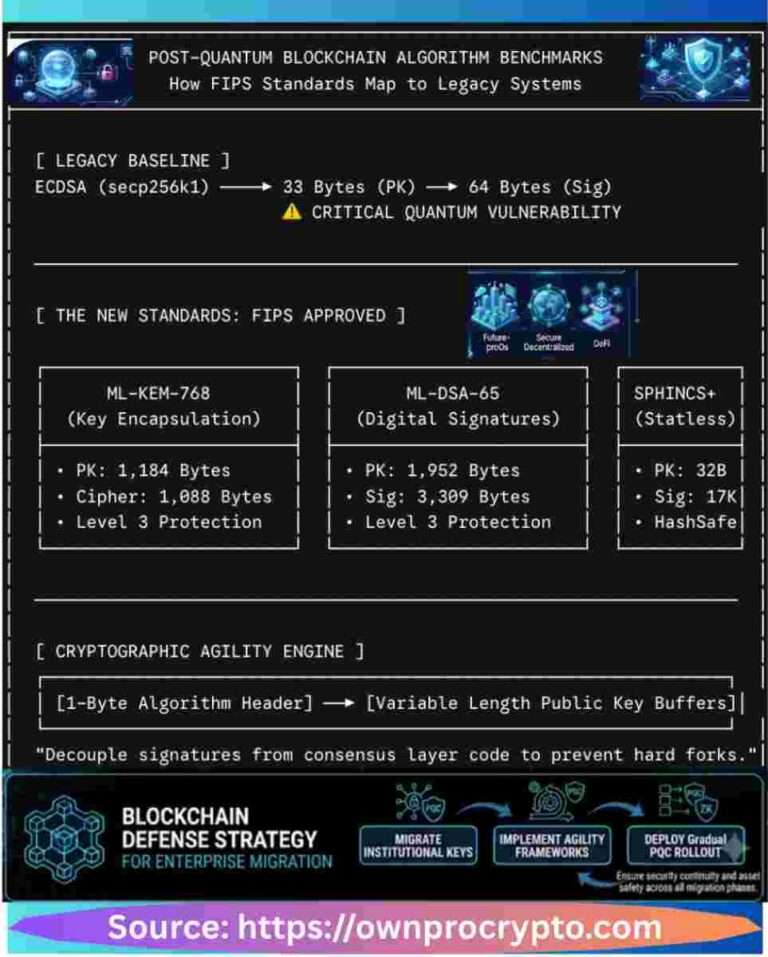
Most existing bridge designs depend on digital signatures.
A validator signs a message:
“Asset locked on Chain A. Release equivalent asset on Chain B.”
The destination chain accepts this message because it trusts the validator signatures.
The problem appears when those signatures rely on classical algorithms such as:
A sufficiently powerful quantum computer could theoretically recover private keys from exposed public keys using Shor’s algorithm.
This means an attacker may not need to exploit bridge code.
They may attack the mathematical foundation securing bridge authorization.
Current Bridge Architecture
Source Chain
     ▼
Validator Committee
(ECDSA Multi-Signature)
     ▼
Destination Chain

Quantum Attack:
Validator Public Keys Exposed
          ▼
Quantum Key Recovery
          ▼
Fake Bridge Approval
          ▼
Unauthorized Asset Release
A successful attack could result in:
| Impact Area | Possible Result |
|---|---|
| Locked assets | Direct theft |
| Wrapped tokens | Supply manipulation |
| Bridge liquidity | Complete drainage |
| User trust | Ecosystem collapse |
| Connected chains | Contagious failures |
Multi-signature security improves protection against traditional attacks because attackers must compromise multiple keys.
For example:
A bridge may require:
5 out of 9 validators to approve transactions
Under classical security assumptions:
Quantum computing changes this equation.
If the underlying cryptography is broken, the attacker may recover multiple validator keys through computation rather than traditional intrusion.
| Bridge Security Model | Classical Security | Quantum Risk |
|---|---|---|
| Single signature | Weak | Critical |
| Multi-signature | Stronger | High |
| Threshold signatures | Stronger | High |
| Quantum-resistant verification | Future-ready | Low |
The issue is not the number of signatures.
The issue is the mathematical security behind those signatures.
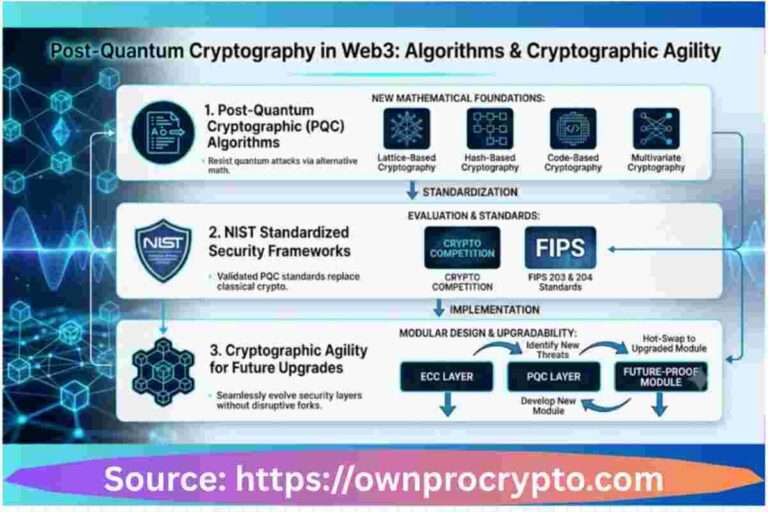
The future of cross-chain security is moving toward systems that require less trust in external validators.
Instead of asking:
Do enough bridge operators approve this message?
The future model asks:
Can this blockchain mathematically verify that this state transition happened?
This shift creates a more secure interoperability model.
| Feature | Legacy Bridge | Post-Quantum Bridge |
|---|---|---|
| Security model | Trusted committees | Mathematical verification |
| Authentication | Classical signatures | PQC signatures |
| Message validation | External approval | Cryptographic proof |
| Key dependency | High | Reduced |
| Quantum resistance | Limited | Designed for future threats |
                 Chain A
                    ▼
        Post-Quantum Proof Generation
                    ▼
┌────────────────────────────────┐
 │ Quantum-Safe Verification Layer │
 │                                │
 │ ML-DSA Signatures               │
 │ Hash-Based Proof Systems        │
 │ Zero-Knowledge Verification     │
 └────────────────────────────────┘
                 Chain B
Future interoperability systems are expected to combine:
Zero-knowledge technology changes how blockchains communicate.
Instead of relying on a group of validators saying:
We confirm this happened.
A receiving blockchain can verify:
The mathematical proof shows this happened.
This removes many centralized trust assumptions.
However, quantum resistance depends on the underlying cryptography.
| ZK Technology | Quantum Position |
|---|---|
| Hash-based STARK systems | Strong quantum resistance |
| Elliptic curve SNARK systems | Requires migration |
| Lattice-based ZK systems | Emerging post-quantum option |
For long-term interoperability, quantum-resistant proof systems will become increasingly important.
Cross-chain communication is not limited to independent Layer 1 networks.
Layer 2 ecosystems also depend heavily on interoperability infrastructure.
Rollups inherit settlement security from their underlying Layer 1 networks, but they still depend on additional components:
A quantum-safe Layer 1 does not automatically protect every connected application.
              Application Layer
                    ▼
              Layer 2 Rollup
                    ▼
        Quantum-Safe Layer 1 Settlement
                    ▼
             Final Blockchain State
Each layer requires its own cryptographic review.
Cross-chain bridges have already become one of the most attacked areas in Web3.
Before quantum computing becomes a practical threat, bridge systems have already demonstrated their weakness through:
Quantum computing introduces a new layer of risk because it can target the cryptographic keys that many bridge systems depend on.
The difference is important:
| Traditional Bridge Attack | Quantum Bridge Attack |
|---|---|
| Exploits software bugs | Exploits mathematical weaknesses |
| Requires hacking infrastructure | Targets cryptographic assumptions |
| Often limited by access controls | Could bypass signature security |
| Human error is common | Algorithm failure becomes the weakness |
The future challenge is not only protecting bridge code.
It is protecting the cryptographic trust model behind bridge communication.
Different bridge designs have different levels of quantum exposure.
| Bridge Architecture | How It Works | Quantum Risk Level | Future Upgrade Path |
|---|---|---|---|
| Multisignature Bridge | Validators approve cross-chain transfers | Very High | Replace signatures with PQC verification |
| Threshold Signature Bridge | Distributed key signing | High | Hybrid PQC threshold signatures |
| Light Client Bridge | Verifies another chain’s state | Medium | Upgrade proof verification |
| Atomic Swap | Uses hash-based conditions | Lower | Increase hash security parameters |
| ZK-Based Bridge | Uses cryptographic proofs | Lowest potential risk | Deploy quantum-resistant proof systems |
The most vulnerable systems are those where asset security depends heavily on a small group of signing keys.
The most common bridge model is the lock-and-mint system.
The process works like this:
Example:
User Deposits ETH
        ▼
Bridge Contract Locks Asset
        ▼
Validators Sign Confirmation
        ▼
Wrapped Asset Created
        ▼
User Receives Token on Another Chain
The security dependency is the validator signature.
If attackers compromise enough validator keys, they can create false confirmations.
Quantum-resistant migration requires replacing this model with stronger verification methods.
Atomic swaps use a different approach.
Instead of trusting a validator committee, they rely on cryptographic conditions through Hash Time-Locked Contracts (HTLCs).
The security model depends mainly on hash functions rather than public-key cryptography.
| Feature | Multisig Bridge | Atomic Swap |
|---|---|---|
| Trust requirement | Validator committee | Mathematical conditions |
| Main security primitive | Digital signatures | Hash functions |
| Quantum exposure | High | Lower |
| Scalability | Higher complexity | Limited |
| Interoperability flexibility | Broad | More restricted |
Hash-based systems are generally more resistant to Shor’s algorithm, although broader system design still requires careful security analysis.
One of the strongest directions for post-quantum interoperability is the use of zero-knowledge light clients.
Instead of trusting bridge operators, the destination chain verifies proof that another blockchain reached a specific state.
The architecture changes from:
Trust these validators
to:
Verify this mathematical proof.
Traditional Bridge
Blockchain A
      ▼
Trusted Validators
      ▼
Blockchain B

Future ZK Bridge
Blockchain A
      ▼
State Proof Generation
      ▼
Proof Verification
      ▼
Blockchain B
Advantages include:
For future quantum-resistant systems, the verification layer itself must also move toward quantum-safe cryptographic assumptions.
Bridge migration should happen gradually.
A realistic transition includes three stages.
| Migration Phase | Main Objective | Implementation |
|---|---|---|
| Phase 1: Assessment | Discover vulnerabilities | Audit bridge keys, validators, cryptographic dependencies |
| Phase 2: Hybrid Security | Maintain compatibility | Add PQC signatures alongside existing systems |
| Phase 3: Native PQ Interoperability | Remove quantum weaknesses | Deploy quantum-safe verification architecture |
Teams should identify:
A complete Cryptographic Bill of Materials (CBOM) helps organizations understand exactly where vulnerable cryptography exists.
During migration, bridges should avoid immediate replacement of existing systems.
Hybrid security combines:
Example:
Bridge Message Approval
        ├── ECDSA Verification
        └── ML-DSA Verification
        │
        ▼
Transaction Accepted
This approach provides compatibility while introducing quantum-resistant protection.
The final goal is removing dependency on vulnerable algorithms.
Future bridges may use:
The objective is not just a safer bridge.
The objective is a more resilient multi-chain ecosystem.
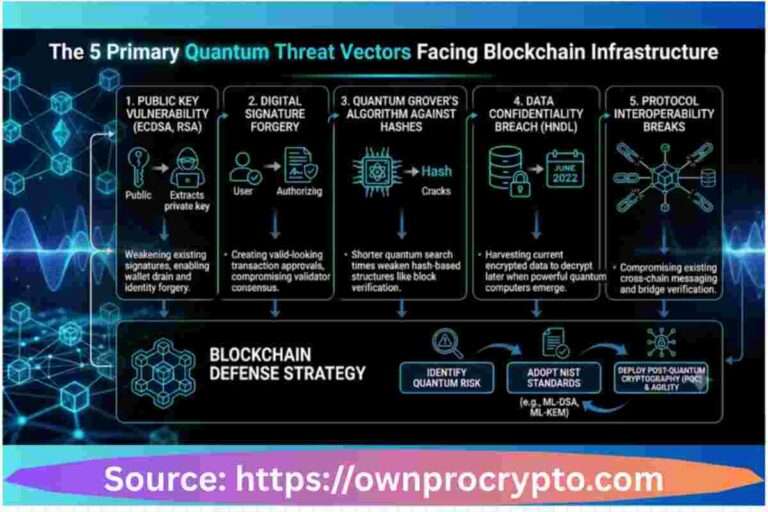
The assessment process is designed to make advanced blockchain security easier to understand.
Users begin by selecting their blockchain environment, infrastructure type, and security components. The Quantum-Resistant Blockchains Toolkit then evaluates factors such as cryptographic algorithms, validator models, bridge usage, custody design, and migration readiness.
After analysis, the system provides:
This approach helps technical teams, investors, and organizations make informed decisions without needing to manually analyze every cryptographic dependency. Tab to Access Quantum-Resistant Threats in Blockchain.
As blockchain ecosystems become increasingly interconnected, Cross-Chain Bridge Quantum Risk will play a central role in the future of Web3 security. Protecting cross-chain bridges will require more than incremental security updates, it will demand quantum-resistant cryptography, stronger validation mechanisms, and coordinated upgrades across multiple blockchain networks. Organizations that begin preparing today will be better positioned to maintain secure interoperability and protect digital assets as quantum computing capabilities continue to advance.
| Security Area | Recommended Action |
|---|---|
| Validator keys | Migrate toward PQC signatures |
| Bridge contracts | Add upgradeable verification modules |
| Relayers | Replace classical authentication |
| Messaging systems | Implement quantum-safe encryption |
| Governance controls | Protect administrative keys |
| Monitoring | Detect abnormal cryptographic behavior |
Cross-Chain Bridge Quantum Risk represent one of the largest quantum risk concentrations in Web3 because they combine:
The next generation of interoperability will likely move away from signature-based trust models and toward proof-based verification.
Cross-Chain Bridge Quantum Risk will not simply be stronger versions of today’s bridges risk.
They will represent a new security architecture built around:
Q: Why are Cross-Chain Bridge Quantum Risk more vulnerable to quantum attacks than normal blockchain transactions?
Cross-Chain Bridge Quantum Risk usually depend on external validators or signing committees. A quantum attacker targeting those keys could affect multiple connected ecosystems at once.
Q: Can existing multisignature bridges become quantum resistant?
Yes, but they require significant upgrades. Simply adding more signatures does not solve the underlying cryptographic weakness.
Q: Are all blockchain bridges vulnerable to quantum attacks?
No. Risk depends on the cryptographic design. Systems using hash-based verification or advanced proof systems may have stronger quantum resistance.
Q: Why are validator committees dangerous in the quantum era?
They create concentrated key targets. If enough validator keys are compromised, attackers may authorize fraudulent bridge transactions.
Q: Are zero-knowledge bridges safer against quantum computers?
Potentially. Their security depends on the underlying cryptographic primitives. Hash-based proof systems generally provide stronger quantum resistance than elliptic curve-based systems.
Q: What happens if a major bridge is compromised after quantum computers arrive?
Attackers could potentially create unauthorized transfers, drain locked assets, or manipulate cross-chain communication.
Q: Can Layer 2 networks inherit quantum security from Layer 1 blockchains?
They inherit settlement security, but local components such as bridges, sequencers, and oracles require separate upgrades.
Q: Why is cryptographic agility important for bridge systems?
Because future algorithms may need replacement. Agile systems can upgrade security without rebuilding the entire interoperability layer.
Q: Are atomic swaps completely quantum safe?
They reduce dependence on vulnerable public-key signatures, but complete security depends on the overall protocol design.
Q: What is the biggest first step for bridge developers?
Perform a complete cryptographic audit and identify every classical signature dependency.
Q: Will post-quantum bridges reduce Web3 scalability?
They may introduce larger proofs and signatures, but optimization and hardware improvements can reduce performance impact.
Continue exploring the complete quantum-resistant blockchain security series:
Quantum-Resistant Blockchains (2026): Securing Web3 Against the Post-Quantum Era
Post-Quantum Cryptography in Web3: Algorithms & Cryptographic Agility
Learn how ML-KEM, ML-DSA, lattice cryptography, and cryptographic agility shape future blockchain security.
The 5 Primary Quantum Threat Vectors Facing Blockchain Infrastructure
Explore wallet attacks, validator compromise, HNDL risks, and future blockchain vulnerabilities.
Multi-Chain Interoperability: Why Cross-Chain Bridges Face the Highest Quantum Risk
We are here : Understand why bridges represent one of the most critical quantum attack surfaces.
The Enterprise Guide to Post-Quantum Blockchain Migration
Discover migration planning, hybrid deployment strategies, and enterprise readiness frameworks.
Crypto Security Hub (2026): Complete Guide to Digital Asset Protection
Anchor: “future digital asset security”
Cross-Chain Blockchain Security: Protecting Bridges & Rollups (2026 Guide)
Anchor: “cross-chain security risks”
Blockchain Interoperability: AI Agents & Cross-Chain Connectivity (2026)
Anchor: “next-generation blockchain interoperability”
Crypto Self-Custody Security Toolkit: Protect Your Digital Assets
Anchor: “self-custody security framework”
MPC vs Multi-Sig vs HSM Custody: Crypto Security Comparison (2026)
Anchor: “institutional custody security models”
The future of Quantum-Resistant Blockchains depends on trusted cryptographic standards that can withstand both classical and quantum attacks. The National Institute of Standards and Technology (NIST) leads the global effort by publishing the official Federal Information Processing Standards (FIPS 203, FIPS 204, and FIPS 205) for post-quantum cryptography. Blockchain developers, security researchers, and enterprise teams should follow these standards to ensure their networks remain compatible with future cryptographic requirements.
Official Resource:
https://csrc.nist.gov/projects/post-quantum-cryptography
Creating secure Quantum-Resistant Blockchains requires more than adopting new cryptographic algorithms. Organizations must also develop cryptographic agility, inventory vulnerable systems, and prepare long-term migration strategies. The Cybersecurity and Infrastructure Security Agency (CISA) publishes practical guidance to help enterprises and infrastructure providers prepare for the transition to post-quantum security.
Official Resource:
https://www.cisa.gov/quantum
The development of Quantum-Resistant Blockchains is closely tied to advances in quantum computing research. Organizations such as IBM Quantum and Google Quantum AI regularly publish research on scalable quantum hardware, error correction, and future computing capabilities. Following credible research helps developers better understand why blockchain networks are preparing years in advance for the arrival of cryptographically relevant quantum computers.
Official Resources:
IBM Quantum
https://www.ibm.com/quantum
Google Quantum AI
https://quantumai.google