
Search by title, topic or phrase
Use our Crypto Search Engine 🔍 to find the topics and keywords you're looking for.
Quantum computing will not break blockchain itself. It challenges the cryptographic systems that prove ownership, authorize transactions, and secure decentralized infrastructure. Quantum-resistant blockchains represent the next security evolution of Web3.
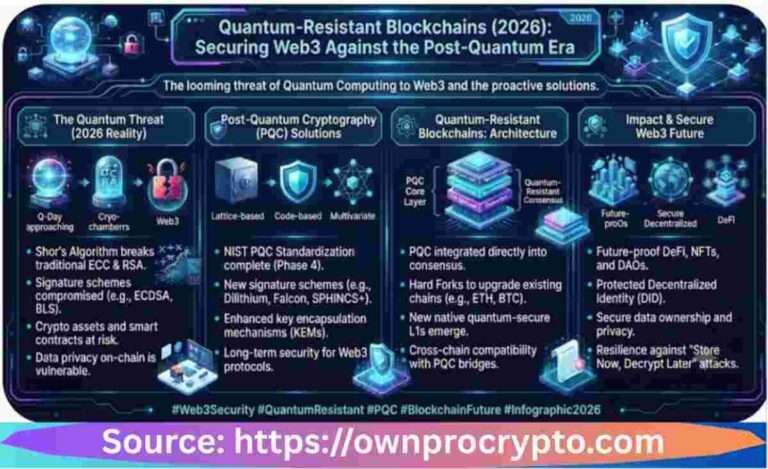
Table of Contents
ToggleBlockchain security has always depended on one critical foundation: mathematics.
Bitcoin introduced decentralized ownership without banks. Smart contract platforms transformed blockchains into programmable financial systems. Layer 2 networks improved scalability, while cross-chain infrastructure connected independent ecosystems into a global Web3 economy.
However, the next major security challenge facing blockchain is not another smart contract exploit, exchange failure, or bridge attack.
It is the possibility that future quantum computers could break the cryptographic algorithms protecting digital ownership itself.
Quantum-resistant blockchain technology represent the next generation of decentralized infrastructure designed to survive the post-quantum era. Instead of relying on traditional cryptography such as Elliptic Curve Cryptography (ECC), these networks are being designed around post-quantum cryptographic algorithms that remain secure against both classical and quantum computing threats.
The goal is not to replace blockchain technology.
The goal is to upgrade the mathematical security layer underneath it.
Current blockchain networks depend heavily on public-key cryptography.
This cryptography allows users to:
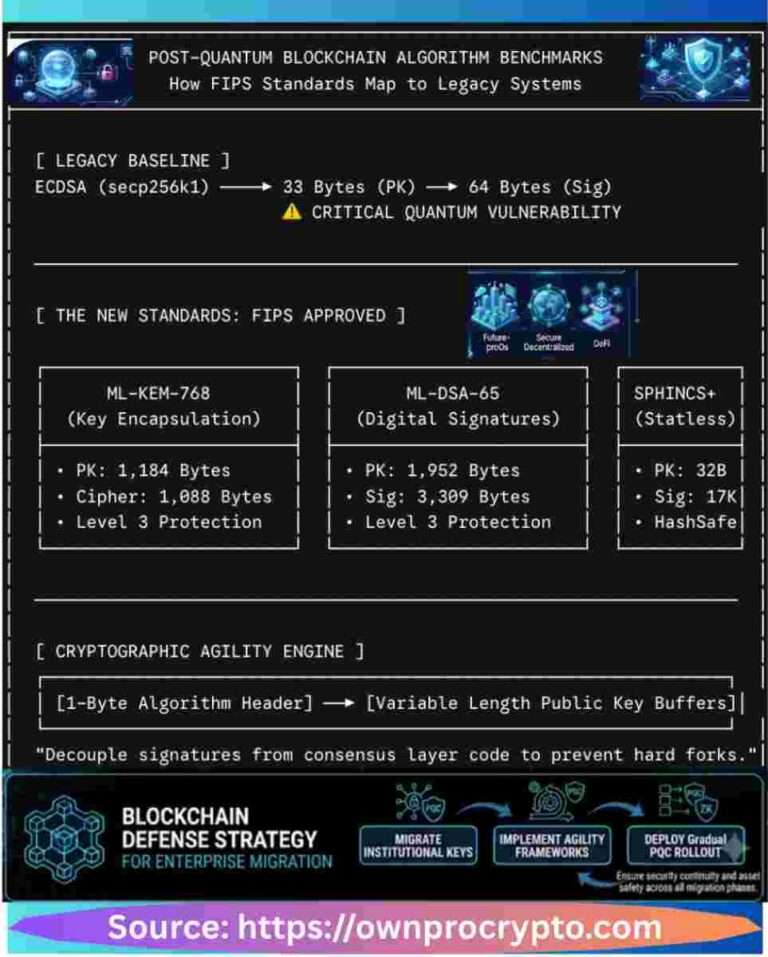
Today, algorithms such as ECDSA, RSA, and Ed25519 remain secure against classical computers.
The problem is that sufficiently powerful quantum computers could use algorithms such as Shor’s algorithm to solve mathematical problems that these systems depend on.
A future quantum attacker could potentially:
| Blockchain Function | Current Technology | Quantum Risk | Future Upgrade |
|---|---|---|---|
| Transaction Signatures | ECDSA, Ed25519 | Private key recovery through quantum algorithms | ML-DSA, FN-DSA |
| Wallet Ownership | Elliptic Curve Cryptography | Public key exposure risk | Lattice-based signatures |
| Validator Authentication | Classical public keys | Validator impersonation | Quantum-safe validator keys |
| Cross-Chain Security | Multi-signature verification | Bridge key compromise | Zero-trust verification |
| Digital Identity | Traditional asymmetric keys | Identity forgery | Post-quantum authentication |
A quantum-resistant blockchain is a blockchain network that uses cryptographic systems designed to withstand attacks from future quantum computers.
The blockchain architecture remains familiar:
The major change happens at the cryptographic layer.
Traditional blockchain:
User Wallet
     ↓
Private Key
     ↓
ECDSA / ECC Signature
     ↓
Blockchain Verification
Quantum-resistant blockchain:
User Wallet
     ↓
Post-Quantum Private Key
     ↓
ML-DSA / Hash-Based Signature
     ↓
Quantum-Safe Blockchain Verification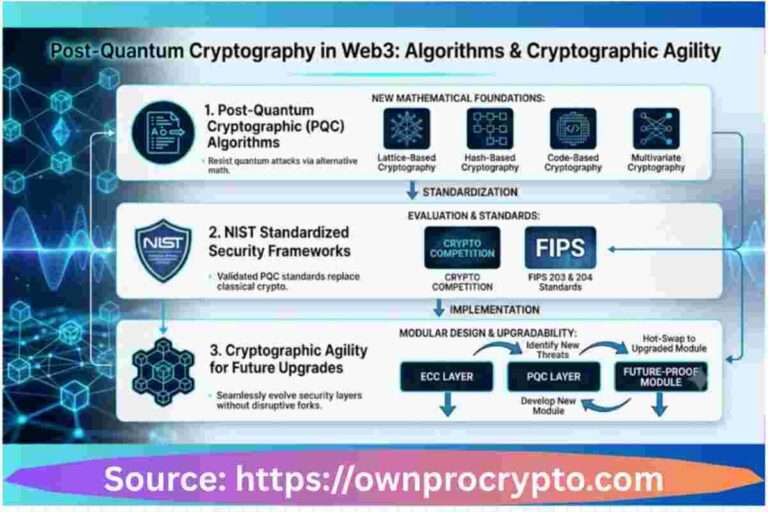
Post-quantum cryptography (PQC) replaces vulnerable mathematical structures with alternatives designed to resist quantum attacks.
The main cryptographic families include:
| Cryptographic Family | Security Foundation | Blockchain Applications |
| Lattice-Based Cryptography | Learning With Errors (LWE) problems | Wallets, validators, signatures |
| Hash-Based Cryptography | Secure hash functions | Long-term signatures, governance keys |
| Code-Based Cryptography | Error-correcting codes | Secure communication systems |
| Multivariate Cryptography | Polynomial equation systems | Specialized authentication |
The transition toward quantum-resistant blockchain infrastructure is strongly influenced by standards developed by the National Institute of Standards and Technology (NIST).
The major algorithms include:
| Standard | Algorithm | Purpose | Blockchain Use |
| FIPS 203 | ML-KEM | Secure key exchange | Validator communication, secure channels |
| FIPS 204 | ML-DSA | Digital signatures | Wallets and transactions |
| FIPS 205 | SLH-DSA | Hash-based signatures | Long-term security applications |
Blockchain networks cannot upgrade their security overnight.
A global migration requires:
This creates a timing challenge known as the “Harvest Now, Decrypt Later” risk.
Attackers can collect encrypted information today and attempt to decrypt it once quantum computers become powerful enough.
For blockchain systems managing assets, identities, and financial records that must remain secure for decades, migration preparation must happen before the threat becomes practical.
| Period | Expected Development |
| Today | Blockchain networks remain secure against classical attacks |
| 2026–2028 | Large-scale PQC migration planning and hybrid deployments |
| 2029–2030 | Potential quantum threat window for vulnerable cryptography |
| 2030+ | Full transition toward quantum-safe infrastructure |
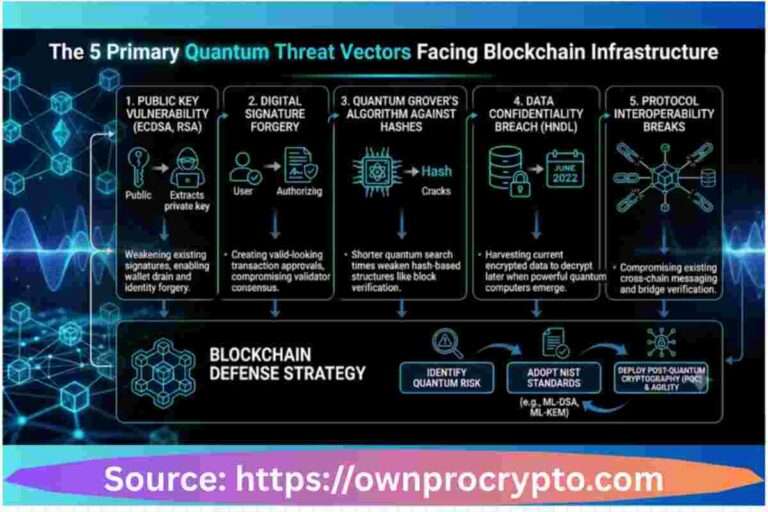
Quantum attacks will not affect every blockchain component equally. Attackers will target areas where cryptographic keys control valuable assets or network authority.
The largest concern is direct wallet compromise.
If quantum computers become capable of breaking elliptic curve cryptography, attackers could derive private keys from exposed public keys and authorize fraudulent transactions.
Potential impact:
Proof-of-Stake networks depend on validator signatures to confirm blockchain activity.
A quantum attacker who compromises validator keys could potentially:
Validator migration is therefore a critical part of post-quantum blockchain planning.
Cross-chain bridges are especially sensitive because they often control large amounts of locked liquidity.
Many bridge designs rely on:
Quantum attacks against these systems could allow attackers to forge bridge approvals and move unauthorized assets.
A future-ready bridge architecture will likely depend more on:
DAO governance depends on cryptographic voting authorization.
If governance keys become vulnerable, attackers could:
Quantum-resistant governance systems will require upgradeable authorization frameworks.
The Harvest Now, Decrypt Later (HNDL) model creates a unique challenge.
Attackers can collect encrypted information today and attempt to decrypt it when quantum systems become powerful enough.
Sensitive Web3 data may include:
Organizations with long-term security requirements must begin migration before the threat becomes active.
Replacing blockchain cryptography is not a simple wallet update.
A complete migration affects:
A practical migration roadmap usually follows three stages.
Organizations identify:
Many enterprises begin by creating a Cryptographic Bill of Materials (CBOM) to track every cryptographic dependency.
During the transition period, many networks will use hybrid security models.
A hybrid transaction may require:
This approach maintains compatibility while introducing quantum-resistant protection.
The final stage removes dependence on vulnerable algorithms.
Future blockchain systems may use:
One of the most important principles of post-quantum blockchain security design is cryptographic agility.
Cryptographic agility means a system can replace its cryptographic algorithms without rebuilding the entire network.
For Web3 developers, this means:
The future of blockchain security depends not only on choosing the right algorithm today, but also on the ability to adapt tomorrow.
The most important design principle for future blockchain networks is cryptographic agility.
Instead of permanently locking protocols into one algorithm, blockchain systems must be designed so cryptographic methods can be upgraded without rebuilding the entire network.
A quantum-ready blockchain should support:
This approach ensures Web3 can adapt as quantum computing continues to evolve.
The transition to quantum-resistant blockchain networks represents the most significant cryptographic upgrade in the history of decentralized technology. It is not merely an optional security feature; it is an essential architectural evolution required to preserve the foundational promise of decentralized trust, digital property rights, and global financial security. Networks that proactively embrace cryptographic agility and transition their core layers early will emerge as the secure, trusted foundations of the post-quantum digital economy.
Prioritize cryptographic agility in your application design. Utilize modular account abstraction, avoid hardcoding legacy cryptographic algorithms, and design your smart contracts to accommodate larger signature and key sizes.
Conduct a comprehensive cryptographic inventory and discovery audit across your digital asset operations. Assess your exposure to harvest-now-decrypt-later risks, deploy hybrid signatures for custody routing, and prioritize security partnerships with quantum-ready networks.
Look beyond short-term metrics like transaction speed or marketing hype. Evaluate projects based on their long-term cryptographic resilience, the maturity of their development roadmaps, and their active plans for quantum-safe infrastructure transitions.
Collaboratively establish standardized, highly efficient post-quantum cryptographic primitives. By working together to solve the performance trade-offs of larger signature sizes, we can ensure the decentralized web remains secure, fast, and accessible for decades to come.
To prepare your technology stack for the post-quantum era, prioritize these actions across the key development horizons:
Wallet Security
Smart Contracts
Cross-Chain Systems
Validators
Oracles
Governance
Compliance
Q: What are quantum-resistant blockchains?
A: A quantum-resistant blockchain is a decentralized ledger that utilizes advanced, post-quantum cryptographic algorithms (such as lattice-based or hash-based cryptography) designed to remain completely secure against attacks from both classical and future quantum computers.
Rooted in Case Study Failure: Foundational architecture.
Q: Will quantum computers break Bitcoin and Ethereum?
A: Not today. While current quantum computers are not powerful enough to compromise the elliptic curve cryptography (ECDSA) securing Bitcoin and Ethereum, a future, cryptographically relevant quantum computer could theoretically do so if these networks fail to upgrade their signature layers over the coming decade.
Rooted in Case Study Failure: Case Study 1 demonstrates that institutions are migrating treasuries to hybrid signatures early because waiting until a practical quantum computer is built creates an immediate security crisis.
Q: Why does Web3 need post-quantum cryptography?
A: Web3 relies entirely on public-key cryptography to prove ownership of digital assets. Because quantum computers can use Shor’s algorithm to easily reverse-engineer private keys from public keys, Web3 must transition to post-quantum cryptography to prevent mass-unauthorized asset theft and network compromise.
Rooted in Case Study Failure: Foundational concept.
Q: What is the biggest quantum threat to crypto?
A: The most immediate and critical threat is the “Harvest Now, Decrypt Later” (HNDL) risk. Attackers can record and store encrypted on-chain transactions and communications today, waiting to decrypt them retroactively once powerful quantum computers become operational.
Rooted in Case Study Failure: Case Study 1 explicitly addressed this threat vector by migrating historical institutional digital asset records to quantum-safe storage ahead of schedule.
Q: Are blockchain bridges vulnerable to quantum attacks?
A: Yes, exceptionally so. Most bridge designs rely heavily on centralized multi-signature committees or validator keys. If a quantum computer can easily forge these signatures, an attacker can instantly drain the entire collateral reserve of the bridge.
Rooted in Case Study Failure: Case Study 1 and Case Study 2 mitigated bridge risks by transitioning to trustless, zero-knowledge message verification models rather than signature-dependent custodial bridges.
Q: Can existing blockchains become quantum-resistant?
A: Yes. Existing blockchains can achieve quantum resistance by executing coordinated protocol upgrades (soft or hard forks) to support post-quantum signature schemes and enabling user account migrations through cryptographic agility.
Rooted in Case Study Failure: Case Study 2 utilized modular smart contract security layers to enable upgradeable signature verification without completely redeploying the core lending protocols.
Q: Does quantum resistance reduce blockchain performance?
A: Yes, in the near-term. Post-quantum cryptographic keys and signatures are substantially larger than classical elliptic curve keys (often several kilobytes vs. 32-64 bytes). This increased size requires more on-chain storage, larger transaction payload sizes, and higher gas fees.
Rooted in Case Study Failure: Operational performance trade-offs.
Q: Is quantum security only important for large institutions?
A: No. While large institutions managing billions of dollars in treasury assets face the highest immediate compliance and operational risks, individual retail users must eventually adopt quantum-safe wallets to protect their personal digital assets from future unauthorized key extraction.
Rooted in Case Study Failure: Case Study 1 (Institutional Migration) and Case Study 2 (DeFi Ecosystem) both show that security must extend from institutional vaults all the way down to retail dApp governance and user wallets.
Q: When should organizations prepare?
A: Preparation should begin immediately. Because mapping cryptographic dependencies, upgrading smart contracts, and migrating custody protocols takes several years of planning and execution, organizations must act now to avoid being caught unprepared.
Rooted in Case Study Failure: Case Study 1 highlights that planning a multi-phase institutional treasury migration required a systematic approach years before active threats materialized.
Q: Is quantum-resistant blockchain the future of Web3 security?
A: Unquestionably. As computational capabilities advance, standard public-key cryptography will be completely deprecated. Quantum resistance will eventually become the baseline requirement for security, trust, and institutional viability across the entire Web3 ecosystem.
Rooted in Case Study Failure: Foundational conclusion.
Continue exploring the complete quantum-resistant blockchain security series:
Post-Quantum Cryptography in Web3: Algorithms & Cryptographic Agility
Learn how ML-KEM, ML-DSA, lattice cryptography, and cryptographic agility shape future blockchain security.
The 5 Primary Quantum Threat Vectors Facing Blockchain Infrastructure
Explore wallet attacks, validator compromise, HNDL risks, and future blockchain vulnerabilities.
Multi-Chain Interoperability: Why Cross-Chain Bridges Face the Highest Quantum Risk
Understand why bridges represent one of the most critical quantum attack surfaces.
The Enterprise Guide to Post-Quantum Blockchain Migration
Discover migration planning, hybrid deployment strategies, and enterprise readiness frameworks.
Crypto Security Hub (2026): Complete Guide to Digital Asset Protection
Anchor: “future digital asset security”
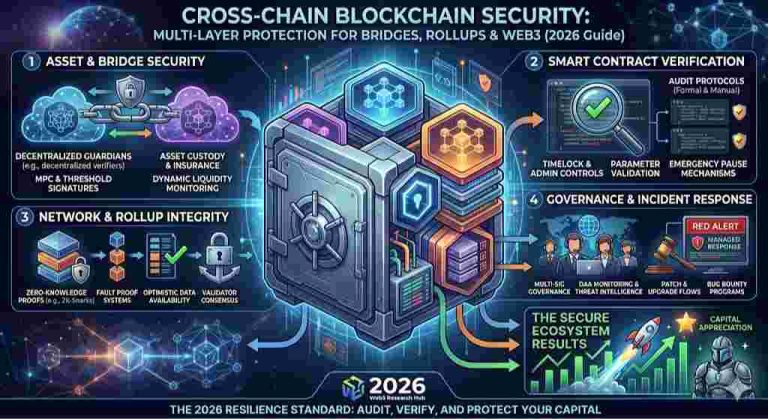
Cross-Chain Blockchain Security: Protecting Bridges & Rollups (2026 Guide)
Anchor: “cross-chain security risks”
Blockchain Interoperability: AI Agents & Cross-Chain Connectivity (2026)
Anchor: “next-generation blockchain interoperability”
Crypto Self-Custody Security Toolkit: Protect Your Digital Assets
Anchor: “self-custody security framework”
MPC vs Multi-Sig vs HSM Custody: Crypto Security Comparison (2026)
Anchor: “institutional custody security models”
The future of Quantum-Resistant Blockchains depends on trusted cryptographic standards that can withstand both classical and quantum attacks. The National Institute of Standards and Technology (NIST) leads the global effort by publishing the official Federal Information Processing Standards (FIPS 203, FIPS 204, and FIPS 205) for post-quantum cryptography. Blockchain developers, security researchers, and enterprise teams should follow these standards to ensure their networks remain compatible with future cryptographic requirements.
Official Resource:
https://csrc.nist.gov/projects/post-quantum-cryptography
Creating secure Quantum-Resistant Blockchains requires more than adopting new cryptographic algorithms. Organizations must also develop cryptographic agility, inventory vulnerable systems, and prepare long-term migration strategies. The Cybersecurity and Infrastructure Security Agency (CISA) publishes practical guidance to help enterprises and infrastructure providers prepare for the transition to post-quantum security.
Official Resource:
https://www.cisa.gov/quantum
The development of Quantum-Resistant Blockchains is closely tied to advances in quantum computing research. Organizations such as IBM Quantum and Google Quantum AI regularly publish research on scalable quantum hardware, error correction, and future computing capabilities. Following credible research helps developers better understand why blockchain networks are preparing years in advance for the arrival of cryptographically relevant quantum computers.
Official Resources:
IBM Quantum
https://www.ibm.com/quantum
Google Quantum AI
https://quantumai.google