
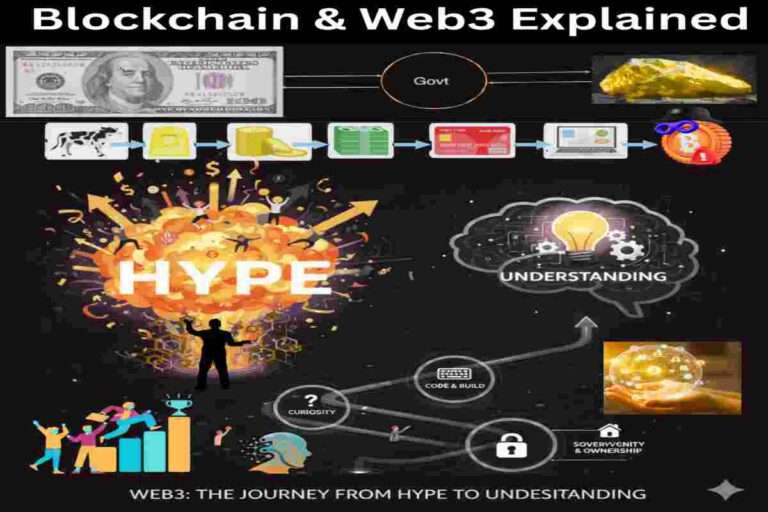
The internet has evolved through several major phases, reshaping how information, value, and control operate online, and today it is transitioning from a platform-centric model to the Sovereign Internet Stack, where individuals and institutions can own assets, manage identity, and participate in digital economies without relying on centralized intermediaries. The architecture of the Sovereign Internet Stack is layered, beginning with the Infrastructure Layer: The Foundation of the Sovereign Web, which provides secure, decentralized computing, storage, and networking; followed by the Protocol Layer: Rules of the Decentralized Economy, establishing communication standards and consensus mechanisms; the Identity Layer: Self-Sovereign Identity, giving users full control over authentication and credentials; the Value Layer: Digital Assets and Tokenized Economies, enabling ownership and monetization of digital assets; and Cross-Chain Interoperability and the Connected Stack, which ensures seamless interaction between multiple blockchains and applications. In 2026, the Web3 ecosystem is defined not by speculation or token cycles but by infrastructure maturity, security discipline, and real economic usage, addressing the historical auctorical imbalance where users generated value without control, and offering a modular, interoperable framework that links decentralized finance, digital ownership, and tokenized assets into a fully sovereign, resilient, and user-controlled internet.
This architecture is the “blueprint” for the interoperable systems discussed in Web3 Interoperability 2026. For a deep dive into internet decentralization, visit the Internet Society.
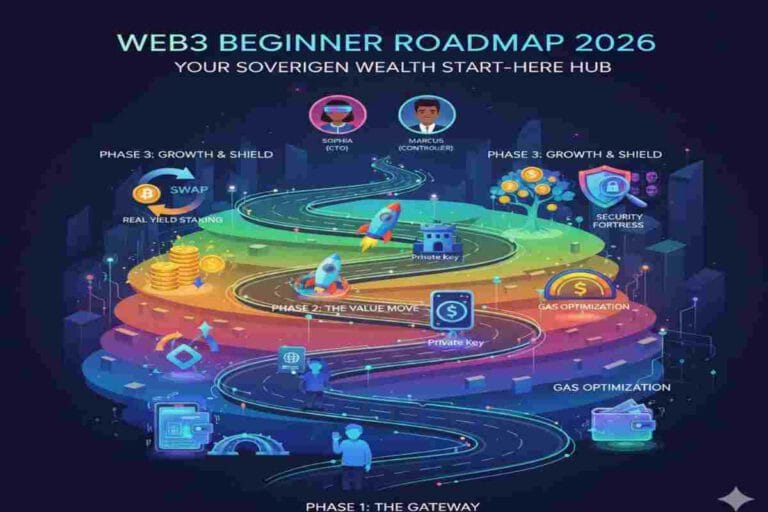
Table of Contents
ToggleThis guide — The Sovereign Internet Stack: Architecture of the Web3 Ecosystem (2026 Guide) — explains the complete architecture of the Web3 ecosystem. It introduces the full system that enables digital sovereignty, including infrastructure, identity, value networks, security, governance, and applications. In other words, it describes how the entire sovereign web works as a layered system.
For a full overview of the ecosystem architecture, see the main hub:
https://ownprocrypto.com/web3-ecosystem-explained/
Within that broader architecture, interoperability is one specific infrastructure capability. While the Sovereign Internet Stack explains all layers of the decentralized internet, the article Web3 Interoperability 2026: The Architecture of the Connected Stack focuses on a narrower but critical function: how different blockchain networks communicate, transfer assets, and share data across ecosystems.
Read the full interoperability pillar here:
https://ownprocrypto.com/web3-interoperability/
In simple terms, the Sovereign Internet Stack describes the entire system, while Web3 Interoperability explains how the networks inside that system connect and interact. Interoperability enables blockchains to function as a connected multi-chain environment, but it is only one component of the broader sovereign architecture that also includes identity systems, digital asset ownership, governance frameworks, security models, and decentralized applications.
For institute leaders, investors, and researchers studying Web3 infrastructure, this relationship is important: the Sovereign Internet Stack defines the strategic architecture of the decentralized internet, while interoperability defines the technical pathways that allow that architecture to operate across multiple blockchain networks.
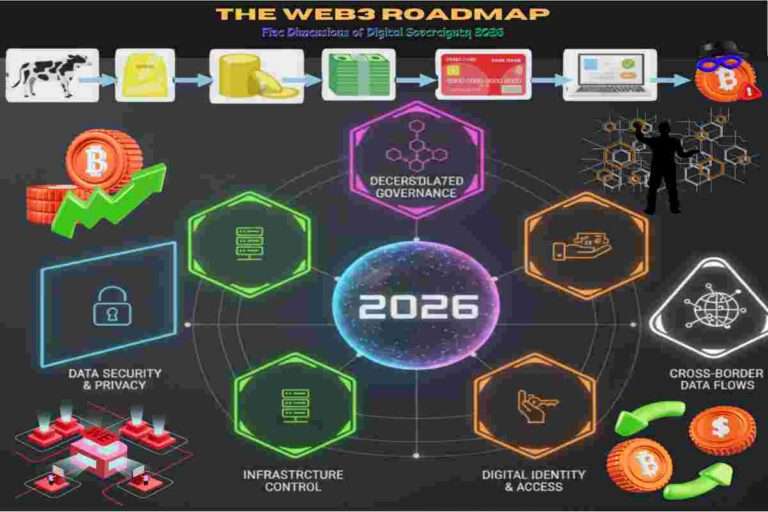
The internet has evolved through three major stages:
Web1 (1990s – early 2000s)
Web1 created the first open network for publishing information. Websites were static, and users mainly consumed content. The early internet allowed users to read information online but offered limited interaction.
Web2 (2005 – present)
Platforms introduced social media, cloud infrastructure, and large-scale digital services. However, this era centralized power within major technology companies that control data, identity, and digital infrastructure.
Web3 (emerging)
Web3 introduces decentralized systems that allow individuals to own their data, identity, and assets through cryptographic technologies and blockchain networks.
Major companies now control:
Users generated value but did not control it. Platforms captured data, revenue, and governance. Trust was outsourced to corporations, and failure cascaded systemically.
The Web3 ecosystem reverses that logic. Instead of trust in institutions, it relies on cryptography. Instead of permission, it relies on protocols. Instead of access, it delivers ownership.
This guide breaks down the Web3 Ecosystem 2026 using a three-pillar framework: Secure, Build, Own. Together, these pillars form the sovereign internet stack.
The Web3 Ecosystem 2026 has flipped this script. We have transitioned from speculative crypto-assets to sovereign digital infrastructure. This shift is driven by the Sovereign Internet Stack—a modular framework where identity, data, and value are decoupled from centralized silos and returned to the individual. In this briefing, we explore how this stack provides the only viable defense against AI-driven centralization and algorithmic control.
The Sovereign Internet Stack emerges as the next evolution of internet architecture. It is designed to restore control over identity, assets, and data to individuals and communities through decentralized technologies.
The Sovereign Internet Stack provides the architectural framework that enables this transition.
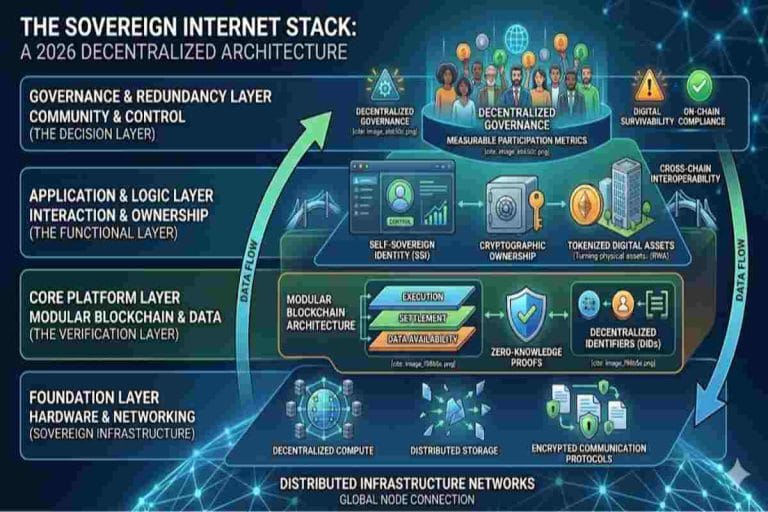
The Sovereign Internet Stack is a layered architecture of decentralized technologies that replaces centralized control with distributed infrastructure and cryptographic ownership.
Rather than relying on centralized platforms, the sovereign web is built from several interconnected layers:
Together, these layers create a system where individuals control their digital identity, data, and assets.
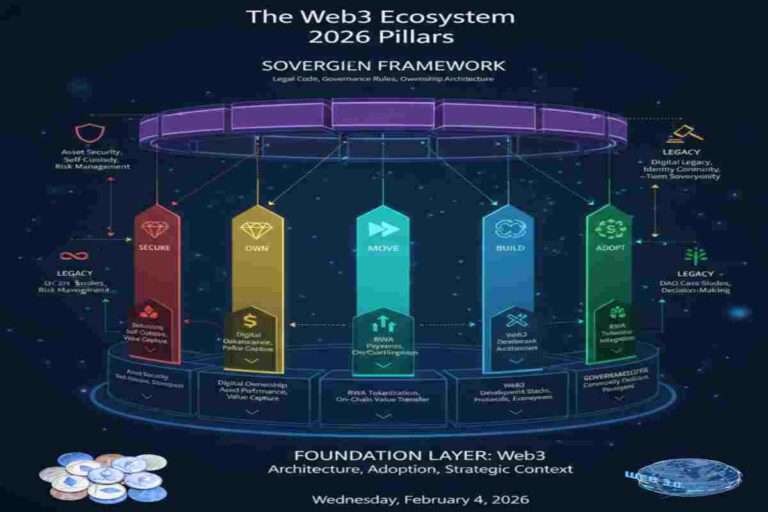
WEB3 SOVEREIGN ECOSYSTEM (Architecture of the Sovereign Internet) | |||
↕ | |||
Sovereign Internet Stack (Architecture) | |||
Infrastructure | Value | Security | Governance |
↕ | ↕ | ↕ | ↕ |
Web3 Development Interoperability | Digital Ownership Stablecoin Payments | Asset Security Legacy & Sovereignty | Governance Framework RWA Tokenization |
This structure highlights how the ecosystem is organized into four functional domains.
Infrastructure powers the decentralized networks and developer tools that make Web3 applications possible.
Value networks enable digital ownership, decentralized finance, and tokenized assets.
Security systems protect assets, identity, and long-term digital inheritance.
Governance frameworks allow decentralized communities to coordinate and manage protocols.
Together, these pillars form a comprehensive model for understanding the transition from centralized internet platforms to a sovereign, user-owned digital ecosystem.
Several structural problems in today’s internet are pushing the transition toward sovereign digital infrastructure.
A small number of platforms control the majority of online services, including social media, search, hosting, and payment systems.
User data is typically stored and monetized by companies rather than owned by the individuals who generate it.
Centralized systems create single points of failure, making them attractive targets for cyber attacks and large-scale data breaches.
Traditional payment infrastructure limits participation in global financial systems.
The sovereign web addresses these issues by enabling self-custody, decentralized governance, and open access infrastructure.
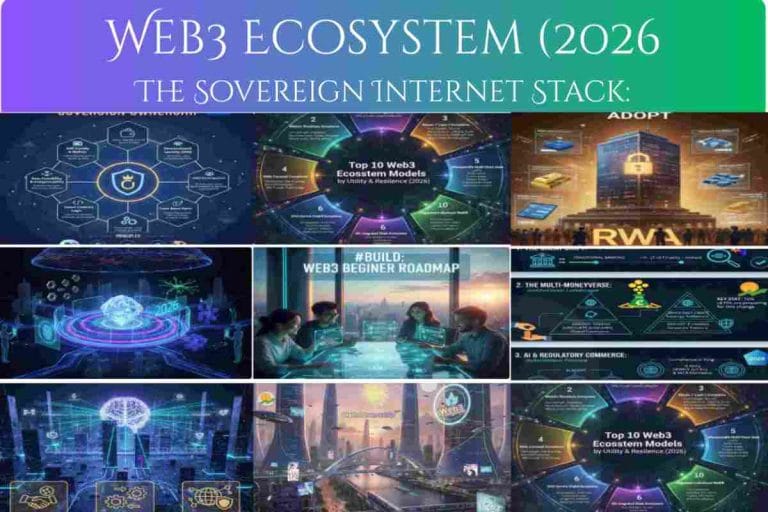
The Sovereign Internet Stack is structured as a layered architecture that organizes decentralized technologies into functional domains. Each layer performs a distinct role in enabling digital sovereignty, from the foundational infrastructure that secures blockchain networks to the governance systems that coordinate decentralized communities.
Together, these layers create a modular ecosystem where identity, assets, applications, and governance operate on open protocols rather than centralized platforms.
Understanding these layers helps researchers, developers, and investors see how the broader Web3 ecosystem is constructed and how different technologies interact within the sovereign internet framework.
The infrastructure layer provides the physical and network foundation of the sovereign internet.
This layer includes:
These systems replace centralized cloud infrastructure with distributed networks maintained by independent participants.
This is the technological base that allows decentralized applications and financial systems to operate without central intermediaries.
Developers building these systems rely on smart contracts, blockchain development frameworks, and decentralized infrastructure tools.
These systems form decentralized infrastructure networks that replace centralized cloud services with globally distributed nodes.
For a detailed technical guide on how these systems are built, see the pillar:
➡️ Web3 Development Guide (2026): Building dApps, Smart Contracts & Ecosystems
https://ownprocrypto.com/web3-development-guide/
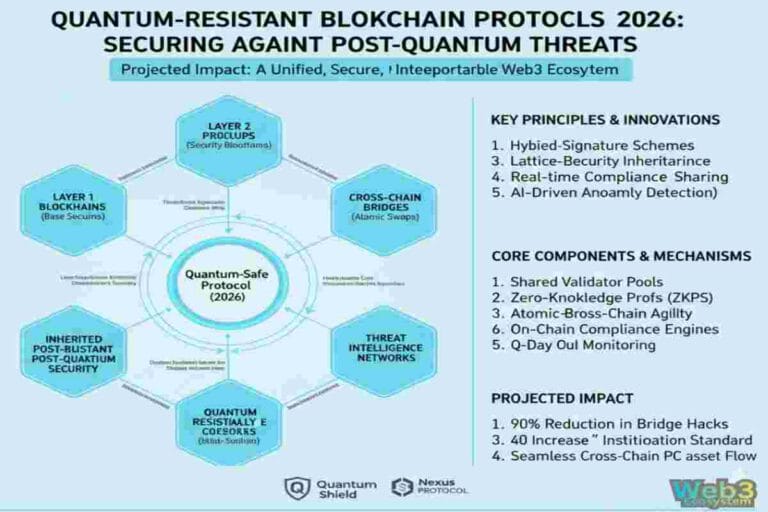
The protocol layer defines how transactions and interactions occur across decentralized networks.
This layer includes:
Protocols enable trustless interactions where users can transact without relying on centralized authorities.
Modern blockchain ecosystems increasingly adopt modular architecture, separating responsibilities across different systems.
Key protocol innovations include:
These technologies improve scalability while maintaining decentralization.
Digital sovereignty requires control over identity.
The identity layer introduces self-sovereign identity systems where users manage their credentials without centralized providers.
Key components include:
Users can prove identity attributes without revealing unnecessary personal information.
Privacy technologies such as zero-knowledge proofs enable identity verification while preserving confidentiality.
Identity wallets also act as access points to decentralized applications and financial services.
These systems enable self-sovereign identity, allowing users to control credentials through decentralized identifiers and cryptographic verification.
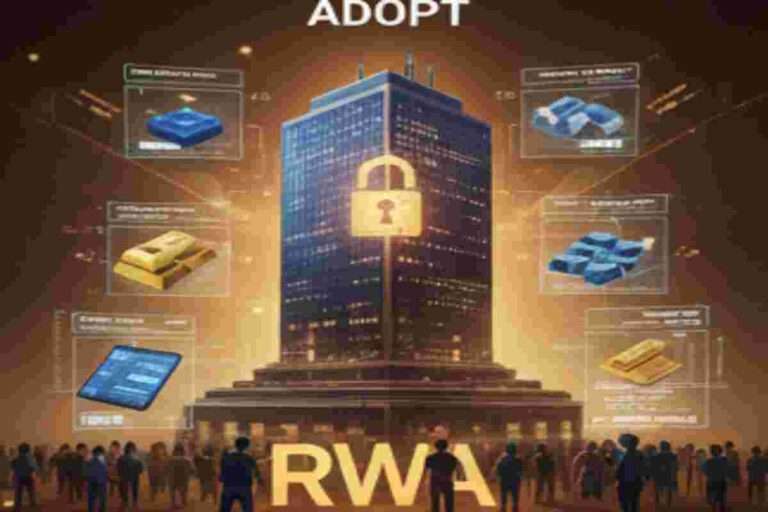
The value layer enables economic activity within the sovereign internet.
Through blockchain tokenization, digital assets can represent:
This layer powers decentralized finance and tokenized investment ecosystems.
Digital ownership is a defining feature of the sovereign web.
➡️ Learn how ownership and asset performance work in practice:
Digital Ownership in 2026: Crypto Asset Performance & ROI
https://ownprocrypto.com/digital-ownership/
Two key financial systems emerging in this layer include stablecoins and tokenized real-world assets.
Stablecoins enable efficient global payments.
➡️ Explore the dominant payment infrastructure here:
Stablecoin Payments 2026: Why USDT & USDC Dominate
https://ownprocrypto.com/stablecoin-payments/
Tokenization also extends beyond crypto assets to include traditional financial instruments.
➡️ Detailed guide:
RWA Tokenization 2026: Guide to Real-World Asset Portfolios
https://ownprocrypto.com/rwa-tokenization/

One of the defining characteristics of the sovereign web is self-custody.
Users control private keys that secure digital assets and identity credentials.
Because control is decentralized, security practices become essential.
Critical security principles include:
For a complete security framework, see:
➡️ Asset Security 2026: Setting Up Your Digital Fortress
https://ownprocrypto.com/asset-security-2026/
Security also extends beyond individual users to long-term digital inheritance.
➡️ Legacy & Sovereignty: Securing Your Digital Life Beyond You
https://ownprocrypto.com/legacy-sovereignty/
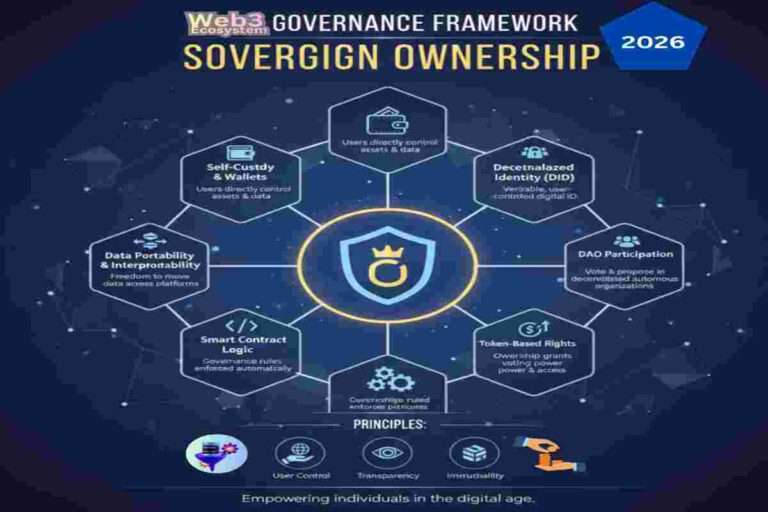
Traditional internet platforms are governed by centralized companies.
In the sovereign internet, governance becomes decentralized.
Decentralized governance models include:
These systems allow communities to control the evolution of protocols and applications.
➡️ Full governance framework:
Web3 Governance Framework: Sovereign Ownership (2026)
https://ownprocrypto.com/web3-governance-framework/
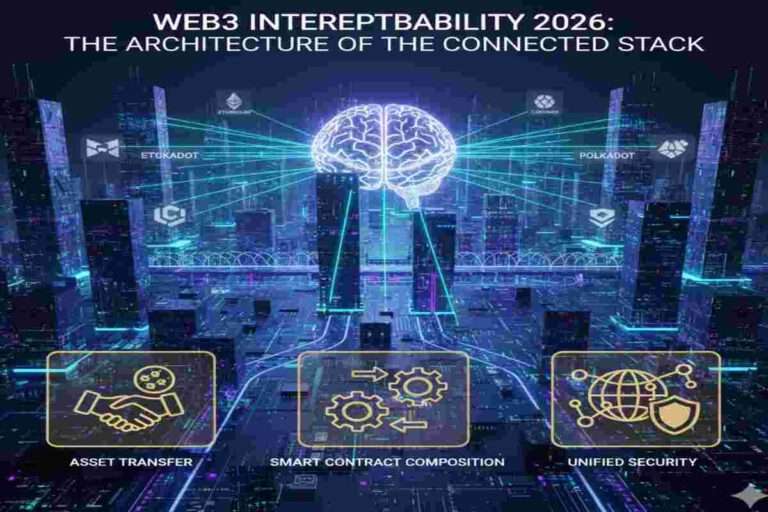
The sovereign web is not built on a single blockchain.
Instead, it operates across a multi-chain ecosystem where different networks specialize in different tasks.
Cross-chain interoperability enables:
Interoperability protocols form the backbone of a connected Web3 ecosystem.
➡️ Full technical overview:
Web3 Interoperability 2026: The Architecture of the Connected Stack
https://ownprocrypto.com/web3-interoperability/
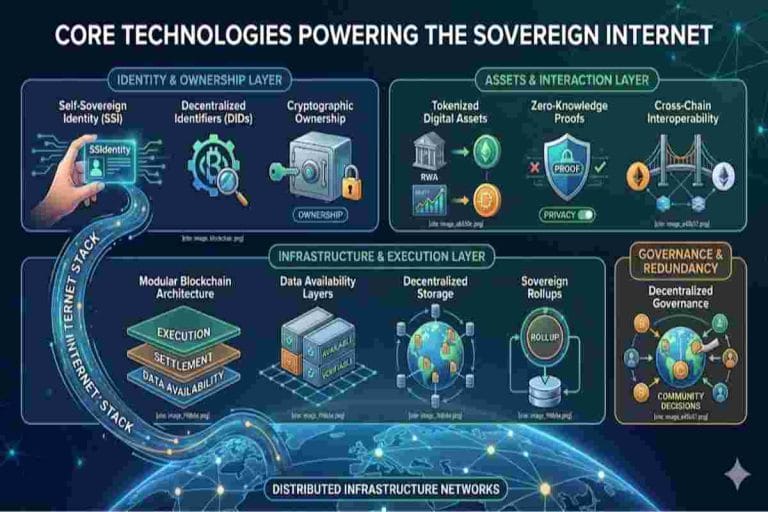
Several breakthrough technologies enable the sovereign internet architecture.
These include:
Self-Sovereign Identity (SSI)
Identity systems where individuals control their digital credentials.
Decentralized Identifiers (DIDs)
Unique blockchain-based identity identifiers.
Modular Blockchain Architecture
Separating execution, settlement, and data availability.
Data Availability Layers
Ensuring blockchain data remains accessible and verifiable.
Sovereign Rollups
Independent execution environments secured by shared infrastructure.
Decentralized Storage
Distributed data hosting across peer networks.
Cryptographic Ownership
Assets secured by private key cryptography.
Tokenized Digital Assets
Blockchain representations of financial and real-world assets.
Cross-Chain Interoperability
Protocols enabling blockchain communication.
Zero-Knowledge Proofs
Privacy-preserving verification technology.
Decentralized Governance
Community-led protocol decision-making.
Distributed Infrastructure Networks
Global node networks that maintain decentralized systems.
Together, these technologies form the foundation of the sovereign internet stack.
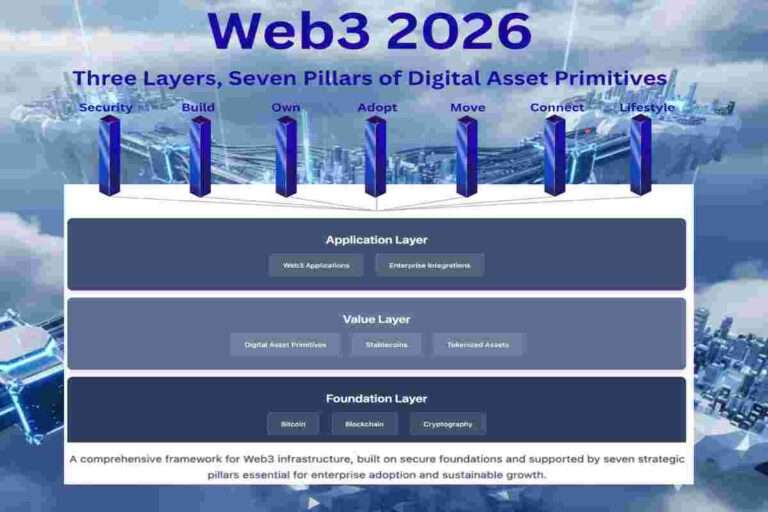
The sovereign stack is not a single technology but a complete ecosystem.
This ecosystem integrates infrastructure, financial systems, identity frameworks, governance models, and applications.
For a full overview of how these systems interact:
➡️ Web3 Ecosystem: Architecture & Adoption (2026)
https://ownprocrypto.com/web3-ecosystem-explained/
This pillar article serves as the central hub connecting all major components of the Web3 ecosystem.
The sovereign web creates opportunities for multiple groups.
Developers
Build applications without relying on centralized platforms.
Investors
Participate in decentralized financial systems and tokenized assets.
Creators
Monetize content directly through blockchain-based platforms.
Institutions
Deploy transparent infrastructure and programmable financial systems.
New participants often encounter challenges when entering decentralized ecosystems.
Common mistakes include:
Education and proper security practices reduce these risks significantly.
| Layer | Role |
|---|---|
| Infrastructure | Distributed networks and blockchain nodes |
| Protocol | Smart contracts and transaction rules |
| Identity | Decentralized identity and wallet systems |
| Value | Digital assets and tokenized economies |
| Security | Asset protection and key management |
| Governance | Community decision-making systems |
| Applications | Decentralized platforms and services |
Modern Web3 infrastructure increasingly relies on modular blockchain design.
Traditional blockchains perform several functions simultaneously:
Modular architectures separate these responsibilities across different layers to improve scalability and efficiency.
Key modular components include:
This separation allows networks to scale while preserving decentralization.
Participation in the sovereign internet typically involves several steps.
Users may begin by:
Learning these tools allows users to move from passive internet consumption toward active digital ownership.
Several blockchain ecosystems already demonstrate elements of a sovereign internet stack.
These ecosystems combine infrastructure, protocols, and applications into cohesive digital environments.
Examples include:
Each ecosystem contributes different components to the broader sovereign web architecture.
Q: What is the sovereign internet?
A sovereign internet refers to an internet architecture where users—rather than centralized corporations—control their digital identity, data, and assets through decentralized technologies.
Q: What is a Sovereign Internet Stack?
It is a cohesive set of technologies (including identity, storage, compute, and networking layers) that allow individuals, organizations, or nations to manage their digital services without relying on centralized global platforms.
Q: How is Web3 related to the sovereign internet stack?
Web3 technologies, such as blockchain, decentralized identity, and tokenized assets, form the technical foundation and execution layer of the sovereign internet stack.
Q: Why is digital sovereignty important?
It provides data ownership, privacy protection, and reduced vendor lock-in. It allows users to maintain a digital presence and comply with local regulations without being subject to the whims of external jurisdictions.
Q: How is a Sovereign Internet Stack different from traditional cloud systems?
Traditional clouds rely on centralized providers with high vendor lock-in and external control. Sovereign stacks prioritize decentralized or locally controlled infrastructure where data ownership is strictly retained by the user.
Q: What role do blockchains play in the sovereign web?
Blockchains provide the secure, transparent, and immutable infrastructure required for verified transactions, digital ownership, and decentralized governance.
Q: What are the core components of a Sovereign Internet Stack?
A typical stack contains five layers: the Identity Layer (DIDs), the Data Layer (personal stores), the Compute Layer (sovereign cloud), the Networking Layer (encrypted protocols), and the Application Layer.
Q: Does a Sovereign Internet Stack mean data must stay in one country?
Not necessarily. While it allows for data residency, the core concept is about legal and operational control, ensuring transparency regarding data location and compliance with regional jurisdictions.
Q: Is running a Sovereign Internet Stack technically difficult?
Historically yes, but modern platforms now simplify the process through managed infrastructure, containerized deployments, and automated orchestration, making them feel as user-friendly as standard cloud services.
Q: Can individuals use a Sovereign Internet Stack?
Yes. Modern tools allow individuals to manage personal data stores, self-sovereign identities, and encrypted communications through user interfaces that no longer require deep technical knowledge.
Q: Can organizations still integrate with traditional internet services?
Yes. Most implement a hybrid model where sensitive data remains on sovereign infrastructure while public-facing services connect to global platforms for broader reach.
Q: What are the biggest challenges of implementing a Sovereign Internet Stack?
The primary hurdles include initial infrastructure costs, the requirement for specialized technical expertise, and ensuring interoperability with legacy systems.
Q: What is the future of Sovereign Internet infrastructure?
The future is moving toward a “multi-sovereign” web characterized by decentralized identity networks, personal AI ownership, and regional digital ecosystems that prioritize Digital Survivability.
The transition toward a sovereign internet represents a fundamental shift in how digital systems operate.
Instead of centralized platforms controlling infrastructure, identity, and economic activity, the sovereign web distributes power across open networks and communities.
The Sovereign Internet Stack combines decentralized infrastructure, cryptographic identity systems, tokenized value networks, and decentralized applications to create a new model for digital ownership.
As these technologies mature, they may redefine how individuals interact with the internet—transforming users from passive participants into active stakeholders in the digital economy.
Switzerland: Swiss Financial Market Supervisory Authority (FINMA) http://www.finma.ch
Welcome to OwnProCrypto (Own & Pro Crypto) — a next-generation Bitcoin and blockchain education platform where the science of finance meets the power of AI-driven automation.
Our mission is simple: to equip you with the knowledge, frameworks, and tools needed to make smarter financial and business decisions in the Web3 economy.
Beyond analysis, OwnProCrypto focuses on transparency, verifiable data, and practical frameworks that investors and builders can actually use. Our goal is not hype — but clear thinking, disciplined analysis, and long-term value creation in the decentralized economy.
Our Background: Salim (Sam) is the founder and lead researcher behind OwnProCrypto, a Web3 intelligence platform focused on crypto security, digital ownership, stablecoin systems, interoperability, and institutional blockchain infrastructure.
Crypto Tools & Analysis:
Crypto Fundamental Analysis Tool | Protocol Evaluation System | DeFi Risk Analysis Tools | Crypto Portfolio Dashboard | Token Risk vs Reward Tool
Guides:
Crypto Fundamental Analysis | Blockchain Project Evaluation | Tokenomics Analysis | DeFi Protocol Analysis | Capital Efficiency
© 2026 OwnProCrypto — Built for smarter crypto decisions