
Search by title, topic or phrase
Use our Crypto Search Engine 🔍 to find the topics and keywords you're looking for.
A professional framework for identifying, measuring, monitoring and responding to the market, liquidity, concentration, counterparty, protocol and security risks that can affect a modern cryptocurrency portfolio.
Table of Contents
ToggleA crypto portfolio can be profitable and still be poorly managed. The reason is simple: portfolio risk is much larger than price volatility.
A serious digital asset investor must consider market drawdowns, concentration, liquidity, exchange exposure, custody architecture, smart-contract dependencies, token unlocks, protocol failures, stablecoin risks, operational mistakes and emerging security threats.
The central objective of risk management is therefore not to eliminate risk. It is to identify risk early, measure its potential impact, control the amount of capital exposed, and maintain a recovery path if something goes wrong.
This framework extends the security architecture discussed in earlier OwnProCrypto research into a broader portfolio-level system. Security protects the assets; risk management determines how much risk the portfolio is willing to carry.

Crypto portfolio risk management is the structured process of identifying, measuring, monitoring and controlling the risks that can reduce portfolio value or prevent an investor from accessing assets when needed.
In traditional finance, portfolio risk can be modeled using volatility, correlation, drawdown, liquidity and credit exposure. Digital assets introduce additional dimensions because ownership depends on wallets, private keys, smart contracts, exchanges, bridges, protocols and blockchain infrastructure.
| Risk Area | Primary Question | Potential Failure | Control Objective |
|---|---|---|---|
| Market Risk | How much can the portfolio decline? | Large drawdown | Position sizing and stress testing |
| Concentration Risk | How dependent is the portfolio on one exposure? | Single-event portfolio damage | Exposure limits |
| Liquidity Risk | Can assets be sold when needed? | Slippage or inability to exit | Liquidity reserves |
| Counterparty Risk | Who controls access to the assets? | Platform failure or freeze | Custody diversification |
| Protocol Risk | What technology does the investment depend on? | Exploit or failure | Protocol due diligence |
| Security Risk | Can an attacker compromise the asset? | Unauthorized transfer | Security architecture |
| Operational Risk | Can the owner execute safely? | Human error | Procedures and redundancy |
The professional approach is to treat these risks as connected rather than independent. A portfolio holding a volatile token through a highly leveraged DeFi protocol inside a single hot wallet may simultaneously carry market, protocol, liquidity and security risk.
A complete crypto risk system should evaluate at least 7 major dimensions. Each layer answers a different question and requires different controls.
Measures volatility, drawdowns, momentum and market-cycle exposure.
Measures dependency on individual assets, sectors, chains or protocols.
Measures how quickly assets can be converted without excessive price impact.
Measures exposure to exchanges, custodians, issuers and service providers.
Measures smart-contract, bridge, oracle and governance dependencies.
Detects threats, suspicious behavior, exploits and changing security conditions.
Measures human error, access failure, recovery weakness and process risk.
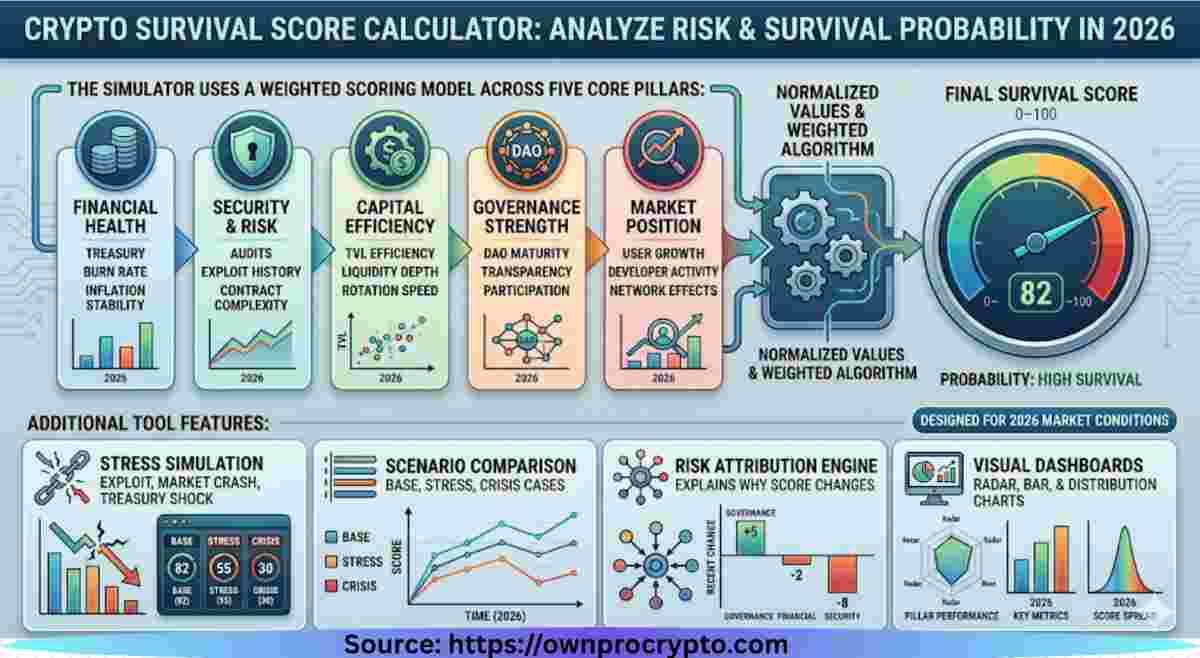
Investors need a practical way to translate many individual risks into one portfolio-level view. A simple internal scoring system can help compare the relative risk of different portfolios or positions.
One useful model is to score each major category from 1 to 5, where 1 represents relatively low exposure and 5 represents severe exposure.
| Score | Risk Level | Interpretation | Suggested Action |
|---|---|---|---|
| 1 | Low | Limited identifiable exposure | Maintain monitoring |
| 2 | Moderate-Low | Manageable exposure | Routine review |
| 3 | Medium | Meaningful exposure | Define mitigation |
| 4 | High | Material portfolio vulnerability | Reduce or hedge exposure |
| 5 | Critical | Potential portfolio-threatening exposure | Immediate review or containment |
The score should not be treated as a scientific prediction of future losses. It is a decision-support framework. Its value comes from forcing the investor to examine risks consistently rather than relying on intuition.

Market risk is the most visible form of crypto risk because it appears directly on the price chart. However, the important question is not simply whether an asset is volatile. The more useful question is whether the portfolio can financially and psychologically survive the volatility.
| Metric | What It Measures | Why It Matters | Risk Signal |
|---|---|---|---|
| Drawdown | Peak-to-trough decline | Measures capital damage | Large drawdown |
| Volatility | Price variability | Measures uncertainty | Rapid expansion |
| Beta | Sensitivity to broader market | Shows systemic exposure | High market dependency |
| Correlation | Relationship between assets | Tests diversification | Correlations rising toward 1 |
| Leverage | Debt relative to capital | Magnifies gains and losses | Forced liquidation risk |
A portfolio with 8 different tokens is not necessarily diversified if all 8 positions respond almost identically to the same market shock. True diversification requires examining the underlying sources of risk.
Concentration risk occurs when too much portfolio value depends on one asset, ecosystem, issuer, protocol, exchange, chain or economic factor.
Concentration can exist even when the portfolio contains many different tokens. For example, 10 assets may all depend on Ethereum infrastructure, the same stablecoin, the same bridge, or the same liquidity venue.
| Concentration Type | Example | Potential Failure | Mitigation |
|---|---|---|---|
| Asset | One token dominates portfolio | Asset-specific collapse | Position limits |
| Chain | Most assets depend on one network | Network disruption | Multi-chain exposure |
| Stablecoin | Large reserve held in one issuer | Depeg or redemption problem | Issuer diversification |
| Custodian | Most assets on one platform | Freeze or insolvency | Custody segmentation |
| Protocol | Large DeFi allocation to one protocol | Exploit or governance failure | Protocol exposure limits |
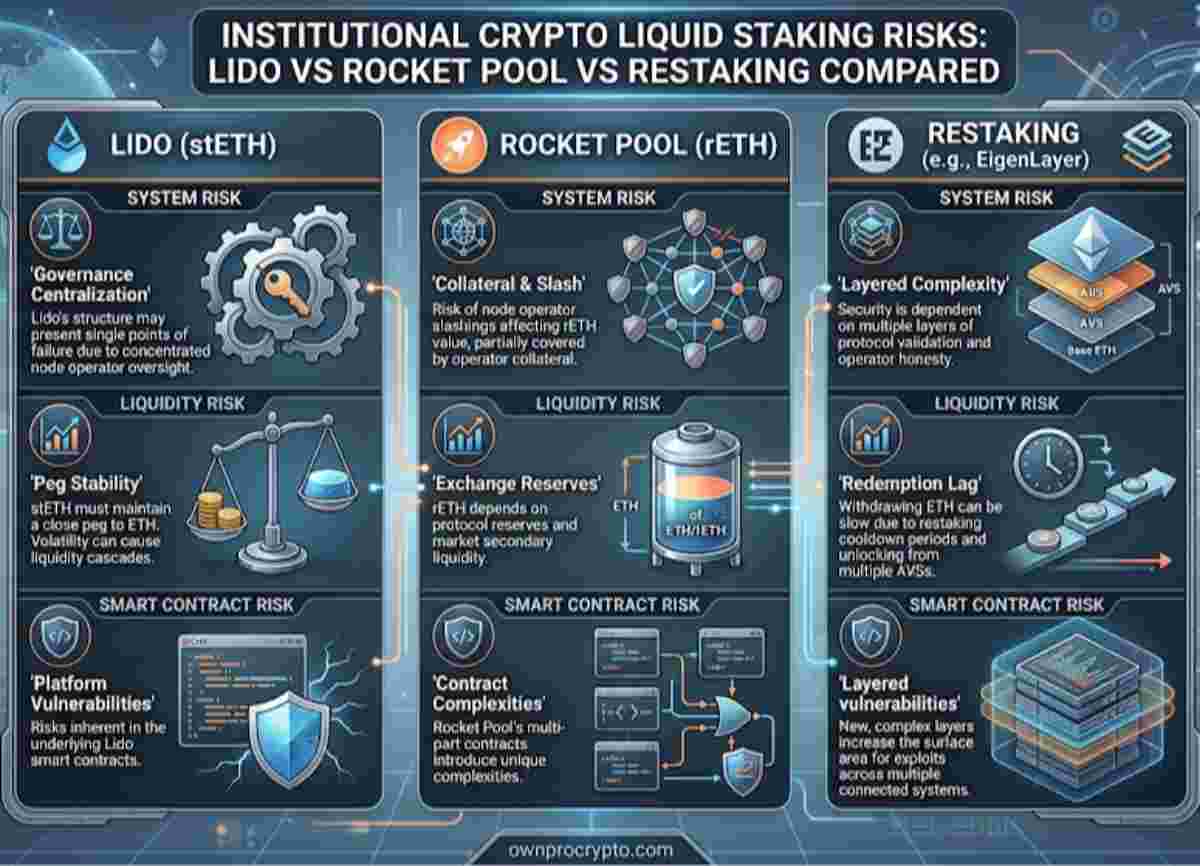
Liquidity risk is often ignored during bull markets because almost everything appears easy to sell. The problem becomes visible when market conditions deteriorate.
An asset can have a large quoted market capitalization while still having insufficient real liquidity for a large investor.
| Liquidity Factor | Low Risk | Higher Risk |
|---|---|---|
| Trading Volume | Deep and consistent | Thin or irregular |
| Order Book | Deep bids and offers | Large gaps |
| Market Access | Multiple venues | Single venue |
| Stablecoin Exit | Multiple conversion routes | Single conversion path |
| DeFi Liquidity | Deep and diversified | Thin pool |
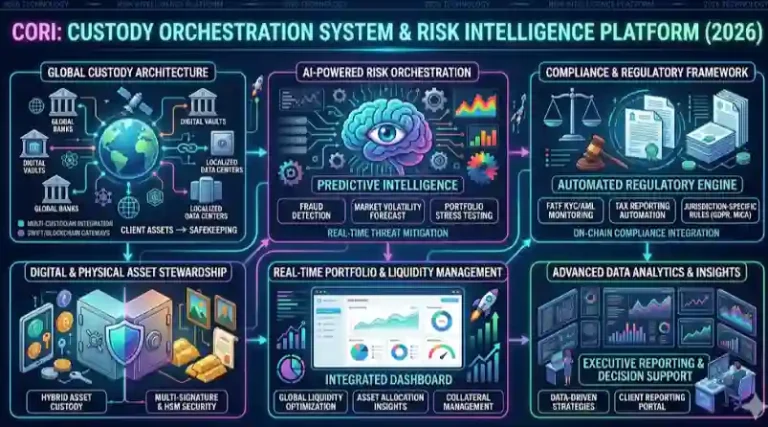
Crypto ownership does not automatically eliminate counterparty risk. Exchanges, custodians, stablecoin issuers, staking providers, lending protocols, bridges and infrastructure providers can all become dependencies.
The goal is not to declare centralized or decentralized systems universally safer. The correct approach is to identify the specific failure modes and decide how much capital should depend on each one.

DeFi introduces another layer of risk because investors may not simply hold an asset. They may deposit it into contracts that contain code, governance mechanisms, oracle dependencies and upgrade permissions.
| Protocol Risk | What to Examine | Potential Consequence |
|---|---|---|
| Smart Contract | Audits, code history, permissions | Asset loss |
| Oracle | Price-feed design and dependencies | Incorrect valuation or liquidation |
| Governance | Voting concentration and proposal controls | Malicious parameter change |
| Upgradeability | Admin keys and upgrade mechanisms | Unexpected code changes |
| Bridge | Validator/security architecture | Cross-chain loss |
| Liquidity | Pool depth and withdrawal conditions | Exit difficulty |
A professional portfolio therefore evaluates not only what token is held, but also where the token is deployed and what systems must continue functioning for the investment thesis to remain valid.
Security intelligence is the bridge between static security controls and active portfolio risk management.
A hardware wallet, multi-signature wallet or custody system can protect the authorization layer, but investors also need to know when the environment surrounding an asset is becoming more dangerous.
Security intelligence focuses on collecting, evaluating and responding to signals that may indicate an emerging threat.
| Security Signal | What It May Indicate | Portfolio Response |
|---|---|---|
| Unexpected wallet activity | Compromise or unauthorized movement | Investigate immediately |
| Contract permission change | Expanded attack surface | Review approvals |
| Protocol exploit | Technology failure | Freeze or reduce exposure |
| Governance anomaly | Potential control takeover | Reassess protocol risk |
| Stablecoin stress | Liquidity or issuer concerns | Review stablecoin allocation |
| Bridge incident | Cross-chain infrastructure risk | Review bridge-dependent positions |
| Phishing campaign | Elevated user-targeting activity | Increase transaction controls |
Security intelligence becomes valuable when information changes an actual portfolio decision.
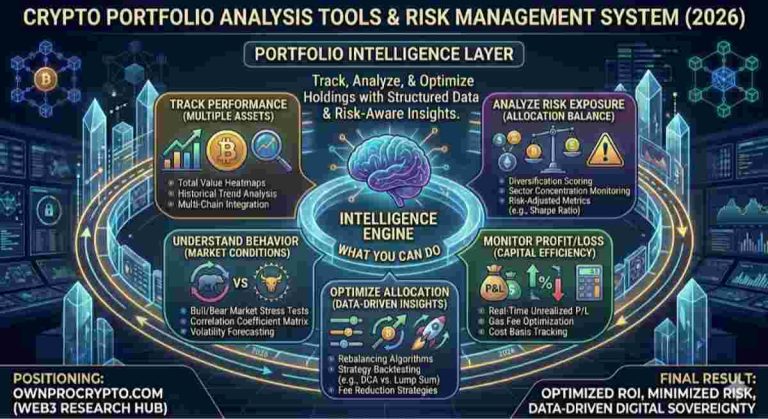
A crypto portfolio is dynamic. Prices change every minute, liquidity changes, protocols upgrade, governance proposals appear, wallets interact with new contracts and market correlations can shift rapidly.
For that reason, a portfolio review performed once every 6 months may be insufficient for an actively managed digital asset portfolio.
| Monitoring Frequency | Recommended Review | Primary Objective |
|---|---|---|
| Continuous | Critical wallet/security alerts | Detect urgent events |
| Daily | Portfolio and market conditions | Identify material changes |
| Weekly | Allocation and exposure | Check drift |
| Monthly | Risk score and thesis review | Reassess assumptions |
| Quarterly | Full portfolio stress test | Challenge the system |
| Annually | Security and recovery architecture | Review resilience |
Stress testing asks a more useful question than “What do I expect to happen?” It asks: “What happens if my assumptions are wrong?”
Investors can create hypothetical scenarios to understand how the portfolio might behave under severe but plausible conditions.
| Scenario | Illustrative Shock | Risk Tested | Question |
|---|---|---|---|
| Market Correction | -30% | Drawdown | Can the portfolio survive? |
| Severe Bear Market | -60% | Capital preservation | Would forced selling occur? |
| Stablecoin Stress | Temporary depeg | Liquidity/counterparty | How much capital is exposed? |
| Exchange Freeze | Access unavailable | Custody | Are alternative assets accessible? |
| Protocol Exploit | Position becomes impaired | Protocol risk | What is the maximum portfolio impact? |
| Wallet Compromise | One wallet unavailable | Security | Can the rest of the system operate? |
Rebalancing should not always be driven by a fixed calendar. A more advanced approach combines allocation drift with changes in underlying risk.
| Trigger | Example | Potential Action |
|---|---|---|
| Allocation Drift | Position becomes too large | Trim exposure |
| Risk Score Increase | Protocol risk rises from 2 → 4 | Reassess position |
| Liquidity Decline | Market depth deteriorates | Reduce position size |
| Thesis Failure | Core investment assumption breaks | Exit or restructure |
| Security Event | Exploit or suspicious activity | Freeze/investigate |
The important distinction is between price-based rebalancing and risk-based rebalancing. A falling price alone does not prove that an asset is safer or more attractive. If the underlying risk has increased, adding capital may increase portfolio fragility.
13 • Response
A risk system is incomplete without predefined actions. When a serious event occurs, investors may have very little time to think clearly.
| Risk Level | Condition | Response |
|---|---|---|
| Level 1 | Normal operating conditions | Monitor |
| Level 2 | Risk beginning to increase | Investigate and document |
| Level 3 | Material risk event | Reduce, isolate or restrict exposure |
| Level 4 | Potential capital-threatening event | Contain, freeze and activate recovery procedures |
This lifecycle is consistent with the broader risk-management philosophy of identifying assets and risks, protecting them, detecting anomalies, responding to incidents and maintaining recovery capability. NIST CSF 2.0 also adds governance as an explicit function, reinforcing the importance of policies, responsibilities and risk decisions.

Professional investors generally do not treat portfolio management as a single decision made by one person. They create processes that separate authorization, monitoring, analysis and execution.
| Area | Basic Approach | Advanced Approach | Institutional Approach |
|---|---|---|---|
| Portfolio Review | Occasional | Scheduled | Continuous + formal reviews |
| Risk Measurement | Price focused | Multi-factor | Portfolio risk architecture |
| Custody | Single wallet/platform | Multiple wallets | Segmented custody |
| Approvals | Single operator | Manual verification | Multi-person controls |
| Monitoring | Price alerts | Portfolio alerts | Security + portfolio intelligence |
| Recovery | Seed backup | Documented recovery | Tested business-continuity system |
Institutional-grade risk management connects strategy, limits, custody, intelligence, response and recovery into one operating system.
Investors do not need to build a sophisticated institutional system on day one. Risk maturity can be developed progressively.
| Stage | Priority | Core Action |
|---|---|---|
| Stage 1 | Inventory | List assets, wallets, platforms and protocols |
| Stage 2 | Classify | Assign market, liquidity, custody and protocol risks |
| Stage 3 | Score | Create a portfolio risk score |
| Stage 4 | Control | Set exposure and custody limits |
| Stage 5 | Monitor | Track market and security signals |
| Stage 6 | Stress Test | Simulate adverse conditions |
| Stage 7 | Respond | Document emergency procedures |
| Stage 8 | Improve | Review incidents and update the framework |
This article is provided for educational and informational purposes only. It does not constitute financial, investment, legal, tax or security advice. Crypto assets involve substantial risk, including the possible loss of capital. Risk scores, scenarios and examples presented in this article are illustrative frameworks and should not be interpreted as predictions or guarantees.
Investors should independently evaluate their circumstances, jurisdiction, objectives, risk tolerance and security requirements before making financial decisions.
Building a resilient digital asset portfolio in 2026 requires more than watching price movements; it requires a structured Crypto Risk Management Framework covering portfolio concentration, custody, smart contract exposure, liquidity, and operational risk. For a broader foundation, explore our Crypto Security Standards: Wallet Protection & Asset Security Guide in 2026. You can also compare these principles with Coin Bureau’s Crypto Risk Management Strategies Guide for additional perspectives on position sizing, drawdown limits, leverage, diversification, and portfolio risk.