
Search by title, topic or phrase
Use our Crypto Search Engine 🔍 to find the topics and keywords you're looking for.
A crypto wallet is only as secure as the keys, devices, recovery systems, and transaction controls surrounding it. This guide explains how serious Web3 investors can build a stronger wallet-security architecture in 2026.
Table of Contents
ToggleCrypto ownership gives investors direct control over digital assets, but that control also transfers much of the security responsibility to the wallet owner. A compromised private key, exposed recovery phrase, malicious transaction approval, or fraudulent support interaction can potentially result in irreversible asset loss.
Bitcoin.org recommends core practices such as secure backups, offline storage for savings, hardware wallets, software updates, and multi-signature protection.
The objective is therefore not simply to own a hardware wallet. The objective is to create a complete wallet security system that protects keys, devices, backups, transactions, and recovery procedures.
Protect the key. Protect the backup. Verify the transaction.
These three controls address three distinct failure points: unauthorized access to the wallet, loss of recovery capability, and accidental or malicious movement of assets.
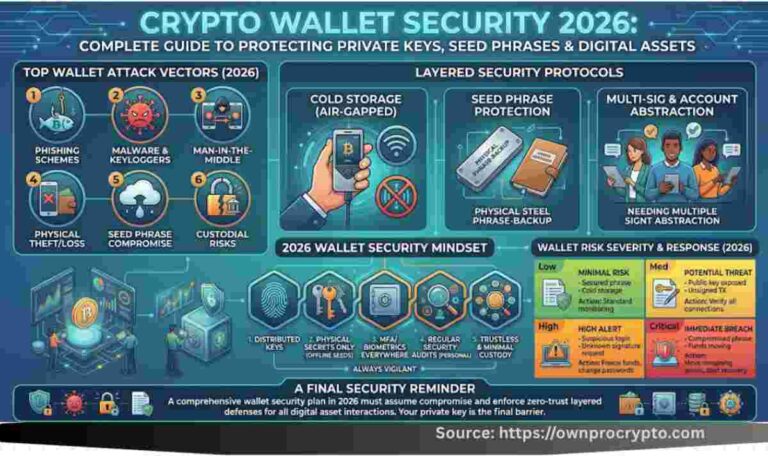
A private key is the cryptographic secret that authorizes spending from a wallet. A recovery phrase, sometimes called a seed phrase or mnemonic, is a human-readable sequence of words used to mathematically restore the entire wallet and its associated private keys.
This creates a critical security distinction: the device is not the ultimate source of ownership. The recovery material is the foundational credential that commands asset control.
1. Private Key
Purpose: Cryptographically signs and authorizes transactions on-chain.
Primary Risk: Unauthorized exposure, theft, or malware extraction.
2. Recovery Phrase (Seed Phrase)
Purpose: Restores full wallet access and key generation across any compatible software or hardware.
Primary Risk: Loss, physical theft, digital leak, or phishing disclosure.
3. PIN / Device Passcode
Purpose: Controls local physical access to the hardware wallet or mobile software interface.
Primary Risk: Physical device loss combined with shoulder-surfing or weak passcode entry.
4. Transaction Approval
Purpose: Authorizes a specific, itemized operation (transfer, contract approval, or swap).
Primary Risk: Blind signing, malicious dApp smart contract approvals, or address poisoning.
Strong wallet protection operates as a layered defense system: Private Keys define ownership, Cold Storage isolates exposure, Recovery Backups build resilience, and Transaction Verification prevents active operational loss. Security improves when independent controls back up each layer.

Hot wallets remain connected to an internet-enabled environment, making them convenient for frequent trading and Web3 interaction. Cold storage keeps private key signing isolated from online systems, making it the standard choice for long-term reserves.
Hot Wallet Profile
Connectivity: Always or frequently online (browser extensions, mobile apps).
Operational Role: Immediate liquidity, daily trading, dApp interactions.
Security Priority: Mitigating active online threats and limiting total balance exposure.
Cold Wallet Profile
Connectivity: Air-gapped or offline isolation (hardware wallets, offline setup).
Operational Role: Strategic capital preservation and long-term storage.
Security Priority: Minimizing online attack surfaces and physical tamper vectors.
Hardware wallets are dedicated physical devices engineered to isolate signing credentials from general-purpose operating systems. Owning a hardware wallet is a foundational step, but optimal security requires disciplined setup and operational hygiene.
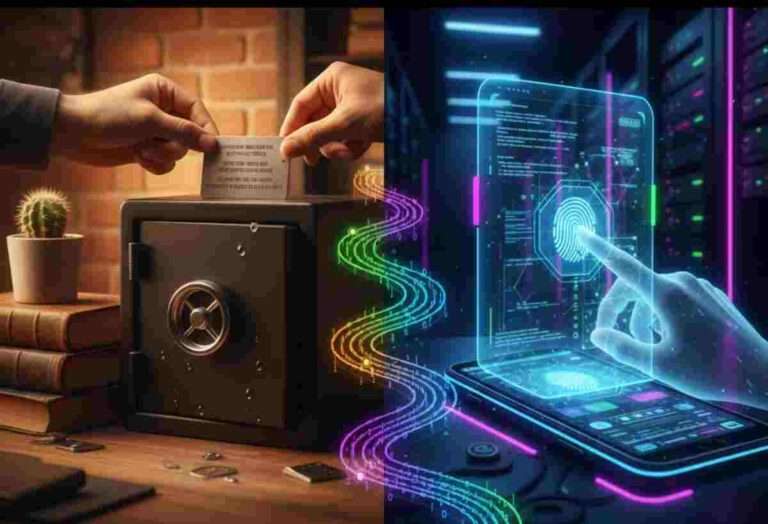
Your recovery phrase represents total control over the wallet’s cryptographically derived addresses. Anyone possessing this mnemonic sequence can clone the wallet and sweep all held funds.
Critical Rule: Never Enter Seed Phrases Online
Never type your recovery phrase into a website, pop-up window, mobile form, or support chat. Legitimate software wallets only request seed phrases during local initialization—never during troubleshooting or verification.
Private key isolation does not protect assets if a user signs a malicious payload. Transaction verification ensures that signed operations precisely match the user’s intent.

Modern attack vectors predominantly target human psychology and operational oversights. Protecting assets requires defense strategies tailored to specific threat vectors.
Phishing Websites & Spoofed Domains
Objective: Capture recovery credentials or trigger malicious smart contract permissions.
Primary Defense: Rely on bookmarked official domains, verify SSL certificates, and audit contract simulation previews.
Fake Support & Impersonation
Objective: Tricking users into revealing seed phrases or downloading remote assistance software.
Primary Defense: Institute a absolute zero-trust policy for inbound support communications.
Clipboard Hijacking & Malware
Objective: Replacing copied destination addresses with attacker-controlled addresses.
Primary Defense: Dedicated workstation security, anti-malware software, and hardware screen confirmation.
Serious investors structure wallet controls as a comprehensive institutional security model spanning six distinct defense layers.
Partitioning assets across functional wallet tiers isolates blast radiuses and ensures an operational error in dApp interactions never jeopardizes long-term treasury capital.
1. Transaction / Hot Wallet
Purpose: Active trading, daily liquidity, and established dApp interactions.
Exposure Profile: Strictly capped working balances (1% – 5% of portfolio).
2. Experimental Wallet
Purpose: Testing new smart contracts, minting, and emerging protocol interactions.
Exposure Profile: Minimal isolated capital; assumed burn account risk.
3. Core Long-Term Vault (Cold Storage)
Purpose: Multi-year strategic reserves and core digital holdings.
Exposure Profile: Complete internet isolation; zero third-party contract interactions.
4. Institutional / Multisig Wallet
Purpose: Shared entity capital, high-value treasury custody, and enterprise operations.
Exposure Profile: Multi-signature approval matrices (e.g., 3-of-5 threshold).
Advanced wallet management relies on continuous monitoring and collective security oversight rather than static assumption.

Robust wallet architecture must plan for unexpected operational contingencies, physical disasters, and long-term asset succession.
Device Damage or Loss
Operational Risk: Inability to sign transactions or access funds.
Control: Redundant offline recovery backups stored in physical security vaults.
Physical Disaster / Degradation
Operational Risk: Total destruction of paper seed backups via fire or water.
Control: Industrial grade stainless steel or titanium seed encoding plates.
Owner Incapacitation or Death
Operational Risk: Permanent loss of family assets due to unshared access credentials.
Control: Documented legal estate planning, dead-man switches, or key-share escrows.
Storage Strategy
Basic (Retail): Single browser software wallet housing all assets.
Advanced Institutional: Multi-tiered segmentation isolating reserves in cold storage.
Signing Authority
Basic (Retail): Single private key / single user approval point.
Advanced Institutional: Multi-party computation (MPC) or Multi-Signature vaults.
Backup Infrastructure
Basic (Retail): Single handwritten paper index stored locally.
Advanced Institutional: Geographically distributed fireproof steel backups and vault escrows.
Review these foundational operational checks to confirm your wallet security posture:
Wallet management is one key pillar of digital asset control. Continue advancing your operational setup with our primary technical guide:
Crypto Security Standards: Wallet Protection & Asset Security Guide in 2026
Achieving institutional-grade security for self-custodied crypto assets requires moving beyond isolated safety tips. By enforcing key isolation, securing recovery media in resilient physical formats, segmenting active transaction tiers from core reserves, and maintaining strict transaction verification protocols, investors can construct an uncompromised defensive posture across 2026 and beyond.
Frequently Asked Questions
This FAQ covers crypto wallet security, private keys, seed phrases, hardware and software wallets, phishing, malicious transactions, DeFi and DApp approvals, recovery, multisig, MPC, exchange security and digital-asset protection practices for 2026.
Crypto Wallet Security Fundamentals
What is crypto wallet security?
Crypto wallet security is the combination of protecting the credentials that control digital assets and preventing unauthorized transactions. It includes private-key and seed-phrase protection, device security, wallet recovery, transaction verification, phishing protection, smart-contract permissions, authentication and operational controls. A secure wallet is not simply a wallet that stores keys offline; it is a complete system for controlling who can authorize transactions.
What is the most important rule for crypto wallet security?
Never give your seed phrase or private key to another person, website, app or support agent. Anyone who obtains the recovery credentials controlling a wallet may be able to recreate or control that wallet. Legitimate wallet support should not need your secret recovery phrase to troubleshoot an account.
Is cryptocurrency safe if I use a secure wallet?
A secure wallet can significantly reduce risk, but no wallet eliminates every threat. Users can still lose assets by exposing recovery information, signing malicious transactions, approving dangerous smart contracts, sending funds to the wrong address, using counterfeit software or losing access to their recovery method. Security is therefore a layered process rather than a single product feature.
What are the biggest crypto wallet security threats in 2026?
Major threats include phishing and fake support, seed-phrase theft, malware, malicious transaction signing, address poisoning, clipboard manipulation, dangerous token approvals, fake wallet applications, compromised websites, social engineering, device theft, counterfeit hardware wallets and poor recovery procedures. AI-generated impersonation and increasingly convincing scams are also making verification more important.
Private Keys, Seed Phrases & Recovery Phrases
What is a private key in crypto?
A private key is secret cryptographic information used to authorize transactions from a blockchain account. Whoever controls the relevant private key generally controls the ability to authorize transactions for that account. Private keys should therefore never be exposed, copied into websites or shared with support personnel.
What is a seed phrase or recovery phrase?
A seed phrase, also called a recovery phrase or Secret Recovery Phrase, is a sequence of words used by many wallets as a backup for generating or restoring wallet accounts. It can represent access to multiple accounts and assets, which is why exposure of one recovery phrase can put an entire wallet setup at risk.
What is the difference between a private key and a seed phrase?
A private key is normally associated with a specific blockchain account, while a seed phrase can act as a broader recovery mechanism from which a wallet can derive multiple accounts and keys. Protecting the seed phrase is therefore critical because it can represent access to much more than one individual address.
Should I store my seed phrase in a password manager?
For a self-custody wallet, entering the seed phrase into a computer, phone, cloud service or password manager creates a digital copy that can potentially be exposed through malware, account compromise or synchronization. For high-value self-custody, an offline backup is generally safer. Users should follow the specific recovery model and threat assumptions of their wallet.
Can I take a screenshot of my seed phrase?
No. Screenshots can be automatically synchronized to cloud storage or remain accessible through device backups and other applications. Storing seed phrases or private keys in screenshots creates unnecessary exposure because cloud synchronization can make them accessible beyond the intended device.
What is the safest way to back up a crypto seed phrase?
Keep an accurate copy offline in a physically protected location and protect it from unauthorized access, fire, water and loss. For significant holdings, users may consider redundant offline backups or professionally designed recovery schemes. The important principle is that the backup should remain inaccessible to attackers while still being recoverable by the legitimate owner.
What happens if someone gets my seed phrase?
Treat the wallet as compromised. An attacker with the recovery phrase may be able to restore the wallet elsewhere and move its assets. Do not continue using a compromised seed as though changing the wallet password will make it safe. Move remaining assets to a newly generated secure wallet using a clean device and a recovery method that the attacker cannot access.
Hardware Wallets & Cold Storage
Are hardware wallets safer than software wallets?
Hardware wallets can provide stronger protection for long-term holdings because the private keys are kept within a dedicated signing device rather than being directly exposed to an internet-connected computer. However, hardware wallets do not protect users from phishing, malicious transaction approvals, leaked recovery phrases, counterfeit devices or signing a transaction they do not understand.
What does a hardware wallet actually protect against?
Its main security advantage is protecting private keys from ordinary online access. A compromised computer may be able to request a signature, but it should not be able to simply extract the private key from a properly designed hardware signer. The device does not automatically determine whether the transaction being signed is legitimate.
Can a hardware wallet be hacked?
Hardware wallets can have software, firmware, supply-chain and physical-security vulnerabilities. More importantly, users can lose funds without the private key ever being extracted by approving malicious transactions or exposing the recovery phrase. Hardware security substantially changes the threat model but does not make a wallet invulnerable.
How can I verify that a hardware wallet is genuine?
Purchase hardware wallets through the manufacturer’s official distribution channels where possible, inspect packaging and device integrity, install software only from verified sources and follow the manufacturer’s authenticity and initialization procedures. Never use a device that arrives with a pre-generated recovery phrase or asks you to enter a recovery phrase into an unfamiliar website.
Is cold storage completely offline and risk-free?
No. Cold storage reduces online attack exposure but introduces other risks, including physical theft, device failure, damaged backups, recovery mistakes and compromised supply chains. Cold storage should therefore be treated as one layer of a broader security architecture rather than a guarantee against loss.
Phishing, Fake Support & Social Engineering
How do crypto wallet phishing scams work?
Attackers create fake websites, wallet applications, support accounts, emails, advertisements or messages that imitate legitimate services. They may ask the victim to verify, synchronize, restore or secure a wallet by entering the recovery phrase. Once the phrase is captured, the attacker can attempt to take control of the wallet.
Will a legitimate crypto wallet support agent ever ask for my seed phrase?
No. A request for your seed phrase, private key or other complete wallet recovery secret should be treated as a major scam warning. Legitimate support should not require the secret that gives complete control of your wallet.
How can I identify a fake crypto wallet app?
Start from the wallet company’s official website rather than an advertisement, social-media message or random search result. Verify the publisher, domain, download source and application details. Do not trust branding alone because fake applications can closely imitate legitimate wallet software.
Can AI make crypto phishing scams more dangerous?
Yes. AI can make fake support messages, websites, voices, videos and personalized social-engineering attempts more convincing. Users should therefore verify important requests through an independently obtained official channel rather than trusting a familiar voice, logo, profile picture or writing style.
What is the safest response to an unexpected wallet security warning?
Stop and verify independently. Do not click the provided link or enter a recovery phrase. Open the wallet application or official website yourself, check the account status and contact support through a verified channel if necessary. Urgency is a common social-engineering tactic.
Transaction Signing, Address Poisoning & Wallet Drainers
Can my crypto be stolen without my private key being hacked?
Yes. A user can authorize a malicious transaction or smart-contract permission while the private key itself remains securely stored. Hardware wallets protect key material, but they cannot stop an owner from approving a transaction that transfers assets or grants dangerous permissions.
What is blind signing?
Blind signing occurs when the user approves a transaction without being able to clearly inspect the meaningful transaction details, such as the contract action, destination or asset effect. It increases the chance of approving something malicious or misunderstood. Where available, users should prefer wallets and applications that provide clear transaction information before approval.
What is address poisoning in crypto?
Address poisoning is a scam in which an attacker creates transactions involving an address that resembles one a victim has previously used. The goal is to make the victim copy the wrong address from transaction history and send funds to the attacker. Always verify the complete destination address using a trusted source rather than relying only on the first or last few characters.
What is clipboard hijacking in crypto?
Clipboard malware can monitor copied wallet addresses and replace them with an attacker’s address before the transaction is submitted. Users should always compare the destination address on the sending device and, where supported, on the hardware wallet before approving the transaction.
Are crypto transaction simulations always safe to trust?
No. Transaction simulations can be useful because they preview expected balance changes, but they are not an absolute security guarantee. Users should combine simulation with contract, destination, permission and hardware-wallet verification.
DeFi, DApps, Token Approvals & Smart Contracts
Can connecting my wallet to a DApp compromise my crypto?
Connecting a wallet does not automatically transfer funds, but a malicious or compromised DApp can trick users into signing transactions or granting token permissions. The main risk is not the connection itself but what the application asks the wallet to authorize afterward.
What is a token approval and why is it dangerous?
A token approval gives a smart contract or spender permission to move specified tokens from your wallet according to the approval rules. Excessive or unlimited approvals can create ongoing exposure if the contract is malicious, compromised or later exploited. Users should review permissions carefully and revoke unnecessary approvals where appropriate.
Should I revoke crypto token approvals regularly?
Periodically reviewing approvals is a sensible security practice, especially for wallets that interact frequently with DeFi applications. Revoke permissions you no longer need and avoid approving more assets or allowances than the application actually requires.
How can I safely use DeFi and crypto DApps?
Use a separate wallet for experimental or higher-risk applications, verify the official website and contract addresses, inspect transaction requests before signing, limit token approvals, keep only the required funds in the connected wallet and avoid approving unexpected transactions. Long-term holdings should generally be separated from wallets used for frequent DApp interactions.
Hot Wallets, Cold Wallets, Exchanges & Wallet Architecture
What is the safest crypto wallet for long-term storage?
For many users, a properly configured hardware wallet or other offline signing architecture provides a strong foundation for long-term self-custody. The safest setup depends on the user’s threat model, technical ability, recovery plan and asset value. A secure hardware device with a poorly protected seed phrase is still vulnerable.
Should I keep all my crypto in one wallet?
Concentrating all assets in one wallet creates a single point of failure. A more resilient setup can separate long-term savings, everyday spending and higher-risk DeFi activity into different wallets. The exact architecture should balance security with recovery complexity.
Is it safer to keep crypto on an exchange or in a self-custody wallet?
They involve different risks. Exchange custody removes some private-key management responsibilities but introduces dependence on the exchange’s security, solvency, account controls and withdrawal policies. Self-custody provides direct control but makes the user responsible for keys, backups, transactions and recovery. The appropriate model depends on the user’s needs and risk tolerance.
How much crypto should I keep in a hot wallet?
Keep only the amount required for normal transactions and applications. Hot wallets are convenient because they are connected to internet-enabled devices, but that connectivity increases exposure to malware, phishing and malicious applications. Long-term holdings can be separated into a more secure storage architecture.
Multisig, MPC, Smart Accounts & Advanced Custody
What is a multisig crypto wallet?
A multisig wallet requires multiple authorized keys or signers to approve a transaction. For example, a 2-of-3 configuration can require two of three designated signers before funds move. Multisig can reduce the risk of one compromised key becoming a complete point of failure.
What is MPC wallet security?
Multi-party computation, or MPC, distributes signing authority across multiple cryptographic shares so that a complete private key does not necessarily exist in one conventional location. MPC can provide sophisticated institutional key-management and recovery capabilities, but the security of an MPC system depends on its implementation, participants, policies and recovery architecture.
Is multisig safer than a hardware wallet?
They solve different problems and can be used together. A hardware wallet protects an individual signing key, while multisig changes the authorization model by requiring multiple signers. A high-value treasury could use multiple hardware-backed signers within a multisig structure to reduce single-key risk.
Are smart contract wallets safer than traditional wallets?
Smart contract wallets can introduce useful security features such as spending limits, recovery mechanisms, session controls and programmable authorization. They also introduce smart-contract and implementation risk. Their security should therefore be evaluated based on the specific account architecture rather than assuming that smart-contract wallets are automatically safer.
Exchange Accounts, Passkeys & Authentication
What is the safest way to secure a crypto exchange account?
Use phishing-resistant authentication such as a passkey or hardware security key where supported, a unique strong password, withdrawal protections, trusted-device controls and account alerts. Avoid relying solely on SMS-based authentication for high-value accounts when stronger options are available.
Are passkeys safer than SMS two-factor authentication for crypto?
Passkeys can provide stronger phishing resistance because authentication is tied to cryptographic credentials rather than a code that can potentially be intercepted or socially engineered. For high-value accounts, users should prefer the strongest phishing-resistant authentication options supported by the exchange and their devices.
Should I use the same email and password for my crypto accounts?
No. Use unique credentials for financial accounts and protect the associated email account with strong authentication. Reusing passwords allows a compromise at one service to become a pathway into another.
Does two-factor authentication protect a self-custody wallet?
Traditional account-based 2FA does not protect the blockchain private key itself. A self-custody wallet is controlled by its signing credentials, while an exchange account may use passwords and authentication factors. Users need to secure both layers when they use exchanges alongside self-custody wallets.
Wallet Recovery, Compromise & Emergency Response
What should I do if my crypto wallet is compromised?
Stop interacting with suspicious applications and assess what was compromised. If the seed phrase or private key was exposed, treat the wallet as permanently compromised and move remaining assets to a newly generated secure wallet as quickly and safely as possible. If only a smart-contract approval was compromised, revoke the relevant permission and assess whether assets have already been moved. Preserve transaction hashes and other evidence for reporting and investigation.
What should I do if I accidentally shared my seed phrase?
Assume the seed phrase is compromised. Do not wait to see whether funds disappear. Generate a completely new wallet using a trusted device and transfer remaining assets to the new wallet. Do not attempt to secure the exposed seed by changing an app password because the recovery phrase itself remains compromised.
What if I only signed a suspicious transaction but did not reveal my seed phrase?
Determine exactly what was signed. Check whether the transaction transferred assets, granted a token allowance, changed account permissions or interacted with a malicious contract. Revoke dangerous approvals where possible, move assets if necessary and inspect the wallet for unexpected activity. A secure private key does not guarantee safety if it was used to authorize a harmful transaction.
Can I recover stolen crypto?
Blockchain transfers are generally difficult or impossible to reverse. Recovery may depend on whether the funds reach a regulated exchange, identifiable service or other controllable point. Victims should preserve transaction hashes, report the theft to relevant authorities and notify affected exchanges or service providers immediately. Never pay someone who guarantees recovery in exchange for an upfront fee.
What happens if I lose my hardware wallet?
Losing the physical device does not necessarily mean losing the assets if a correct recovery method exists and the device was protected by an appropriate PIN or authentication mechanism. The recovery phrase or approved recovery system is what allows the wallet to be restored. If the recovery information is also lost, access may be permanently lost depending on the wallet architecture.
Recovery Testing, Inheritance & Long-Term Security
Should I test my crypto wallet recovery phrase?
Yes. A backup that has never been tested may contain an incorrect word, incorrect order, missing information or an incompatible recovery configuration. A controlled recovery test can confirm that the backup actually restores the intended wallet before an emergency occurs. Recovery should be tested without exposing the phrase to an internet-connected device.
How often should I review my crypto wallet security?
Review security whenever there is a major change in your devices, wallet software, exchange accounts, holdings or applications. A periodic review should include recovery backups, wallet permissions, trusted devices, authentication methods, software updates and the separation between long-term and transactional wallets.
How should I prepare my crypto wallet for inheritance?
Create a documented recovery and estate plan that explains how authorized beneficiaries can access assets without unnecessarily exposing the recovery secret during your lifetime. For significant holdings, multisig, professional custody or specialized inheritance mechanisms may provide stronger controls than leaving a single seed phrase in an ordinary document.
Why is crypto recovery considered a security problem?
Recovery creates a trade-off between preventing permanent loss and preventing unauthorized access. A recovery mechanism that is too difficult can lock out legitimate owners, while one that is too easy can become an attack path. A strong recovery design therefore needs to balance accessibility, redundancy and protection against unauthorized recovery.
2026 Security Trends & Advanced Threats
What new crypto wallet security threats should users watch in 2026?
Users should pay particular attention to AI-assisted phishing, fake wallet applications, malicious transaction requests, address poisoning, sophisticated social engineering, compromised DApps, dangerous token permissions and attacks against wallet recovery systems. Security is increasingly moving from simply protecting private keys toward verifying what the key is being asked to authorize.
Can AI agents access or control crypto wallets?
AI agents can be given wallet permissions or transaction-signing capabilities in some systems. That can automate payments and DeFi activity but creates a new authorization risk: an agent can potentially be manipulated into requesting or approving an unintended transaction. Users should apply least-privilege permissions, spending limits, human approval for high-value actions and hardware-backed signing where appropriate.
Is a hardware wallet enough to protect crypto in 2026?
No. A hardware wallet is an important security layer, especially for long-term holdings, but it cannot prevent a user from revealing a seed phrase, signing a malicious transaction, approving a dangerous contract or falling for a fake application. The strongest setups combine secure key storage with transaction verification, wallet segmentation, phishing-resistant authentication and a tested recovery plan.
What is the best crypto wallet security setup for 2026?
For meaningful holdings, use layered security: keep long-term assets separate from everyday wallets, protect recovery information offline, use a reputable hardware or appropriately secured signing system, enable phishing-resistant authentication for exchange accounts, verify every transaction before signing, limit DApp permissions, maintain redundant recovery arrangements and periodically test the recovery process. Higher-value users can add multisig, MPC or institutional custody depending on their threat model.
What is the simplest crypto security checklist for beginners?
Keep your seed phrase offline and never share it; download wallet software only from verified sources; use a hardware wallet for significant long-term holdings; enable strong authentication on exchanges; verify addresses and networks before sending; never sign unexpected transactions; avoid unlimited token approvals; separate long-term funds from experimental DApps; keep software updated; and maintain a tested recovery plan.
Last reviewed: August 2026. Wallet software, hardware devices, attack techniques and security recommendations can change quickly. Always verify wallet downloads, security notices and recovery procedures through the official source for the specific wallet or service you use.
This article is part of our Crypto Security & Digital Asset Protection Library, a connected group of resources designed to help readers protect private keys, secure wallets, evaluate custody models, identify transaction risks, and build stronger digital-asset security systems in 2026.