Crypto Security · Practical Tool — Security Assessment
Practical Tool: Use the Crypto Security Checklist
How to Use the Crypto Security Checklist
Understanding crypto security is only the first step. The more useful question is whether your own setup is actually protected against the risks that matter to you. The Crypto Security Checklist turns the principles discussed in this article into a practical self-assessment, helping you identify weaknesses across wallet protection, authentication, recovery, device security, transaction safety, and operational habits.
🛡️ Practical security principle
The goal is not to collect the largest number of security tools. The goal is to identify the weaknesses that could cause the greatest loss and strengthen those points first.
Step-by-Step: Assess Your Crypto Security
01. Open the Crypto Security Checklist
Start with the Crypto Security Checklist. Use it as a practical assessment of your current security posture rather than assuming that owning a hardware wallet or enabling two-factor authentication automatically makes your setup secure.
02. Assess Your Recovery Protection
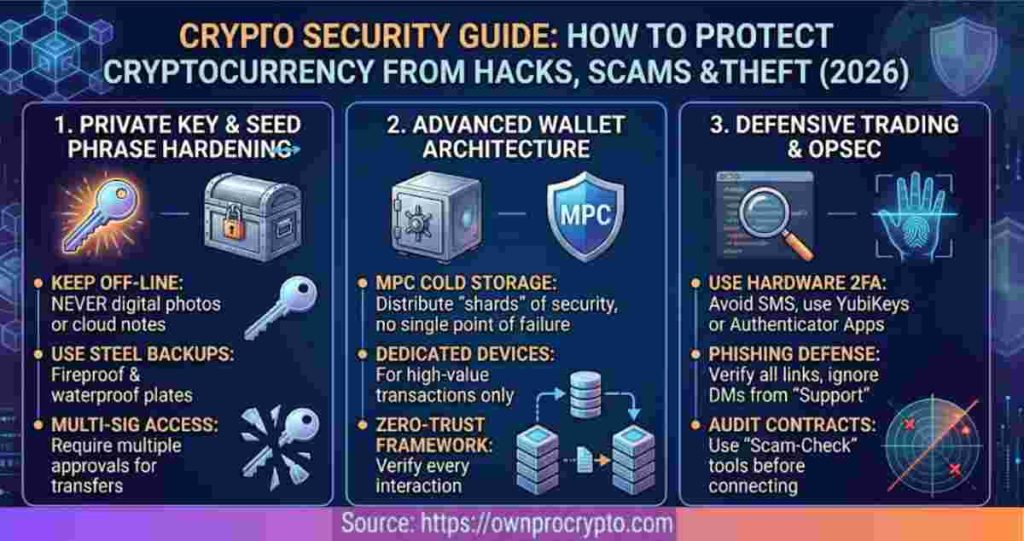
Consider how your seed phrase, private keys, backup credentials, or other recovery mechanisms are protected. A security system can fail completely if its recovery information is exposed, destroyed, forgotten, or accessible to the wrong person.
03. Review Wallet and Device Security
Evaluate the devices and wallets you use for crypto. Consider software updates, browser extensions, wallet installation sources, device access, malware exposure, and whether high-value assets are unnecessarily exposed to everyday browsing activity.
04. Check Your Account Authentication
Review the security of exchange accounts, email accounts, password management, multi-factor authentication, active sessions, withdrawal controls, and API keys. Your crypto security perimeter extends beyond the wallet itself.
05. Evaluate Transaction Safety
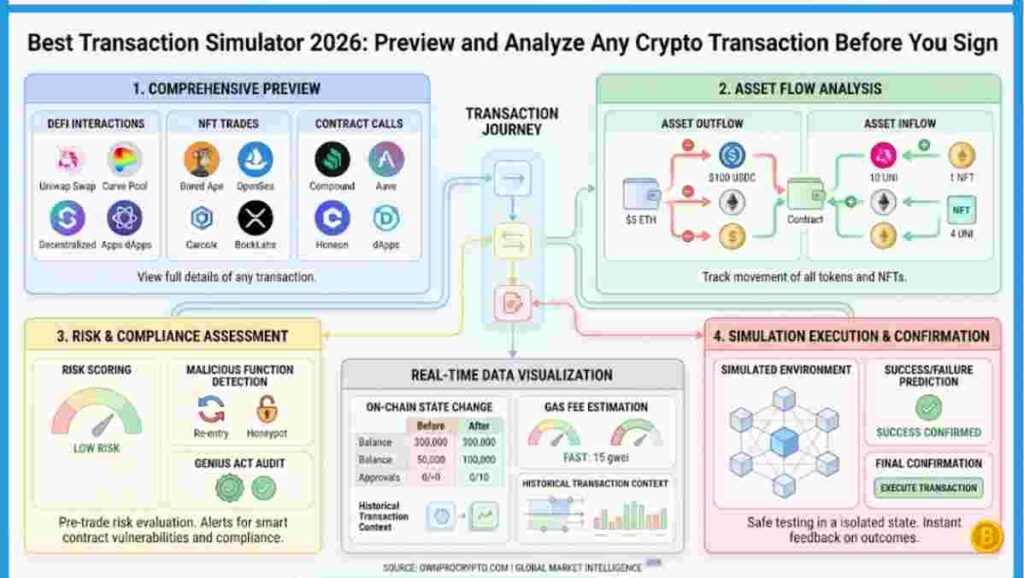
Think about how you verify wallet addresses, blockchain networks, transaction amounts, smart-contract interactions, and signing requests before approving them. Strong authentication cannot protect you from voluntarily signing the wrong transaction.
06. Review Your Web3 and DApp Exposure
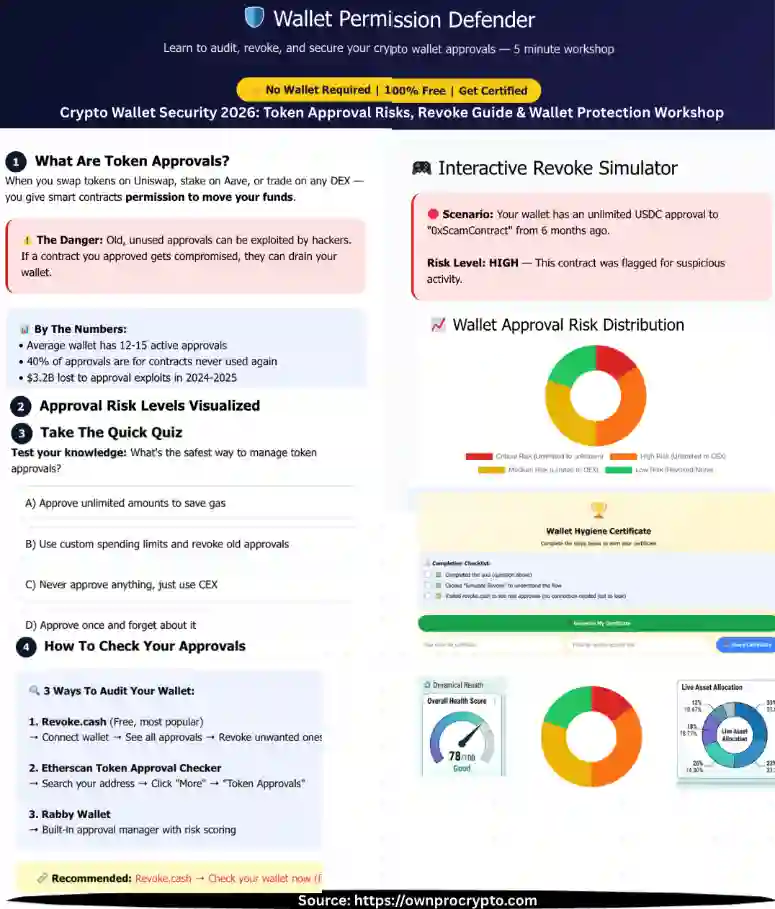
If you use DeFi, NFTs, staking, bridges, or other Web3 applications, review your connected applications and token permissions. Pay particular attention to approvals and interactions that are no longer necessary.
07. Consider Your Custody Model
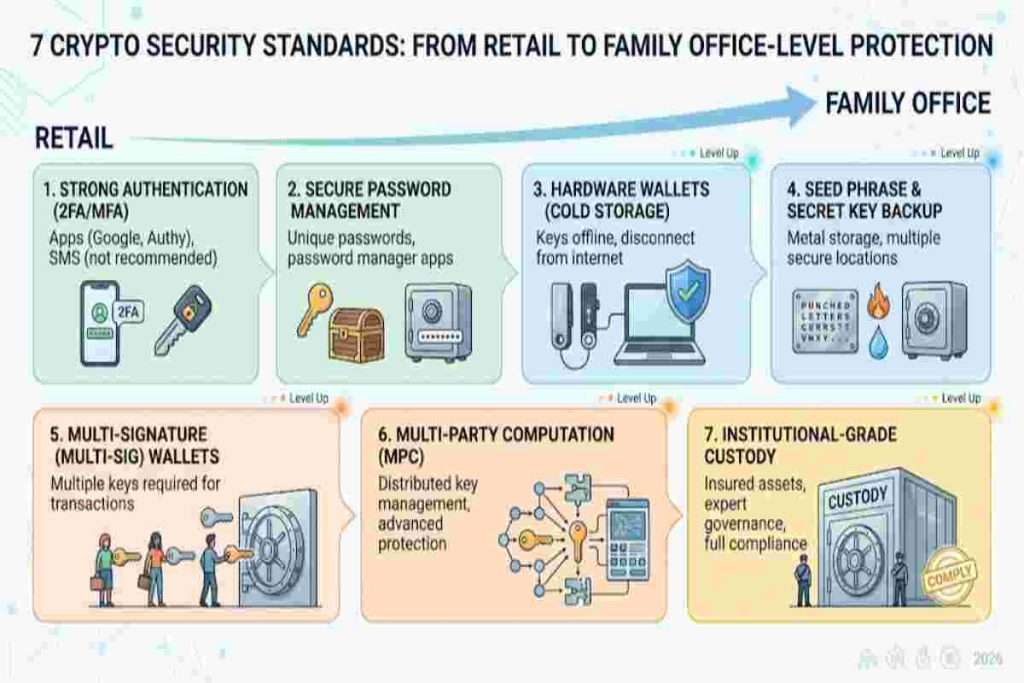
Security requirements change with the amount of capital at risk and the way assets are used. Consider whether software wallets, hardware wallets, multisig, MPC, exchange custody, or a combination of approaches is appropriate for your situation.
08. Review Your Security Score and Weak Points
Use the checklist results to identify where your current setup is strongest and where additional protection may be justified. Do not focus only on the overall score; the individual weaknesses are often more useful for deciding what to improve next.
09. Build a Security Stack That Matches Your Risk
Use the assessment to think about your complete security stack rather than buying isolated products. A long-term holder, active trader, DeFi user, and professional treasury should not necessarily have the same architecture.
10. Reassess When Your Risk Changes
Run the assessment again when your portfolio grows, you begin using new protocols, change devices, add exchange accounts, move into active trading, or adopt a different custody model. Security is an operating process, not a one-time configuration.
🔬 Institute-level interpretation
A security score is useful only when it leads to better decisions. The important question is not simply “How secure am I?” but “Which failure would hurt me most, and what control would reduce that risk?”
What the Checklist Can—and Cannot—Tell You
The Crypto Security Checklist should be treated as a decision-support tool, not a guarantee that your assets are safe. No checklist can eliminate smart-contract vulnerabilities, exchange failures, phishing, compromised infrastructure, human error, or unknown future attack methods.
Its value is in making your current security posture easier to examine. It gives you a structured starting point for identifying gaps and deciding where additional controls may provide the greatest benefit.
⚠️ Important: A security score is not a guarantee
A high score does not mean that a wallet, exchange account, protocol, or device is immune to compromise. Use the assessment to identify weaknesses and improve your security architecture—not as a reason to stop reviewing it.
✅ When should you use the tool?
Use the checklist when setting up a new wallet, reviewing an exchange account, increasing the amount of crypto you hold, beginning DeFi activity, changing your custody model, or simply checking whether your current security practices still match your level of risk.
🛠️ Practical OwnProCrypto Tool
Crypto Security Checklist
Put the security framework into practice. Review your current setup, identify weaknesses, and use the results to build a stronger security stack based on your actual crypto activity and risk profile.
Open the Crypto Security Checklist →
🔎 Continue the security review: After learning how the major layers of crypto security work, use the Crypto Security Checklist to turn those principles into a practical assessment of your own wallet, accounts, devices, permissions, custody model, and recovery process.