infographic of site logo for contact us

OwnProCrypto.com

Use our Crypto Search Engine 🔍 to find the topics and keywords you're looking for.

Protect · Detect · Respond · Recover

Crypto Protection Architecture: Protecting Digital Assets Across Access, Custody, Transactions & Recovery

2026 Crypto Protection Architecture · Access & Devices · Custody & Wallet Security · Transaction Security · Recovery & Continuity

Crypto Protection Architecture is the system for protecting digital assets across access, custody, transactions, recovery, devices, credentials, and operational continuity.

Explore Asset Security 2026 →

Security is not a single control. It is a connected chain in which weaknesses in access, custody, transactions, recovery, or operational processes can affect the security of the entire asset environment. Explore Crypto Security →
The SECURITY pillar answers one security question:
How do you protect digital assets when access, custody, transactions, devices, or recovery mechanisms become exposed or fail? Explore Crypto Security Hub →
Access
→
Custody
→
Transactions
→
Recovery
Infographic of Crypto Asset Security 2026: Crypto Protection Architecture Complete 2026 Guide
Crypto Asset Security: Crypto Protection Architecture

What Is Crypto Asset Security Architecture?  

Crypto asset security architecture is the connected framework used to protect access, credentials, custody mechanisms, transactions, devices, recovery paths, and operational continuity.

Explore Asset Security Architecture →

The security architecture connects individual controls into a broader system so that protection does not depend on one wallet, one device, one credential, or one recovery method.

Explore Crypto Security →

The real security question is what happens when trust breaks, an access path fails, a credential is exposed, a transaction becomes malicious, or the normal recovery path is no longer available.

Explore Crypto Threat Intelligence →

01 I need to secure access. Start with devices, accounts, authentication, credentials, and the environments used to reach digital assets.
Explore Wallet Security →
02 I need to secure custody. Move into custody when the central question is who controls the mechanisms that authorize asset movement.
Explore Digital Asset Custody →
03 I need to secure transactions. Use transaction security resources when authorization becomes an on-chain transaction or application interaction.
Explore Transaction Security Tools →
04 I need recovery and continuity. Move into recovery when legitimate control must continue after loss, compromise, device failure, or unavailable access.
Explore Crypto Recovery →

The architecture is the map. The specialist pages provide the detailed treatment of each individual domain.
Explore Crypto Security →

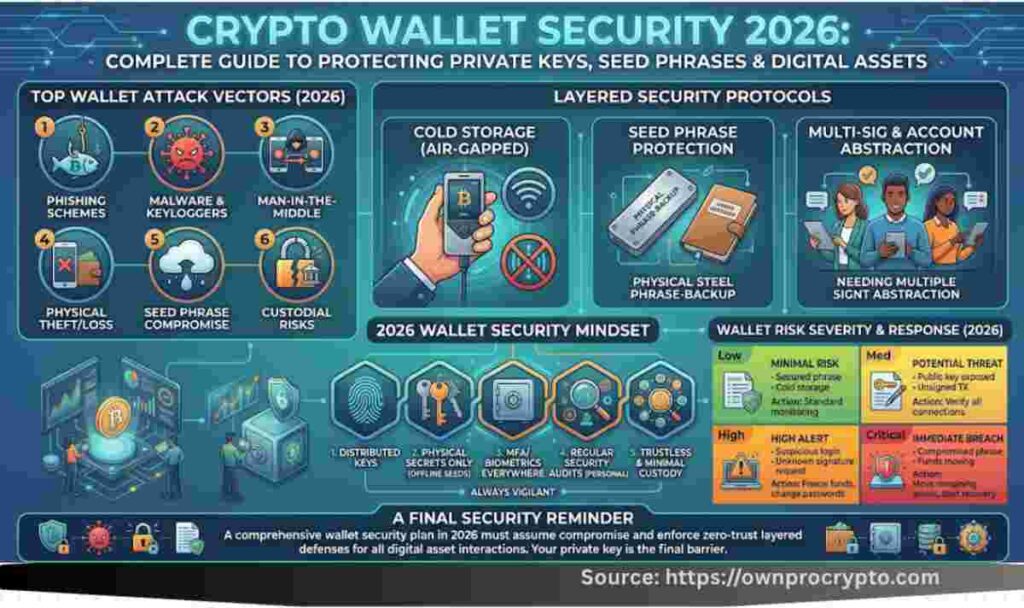
Infographic of Crypto Wallet Security 2026: Complete Guide to Protecting Private Keys, Seed Phrases & Digital Assets
Crypto Wallet Security

How Does Crypto Asset Security Protect Access? 

Access security protects the paths through which people, devices, accounts, applications, and credentials reach digital assets.

Explore Wallet Security →

Access is the first layer of the security chain because compromised devices, exposed credentials, weak authentication, or unsafe environments can undermine otherwise strong custody controls.Explore Crypto Security Checklist →
Crypto Security Access Layer
Devices & Operating Environment
↓
Accounts & Authentication
↓
Credentials & Permissions
↓
Wallet & Asset Access
↓
Continuous Monitoring
01 I need safer crypto wallet access. Review wallet security practices and controls around the devices and credentials used to reach assets.Explore Crypto Wallet Security →
02 I need to assess my security setup. Use a structured checklist to review the major controls surrounding your crypto environment.Explore Security Checklist →
03 I need to evaluate my crypto risk. Move into risk assessment when the objective is measuring exposure rather than simply reviewing controls.Run Crypto Risk Assessment →
04 I need security tools. Use practical security tools when you need to check, assess, monitor, or evaluate a specific risk.Explore Crypto Security Tools →
Infographic of Crypto Scam Recovery (2026): How to Recover Stolen Crypto & Trace Funds
Crypto Scam Recovery (2026)

How Does Crypto Asset Security Protect Custody?

Custody security focuses on the mechanisms that control or authorize movement of digital assets, including self-custody, wallets, institutional custody, multisignature systems, and MPC-based infrastructure.

Explore Self-Custody Security →
Custody becomes a security architecture problem when control depends on private keys, signing mechanisms, credentials, policies, recovery procedures, or multiple authorized parties.Explore Institutional Custody →
Custody ComponentPrimary QuestionSECURITY Role
Self-CustodyWho controls the assets directly?Protect private keys, wallets, devices, credentials, and recovery paths.
Wallet SecurityHow is asset access protected?Reduce unauthorized access and signing exposure.
MPC & MultisigHow is signing authority separated?Evaluate distributed control and authorization architecture.
Institutional CustodyHow is organizational control protected?Evaluate custody providers, policies, authorization, and operational controls.
01 I need self-custody security. Start with the security principles governing personal control of crypto assets.Explore Self-Custody Security Toolkit →
02 I need wallet security. Move into wallet-specific controls when the security question concerns wallet access and authorization.Explore Wallet Security →
03 I need institutional custody. Compare institutional custody architecture when asset control requires organizational systems.Explore Institutional Custody Providers →
04 I need to compare custody models. Evaluate MPC, multisig, HSM, and related custody architectures when control separation is the central decision.Compare Custody Architectures →
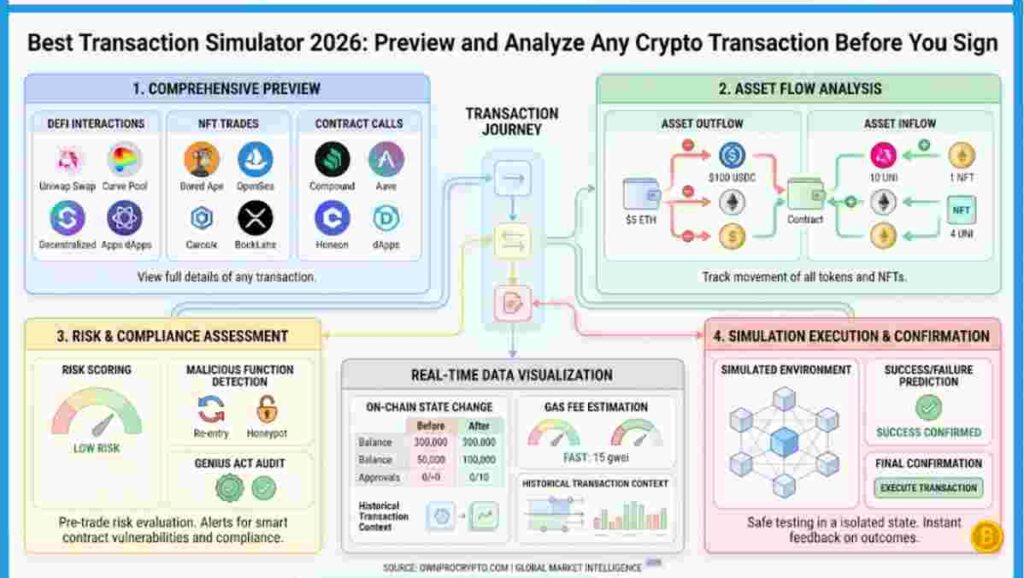
Infographic of Best Transaction Simulator 2026
Transaction & Smart Contract Security

How Does Crypto Asset Security Protect Transactions?

Transaction security protects the point at which authorized access becomes an actual blockchain transaction, wallet signature, smart contract interaction, or application action.

Explore Transaction Security →
A secure custody environment can still be exposed by malicious approvals, incorrect addresses, compromised applications, unsafe smart contracts, or poorly understood transaction permissions. Assess Smart Contract Risk →
01 I need transaction security. Review the controls that reduce errors, malicious activity, and unauthorized transaction outcomes. Explore Transaction Simulator →
02 I need smart contract risk analysis. Move into smart contract risk when application interactions are the primary security concern. Run Smart Contract Risk Assessment →
03 I need wallet approval security. Review token and contract approvals when permissions granted to applications may create ongoing exposure. Explore Wallet Approvals →
04 I need transaction risk protection. Use security analysis when a transaction, protocol interaction, or asset movement presents elevated risk. Run Crypto Asset Risk Analysis →

How Does Crypto Asset Security Support Recovery?

Recovery security addresses what happens after access is lost, credentials are compromised, assets are exposed, a device fails, or a security incident disrupts normal control.
Explore Crypto Loss Response →

Recovery security focuses on restoring legitimate control after disruption. It addresses the recovery paths, decision points, continuity measures, and safeguards needed to regain secure operation without carrying the original exposure forward. Explore Crypto Incident Response →
Crypto Security Recovery Path
Contain
↓
Assess
↓
Protect
↓
Investigate
↓
Recover & Strengthen
01 I need to respond to a crypto incident. Start with incident response when compromise, theft, exposure, or suspicious activity has already occurred.
Explore Incident Response →
02 I lost access or assets. Move into loss-response resources when the immediate problem is recovery after loss or compromise.
Explore Crypto Loss Response →
03 I need scam recovery guidance. Use specialist recovery resources when fraud or a scam is the primary incident.
Explore Crypto Scam Recovery →
04 I need continuity after a security failure. Evaluate survivability and continuity when the goal is keeping legitimate control functional through disruption.
Explore Crypto Survivability →
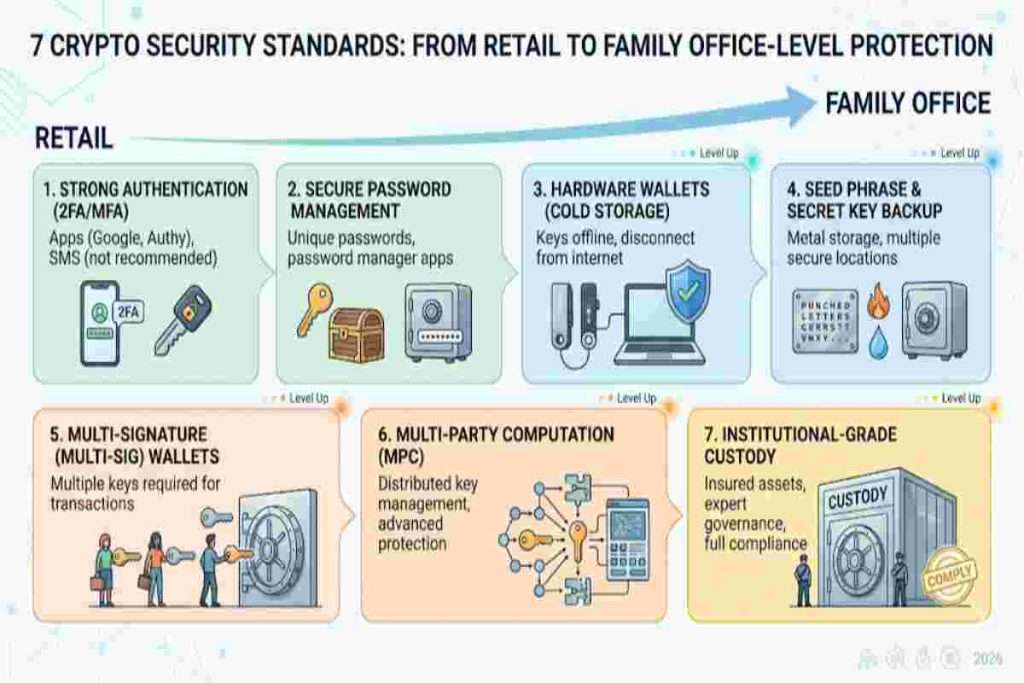
Infographic of Crypto Security Standards: From Retail to Family Office-Level Protection
Crypto Asset Security Review

How Should You Review a Crypto Asset Security Architecture?

A crypto security review examines the complete control environment rather than evaluating one wallet, device, or credential in isolation.

Explore Crypto Risk Analysis →

Review LayerPrimary QuestionSecurity Focus
Access & DevicesWho or what can reach the assets?Devices, accounts, authentication, credentials, and access environments.
Custody & CredentialsWho can authorize movement?Wallets, keys, signing systems, custody providers, MPC, and multisig.
TransactionsWhat can an authorized action actually do?Approvals, addresses, smart contracts, applications, and transaction risk.
RecoveryWhat happens when normal control fails?Recovery paths, incident response, loss response, and continuity.
Segmentation & PrivacyHow much exposure exists between assets and identities?Separation, operational privacy, account segmentation, and exposure reduction.
Incident ReadinessCan the system respond when something goes wrong?Containment, assessment, investigation, recovery, and resilience.
A security review is broader than a checklist. It evaluates how the individual security controls work together, identifies dependencies and weak links between them, and determines where the overall architecture may fail under realistic operating conditions.  Review How Secure Your Crypto Is →
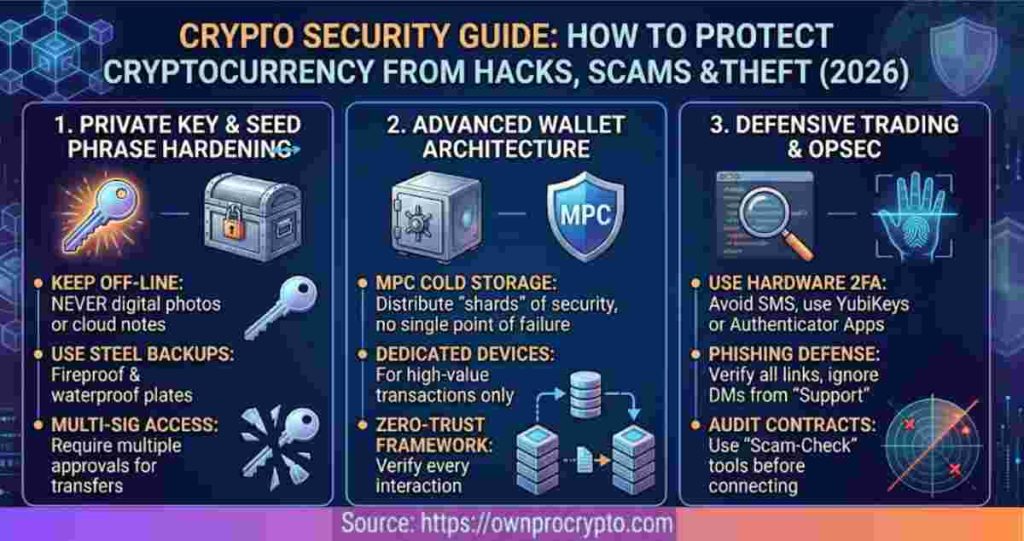
Infographic of Crypto Security Guide: How to Protect Cryptocurrency from Hacks, Scams & Loss This guide answers 40 essential crypto security questions
Tab to Access Crypto Self-Custody Toolkit Now

How Do You Improve Crypto Security Over Time?

Crypto security resilience is the ability of the security environment to continue functioning, adapt, and remain controllable as conditions change. It extends beyond recovering from an incident by strengthening architecture, separating critical functions, preparing for failure, and continuously improving security controls.
Explore Crypto Security Standards →

Foundation
→
Protection
→
Resilience
→
Continuous Review
01 I need a security foundation. Establish the basic controls that protect access, custody, transactions, devices, and recovery.
Explore Crypto Security Foundation →
02 I need stronger protection. Layer controls around wallets, custody, transactions, credentials, and operational exposure.
Explore Crypto Security Tools →
03 I need greater resilience. Build systems that can withstand device loss, credential compromise, operational failure, and security incidents.
Explore Crypto Survivability Framework →
04 I need continuous security review. Use recurring assessments and practical tools to identify changing risks over time.
Explore Crypto Risk Management Tools →
Infographic of Crypto Incident Response: What to Do After a Wallet Hack, Scam or Security Breach or Crypto Loss Response
Crypto Incident Response

How Should Crypto Asset Security Respond to an Incident?

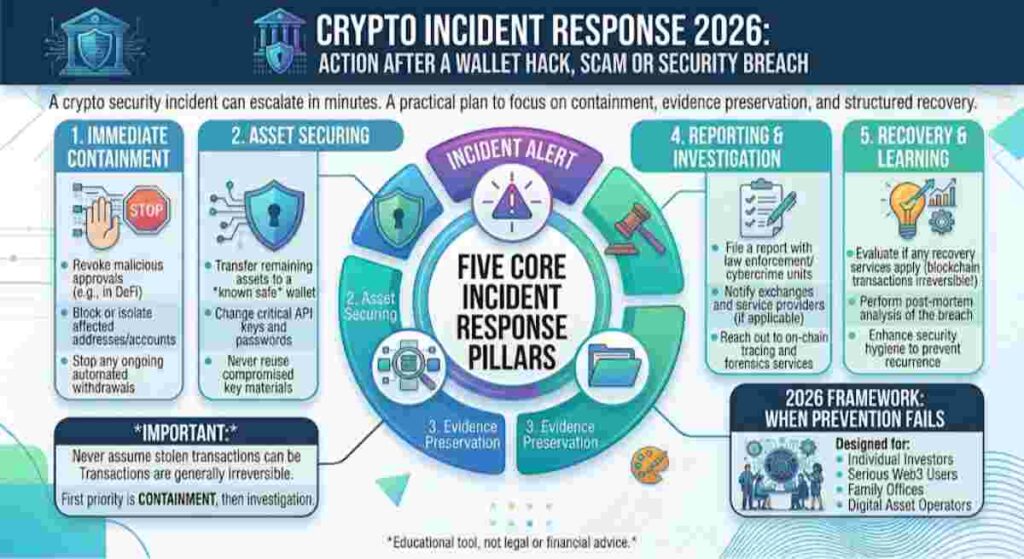
Crypto security incident response is the active security process used when compromise, unauthorized activity, credential exposure, suspicious transactions, or other security failures require immediate action. Its purpose is to contain the threat, establish what is affected, protect remaining control, and support the next investigative or recovery decision.
Explore Crypto Incident Response →

Contain
→
Assess
→
Protect
→
Investigate
01 I need to contain a suspected compromise. Prioritize immediate exposure reduction before attempting broader investigation or recovery.
Explore Incident Response →
02 I need to assess the damage. Determine which accounts, devices, credentials, transactions, or assets may have been affected.
Explore Risk Analysis →
03 I need to protect remaining assets. Strengthen unaffected control paths while the incident is being investigated.
Explore Loss Response →
04 I need to investigate the incident. Move into threat intelligence and incident analysis when determining the source and scope becomes the priority.
Explore Threat Intelligence →
Infographic of Crypto Asset Security Checklist
Crypto Asset Security Checklist

What Should a Crypto Asset Security Checklist Cover?

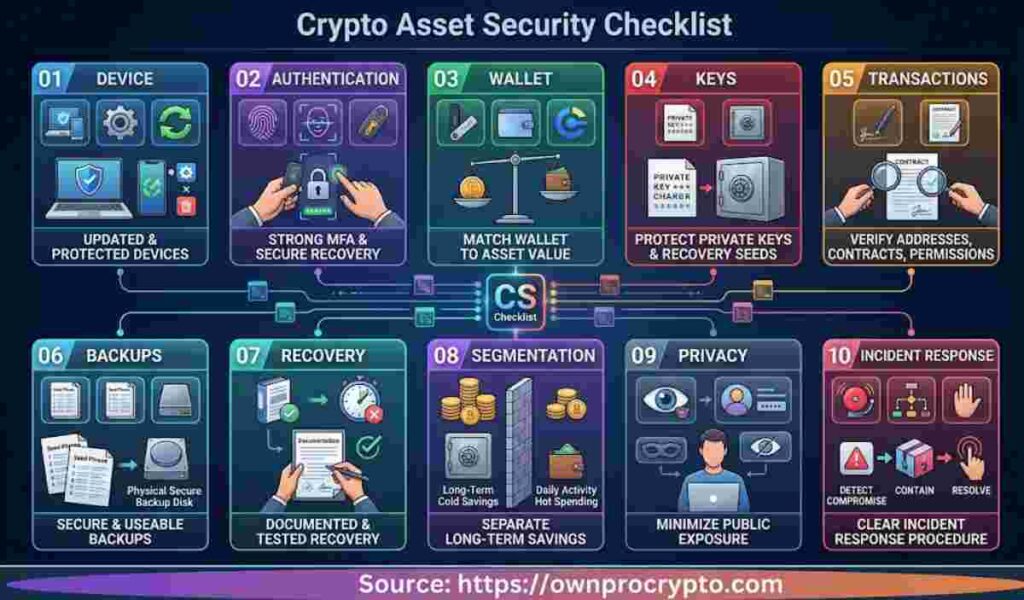
A practical crypto security checklist converts the broader security architecture into specific controls that can be verified, documented, and reviewed. It provides a repeatable way to confirm that essential access, custody, transaction, recovery, and incident-readiness measures are actually in place.

Explore Crypto Security Checklist →

01 Access controls. Review devices, accounts, authentication, credentials, and access permissions.
Review Access Security →
02 Custody controls. Review wallets, private-key exposure, signing authority, custody providers, and recovery mechanisms.
Review Self-Custody →
03 Transaction controls. Review approvals, smart contract interactions, addresses, applications, and transaction risk.
Review Transaction Security →
04 Recovery controls. Review incident response, loss response, recovery procedures, and continuity mechanisms.
Review Recovery →
Diagram showing Fortress System™ : Scam-Resistant Crypto & Blockchain Security Framework (2026)
Building a More Resilient Crypto Security System

What Does SECURITY Own — and What Does It Not Own?

The SECURITY pillar owns the protection of digital assets, access, custody, transactions, recovery, risk, threats, and operational resilience. It does not replace the pillars responsible for ownership, construction, movement, governance, connection, adoption, or legacy.

Explore the Crypto Security Hub →
Topic SECURITY Owns? Primary Authority Why
Asset Security YES SECURITY Core protection and resilience intent.
Wallet Security YES SECURITY Protects access and signing mechanisms.
Custody Security YES SECURITY Protects mechanisms controlling asset movement.
Transaction Security YES SECURITY Protects blockchain and application interactions.
Incident Response YES SECURITY Owns containment, assessment, protection, investigation, and recovery.
Threat Intelligence YES SECURITY Identifies and evaluates security threats and exposure.
Digital Ownership Itself NO OWN OWN answers what is owned and controlled.
Technical System Construction NO BUILD BUILD owns development and technical architecture.
Payments & Settlement NO MOVE MOVE owns the movement and settlement of value.
Interoperability NO CONNECT CONNECT owns communication and cross-system connectivity.
Governance & Compliance NO GOVERNANCE GOVERNANCE owns rules, compliance, accountability, and institutional decision systems.
Succession & Continuity Beyond the Owner NO LEGACY LEGACY owns long-term succession and generational continuity.
Investment & Adoption Decisions NO ADOPT ADOPT owns adoption, research, portfolio, and implementation decisions.
The permanent SECURITY boundary:

OWN answers “What do I own and control?”

SECURITY answers “How do I protect that control and respond when it is threatened?”

BUILD answers “How is the system constructed?”

MOVE answers “How does value move?”

Continue Through Crypto Security →
External Security Resource

NIST Cybersecurity Framework 2.0

For a broader cybersecurity risk-management reference, the NIST Cybersecurity Framework 2.0 provides a structured approach to identifying, managing, prioritizing, and communicating cybersecurity risk across an organization.

Explore the NIST Cybersecurity Framework 2.0 →

Infographic of Next-Gen AI Security Systems. Can Your Infrastructure Survive Autonomous Cyber Attacks Towards 2030?
Next-Gen AI Security Systems
FAQ

FAQs About Crypto Protection Architecture

Practical answers to the core questions surrounding crypto asset security architecture, access, custody, transactions, recovery, incident response, and ongoing security review.

Architecture & Fundamentals

What is crypto asset security architecture?

Crypto asset security architecture is the connected framework used to protect digital assets across access, devices, credentials, custody, transactions, recovery, incident response, and operational continuity. It treats security as a complete system rather than relying on one wallet, device, or control.

Explore Asset Security Architecture →

What does crypto asset security protect?

Crypto asset security protects the mechanisms through which digital assets are accessed, controlled, authorized, transferred, monitored, and recovered. This includes devices, accounts, credentials, wallets, custody systems, transactions, recovery paths, and incident-response processes.

Explore Crypto Security →

Access & Custody Controls

What is the difference between access security and custody security?

Access security focuses on how people and systems reach digital assets through devices, accounts, authentication, and credentials. Custody security focuses on how control and signing authority are held and protected through wallets, keys, multisignature systems, MPC, or institutional custody.

Explore Wallet Security →

How does transaction security reduce crypto risk?

Transaction security focuses on the point where authorized access becomes an actual blockchain transaction or application interaction. It addresses signing, approvals, destinations, smart contracts, applications, and other risks that can turn legitimate access into an unsafe transaction.

Explore Transaction Security →

Recovery & Incident Handling

Why is recovery part of crypto asset security?

Recovery is part of security because protection must continue when normal access fails. A resilient security architecture needs defined paths for responding to lost access, compromised credentials, device failure, asset exposure, security incidents, and other disruptions.

Explore Crypto Loss Response →

What should I do after a suspected crypto security incident?

The immediate priority is to reduce further exposure, assess what may have been affected, protect remaining assets, and establish an appropriate investigation and recovery path. Incident response provides the structured process for handling suspected compromise or unauthorized activity.

Explore Crypto Incident Response →

Review & Continuous Improvement

How should I review my crypto security setup?

A security review should examine access, devices, credentials, custody, signing authority, transactions, recovery, privacy, segmentation, incident readiness, and operational resilience. The objective is to identify weak links before they become security failures.

Review How Secure Is My Crypto →

How can crypto security improve over time?

Security improves through layered controls, recurring reviews, stronger access and custody practices, transaction safeguards, recovery preparation, incident readiness, and continuous adaptation as threats and operating environments change.

Explore Crypto Security Standards →

Looking for another topic? Search the OwnProCrypto research archive.
Comments
💬 What’s Your Take? Leave a Comment Below 0
← Digital Ownership Architecture: Control, Rights & Productive Web3 Assets
Crypto for Beginners (2026): How to Buy Bitcoin & Start Safely with $10 →
🛠 Explore Tools ▼
📚 Explore Crypto Research Select a research category