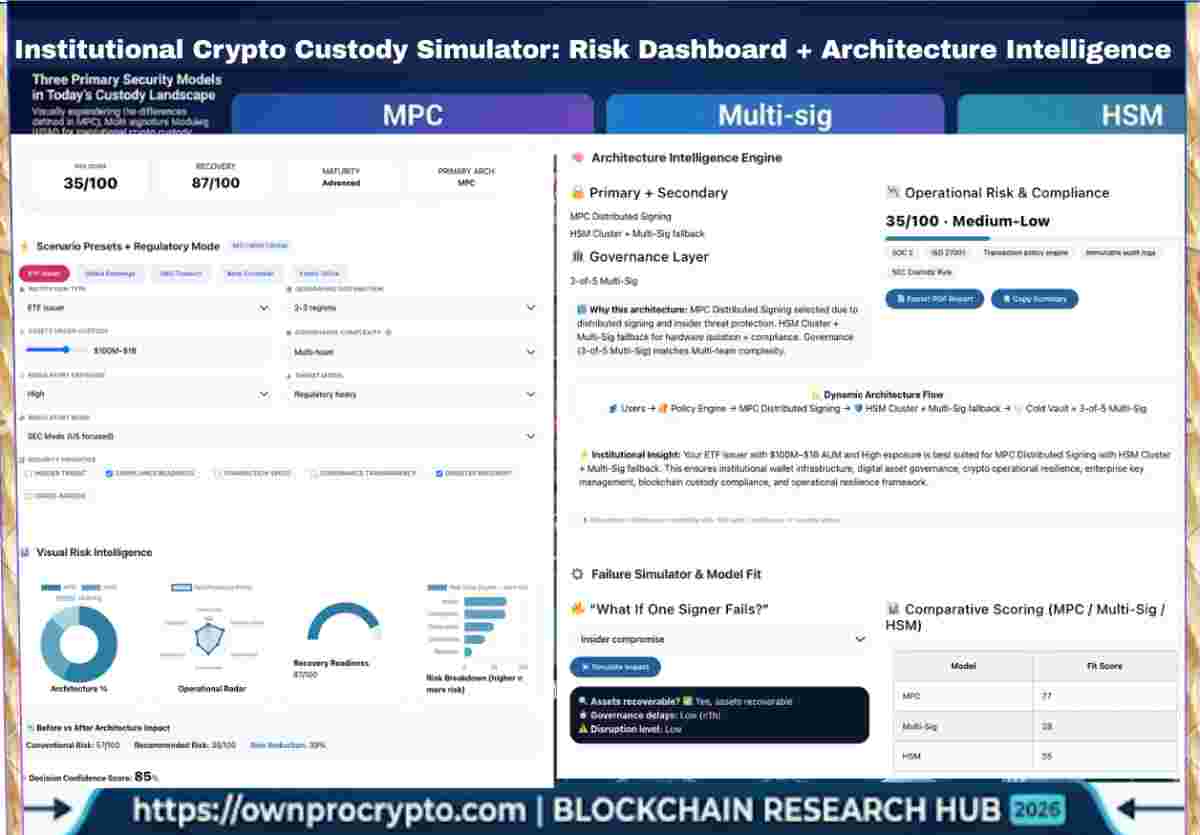
Best Digital Asset Custody Platforms →
Explore the broader digital asset custody landscape, including custody models, MPC, HSM, governance, recovery, insurance, tokenized assets and enterprise custody architecture.
Search by title, topic or phrase
Use our Crypto Search Engine 🔍 to find the topics and keywords you're looking for.
First Answer: The best institutional crypto custody provider depends on an institution’s security requirements, custody model, regulatory needs and operating structure. Leading providers such as Fireblocks, BitGo, Anchorage Digital, Copper, Coinbase Prime and Fidelity Digital Assets differ in private-key control, MPC and HSM architecture, qualified custody, asset segregation, transaction controls, settlement, staking, insurance and institutional integrations. A meaningful comparison should therefore look beyond provider features and pricing to evaluate custody structure, regulatory status, key-management architecture, supported assets, recovery controls, counterparty exposure, liquidity and total operating costs.
Table of Contents
ToggleInstitutional crypto custody refers to the institutional-grade infrastructure, cryptographic key management, and regulatory frameworks required by enterprises, funds, and financial institutions to safely store, manage, transfer, and settle digital assets. Unlike retail self-custody wallets that rely on a single seed phrase, institutional custody solutions utilize advanced security architectures such as Multi-Party Computation (MPC), multi-signature schemes, and Hardware Security Modules (HSMs) combined with role-based access controls (RBAC), multi-tiered approval workflows, and institutional-grade insurance coverage to eliminate single points of failure and counterparty risk.
The landscape of digital asset custody has shifted dramatically. With global institutional crypto custody assets scaling rapidly past multi-billion-dollar milestones, robust custodial infrastructure has transitioned from an operational luxury to a strict fiduciary and regulatory requirement.
| Dimension | Institutional Custody | Self-Custody (Retail/Hardware) | Exchange Custody |
| Key Management | Multi-Party Computation (MPC) / HSM / Multi-Sig | Single Seed Phrase / Hardware Device | Platform-Controlled Hot/Warm Wallets |
| Governance & Policies | Enterprise RBAC, multi-user approval policies | Single-user authorization | Platform-managed risk controls |
| Regulatory Standing | Qualified Custodian / OCC-chartered / Regulated Trust | Unregulated / User-held | Exchange license / Varies by jurisdiction |
| Risk Profile | Mitigated single point of failure; institutional insurance | Human error / loss of seed phrase / physical theft | High counterparty & platform insolvency risk |
The institutional crypto custody market has evolved from simple asset storage into a complete digital asset infrastructure layer. In 2026, institutions increasingly evaluate custody providers based on security architecture, regulatory status, trading connectivity, settlement capabilities, staking support, and tokenized asset infrastructure.
Large financial institutions, hedge funds, ETF issuers, family offices, and corporate treasuries are moving toward specialized custody platforms that combine secure key management with operational controls and compliance frameworks.
| Market Metric | 2026 Overview |
|---|---|
| Institutional adoption | Increasing adoption among banks, asset managers, ETFs, family offices, and corporate treasuries |
| Assets under custody | Institutional digital asset custody represents hundreds of billions in managed digital assets across major providers |
| Leading deployment model | Hybrid custody combining MPC, cold storage, policy controls, and API-based infrastructure |
| Fastest-growing segment | Institutional Bitcoin, tokenized assets (RWA), stablecoin treasury management, and regulated digital funds |
| Key regulatory trend | Greater demand for qualified custodians, asset segregation, AML controls, and transparent reporting |
Our rankings are determined through rigorous evaluation across six core institutional criteria:
Before selecting a custody provider, institutions should evaluate more than security. Supported blockchain networks, asset coverage, staking availability, stablecoin infrastructure, and tokenized asset support can directly impact operational flexibility.
Different providers specialize in different ecosystems. Some focus on Bitcoin and institutional-grade custody, while others support broader blockchain infrastructure, staking, DeFi connectivity, and tokenized assets.
| Provider | BTC | ETH | SOL | Stablecoins | Tokenized Assets | Staking |
|---|---|---|---|---|---|---|
| Fireblocks | Strong support through integrations | Available through partners | ||||
| BitGo | Supported | Growing institutional support | Available | |||
| Anchorage Digital | Supported | Strong regulated asset focus | Native staking support | |||
| Copper | Supported | Institutional token support | Available | |||
| Coinbase Prime | Strong ecosystem support | Available | ||||
| Fidelity Digital Assets | Limited ecosystem focus | Limited | Institutional focus | Developing digital asset services | Limited |
Institutional custody platforms are deployed in different ways depending on operational requirements. Some organizations prefer fully managed custody, while others require hybrid infrastructure with internal controls and customized governance.
| Model | Best For | Advantages | Considerations |
|---|---|---|---|
| Managed Custody | Funds, family offices, traditional institutions | Professional security, compliance support, reduced operational burden | Less direct infrastructure control |
| Hybrid Custody | Banks, enterprises, large asset managers | Balance between control and professional custody services | Requires governance setup |
| Self-Managed Infrastructure | Technology companies and advanced institutions | Maximum customization and control | Higher operational responsibility |
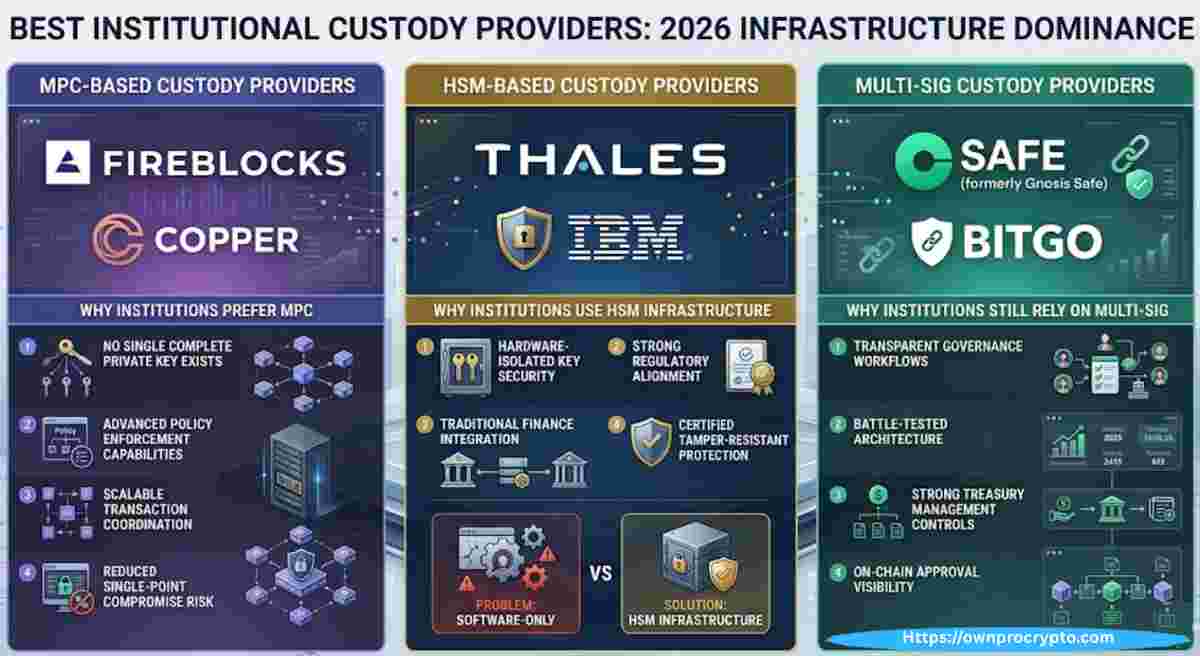
| MPC-Based Architecture | Institutions requiring distributed key security | Reduces single-point private key risk | Requires policy management |
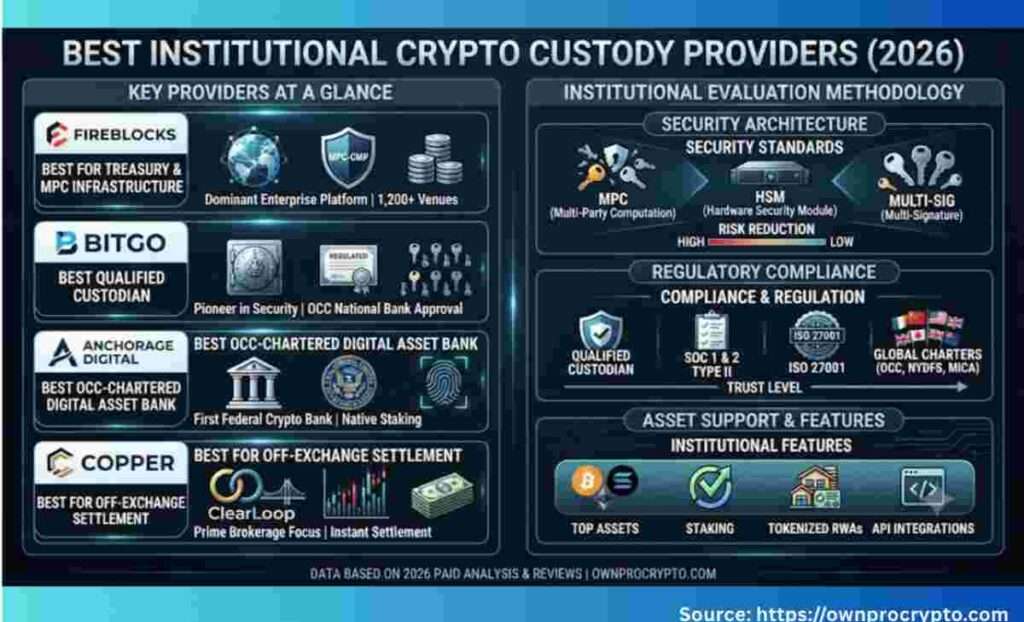
Fireblocks has cemented its position as a dominant enterprise custody platform, with over $6 trillion in digital assets safely transferred across thousands of institutional clients. Utilizing proprietary MPC-CMP (Multi-Party Computation Coordination Mechanism) technology, Fireblocks splits private keys across multiple independent environments so that a complete private key is never assembled in a single location. Its unified network connects institutions directly to over 1,200 liquidity venues, DeFi protocols, and counterparties without settlement risk. Supported by extensive SOC 2 Type II and ISO 27001 certifications, Fireblocks expanded its footprint with full MiCA clearance for RWA custody in Europe. Clients include global financial institutions such as BNY Mellon, BNP Paribas, ANZ, and Revolut.
Founded in 2013, BitGo pioneered multi-signature institutional security and has evolved into a premier regulated qualified custodian. BitGo holds key regulatory approvals, including an OCC national bank charter approval, expanding its trust framework alongside international licenses under MiCA in Germany and virtual asset permissions in Dubai. BitGo supports thousands of institutional clients, managing substantial assets under custody with deep institutional insurance backing. Its architecture provides flexible cold, warm, and hot storage models backed by rigorous compliance controls, making it a preferred choice for family offices, exchanges, and regulated funds.
Anchorage Digital stands out as the first crypto-native digital asset firm to secure a federal bank charter from the Office of the Comptroller of the Currency (OCC). Validated by years of rigorous federal banking oversight, Anchorage provides institutional-grade custody, native staking, governance, and trading services. Its platform is built from the ground up for institutional fiduciaries, featuring advanced HSM and MPC security controls, biometric authentication, and deep integration with major asset managers like BlackRock. Anchorage’s federal charter offers institutional clients unmatched regulatory clarity and bankruptcy-remote asset protection.
Operating under the New York Department of Financial Services (NYDFS) as a qualified custodian and trust company, Coinbase Prime secures a substantial share of total global crypto market capitalization. Coinbase Prime offers an all-in-one institutional platform combining cold storage and advanced MPC technology with integrated prime brokerage, execution algorithms, deep liquidity pools, and lending services on a single interface. Backed by the financial transparency of a publicly traded parent company (NASDAQ: COIN) and rigorous SOC 1 and SOC 2 Type II audits, Coinbase Prime is a staple for ETFs and institutional asset managers.
Copper delivers secure digital asset custody coupled with cutting-edge prime brokerage services. Its flagship innovation, ClearLoop, allows institutional investors to trade on multiple centralized exchanges without moving assets out of Copper’s secure custody, dramatically reducing counterparty and exchange insolvency risks. Copper utilizes robust MPC security frameworks, bespoke governance controls, and comprehensive institutional reporting, making it a favorite among hedge funds and high-frequency trading desks.
Fidelity Digital Assets brings the institutional trust and capital strength of Fidelity Investments managing over $4 trillion in total AUM directly into the digital asset ecosystem. Backed by an OCC national trust bank charter, Fidelity Digital Assets provides institutional-grade Bitcoin and Ethereum custody and execution. Ranked exceptionally low in counterparty default risk models, Fidelity offers traditional financial institutions, family offices, and registered investment advisors (RIAs) a familiar, highly secure counterparty with robust offline vaults and comprehensive SOC 1/SOC 2 certifications.
BNY Mellon leverages its centuries-old legacy as the world’s largest traditional custodian to offer institutional-grade digital asset custody, combining traditional asset servicing technology with advanced multi-chain custody solutions.
A joint venture between Nomura, Ledger, and CoinShares, Komainu combines traditional Japanese institutional banking rigor with advanced hardware-backed digital asset security. Komainu provides compliant custody solutions tailored for institutional clients across Europe, the Middle East, and Asia, offering segregated vault accounts and flexible multi-tier governance frameworks.
Backed by standard-setting global financial institutions including Standard Chartered and Northern Trust, Zodia Custody delivers institutional-grade digital asset safekeeping that adheres strictly to traditional banking compliance standards. Zodia bridges traditional finance and decentralized assets with rigorous AML/KYC controls, segregated cold storage, and regulatory approvals across multiple global financial hubs.
Taurus specializes in enterprise-grade infrastructure for banks and issuing houses, providing modular solutions for digital asset custody, tokenization of securities (Taurus-PROTECT), and decentralized network node operation. Taurus is widely deployed by major European and global universal banks looking to build native digital asset rails.
Hex Trust provides fully licensed digital asset custody and banking infrastructure for institutional markets across Asia and Europe, specializing in institutional staking, DeFi connectivity, and tokenization.
Cobo offers customizable institutional custody solutions combining MPC, Smart Contract accounts, and custodial wallets designed for web3 builders, funds, and traditional enterprises.
Gemini Trust Company operates as a NYDFS-regulated trust company and qualified custodian, offering offline cold storage architecture, $200+ million in insurance coverage, and robust compliance controls.
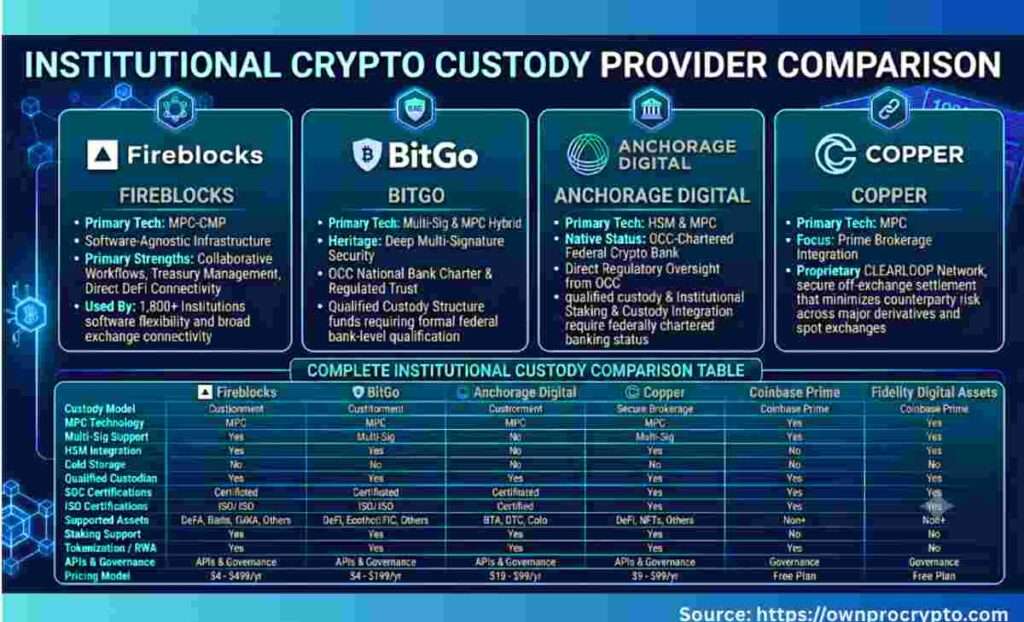
The leading institutional custody providers differ in architecture, compliance positioning, and operational features. This comparison highlights the core capabilities institutions typically evaluate before selecting a provider.
| Feature | Fireblocks | BitGo | Anchorage Digital | Copper |
|---|---|---|---|---|
| MPC Security | ✅ Core technology | Supported | Supported | Core technology |
| Cold Storage | Available through solutions | Strong offering | Strong offering | Available |
| Qualified Custodian | Through regulated partners | ✅ Yes | ✅ Yes | Jurisdiction dependent |
| Staking Support | Via integrations | Available | Native capabilities | Available |
| API Access | Advanced APIs | Enterprise APIs | Institutional APIs | Advanced APIs |
| Insurance Options | Available | Available | Available | Available |
| Off-Exchange Settlement | Supported | Supported | Supported | Strong focus |
Fireblocks is fundamentally built on enterprise MPC-CMP technology, empowering teams to operate collaborative workflows, treasury management, and direct DeFi connectivity without traditional private key bottlenecks. BitGo, conversely, carries a deep heritage in multi-signature security and holds an OCC national bank charter, making it exceptionally attractive to funds requiring formal federal bank-level qualification and regulated trust structures.
Fireblocks serves as a software-agnostic infrastructure and network layer utilized by over 1,800 institutions, whereas Anchorage Digital operates as a federally chartered crypto bank with direct regulatory oversight from the OCC. Institutions prioritizing software flexibility and broad exchange connectivity lean toward Fireblocks; those requiring federally chartered banking status choose Anchorage.
Both BitGo and Anchorage provide federally chartered regulatory standings and qualified custody. BitGo’s strength lies in its long-standing multi-sig/MPC hybrid architecture and versatile enterprise tools, while Anchorage’s strength stems from its native status as an OCC-chartered bank with built-in institutional staking and custody integration.
Fireblocks is optimized for broad treasury operations, tokenization, and multi-venue connectivity. Copper focuses heavily on prime brokerage integration and its proprietary ClearLoop network, enabling secure off-exchange settlement that minimizes counterparty risk across major derivatives and spot exchanges.
| Comparison Dimension | Fireblocks | BitGo | Anchorage Digital | Copper |
| Primary Technology | MPC-CMP | Multi-Sig & MPC | HSM & MPC | MPC |
| Regulatory Status | Tech provider / Regulated partners | OCC National Bank / Regulated Trust | OCC Federal Charter | FCA registered / Global |
| Best Suited For | Enterprise treasury & DeFi workflows | Regulated funds & qualified custody | Institutional banking & native staking | Prime brokerage & off-exchange settlement |
| Feature / Attribute | Fireblocks | BitGo | Anchorage Digital | Copper | Coinbase Prime | Fidelity Digital Assets |
| Custody Model | MPC-SaaS | Multi-Sig / MPC | Chartered Bank Custody | MPC Custody | Qualified Custodial Trust | Chartered Trust Bank |
| MPC Technology | Yes (MPC-CMP) | Yes | Yes | Yes | Yes | Yes |
| Multi-Sig Support | Optional | Native Core | Supported | Supported | Supported | Supported |
| HSM Integration | Yes | Yes | Yes | Yes | Yes | Yes |
| Cold Storage | Air-gapped options | Multi-sig offline vaults | HSM-backed cold vaults | Offline HSM vaults | Deep cold storage | Air-gapped cold storage |
| Qualified Custodian | Via Partners | Yes | Yes | Yes | Yes | Yes |
| SOC Certifications | SOC 2 Type II | SOC 2 Type II | SOC 2 Type II | SOC 2 Type II | SOC 1 & 2 Type II | SOC 1 & 2 Type II |
| ISO Certifications | ISO 27001 | ISO 27001 | ISO 27001 | ISO 27001 | ISO 27001 | ISO 27001 |
| Supported Assets | 1,400+ tokens | Hundreds | Broad support | Broad support | 470+ assets | Select (BTC, ETH, SOL, etc.) |
| Staking Support | Yes | Yes | Yes | Yes | Yes | Yes |
| Tokenization / RWA | Yes (MiCA aligned) | Yes | Yes | Yes | Yes | Expanding |
| APIs & Governance | Advanced | Robust | Institutional | Advanced | Advanced | Institutional |
| Pricing Model | Tiered SaaS / Volume | AUM / Transaction | AUM / Tiered | AUM / Tiered | Volume / AUM | Tiered Enterprise |
Copper & Coinbase Prime: Hedge funds require ultra-low latency trading execution, cross-exchange liquidity access, and capital efficiency. Copper’s ClearLoop and Coinbase Prime’s integrated order management systems eliminate settlement lag and reduce exchange counterparty risk.
Fidelity Digital Assets & Coinbase Prime: Registered Investment Advisors (RIAs) and traditional asset managers demand trusted counterparty brands, transparent public reporting or federal trust charters, and bulletproof audit trails.
BitGo & Anchorage Digital: Family offices prioritize generational asset security, flexible multi-user governance, and qualified custodian regulatory compliance for estate planning and wealth management.
Fireblocks: Corporate treasuries holding digital assets or stablecoins require programmatic policy engines, automated multi-tiered approval workflows, and seamless ERP/accounting integrations.
BitGo & Fireblocks: Exchanges need high-throughput hot, warm, and cold wallet management frameworks with automated sweeping, fraud detection, and instant liquidity routing.
Coinbase Prime & Fidelity Digital Assets: Spot ETF issuers require institutional custodians with proven capability to handle billions in underlying assets, authorized participant (AP) creation/redemption mechanics, and rigorous SEC compliance.
Zodia Custody & Komainu: Traditional banks require institutional partners built on bank-grade compliance (Standard Chartered, Nomura heritage) that integrate seamlessly into existing risk management frameworks.
Fireblocks: Fintechs launching crypto trading, wallet features, or yield products rely on Fireblocks’ developer-friendly APIs and rapid white-label deployment capabilities.
Anchorage Digital & BitGo: Issuers managing multi-billion dollar stablecoin reserves require federally chartered custody and absolute bankruptcy remoteness to back circulating tokens.
Fireblocks & Taurus: Issuers tokenizing real-world assets (RWAs) require specialized smart contract compliance controls, life-cycle management, and MiCA-aligned regulatory tracking.
Institutional custody requirements vary significantly across jurisdictions. Financial institutions increasingly prioritize providers that support licensing requirements, AML controls, asset segregation, reporting standards, and regulatory transparency.
| Region | Primary Framework | Notes |
|---|---|---|
| United States | SEC custody rules, state regulations, FinCEN requirements | Focus on qualified custody, reporting, and investor protection |
| European Union | MiCA regulation | Establishes licensing and operational requirements for crypto service providers |
| United Kingdom | FCA crypto regulations | Emphasis on registration, AML compliance, and safeguarding |
| Singapore | MAS regulatory framework | Strong focus on licensing and risk controls |
| Hong Kong | SFC virtual asset regulations | Regulated custody requirements for licensed platforms |
| UAE | VARA and ADGM frameworks | Growing institutional digital asset market |
A qualified custodian is a regulated financial institution such as a bank, trust company, or broker-dealer legally authorized to safeguard customer funds and securities, ensuring complete asset segregation from the custodian’s corporate balance sheet.
U.S. regulatory frameworks (including evolving SEC custody rules) require investment advisers to maintain client crypto assets with qualified custodians, mandating strict independent audits, uncompromised asset segregation, and clear bankruptcy remoteness.
In Europe, the MiCA regulatory framework establishes rigorous licensing requirements for crypto-asset service providers (CASPs) and custodians, enforcing mandatory capital reserves, anti-money laundering controls, and strict consumer asset protection standards.
Institutional custodians implement enterprise-grade Anti-Money Laundering (AML) and Know Your Customer (KYC) onboarding pipelines alongside the FATF Travel Rule, tracking originator and beneficiary information across all digital asset transfers.
Custodians provide verifiable cryptographic proof of reserves (PoR) and legal asset segregation, ensuring client digital assets are never rehypothecated or comingled with corporate operating funds.
Automated multi-account fund distribution, balance sheet visibility, cash-to-crypto reconciliation, and multi-currency reporting.
Table:
| Pricing Model | How It Works | Best For |
|---|---|---|
| Assets Under Custody Fee | Percentage based on assets stored | Funds and large portfolios |
| Transaction Fees | Charged per movement | Active traders |
| Platform Subscription | Fixed enterprise pricing | Corporations |
| Custom Enterprise Contracts | Negotiated pricing | Banks and institutions |
Distributed key generation and threshold signing eliminating single points of vulnerability.
Granular permissioning defining exactly what actions traders, risk officers, compliance managers, and administrators can perform.
High-performance REST and WebSocket APIs enabling automated programmatic execution, ERP sync, and custom enterprise software integration.
Modern institutional custody is not only about storing assets. Enterprises increasingly require connectivity with trading platforms, treasury systems, compliance providers, and blockchain networks.
A strong integration ecosystem allows institutions to manage digital assets as part of broader financial operations.
| Integration Category | Business Value |
|---|---|
| Trading Platforms | Enables institutional execution and liquidity access |
| Banking Systems | Connects digital assets with traditional financial workflows |
| Treasury Software | Improves portfolio visibility and cash management |
| Compliance Solutions | Supports monitoring, reporting, and risk management |
| Blockchain Networks | Expands supported assets and tokenized opportunities |
Secure settlement infrastructure (such as Copper ClearLoop) allowing trading across multiple venues without moving funds out of custody.
Secure protocol participation (Ethereum, Solana, etc.) enabling institutions to earn native blockchain yields directly from cold or warm custody without risking slashing penalties or asset lockups.
Native infrastructure for minting, holding, and managing tokenized real-world assets, institutional bonds, and compliant stablecoins.
The best custody provider depends on the institution’s operational model, regulatory requirements, and asset strategy.
| Organization Type | Recommended Provider Focus |
|---|---|
| Hedge Fund | Advanced trading connectivity, MPC security, fast settlement |
| Family Office | Security, simplicity, reporting, multi-wallet support |
| Corporate Treasury | Governance controls, approvals, accounting integration |
| ETF Issuer | Regulated custody, audit support, institutional reporting |
| Commercial Bank | Qualified custody, compliance infrastructure, scalability |
| Fintech Company | API access, flexible infrastructure, developer tools |
Institutional custody pricing generally combines an onboarding/setup fee, an Assets Under Custody (AUM) basis-point fee (ranging from 5 to 30 bps), and per-transaction or API execution fees. Hidden enterprise costs often include minimum monthly fees, extra charges for multi-chain custom token support, and withdrawal gas markups.
Define asset allocation requirements, liquidity needs, multi-jurisdictional compliance mandates, and internal stakeholder access roles.
Execute formal vendor due diligence, legal contract reviews, API sandbox testing, and staged multi-signature/MPC wallet setup before moving foundational treasury capital.
Moving digital assets into institutional custody requires careful planning. The largest challenges usually involve governance, migration processes, internal approvals, and operational security.
| Challenge | Best Practice |
|---|---|
| Wallet Migration | Create verified migration procedures and test transfers |
| Governance Policies | Define approval workflows and transaction limits |
| Access Controls | Implement role-based permissions |
| Disaster Recovery | Establish backup procedures and recovery plans |
| Staff Training | Train teams on custody operations and security policies |
Establish rigid corporate governance policies, multi-person authorization thresholds, and recurring internal audits to maintain zero operational friction.
Institutional custody is becoming a foundational layer for the digital asset economy. Banks, asset managers, ETF providers, and corporations are expanding their involvement as regulatory clarity improves.
| Trend | Expected Impact |
|---|---|
| Institutional Bitcoin Adoption | Increased demand for secure regulated custody |
| Tokenized Assets | Growth of custody solutions supporting RWAs |
| Stablecoin Infrastructure | Greater enterprise treasury adoption |
| Digital Asset Funds | More demand for institutional reporting and compliance |
| Cross-Border Settlement | Increased use of blockchain-based settlement systems |
Institutional tokenization of short-term government bonds, money market funds, and private credit continues to explode, requiring custodians to natively manage smart-contract-enabled securities alongside native cryptocurrencies.
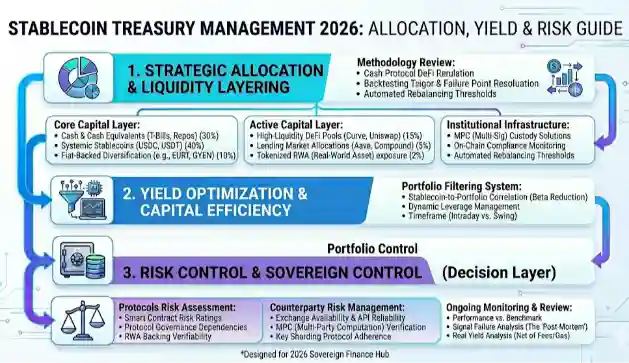
Corporations and payment giants are scaling stablecoin treasuries, driving demand for automated programmatic compliance and multi-chain stablecoin settlement rails.
Custodians are deploying AI-driven anomaly detection and predictive behavioral monitoring to instantly intercept fraudulent withdrawal attempts and flag suspicious transaction patterns.
Fireblocks: Unmatched for enterprise flexibility, treasury automation, and broad Web3 connectivity.
Anchorage Digital & BitGo: Industry pioneers with federal banking charters and uncompromising regulatory frameworks.
Fidelity Digital Assets & Coinbase Prime: The gold standard for institutional asset managers, ETFs, and regulated funds.
Different institutions require different custody capabilities. The right provider depends on security needs, regulatory requirements, asset strategy, and operational complexity.
| If You Need… | Recommended Provider Type |
|---|---|
| Maximum Security | MPC-focused institutional custody providers |
| Regulatory Compliance | Qualified custodians with strong licensing frameworks |
| Active Trading | Providers with exchange connectivity and settlement tools |
| Corporate Treasury | Enterprise custody with governance controls |
| Digital Asset Funds | Institutional reporting and portfolio management solutions |
| Global Custody | Multi-jurisdiction providers with broad infrastructure |
Selecting the Best Institutional Crypto Custody Providers requires more than comparing security features alone. The right institutional custody partner depends on your organization type, regulatory jurisdiction, asset strategy, trading activity, blockchain requirements, and operational risk framework.
Before choosing a provider, institutions should evaluate custody architecture, compliance standards, supported digital assets, governance controls, insurance coverage, integration capabilities, and long-term scalability. Testing sandbox environments, reviewing internal approval workflows, and assessing regulatory alignment can help ensure the selected custody solution meets your fiduciary responsibilities.
As digital assets become increasingly integrated into traditional finance, the best institutional crypto custody provider is the one that aligns technology, security, compliance, and operational flexibility with your institution’s long-term goals.
What is institutional crypto custody?
Institutional crypto custody is professional-grade cryptographic key management and asset safekeeping designed for businesses, funds, and financial institutions, utilizing advanced security like MPC and strict regulatory controls.
What is the best institutional crypto custody provider?
The top providers include Fireblocks for enterprise workflow automation, BitGo and Anchorage for federally chartered qualified custody, and Coinbase Prime and Fidelity for asset managers.
Fireblocks vs BitGo: Which is better?
Fireblocks is an advanced software and MPC infrastructure platform ideal for active treasuries and Web3 funds, whereas BitGo specializes as a federally chartered qualified custodian with a rich multi-sig heritage.
Fireblocks vs Anchorage: Which platform should institutions choose?
Choose Fireblocks if you need customizable SaaS workflow automation and broad exchange connectivity; choose Anchorage if you require an OCC-chartered digital asset bank.
Is Fireblocks a custodian or custody infrastructure?
Fireblocks operates primarily as a secure technology infrastructure provider powering institutional custody, rather than acting as a standalone qualified custodian itself (though it partners with qualified custodians).
Is Anchorage a qualified custodian?
Yes, Anchorage Digital operates as a federally chartered digital asset bank regulated by the OCC, granting it full qualified custodian status.
Is BitGo a qualified custodian?
Yes, BitGo operates as a qualified custodian holding federal and state trust regulatory approvals.
What is MPC custody?
Multi-Party Computation (MPC) is a cryptographic security technology that splits private keys across multiple independent computers or parties, ensuring no single entity ever holds the complete private key.
What is the difference between MPC and multisig?
MPC splits a single private key into multiple cryptographic shares at the signing layer, while multi-signature creates multiple distinct on-chain private keys that must individually sign transactions.
What is HSM custody?
Hardware Security Module (HSM) custody stores and manages cryptographic keys inside physical, tamper-resistant hardware devices certified to strict security standards.
What is institutional cold storage?
Institutional cold storage refers to air-gapped offline storage vaults completely isolated from the internet to secure long-term digital asset holdings.
Which custody providers support Ethereum staking?
Major institutional custodians including Fireblocks, BitGo, Anchorage, Coinbase Prime, and Copper offer secure, integrated institutional staking services.
Which custody providers support tokenized RWAs?
Fireblocks, Taurus, Anchorage, and Hex Trust offer specialized infrastructure for issuing and holding tokenized real-world assets.
Which providers support stablecoin treasury management?
Fireblocks, BitGo, and Anchorage provide advanced programmatic treasury tools for enterprise stablecoin management.
Which provider is best for hedge funds?
Copper and Coinbase Prime are widely favored by hedge funds due to their high-speed trading execution and off-exchange settlement capabilities.
Which provider is best for family offices?
BitGo and Anchorage are ideal for family offices seeking regulatory oversight, qualified custody, and estate-planning governance controls.
Which provider is best for banks?
Zodia Custody and Komainu provide bank-backed compliance frameworks tailored specifically for traditional banking institutions.
Which provider is best for crypto exchanges?
BitGo and Fireblocks offer high-throughput hot and cold wallet infrastructures capable of managing massive exchange liquidity volumes.
How much does institutional crypto custody cost?
Pricing typically ranges from an initial onboarding fee, 5 to 30 basis points (bps) annually on Assets Under Custody (AUM), plus transaction or network fee markups.
What insurance should a custodian provide?
Institutional custodians should provide robust specie, crime, and third-party liability insurance covering digital assets against theft, key compromise, and employee collusion.
Which certifications should institutional custodians have?
Custodians must hold independent SOC 1 Type II, SOC 2 Type II, and ISO/IEC 27001 certifications.
Can institutions self-custody digital assets?
While technically possible via hardware wallets or custom multi-sig, self-custody exposes institutions to severe internal risk, compliance violations, and a lack of fiduciary insurance.
What happens if a custody provider fails?
Qualified custodians and federally chartered banks hold client assets in bankruptcy-remote, legally segregated accounts, ensuring creditors cannot claim client funds.
How do institutions migrate between custody providers?
Migration involves establishing secure API links with the new custodian, generating new deposit addresses, and executing on-chain or off-exchange settlement transfers under strict multi-person approval policies.
Who is the largest crypto custodian?
Coinbase Prime and Fireblocks handle some of the largest asset volumes and client rosters in the institutional digital asset ecosystem.
Is BitGo regulated?
Yes, BitGo is regulated under state and federal trust frameworks, including OCC approval.
Is Anchorage federally chartered?
Yes, Anchorage Digital holds a federal banking charter issued by the OCC.
Which custody provider is best for Bitcoin ETFs?
Coinbase Prime and Fidelity Digital Assets act as primary custodians for the majority of major spot Bitcoin and Ethereum ETFs.
How secure is institutional crypto custody?
Institutional custody is extremely secure, utilizing multi-layer MPC/HSM cryptography, physical air-gapped vaults, and zero single points of failure.
Can institutions self-custody crypto?
Fiduciary and regulatory rules generally discourage or prohibit pure retail self-custody, requiring institutional-grade qualified custodians.
Explore the custody architecture, security controls, institutional risk frameworks and regulatory resources behind professional digital asset custody decisions.
Explore the broader digital asset custody landscape, including custody models, MPC, HSM, governance, recovery, insurance, tokenized assets and enterprise custody architecture.
Navigate OwnProCrypto’s wider security resources covering institutional custody, self-custody, wallet security, security standards, threat intelligence and practical protection tools.
Examine custody concentration, counterparty exposure, operational risk, recovery planning and portfolio-level controls that should sit alongside a professional custody strategy.
Use structured decision frameworks for custody and counterparty controls, operational risk, security review and digital asset infrastructure decisions.
Official Fireblocks documentation explaining its direct-custody model, MPC architecture, transaction policies, key recovery and institutional control framework.
Official BitGo information on institutional qualified custody, MPC and multi-signature key management, asset segregation, reporting and regulated custody structures.
Official Anchorage Digital custody information covering qualified custody, asset segregation, institutional controls, staking and its federally chartered banking structure.
Official U.S. banking-regulator guidance on national bank authority to provide crypto-asset custody and related execution services, including third-party risk management considerations.