infographic of site logo for contact us

OwnProCrypto.com

Use our Crypto Search Engine 🔍 to find the topics and keywords you're looking for.

PERSONAL CRYPTO CONTROL • 2026

How Much Control Do You Really Have Over Your Crypto? Crypto Self-Custody Score

Your crypto may be worth a lot, but how much control do you actually have over it? A wallet address alone does not answer that question. Your real level of control also depends on who can approve transactions, how your keys are protected, what happens if a device is lost, and whether you can recover access when something goes wrong.

The Digital Sovereignty Score is a simple six-question assessment designed to help you understand the strength of your personal crypto setup. It looks at the practical controls that determine whether you can protect, access, and recover your assets without depending too heavily on one person, device, service, or backup.

THE SIMPLE QUESTION Could one failure leave you unable to control your crypto?

Answer six questions to find your current score, identify your weakest area, and get a practical checklist for improving your setup.

Infographic of Crypto Self-Custody Guide to Secure Digital Asset Ownership (2026)
Not sure if a crypto website is legit or a scam?

What Is Digital Sovereignty in Crypto?

Digital sovereignty simply means having meaningful control over your own digital assets. In practical terms, it means you are not unnecessarily dependent on a single exchange, device, person, password, signing key, or recovery method.

You do not need an extremely complicated setup to have strong control. The goal is not to maximize the number of wallets, devices, or security products. The goal is to build a setup where a predictable failure does not automatically become a permanent loss of access.

In plain English

Digital sovereignty = the ability to control and recover your crypto without relying too heavily on a single point of failure.

What Can Affect Your Level of Control?

  • Who controls the device used to approve transactions?
  • Can one compromised device or account move your entire balance?
  • Do you have a safe way to recover if your main device is lost?
  • Can you recover access if you become unavailable?
  • Are important recovery details protected from unauthorized access?
  • Are your security arrangements appropriate for the amount you hold?
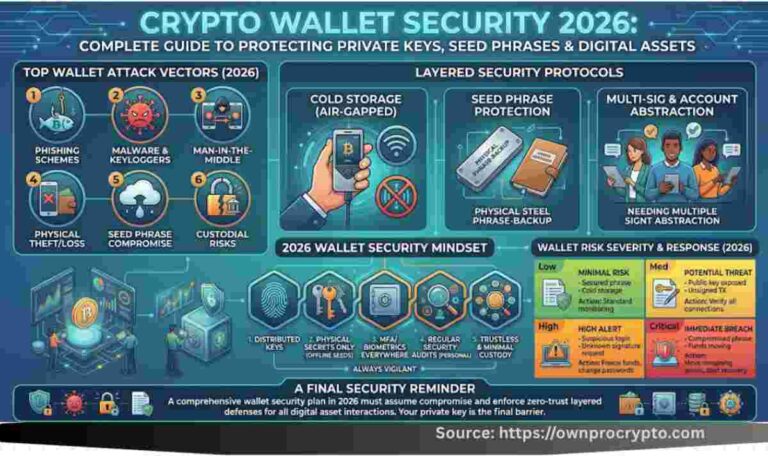
Infographic of Crypto Wallet Security 2026: Complete Guide to Protecting Private Keys, Seed Phrases & Digital Assets
Not sure if a crypto website is legit or a scam?

Why Your Wallet Alone Does Not Tell the Whole Story

A hardware wallet can protect private keys. A multisignature setup can require multiple approvals. A backup can help restore access. But each control solves a different problem.

For example, having a hardware wallet does not automatically mean that your recovery plan is strong. Likewise, using multisig does not automatically mean that all signers, backups, and recovery procedures are properly protected.

Strong personal crypto security therefore depends on how several controls work together.

THE DIGITAL SOVEREIGNTY MODEL
Protect
Keys & Devices
→
Control
Who Can Act
→
Limit
Single Failures
↓
Recover
Restore Access
←
Prepare
For Emergencies
←
Review
Weak Points

The goal is not perfect security. The goal is to reduce the chance that one mistake, loss, compromise, or unavailable person causes a disproportionate loss of control.

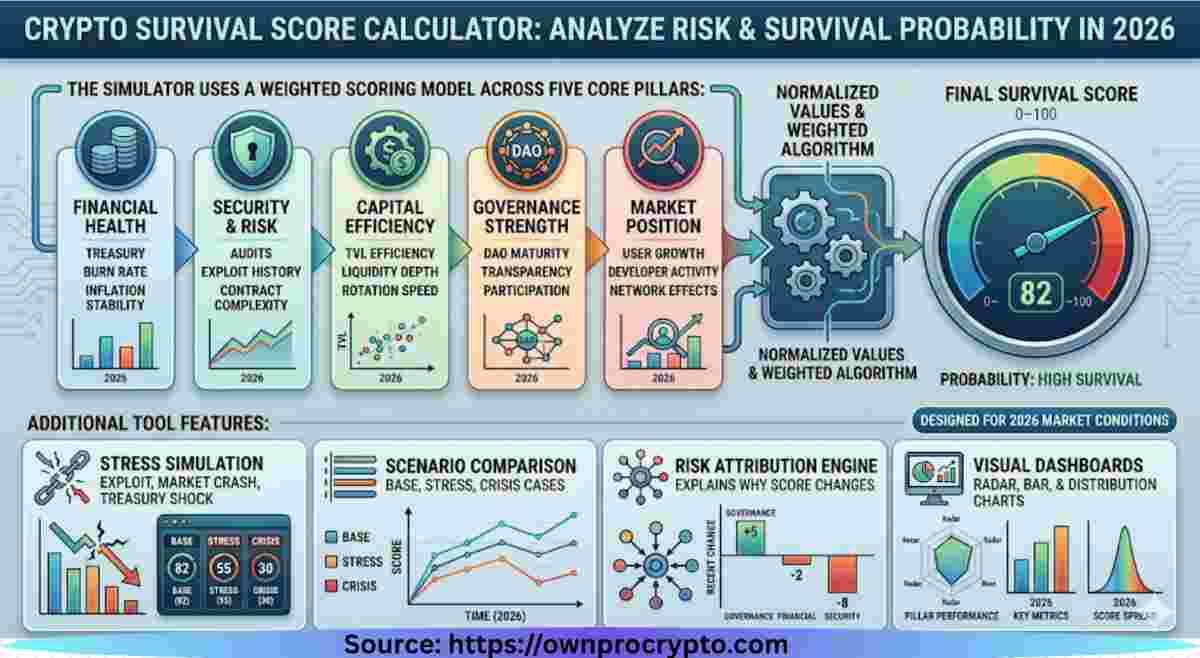
Infographic of Crypto Survival Score Calculator: Analyze Risk & Survival Probability in 2026
Not sure if a crypto website is legit or a scam?

The 6 Areas Behind Your Digital Sovereignty Score

The calculator evaluates six practical areas of personal crypto control. Each area represents a different part of your ability to protect and recover your assets.

#AreaWhat It ChecksWhy It Matters
01Key ProtectionHow your main crypto is securedReduces exposure to device and key compromise
02Transaction ControlWhether more than one approval is neededReduces dependence on one signer
03RecoveryHow your access is backed upHelps prevent permanent loss after device failure
04ContinuityWhat happens if you become unavailableHelps preserve access during serious life events
05IndependenceHow dependent your setup is on one provider or locationReduces concentration of control
06GovernanceHow you manage assets that involve shared decisionsHelps active participants maintain control over governed assets
Infographic of Crypto Scam Recovery (2026): How to Recover Stolen Crypto & Trace Funds
Not sure if a crypto website is legit or a scam?

Key Protection: Who Can Control the Funds?

Your first layer of control is the protection of the keys or signing authority used to approve transactions.

The important question is not simply whether you own a hardware wallet. It is whether the device, credentials, and signing process are protected appropriately for the assets you hold.

Stronger Setup

  • Main holdings are not dependent on an ordinary online account alone.
  • Signing devices are protected from unnecessary exposure.
  • Important credentials are not casually shared or stored.
  • The security level matches the value being protected.
Practical rule: The more value you control, the more carefully you should separate everyday access from the authority needed to move your most important holdings.
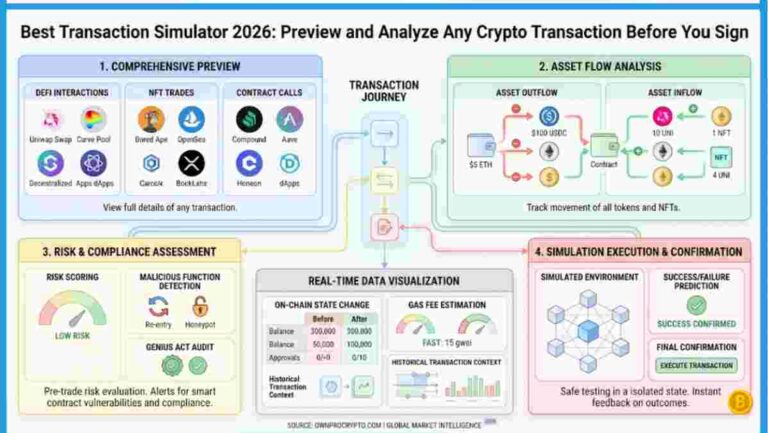
Infographic of Best Transaction Simulator 2026
Not sure if a crypto website is legit or a scam?

Transaction Control: Can One Person Move Everything?

A major weakness in some crypto setups is that one device, one person, or one compromised account can approve a transaction affecting the entire balance.

Multisignature arrangements can reduce this dependency by requiring multiple authorized approvals before a transaction is completed.

Single Approval
1

One compromised signing path may be enough to move funds.

→
Multiple Approval
2+

Multiple independent approvals can reduce single-point exposure.

Multisig is not automatically better for every person or every wallet. It also introduces additional recovery and coordination requirements. The important question is whether the arrangement is appropriate for your situation.

Infographic Diagram shows The Lost Key Problem: The Silent Crypto Wealth Killer
Not sure if a crypto website is legit or a scam?

Recovery: What Happens If Your Main Device Is Lost?

Security is incomplete if you can protect your crypto today but cannot recover access tomorrow.

Think about realistic failures: a damaged device, lost hardware, forgotten credentials, unavailable signer, or another event that prevents normal access.

A Good Recovery Plan Should Answer:

  1. What information is needed to recover access?
  2. Where is that information stored?
  3. Who can access it?
  4. What happens if the primary device is destroyed?
  5. Has the recovery process actually been tested?
Important: A backup is not necessarily a recovery plan. If you have never tested recovery, you may not know whether the backup is complete, usable, or accessible when needed.

Continuity: What If You Cannot Manage Your Crypto?

Personal crypto control also includes planning for situations where you temporarily or permanently cannot manage your assets yourself.

This can include serious illness, incapacity, extended travel, loss of access, or death. Without a clear plan, assets can remain technically secure while becoming practically inaccessible to the people who need to recover them.

A continuity plan should separate instructions from sensitive secrets where appropriate. The objective is to make the recovery process understandable without casually exposing the information that controls the assets.

infographic of Best Institutional Crypto Custody provider and Reviews
Not sure if a crypto website is legit or a scam?

Independence: How Much Does Your Setup Depend on One Provider?

Your crypto may be self-custodied while parts of your overall setup still depend heavily on one company, exchange, location, account, or service.

This does not mean every person needs multiple countries, companies, or complex structures. Instead, consider whether a single external dependency could prevent you from accessing or managing an important part of your assets.

Lower dependence

Important control does not rely entirely on one external service.

Higher dependence

A single provider, account, or access path can significantly affect control.

Governance: Do You Control the Decisions Around Your Assets?

Some crypto assets involve community or protocol decisions. If you actively participate in those systems, your ability to manage voting or delegation can become part of your overall control model.

This category is most relevant to people who hold assets involving governance participation. If you do not participate in DAO or protocol governance, this area should not be treated as the defining measure of your overall crypto security.

Remember: Digital sovereignty is primarily about control and recoverability. Governance participation is only relevant where your assets actually depend on it.
infographic of Why Institutions Are Replacing Multi-Sig with MPC Infrastructure in 2026
Not sure if a crypto website is legit or a scam?

How the Digital Sovereignty Score Works

The calculator asks six questions. Each answer represents a different level of maturity in that area. The answers are combined into a score from 0 to 100.

0–39 Centralized High dependence on single points of control
40–69
Hybrid
Some strong controls, but important gaps remain
70–100
Sovereign
Stronger personal control and resilience

The score is intended as a practical self-assessment, not as a guarantee that your assets are safe or as a professional security audit.

Step by step How the Digital Sovereignty Score Works

You don’t need to understand complicated crypto security systems to use this tool.
Just answer 6 simple questions about how you protect and manage your
crypto. Your answers produce a score from 0–100, identify your
weakest area, and give you practical steps to improve your setup.

01 — Answer 6 quick questions

Tell us how you store your crypto, protect your backups, share control,
and prepare for recovery.

02 — Get your score

Your answers are converted into a simple 0–100 score showing the strength
of your current setup.

03 — Find your weakest area

The calculator highlights the part of your setup that may need the most
attention first.

04 — Follow your action checklist

Use the personalized suggestions to improve your crypto security one step
at a time.

Ready to see your score?

Answer the six questions and find out how strong your current crypto protection really is.      Start My Digital Sovereignty Score →

What to Do After Getting Your Score

Your score is a starting point, not a guarantee that your crypto is completely
safe. If your result shows a weakness, focus on that area first rather than
trying to change everything at once.

For a broader review of your personal setup, continue with the
Crypto Security Checklist.
To understand the wider principles behind crypto protection, see the
Crypto Security Standards guide.
You can also explore the
Crypto Security Hub
for additional crypto security resources and practical guidance.

For broader cybersecurity guidance, you can also consult
NIST Cybersecurity Framework.
For application and smart-contract security resources, see
OWASP.

What Your Result Means

ScoreResultPlain-English MeaningNext Step
0–39CentralizedYour crypto control depends heavily on one or more single points of failure.Start by fixing the weakest area shown by the calculator.
40–69HybridYou have some meaningful controls, but important dependencies remain.Strengthen the weakest control before adding unnecessary complexity.
70–100SovereignYour setup demonstrates stronger independence and recovery preparation.Keep testing your controls and review them as your holdings change.

Your Weakest Link Matters More Than a Perfect Score

A single overall number is useful, but the most valuable part of the assessment may be the weakest-link result.

Imagine that your key protection is excellent but your recovery plan is extremely weak. Your hardware may be difficult to compromise, yet a serious device failure could still create a major problem.

YOUR CRYPTO
Key
Protection
Transaction
Control
Recovery
Continuity
Independence
Governance

The purpose of the calculator is therefore not simply to give you a number. It helps answer: “What should I improve first?”

Infographic of Digital Ownership 2026 Exploring Crypto Asset Performance, ROI & Sovereign Control
Not sure if a crypto website is legit or a scam?

How to Improve Your Digital Sovereignty

You do not need to fix everything at once. Start with the area that creates the largest practical weakness in your current setup.

  1. Identify your most important holdings. Decide which assets require your strongest protection.
  2. Review who can access them. Look for unnecessary dependence on one person, device, account, or service.
  3. Check your recovery method. Make sure you have a realistic way to regain access after device loss or failure.
  4. Reduce dangerous single points of failure. Consider stronger authorization or separation where the value justifies it.
  5. Document your continuity plan. Make sure the recovery process does not depend entirely on memory.
  6. Test before assuming. A control you have never tested may not work the way you expect.

Digital Sovereignty vs. Keeping Crypto on an Exchange

Self-custody and exchange custody involve different trade-offs. The important issue is not simply whether one is universally “safe” and the other is “unsafe.”

ConsiderationThird-Party CustodySelf-Custody
Who controls access?Primarily the service providerYou control the signing authority
Recovery responsibilityProvider account recovery may helpYou are responsible for recovery
Key responsibilityProvider generally manages custodyYou manage your own keys or signing setup
Main failure concernProvider, account, or withdrawal dependencyKey loss, theft, or recovery failure
Personal responsibilityLower direct key-management burdenHigher responsibility for security and recovery

The purpose of the Digital Sovereignty Score is not to tell you that every asset must be self-custodied. It helps you understand how much direct control you currently have and where that control may be fragile.

Who Is the Digital Sovereignty Score For?

01

Long-Term Holders

People holding meaningful crypto amounts and wanting to review their self-custody setup.

02

Self-Custody Beginners

People who want to understand which parts of their setup need improvement.

03

Experienced Holders

Users who want a quick second look at keys, recovery, authorization, and continuity.

04

Crypto Families

People beginning to think about recovery, continuity, and access beyond one individual.

What This Calculator Does Not Measure

The Digital Sovereignty Score is deliberately focused. It does not attempt to measure every possible type of crypto risk.

  • Market or price risk
  • Investment performance
  • Smart-contract vulnerability testing
  • Protocol financial risk
  • Liquidity risk
  • Exchange financial health
  • Tax or legal advice
  • Professional cybersecurity certification

Those are separate questions. This calculator focuses on one specific problem: your ability to control and recover your own crypto.

TAKE THE ASSESSMENT

Find Your Digital Sovereignty Score

Answer six quick questions about your current setup. Your result will show your score, your current control level, your weakest area, and practical steps you can take next.

You do not need to know technical crypto terminology to use the calculator. Just answer based on how you currently manage your assets.

✓ 6 questions✓ 0–100 score✓ Weakest-link analysis✓ Personal action checklist

Digital Sovereignty Checklist

Before you finish, use this quick checklist as a practical review of your current setup.

  • My most important crypto is protected appropriately.
  • I know exactly who can approve important transactions.
  • A single compromised device cannot expose an unacceptable amount of value.
  • My recovery information is protected and accessible when needed.
  • I have considered what happens if I become unavailable.
  • I understand my dependence on exchanges and other third parties.
  • I have tested my recovery process rather than simply assuming it works.
  • I review my security setup when my holdings or circumstances change.

Frequently Asked Questions About Digital Sovereignty

What does digital sovereignty mean in crypto?

Digital sovereignty means having meaningful control over your crypto and the ability to
protect and recover that control without unnecessary dependence on one person, device,
provider, or recovery method.

What is a Digital Sovereignty Score?

It is a 0–100 self-assessment based on six areas of personal crypto control: key
protection, transaction control, recovery, continuity, independence, and governance.

Is a higher Digital Sovereignty Score always better?

A higher score indicates stronger control across the areas measured by the calculator.
However, the score is a practical self-assessment rather than a guarantee of security.

Does self-custody automatically mean I am fully sovereign?

No. Self-custody can give you direct control over your keys, but your overall setup may
still have weaknesses in recovery, authorization, continuity, or other areas.

Do I need multisig to have strong crypto security?

Not necessarily. Multisig can reduce dependence on a single signer, but the appropriate
setup depends on the amount you hold, your technical ability, your recovery plan, and
your personal circumstances.

What is the weakest link in my crypto setup?

The weakest link is the area where your current protection or recovery preparation is
least mature. The calculator highlights the lowest-scoring area so you can prioritize
improvement instead of trying to change everything at once.

Can I use the calculator if I keep some crypto on an exchange?

Yes. The assessment is designed to help you understand your overall level of personal
control. Keeping some assets with a third party does not make the calculator irrelevant;
it simply means part of your crypto depends on external custody.

How often should I check my Digital Sovereignty Score?

Recheck your setup when your holdings change significantly, you move to a different
custody arrangement, add new devices or signers, or make major changes to your recovery
plan.

FINAL PRINCIPLE

Your Crypto Control Is a System

Strong digital sovereignty does not come from owning one particular wallet or security product. It comes from having a sensible system for control, protection, authorization, recovery, and continuity.

The most useful question is therefore not:

“Which wallet is safest?”

It is:

“If something goes wrong, can I still safely control and recover my crypto?”

That is what the Digital Sovereignty Score is designed to help you discover.

Crypto Research

Continue Your Crypto Self-Custody & Security Research

This resource library is part of our Crypto Self-Custody Security Framework — a connected collection of tools and guides designed to help you assess wallet security, understand custody risks, and strengthen control over your digital assets.

• Crypto Self-Custody Security Toolkit — assess your self-custody setup and identify security gaps
• Crypto Security Hub (2026) — the complete guide to protecting digital assets and crypto accounts
• Crypto Self-Custody Score — understand how much control and protection you really have over your crypto
• Crypto Security: A Practical Framework for Protecting Digital Assets in 2026 — practical principles for reducing common crypto security risks
• Crypto Security Standards: Wallet & Asset Protection Guide (2026) — security standards and practices for safer wallet and asset protection
• Crypto Security Checklist Tool — run a practical wallet safety and self-custody audit
• MPC vs Multi-Sig Wallets — compare two important approaches to crypto custody and wallet security
• External Security Research — use reputable independent standards and research alongside these resources when evaluating digital-asset security practices
Looking for another topic? Search the OwnProCrypto research archive.
Comments
💬 What’s Your Take? Leave a Comment Below 0
← Enterprise Digital Identity Solutions: Complete Business Guide
Portfolio Allocation Strategy: How to Balance Real Estate, Gold & Crypto →
🛠 Explore Tools ▼
📚 Explore Crypto Research Select a research category