
Table of Contents
ToggleMulti-cloud MPC architecture is becoming a critical infrastructure layer for institutional digital asset custody in 2026. As crypto exchanges, stablecoin issuers, digital asset funds, and tokenized finance platforms scale globally, relying on a single cloud provider introduces operational and security risks that modern custody systems can no longer tolerate.
Traditional MPC custody deployments often concentrate signing infrastructure within one cloud ecosystem. While cryptographically secure, these deployments remain vulnerable to regional outages, DNS failures, account freezes, routing instability, and cloud-level infrastructure disruptions. Institutional custody architecture is therefore evolving toward distributed multi-cloud MPC systems designed to maintain transaction continuity even during partial infrastructure failure events.
This guide explains how multi-cloud MPC architecture works, why institutions increasingly deploy distributed signing nodes across multiple cloud environments, and how sovereign-grade custody infrastructure improves resilience, operational continuity, and digital asset security at scale.
Many institutional custody systems still route signing operations through a single cloud provider such as AWS, Azure, or Google Cloud. While operationally simple, this creates concentrated infrastructure dependency that can disrupt institutional transaction pipelines during outages or routing failures.
Modern digital asset operations require continuous availability during:
If signing infrastructure becomes unavailable, institutional operations may freeze entirely.
| Risk Area | Single-Cloud Setup | Multi-Cloud MPC Architecture |
|---|---|---|
| Regional outage risk | High | Reduced |
| Infrastructure dependency | Centralized | Distributed |
| Signing continuity | Fragile | Resilient |
| DNS failure impact | Severe | Isolated |
| Disaster recovery | Limited | Strong |
| Sovereign redundancy | Weak | Advanced |
Problem: Single-cloud custody infrastructure creates operational dependency and concentrated failure risk.
Solution: Multi-cloud MPC architecture distributes signing infrastructure across independent cloud and sovereign environments.
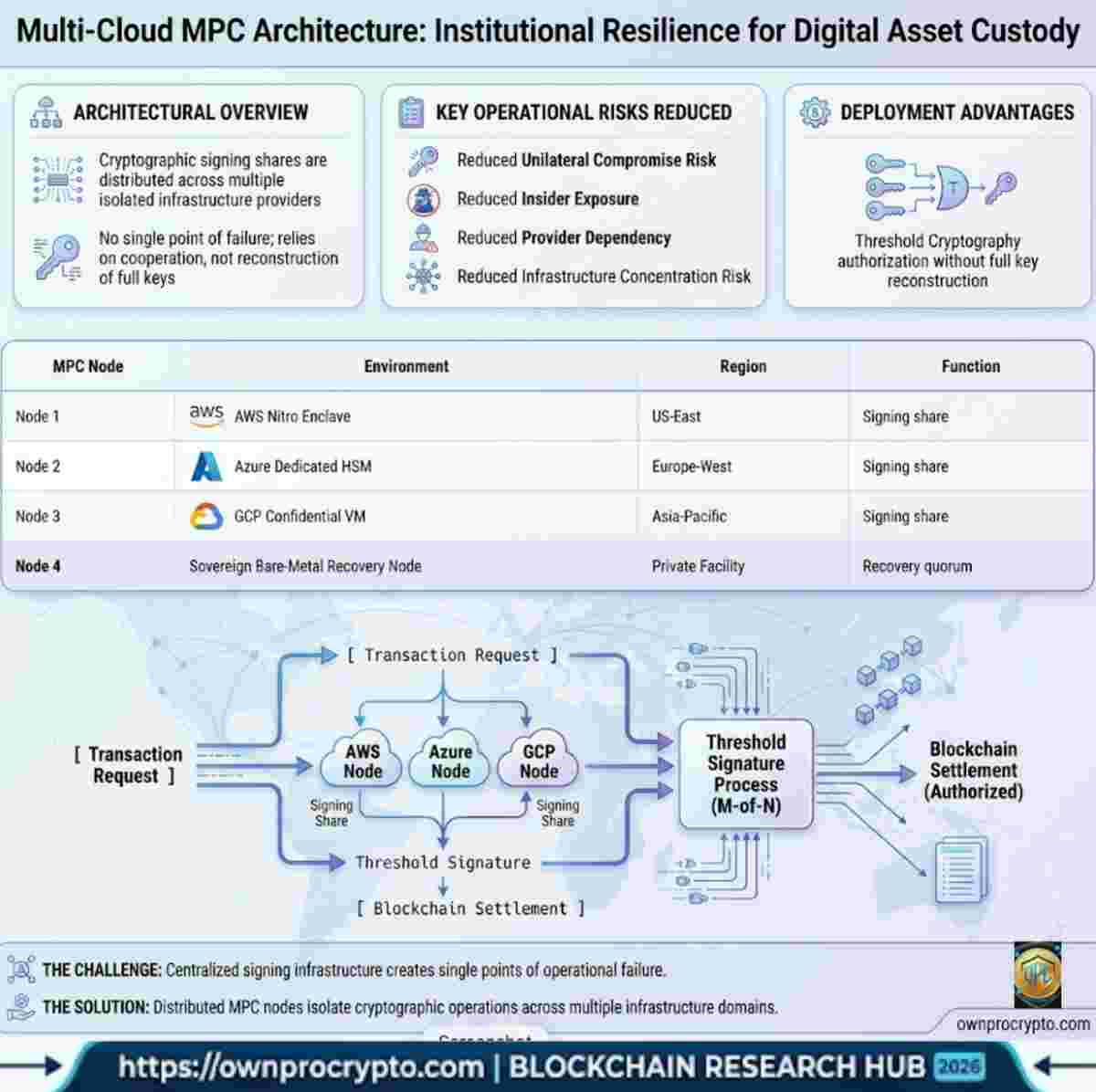
Multi-cloud MPC architecture distributes cryptographic signing shares across multiple isolated infrastructure providers instead of relying on a single environment.
In threshold cryptography, no individual node contains the complete private key. Instead, independent signing fragments cooperate programmatically to authorize blockchain transactions without reconstructing the full key.
This architecture significantly reduces:
| MPC Node | Environment | Region | Function |
|---|---|---|---|
| Node 1 | AWS Nitro Enclave | US-East | Signing share |
| Node 2 | Azure Dedicated HSM | Europe-West | Signing share |
| Node 3 | GCP Confidential VM | Asia-Pacific | Signing share |
| Node 4 | Sovereign Bare-Metal Recovery Node | Private Facility | Recovery quorum |
[ Transaction Request ]
          │
 ┌────────┼────────┐
 │        │        │
AWS     Azure     GCP
Node      Node     Node
 │        │        │
 └────────┼────────┘
          │
 Threshold Signature
          │
 [ Blockchain Settlement ]
Problem: Centralized signing infrastructure creates single points of operational failure.
Solution: Distributed MPC nodes isolate cryptographic operations across multiple infrastructure domains.
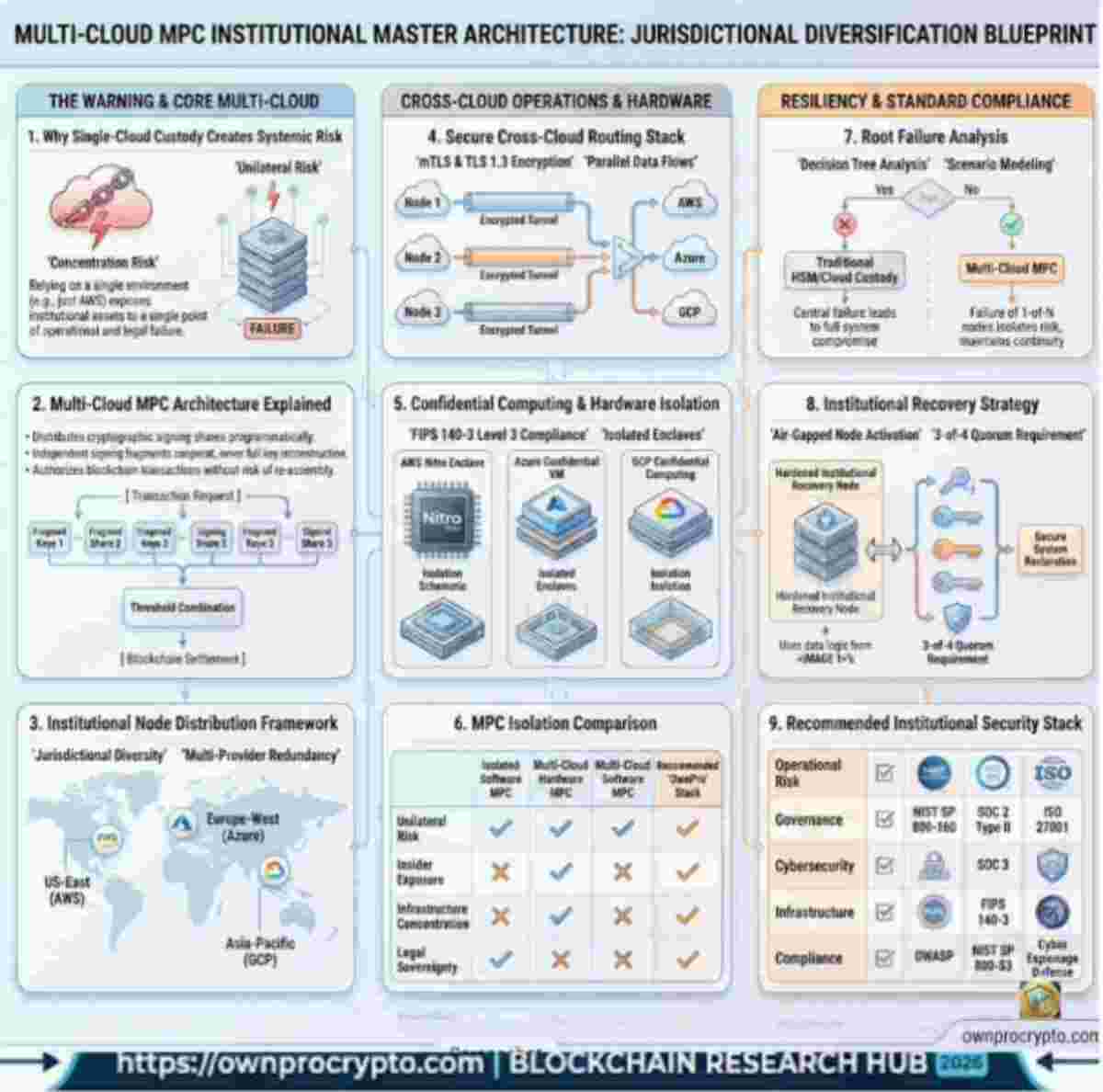
Institutional MPC infrastructure is designed around geographic and provider diversity. The objective is not only cryptographic security, but operational survivability during adverse network conditions.
Modern node distribution strategies prioritize:
| Layer | Recommended Strategy |
|---|---|
| Primary nodes | Multi-cloud deployment |
| Recovery nodes | Sovereign bare-metal |
| Transport | Dedicated interconnect |
| Encryption | TLS 1.3 + PQ protection |
| State coordination | Async synchronization |
| Failover | Automated quorum rotation |
This architecture minimizes the probability of catastrophic signing interruption during cloud-level instability.
Problem: Infrastructure concentration increases correlated failure exposure.
Solution: Geographic and provider diversity improve institutional custody resilience.
One of the largest operational challenges in multi-cloud MPC architecture is maintaining reliable communication between distributed signing nodes.
Cross-cloud cryptographic coordination introduces:
High-frequency institutional systems require deterministic transaction coordination capable of functioning during volatile network conditions.
| Infrastructure Layer | Purpose |
|---|---|
| AWS Direct Connect | Private routing |
| Azure ExpressRoute | Dedicated transport |
| Anycast isolation | DDoS mitigation |
| Asynchronous MQ | State synchronization |
| TLS 1.3 | Encrypted communication |
| Post-Quantum PSK | Forward protection |
Dedicated cloud interconnects significantly improve routing reliability by avoiding public internet exposure during MPC coordination phases.
Problem: Public internet routing introduces instability into distributed signing operations.
Solution: Dedicated interconnect infrastructure improves deterministic communication reliability.
Institutional custody providers increasingly combine MPC architecture with confidential computing technologies to reduce infrastructure-level exposure.
Modern confidential computing environments include:
These systems encrypt memory at the hardware level, helping isolate signing operations from host-level inspection.
| Security Layer | Traditional VM | Confidential Computing |
|---|---|---|
| Memory encryption | Limited | Hardware enforced |
| Hypervisor visibility | Possible | Restricted |
| Insider exposure risk | Higher | Lower |
| Institutional suitability | Moderate | High |
Problem: Standard cloud virtual machines expose custody systems to infrastructure-level compromise risks.
Solution: Confidential computing isolates signing operations through hardware-enforced memory protection.
A digital asset liquidity venue operating a cross-cloud 2-of-3 MPC deployment experienced a major settlement disruption during market volatility.
The infrastructure relied on:
The signing system used synchronous REST coordination with strict timeout thresholds.
During a DNS degradation event, the AWS node failed to acknowledge the signing request within the required timing window. The Azure node interpreted the delay as a compromise event and automatically locked its signing share.
The result:
| Failure Vector | Operational Impact |
|---|---|
| DNS degradation | Signing interruption |
| Synchronous coordination | Timeout cascade |
| Rigid state validation | False compromise trigger |
| Missing async fallback | Recovery failure |
The infrastructure was later redesigned using asynchronous state synchronization and distributed message coordination.
Problem: Network instability triggered catastrophic signing lockouts.
Solution: Asynchronous state coordination separates transport instability from cryptographic validation.
Institutional custody architecture must assume that partial infrastructure failure will eventually occur.
Modern disaster recovery frameworks increasingly include:
| Failure Event | Recovery Layer |
|---|---|
| Cloud outage | Secondary provider |
| DNS disruption | Anycast rerouting |
| Provider lockout | Sovereign recovery node |
| Node compromise | Threshold quorum rotation |
| Regional failure | Cross-jurisdiction recovery |
The most resilient custody systems avoid complete dependency on commercial cloud availability zones.
Problem: Public cloud dependency creates systemic operational vulnerability.
Solution: Sovereign failover systems maintain signing continuity during infrastructure disruptions.
Institutional MPC deployments increasingly rely on infrastructure-as-code frameworks to maintain deterministic security configuration across environments.
infrastructure:
  provider: aws
  isolation_layer: enclave

network_security:
  transport: dedicated_interconnect
  encryption: TLS_1.3

state_synchronization:
  transport: asynchronous_mq
heartbeat_interval_ms: 100| Component | Recommendation |
|---|---|
| Signing model | 3-of-5 MPC |
| Recovery architecture | Sovereign bare-metal |
| Isolation layer | Confidential computing |
| Routing | Dedicated interconnect |
| Synchronization | Async state engine |
| Compliance logging | Immutable audit system |
Problem: Manual infrastructure deployment introduces configuration inconsistency and operational drift.
Solution: Infrastructure-as-code frameworks improve deployment consistency and custody resilience.
| Security Area | Recommended Practice |
|---|---|
| Key exposure | Never reconstruct full key |
| Provider dependency | Multi-cloud distribution |
| Memory protection | Hardware isolation |
| Routing security | Dedicated interconnect |
| Disaster recovery | Sovereign failover |
| Auditability | Immutable logging |
| Compliance | RBAC + policy engine |
| Latency management | Async coordination |
Multi-cloud MPC architecture distributes cryptographic signing shares across multiple cloud providers to improve operational resilience and reduce infrastructure concentration risk.
Institutions use distributed MPC nodes to maintain signing continuity during outages, reduce single-provider dependency, and improve operational resilience.
By separating signing infrastructure across independent environments, institutions reduce the probability of catastrophic operational failure or unilateral compromise.
Deterministic routing refers to predictable low-latency communication between distributed signing nodes during cryptographic coordination.
Confidential computing protects signing operations through hardware-enforced memory isolation that limits host-level visibility into cryptographic processes.
Threshold MPC systems continue operating as long as the minimum signing quorum remains available.
Multi-cloud MPC architecture is becoming a foundational layer of institutional digital asset infrastructure as custody systems evolve beyond simple wallet protection into resilient distributed financial infrastructure.
The future of institutional custody will increasingly depend on:
Rather than relying on isolated custody technologies, institutions are building layered operational architectures capable of maintaining continuity during cloud outages, infrastructure disruptions, and adversarial network conditions.
As digital asset markets mature and institutional participation accelerates, resilient multi-cloud MPC infrastructure will become essential for secure long-term custody, treasury operations, and global digital asset settlement systems.
For a deep-dive analysis of how these cryptographic primitives operate at scale, review the industry benchmark on MPC vs. Multi-Sig Key Management Architecture provided by Fireblocks.
Problem: Single-cloud custody infrastructure creates operational dependency and concentrated failure risk.
Solution: Multi-cloud MPC architecture distributes signing infrastructure across independent cloud and sovereign environments.
Welcome to OwnProCrypto (Own & Pro Crypto) — a next-generation Bitcoin and blockchain education platform where the science of finance meets the power of AI-driven automation.
Our mission is simple: to equip you with the knowledge, frameworks, and tools needed to make smarter financial and business decisions in the Web3 economy.
Beyond analysis, OwnProCrypto focuses on transparency, verifiable data, and practical frameworks that investors and builders can actually use. Our goal is not hype — but clear thinking, disciplined analysis, and long-term value creation in the decentralized economy.
Our Background
Crypto Tools & Analysis:
Crypto Fundamental Analysis Tools | Protocol Evaluation System | DeFi Risk Analysis Tools | Crypto Portfolio Dashboard | Token Risk vs Reward Tool
Guides:
Crypto Fundamental Analysis | Blockchain Project Evaluation | Tokenomics Analysis | DeFi Protocol Analysis
© 2026 OwnProCrypto — Built for smarter crypto decisions